If you’re of a certain age like me, you’ll likely remember that novelizations and adaptations of films and television series were prolific throughout the 1970s and 1980s, and they continue to this day. There’s only so much room in a two-hour (or two and a half, or maybe three) film that can be conveyed, with who knows what left on the cutting room floor, and the same can be said with TV series as well. In the case of the original Star Trek series, for example, writer James Blish had access to the shooting scripts for the episodes and not the final episodes. In certain cases titles were different, and some of the adaptations contained added material that were left out of the final telecasts. Blish wrote twelve volumes of Star Trek adaptations until his death, and his wife J.A. Lawrence would complete the novelizations for a thirteenth volume called Mudd’s Angels. And Marvel Comics would handle numerous comic book adaptations of certain franchises like Star Wars, Battlestar Galactica, and Logan’s Run, among others. How many of you remember back in the 1960’s when DC Comics did their own adaptation of the first James Bond film Dr. No? It’s out there if you can find it! These are but a few that I mention here.
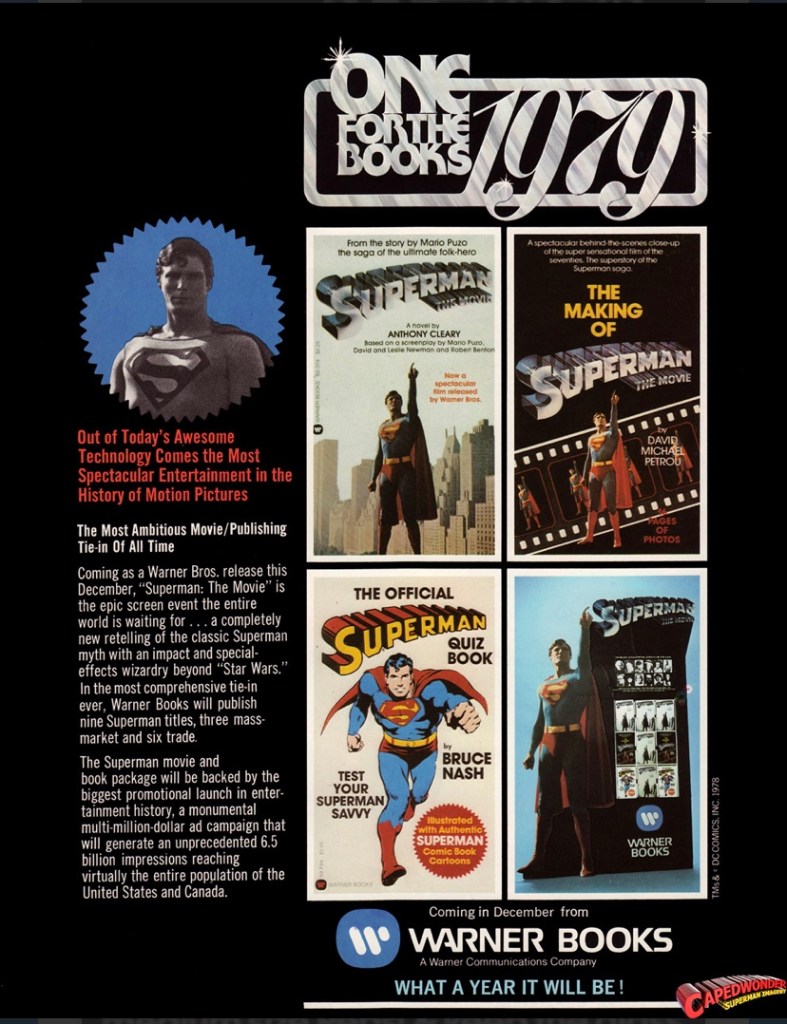
And then there’s Superman. When the film came out in 1978, Warner Bros. prepared a huge marketing campaign that included blueprints, art portfolios, record albums, theatrical trailers, a thorough in-depth look at the making of the film, even a telephone book (and if you remember something like that, you’re definitely of a certain age!) and such much more to bring awareness to the public that they were sparing no expense to bring this film to life like it had never been done in the then-40 year history of the character.
But there was no comic book adaptation, and there was no novelization, either. Well, there was, and that’s where it gets confusing to some people. Allow me to explain.
In preparing for the film, Warner Bros. prepared a marketing display of numerous books to tie in to the film, and among them was a novelization of the book by writer Anthony Cleary, which was scheduled for release on November 1, 1978, a month and a half before the film’s release. In looking at the front cover, one can see an interesting note: “Based on a screenplay by Mario Puzo, David and Leslie Newman, and Robert Benton”. This means that he had access to the Newman/Benton script from 1976 and not the Tom Mankiewicz revisions from 1977, which means we would have seen numerous camp elements in the book such as Lex Luthor eating Kleenex, Otis flushing a toilet and the toilet descending into the lower depths of Metropolis, Superman catching Telly Savalas and Savalas quipping, “Who loves ya, baby?” and who knows what other elements. So that means the novelization would have been greatly different from the final film.
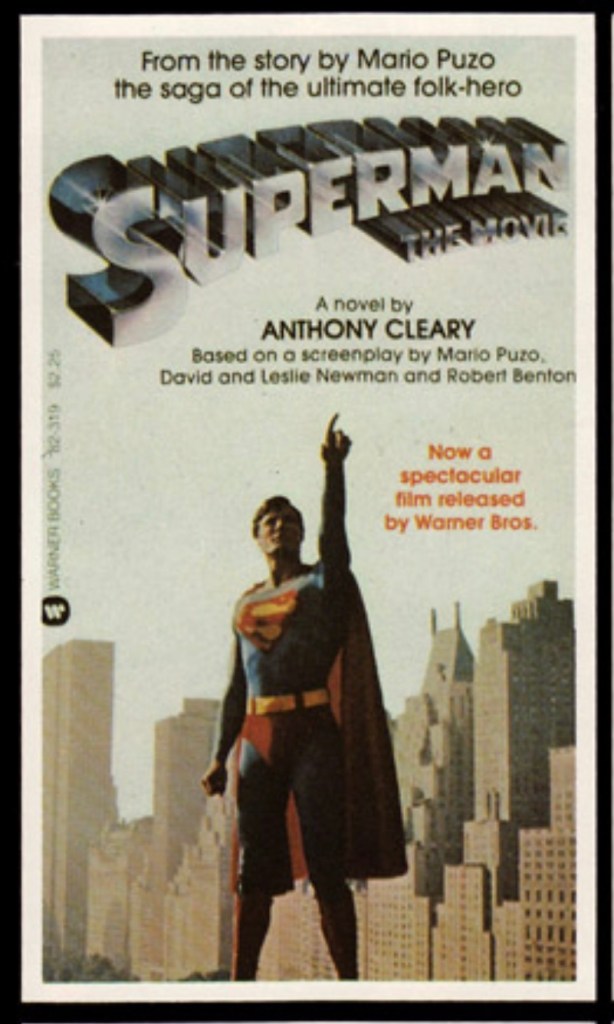
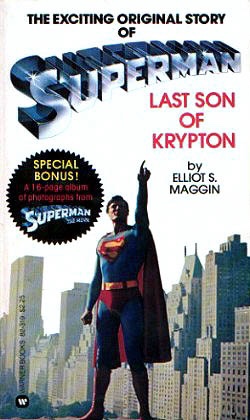
Then almost at the last minute, the novelization was pulled, and instead fans found a tie-in novel called Superman: Last Son of Krypton, written by longtime comics writer Elliot S. Maggin.
What had happened to the Cleary novelization? Well, we have Mario Puzo to thank for that. When he was contracted to write the screenplay for the film, he had a clause stating in his contract that if any elements of his screenplay made it into any other form of media, then he would receive a huge settlement. This included his portrayal of the planet Krypton and the subsequent Fortress of Solitude as seen in the final film. He also included a number of elements in his script that didn’t make it into the film. According to writer David Michael Petrou in his book “The Making of Superman: The Movie”, the main city of Kryptonopolis would appear several times in the film; there would be villainous characters such as Jax-Ur, Professor Vakox, and Kru-El; all of the members of the Kryptonian council would have a huge S shield on their cloaks; there would also be a huge S shield on the wall of the council chamber; and whoever would play Superman would also play his father Jor-El at the start of the film, given that two characters greatly resembled each other at that period of time in the comics.
As a result of the Puzo clause, the Cleary novelization was scrapped, and Maggin’s original novel was released instead. The novel, while following the traditional elements of the Superman origin story, would have seen Superman being mentored by Albert Einstein and possibly being groomed to join the Green Lantern Corps, and Superman teaming up with Lex Luthor to stop an intergalactic foe. In 1996 Maggin detailed the origins of his novel:
“Last Son of Krypton started out as a treatment for a movie – the Superman movie that I was trying to convince DC Comics needed to be made as far back as 1974. When Mario Puzo showed up at the office one day to tell me he’d gotten an assignment to write a Superman movie and would I spend a couple of days with him telling him who the character was, I was thrilled and disappointed. I spent two days with Puzo, telling stories and smoking enormous cigars, and had a fine time. Then I took my ignored little treatment upstairs to Warner Books where a senior editor said go ahead and write a novel out of it. I did, and through a series of unlikely events, the novel was published the same day as the movie was released, and became a bestseller.”
Maggin continued, “The book was released when I lived in New Hampshire, the day Superman: The Movie was released. I got a frantic phone call that week from the guy who was president of DC Comics (Sol Harrison) saying that Alexander Salkind – the producer of the movie – wanted to sue me. Apparently someone had finally read him the book or something, and he thought there were too many incidents in common with the movie. I said that I had not seen the movie or read the script, but that I had handed in my manuscript a full year before Mario Puzo handed in his script, and owing to my conversations with Puzo. I told this guy where to look for proof of that, and said maybe I should sue Salkind.”
The original novel did well and sold thousands of copies, and to this day it is highly sought after by Superman fans. In addition to the original story, it also included a photo album of sixteen pages of photos from the film, indicating the characters and their portrayers. Most interesting is that Christopher Reeve’s name is not mentioned in the photo album with the characters of Clark Kent and Superman (which is an equally interesting throwback to the two “Superman” serials when Kirk Alyn was mentioned nowhere in the credits as portraying the Man of Steel).
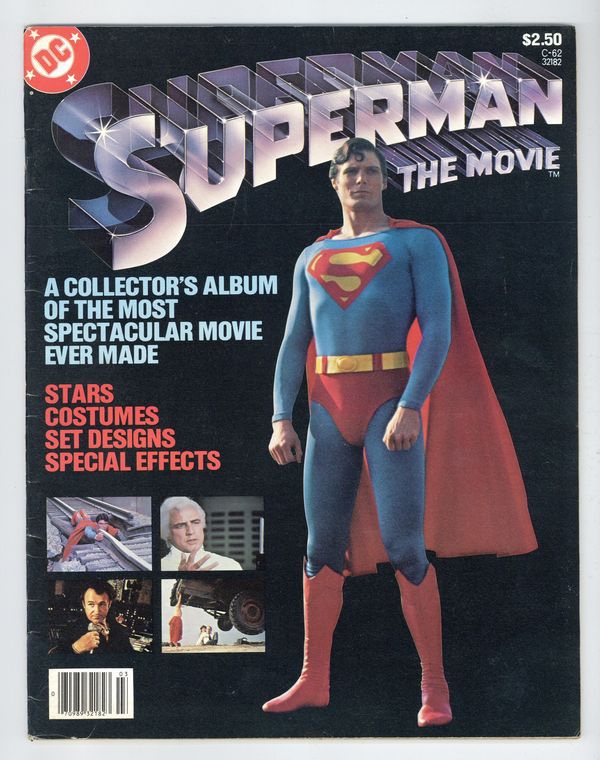
And there was no comics adaptation from DC Comics either, given the clause in the Puzo contract. To that end they published a giant-sized 64-page movie albums that tied in to the film, complete with behind the scenes photos and interviews with cast and crew members on some of the various aspects of making the film. That, too, became a huge bestseller for DC Comics, and it it still sought out as a highly collectible item for anyone’s Superman collection.
I do have to mention this. In 1979 we would see a few elements from the film brought to animated form in the fourth season of “The World’s Greatest Super Friends!” That particular season, which consisted of only eight episodes, would adapt elements from many different sources, so the creators obviously researched their literature well for this season. In the episode “Rub Three Times for Disaster”, we are shown the exterior of the Fortress of Solitude, which is obviously inspired by John Barry’s designs for the film. And the episode “Lex Luthor Strikes Back” contains even more elements that harken back to the film, including Lex Luthor’s underground lair, a Lois Lane that looks suspiciously like the late Margot Kidder, and Luthor’s assisted Orville Gump, who dresses like a certain character played by Ned Beatty – perhaps Otis and Orville are identical twins? For years I considered this episode as a quasi-sort of sequel to Superman: The Movie, not knowing what would come next in the series.
A few years later DC Comics would start integrating elements of the films into its comic book series, slowly at first as little Easter eggs to the fans. In one comic book, I forget the story, an intergalactic villain is seen with the skulls of his victims on a shelf in his lair, and one of them bears the name Otis. (Looks like we know what happened to him!) In another issue circa 1982-83 we see screenwriters David and Leslie Newman mentioned by name as they are consulted on the script for a Superman movie project starring Gregory Reed, a running storyline of the 1970s and 1980s where a Superman movie series was filmed in Metropolis. And in a birthday tribute to longtime DC Comics editor Julius Schwartz, Superman flies him to a parallel Earth, and one passerby commented, “Don’t tell me there making another one of those movies again!” There had even been some cross-promotion for the film in a couple of comics stories and, most memorably, in a special Sunday edition of the World’s Greatest Superheroes syndicated comic strip, where Superman flies through Metropolis and asks himself, “I wonder what’s been happening since I was gone…” and in the background we see a movie marquee for the film. But it would not be until 2006 when we would see the crystal Fortress of Solitude shown in the comics for the first time. And the TV series Smallville would also incorporate elements from the films throughout the series, owing to the show’s love and affection for the now-classic films.
In October 1980, when HBO acquired the rights to broadcast Superman: The Movie on television, they had access to the complete theatrical cut of the film. As fans know, Warner Home Video (then known as WCI Home Video) issued a truncated 127-minute cut of the film that was poorly panned and scanned, and sped up to process the entire film on one videotape, owing to the technology of the time. Some of the scenes were edited, and the film’s lengthy eight-minute end credits sequence was almost completely cut. HBO would run a 142-minute version of the film that was tweaked ever so slightly, and only serious fans could catch where the tweaks occurred. I myself can recall three such tweaks during the film. (If anyone has a video of that 1980 HBO broadcast in their collection, please let me know!)
What I did was use my audiotape recorder and I taped the audio of the film for my collection. I did that for several different movies until my parents bought our first VCR for a graduation gift from high school for me in 1984. I took those audiotapes, and in the fall of 1980 I wrote out my own adaptation of Superman. Some of the bullies in my class made fun of me for spending more time writing and no time wanting to be like them. It was 125 pages in length and was crude, but for a kid all of fourteen years old I thought it was pretty cool. I had done it all for fun. Some time later it got thrown out, I forget when, but looking back part of me wishes I still had it to this day.
Recently, artist Dave Santia did a tribute to Superman: The Movie in the form of four separate illustrations that beautifully recreate moments from the film, while giving fans a taste of what a comic book adaptation would have looked like. Dave is a wonderful artist whom I met in Detroit earlier this year at the Christopher Reeve Legacy Reunion, and his artwork can be found on Facebook.
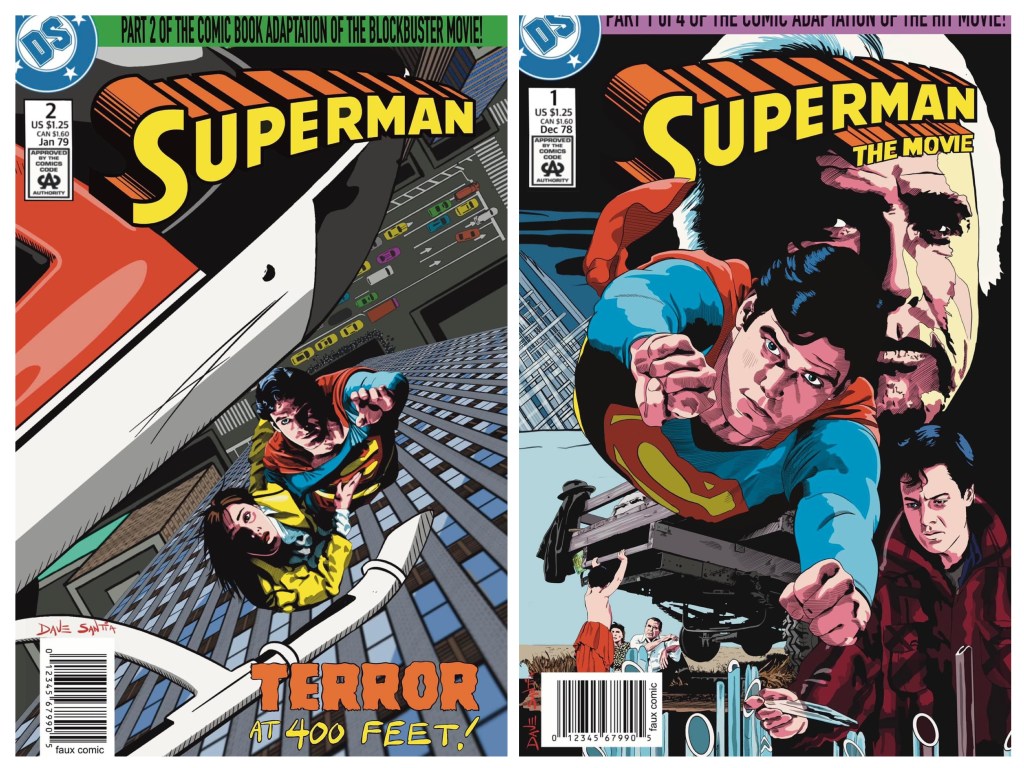
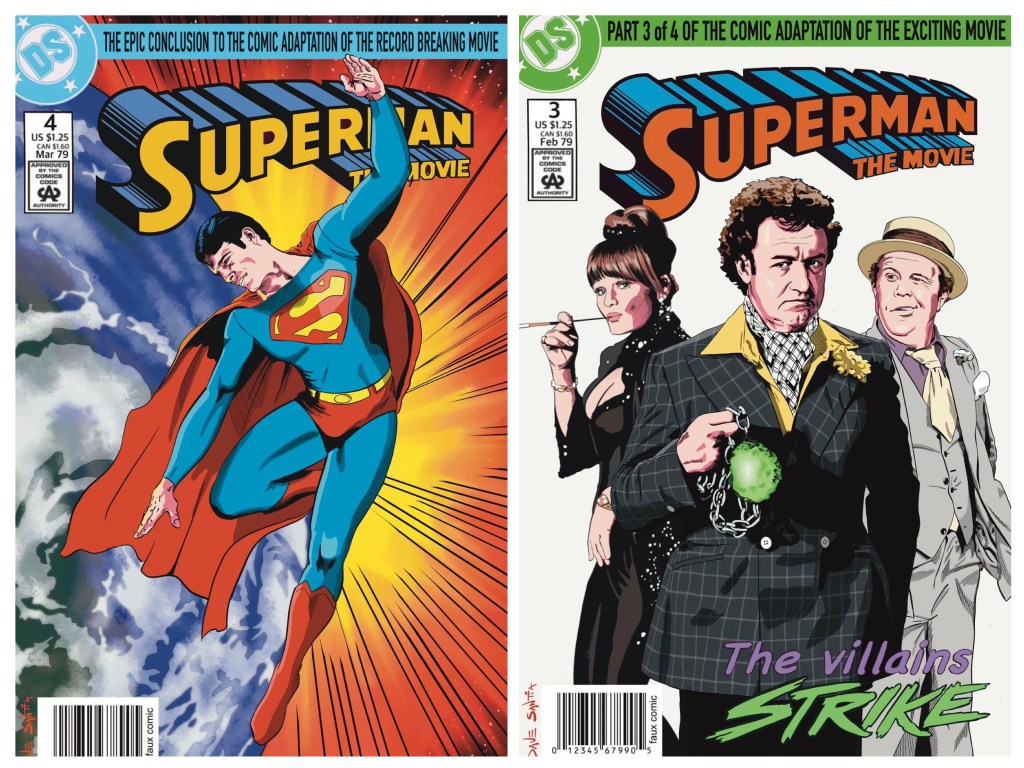
But the fun doesn’t end there. In my next installment on the blog I will discuss the novelizations and adaptations for the three Superman sequels that would follow in the 1980s.
 Superman: The Blog