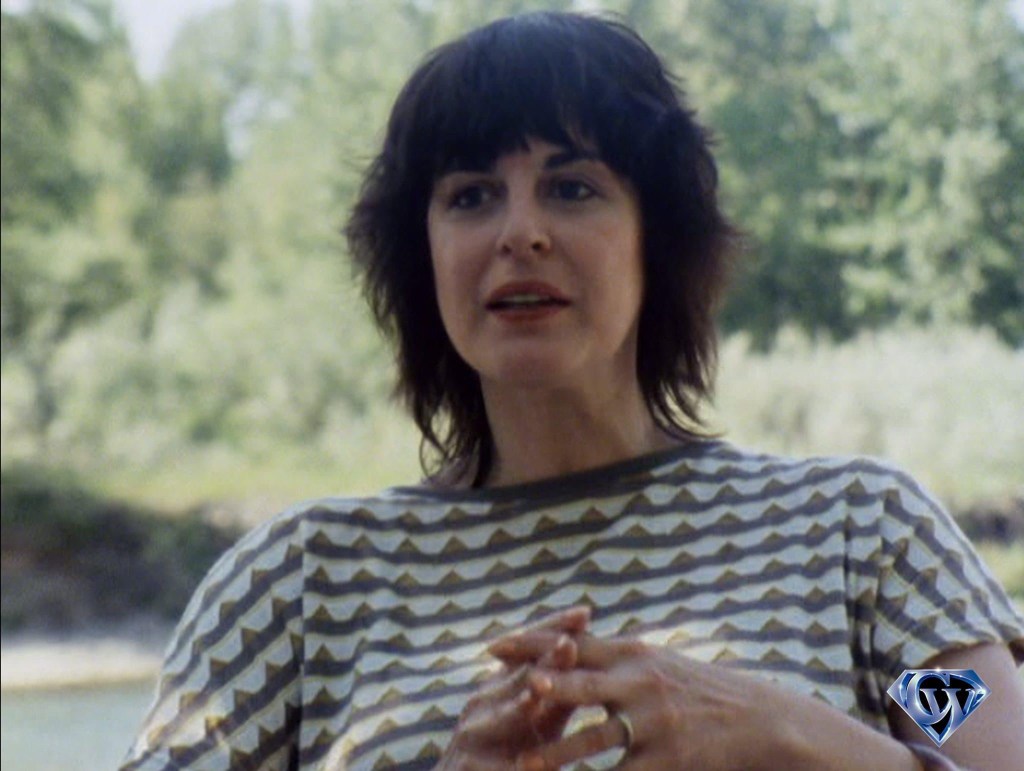
It began as a simple research assignment: analyze the scripts for Superman and Superman II written by David and Leslie Newman in 1976 and 1979, respectively; identify the specific elements written by the Newmans that would survive into the final films themselves; and point out those particular elements of the scripts that did not survive their respective drafts. Simple enough, on the surface.
No sooner had I completed my research that I learned from Sarah Douglas, who portrayed Ursa in the two films, that Leslie Newman had passed away toward the end of 2020. My research had been essential for a beautiful tribute to the celebrated screenwriter who helped pen the scripts for the first three Superman films (and who also made a cameo in the extended TV version of Superman III as Ross Webster’s secretary).
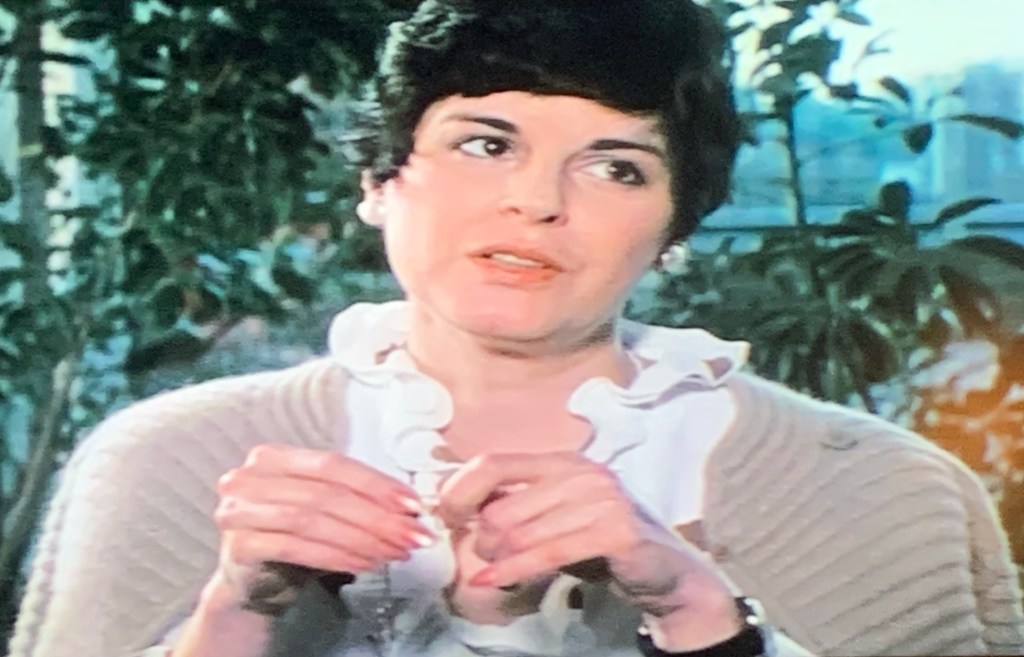
But it was one sequence in particular that brought me back to a place that I never thought I would find myself in again after so many years.
Since 1999 I have studied and analyzed all four of the known versions of Superman II – the 1980-81 theatrical release, the 1984 extended TV cut, the 2006 DVD release of Superman II: The Richard Donner Cut, and the 2015 Vudu streaming version of the Donner Cut – in my attempt to specifically identify which scenes were directed under Richard Donner’s tenure on the film in 1977 and which scenes were helmed under Richard Lester’s tenure in 1979-80. As more information and more footage became available, I took it upon myself to identify those pieces of the puzzle and how they fit into the larger tapestry of the production of the film. Each time I would update my research accordingly, making changes and revisions as needed to bring the analysis up to date and as accurate as possible. And each time I finished my analysis, I felt that it was finally complete and my research on Superman II was behind me.
Not so.
Once I began reading through the lunar sequence in the Newmans’ draft, certain aspect began to leap off the page for me. It was then that I started added everything up, and I soon realized that I was onto something fresh here that I had been completely wrong about for decades. Armed with a copy of the 1977 shooting script from Tom Mankiewicz, the 1979 revised shooting script from the Newmans, a DVD copy of the extended TV version, Blu-ray copies of the theatrical release and the 2006 Richard Donner Cut, and a digital streaming copy of the Richard Donner Cut on Vudu, I began to deep dive once again into the film, focusing my attention this time specifically on the lunar sequence. Once more unto the breach, dear friends.
Please note that all time sequences of each shot in question are taken from the 1980-81 theatrical release (with brief forays into the 1984 external TV cut).
0:24:43 – 0:25:17 (NASA controllers at Houston contacting Artemis II) – Lester footage (0:34).
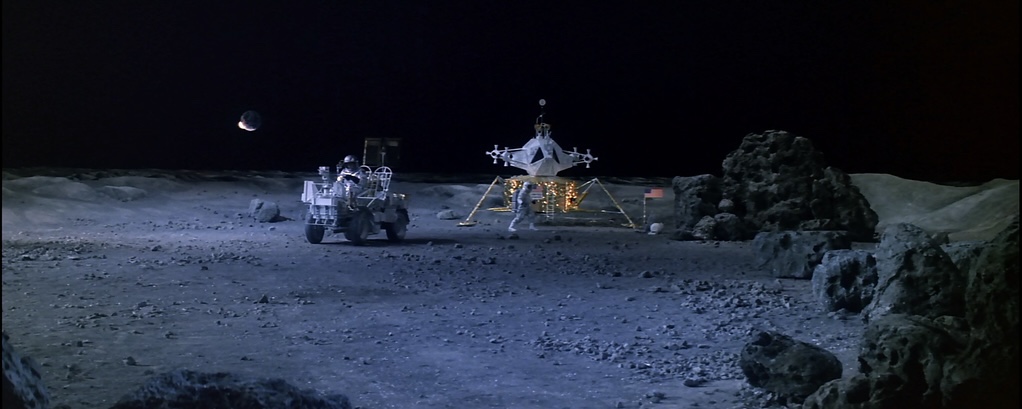
0:25:17 – 0:25:21 (exterior of lunar surface) – Donner footage with Lester-directed voiceovers (0:04). The voiceovers of John Morton and Shane Rimmer were overseen during Richard Lester’s tenure on the film in 1979-80.
At this point the controller refers to the astronaut as Nate. This name is consistent with the identity of the astronaut as referenced in the Newman’ script from 1979. The Tom Mankiewicz script from 1977, however, refers to this astronaut as Dave.
0:25:21 – 0:25:25 (interior of Artemis II; “All systems normal, Houston…”) – Lester footage (0:04).
In this brief clip I can determine that this is indeed Lester footage. At the end of the shot refers to the other American astronaut by the name Andy, which is also referenced in the Newmans’ script from 1979.
In addition the exterior of the lunar module is highly detailed with equipment, whereas in the Donner footage the module does not contain any specific detailing on the exterior of the lunar module. This further points to the closeups of the exterior of the lunar module as Richard Lester footage.
Also, it is believed that these were scenes that Richard Donner never got around to filming after the simultaneous shooting on both Superman films came to an end in 1977 so the focus could center on completing the first film.
Finally, I looked up John Morton’s acting credits on IMDb, and he had in fact worked with Richard Lester in or around early 1979 on the film Cuba, in the role of Gary, just prior to both men working on Superman II.
0:25:25 – 0:25:53 (exterior of lunar surface; closeup of Boris) – Donner footage with Lester-directed voiceovers (0:08).
0:25:33 – 0:25:18 (détente humor; Ursa flies by; controllers’ reactions) – Lester footage (0:45). We have further conclusive evidence that the interior shots of the lunar module were filmed by Richard Lester.
First, the exterior of the lunar surface is inconsistent with the lunar surface as it appears in all of the Richard Donner footage. In addition, the exterior illumination appears to the left of the lunar module as Ursa flies by. This illumination is inconsistent with the illumination from the Earth and the sun in the Donner footage, which is behind the module, not in front.
Furthermore, it appears that Richard Lester used a stuntwoman to portray Ursa in this quick flyby shot, though it is impossible to clearly identify the stuntwoman portraying Ursa in these brief moments. In a Facebook post from 25 January 2021, both Sarah Douglas and Jack O’Halloran (Non) stated that neither of them filmed any additional shots for Richard Lester for the lunar sequence.
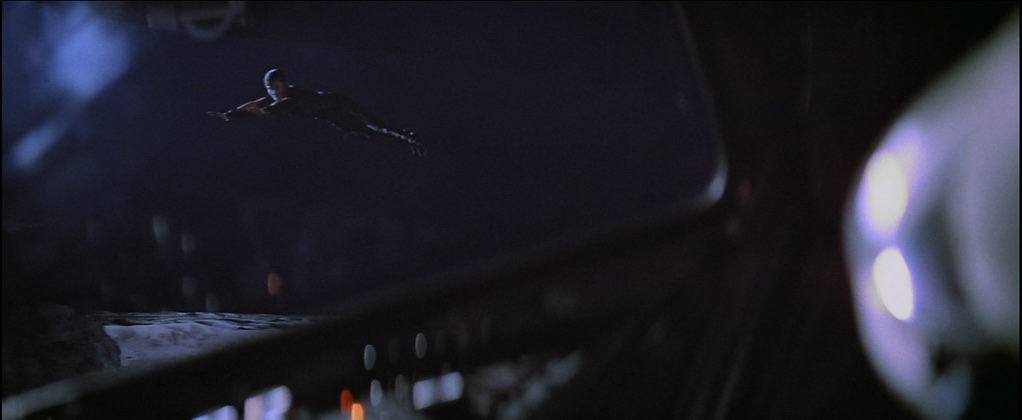
0:26:18 – 0:27:11 (Ursa confronts Andy) – Donner footage (0:43). In this sequence, the wires holding the astronaut are clearly visible in the shot. According to the Tom Mankiewicz script from 1977, the astronaut is named Robbie, not Andy.
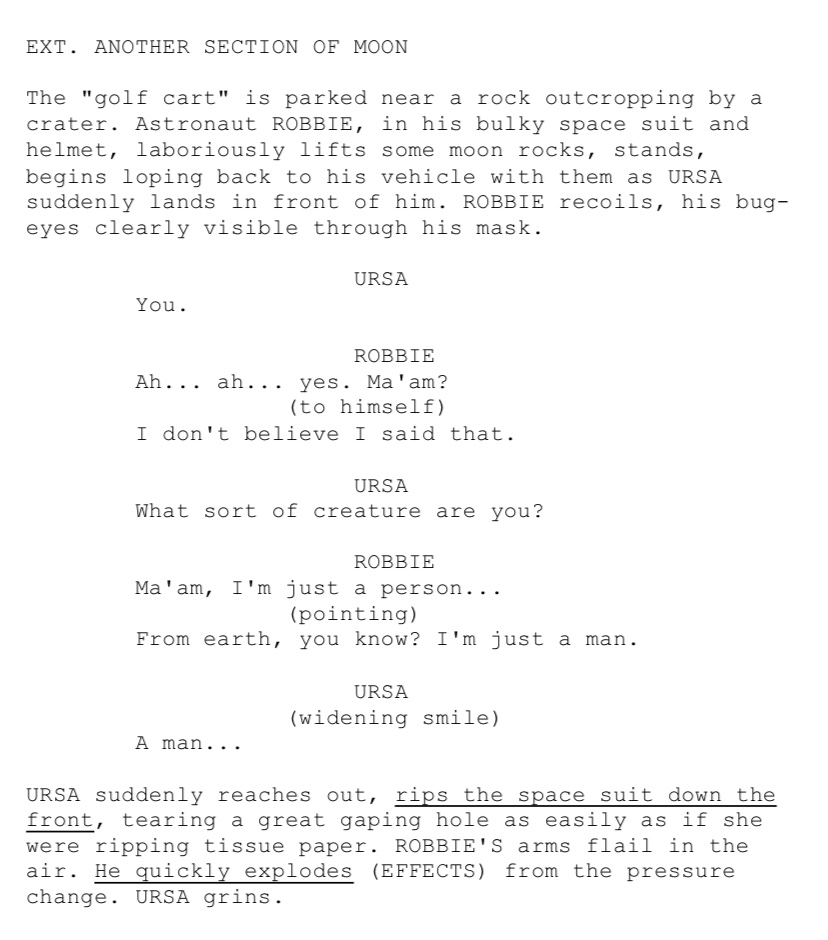
0:27:01 – 0:27:03 (Ursa lands) – Lester footage (0:02). While Sarah Douglas clearly stated that she did not film any additional footage for the lunar sequence for Richard Lester, this is clearly an insert shot filmed at another time and inserted into the sequence. This shot was removed from the film for the Donner Cut.
0:27:03 – 0:26:16 (Ursa kills Andy; Zod mills Boris; villains on the lunar rover) – Donner footage (1:13). A couple of brief moments are trimmed from the sequence of Zod killing Boris – of Boris bouncing and landing before Zod, and Zod pulling the oxygen cord the first time – from the Donner Cut.
0:28:16 – 0:28:20 (Nate attempts a manual liftoff) – Lester footage (0:04). Another difference between the Lester footage and the Donner footage can be found in the location of the control panel, which appears to be located on John Morton’s right. In other shots a different control panel is seen on the left of the astronaut, just under the module’s window.
0:28:20 – 0:28:28 (attempting manual liftoff) – Donner footage (0:08). As stated earlier, the detailing on the outside of the lunar module is not present in the Donner footage as it is in the Lester footage. Also, a mannequin of the astronaut is inside the module as opposed to an actor.
0:28:28 – 0:28:30 (attempting manual liftoff) – Lester footage (0:02).
0:28:30 – 0:28:34 (Zod and Ursa watch as Non pulls on the lunar module’s landing gear) – Donner footage (0:04). Behind the scenes footage from this sequence can be seen in the “Making of Superman II” documentary, and numerous production photographs confirm that Richard Donner filmed the exterior portions of this sequence. In addition, the control panel seen in the shot is different from the panel that appears earlier in the Lester footage.
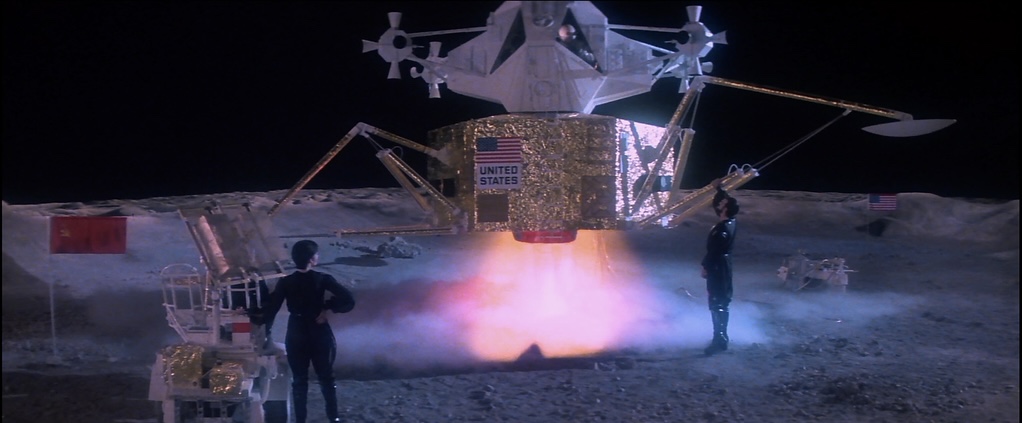
0:28:34 – 0:28:37 (module panels begin to crash inside) – Lester footage (0:03).
0:28:37 – 0:28:38 (Non pulls on the landing gear) – Donner footage (0:01).
0:28:38 – 0:28:40 (module panels crash inside) – Lester footage (0:02).
0:28:40 – 0:28:48 (module collapses; Non flies up) – Donner footage (0:08).
0:28:48 – 0:28:53 (module panels crash inside; Nate is killed) – Lester footage (0:05). Another indicator that this is Lester footage can be found in this last clip. Here, when Nate is killed, he falls to his right in the module. This is different from the next shot, which shows the astronaut slumping down to his left and onto the control panel as he is killed.
0:28:53 – 0:28:54 (astronaut is killed) – Donner footage (0:01).
0:28:54 – 0:29:40 (NASA loses control) – Lester footage (0:46). The time indicated for this sequence is taken from the extended TV cut first shown on ABC in 1984. Nine additional seconds were added to the scene of the controllers chalking up the loss of communication to electrical interference from someone using a hair dryer. The last four seconds of this added footage appears in the Richard Donner Cut, resulting in the scene running 20 seconds long.
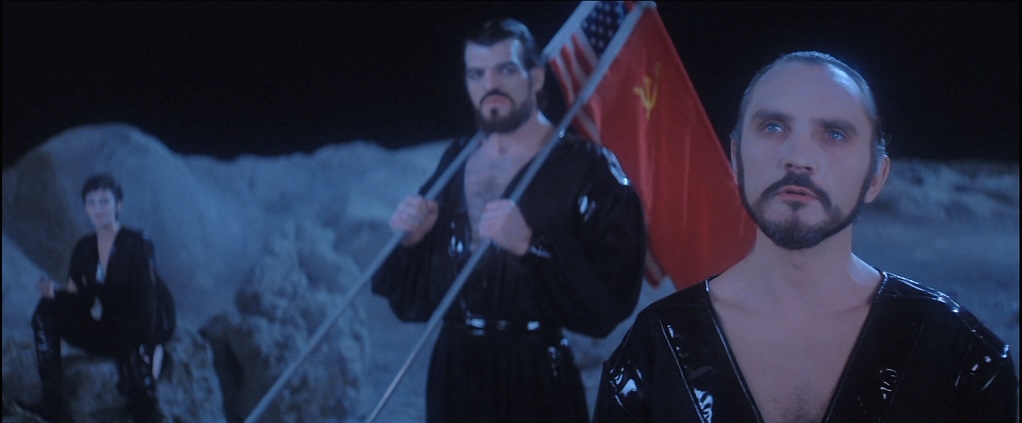
0:29:40 – 0:30:32 (villains discuss their powers, fly to Earth) – Donner footage (0:52). Seven seconds of footage were restored to the extended TV cut in 1984, of Zod telling Ursa that she will have everything she wants, and Ursa saying, “Men… to kill!” This added footage is only in the extended TV cut and in no other version of the film. For the Donner Cut, the final shot of the villains flying off is rotated, giving added emphasis to the villains’ flight.
Altogether, the sequence runs five minutes, 49 seconds long, with 2:27 of the footage confirmed and verified as Richard Lester footage and the remaining 3:22 of the footage confirmed and verified as Richard Donner footage. Of the Lester footage for the sequence, one minute, seven seconds corresponds with the shooting script written by David and Leslie Newman in 1979. This would bring the total composite tally of all Lester footage used in the final film to approximately 67 percent, with the remaining 31 percent comprised of Donner footage.
For the Richard Donner Cut, the numbers must be adjusted to 81 percent of Donner footage and 19 percent of Lester footage. For the extended TV cut, the numbers are again adjusted to 57 percent Lester footage and 42 percent Donner footage.
When you take into account all of the factors – the Tom Mankiewicz script from 1977, the Newmans’ script from 1979, the set design, the lighting, the props, and most importantly all of the available footage – this critical sequence from Superman II becomes clearer to define and adds further detailed pieces to this already growing puzzle of one of the most complicated productions in film history.
Which leaves one final question to ask: which version of the film will be included in the 4K release next year – the final Richard Donner Cut, the Vudu streaming version, the extended TV cut, or maybe a comprehensive package of all four versions of the film similar to what Paramount Home Video did earlier this year with their 4K release of Star Trek: The Motion Picture? Only time will tell.
 Superman: The Blog