In November 2006 Warner Home Video released the Richard Donner Cut of “Superman II” on DVD, HD-DVD, and Blu-ray, giving fans and film students alike the opportunity to witness the original concept of the film as conceived by Donner, screenwriter Tom Mankiewicz, and the many cast and crew members involved in its production throughout 1977. Upon its release, the film was met with enthusiasm, anticipation, and even criticism, as viewers soon discovered the many differences between the Donner Cut and the original theatrical version released in 1980-81 under the direction of Richard Lester. Some fans found it to be far superior to the original theatrical release, calling it the perfect complement to the original “Superman” film from 1978. Others found it to be an incomplete mess, a mash-up of styles, and essentially a bonus feature to the theatrical release. Sixteen years later, the debate continues.
The Richard Donner Cut became the third version of “Superman II” to be released over the years, along with the theatrical version in 1980-81 and the extended TV broadcast first shown on the ABC network in February 1984. However, for the longest time, there was a fourth version of the film that had been prepared of which people had at the time been unaware: a longer alternate version of the Richard Donner Cut.

I first heard about this alternate version of the film some time in 2017 through a link shared on Facebook. This took me to an online message board in which posters had shared that a 122-minute cut of the film had surfaced on a number of digital platforms, including Amazon and Vudu. The fans commented that some of the added footage in the film included scenes set during the Phantom Zone villains’ attack in East Houston. Some time later I had come across even more footage shot by Richard Donner set during the first scene in the Fortress of Solitude, of Lex Luthor accessing Jor-El’s interactive lessons, which had been shared on Facebook.
This began a quest for me to locate this alternate version of the Donner Cut. At the time I had invested nearly twenty years of my life studying and analyzing every known aspect of the film and its many incarnations on VHS, laserdisc, and DVD, from the theatrical release to at least three versions of the extended broadcast, to the 2004 Restored International Cut, and to the Donner Cut itself. I was determined to find this alternate version somehow.
In the late spring of 2018, I finally had the opportunity to track down the alternate Donner Cut on Vudu. The digital platform advertised the 122-minute cut of the film, which I had linked (along with Amazon) to my Movies Anywhere account, and I was now excited to see this extra footage in all its glory for the first time on my Amazon Fire smart TV. Upon viewing the preview screen, the film was advertised as the 116-minute release from 2006. I felt my excitement begin to turn to disappointment in just a short amount of time. I immediately skipped to the first Fortress sequence, and sure enough, it was the version that I had seen over the past twelve years. The footage was not there.
I immediately contacted Vudu’s customer service to inquire about the discrepancy, and the agent informed me that they had been given erroneous information from Warner Home Entertainment that they had been given the alternate version but had received the regular version instead. At the very least, if my DVD went out, I would have a digital copy as backup.
But sometimes the best miracles happen when you’re not looking.
Flash forward to early November 2018. I can’t explain how or why it happened, but for some reason I pulled up my Kindle device, which I had for a few years now. It had been a great device for books, documents, and a few games. It now served as a backup for several key apps that I had difficulty accessing on my Android (not so) smart phone, including Facebook, Messenger, Spotify, Word document creator, and email. Other features on my phone I had little or no use for. On a whim I decided to click on the video section, and to my surprise I learned that all of the movies that I had on my Movies Anywhere page were also available on my Kindle.
Including the Donner Cut.
But not just the regular version. It was the 122-minute alternate Donner Cut. I immediately downloaded the film onto my Kindle, and now I had access to this version of the film that had been making the rounds in the digital realm for at least the past three years. Now I had the opportunity to discover the differences between the two versions of the film.
At its essence, the alternate version of the Richard Donner Cut of “Superman II” is fundamentally the same as the released version by and large, but it also has its share of differences as well. This analysis will break down the differences between the two versions and attempt to lay bare why those differences occurred.
(As I have already previously analyzed all of the footage in the previous releases of the film, I will focus solely on those differences as originally planned.)
When Warner Bros. received six tons of footage from the overseas film vaults, film editor and restoration producer Michael Thau (who supervised the 2001 remastered version of “Superman: The Movie” for its initial DVD release) began cataloging all of the elements pertaining to “Superman II”, including raw footage, alternate takes, sound elements, and continuity logs, among others. In a 2006 interview he stated, “Reconstructing this film is not only rare but probably unique in film history. I don’t think there is a film that had so much footage shot and not used. The opportunity of putting this back together is the best job I could ever have in my life. It was just painstaking, meticulous work. It took a long time, but we found everything.”
As early as 2001, Richard Donner had been approached by Warner Bros. executives to assemble his cut of the film, which he refused, and the studio considered going forward without Donner’s involvement at all. By this time fans began to petition Warner Bros. to release Donner’s original version of the film that he had shot back in 1977 before his firing from the project in March 1979. Petitions hosted by a leading “Planet of the Apes” website asked Warner Bros. executive George Feltenstein to seriously consider the project.
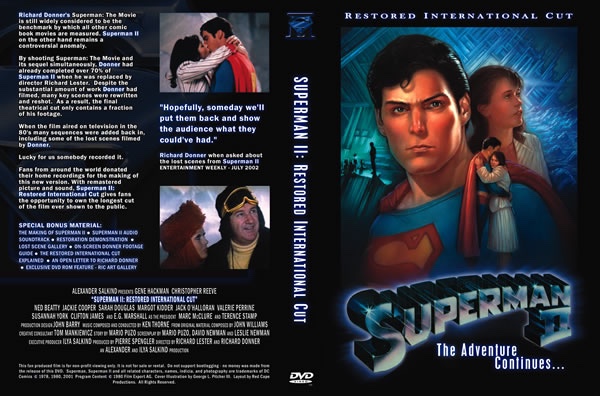
Simultaneously, work on the fan-produced Restored International Cut of “Superman II” resulted in its release on DVD in October 2004, shortly after the passing of Christopher Reeve, with the intention of freely distributing the project to fans and reminding them that Donner’s work on the film was not forgotten. Once copies began to surface for sale (it is unclear whether it was distributed on eBay or at comic book stores), Warner Bros. issued a cease and desist order to the editor, who wished to remain anonymous, halting all distribution of the project, which had ironically been his intention all along. In a 2004 interview he stated, “I had created a project that was intended to be destroyed.” The Restored International Cut would serve as a further impetus to bring the Donner Cut to life. (To this day, the RIC is still distributed through various file-sharing sites.)
In 2005 Warner Bros. announced that work had begun to bring the Donner Cut of “Superman II” to life, with Michael Thau supervising the recut without Donner’s involvement or blessing at first. The final push to make the film a reality was the acquisition of Marlon Brando’s footage for use in “Superman Returns”. Eventually, Donner soon became involved in recutting and restoring the film, as did Tom Mankiewicz. They would bring the film back to the original concept as developed in 1977, though at times it hurt Donner to see the footage that he had shot and know that significant portions had been discarded by Richard Lester and the Salkinds in 1979. Thau, however, had a fresher, more objective eye that had not been tainted by three decades of animosity.
Even down to the ending, the three men were determined to give the film its sensibility back. At one point Donner considered using the “magic kiss” ending from the theatrical release. According to Thau, “It was Tom who said, ‘Only Superman should kiss Lois. Clark should not kiss Lois.’” This led to them using the original ending of Superman turning back time (which had been moved to the ending of the first film), combining original footage of Jackie Cooper from 1977, newly shot footage of an unidentified actress as Lois Lane, recycled footage and visual effects from the first film, and new footage and effects.
At times during the assembly process, new footage was shot of an unidentified actor portraying Superman in a few brief scenes. At other times, Michael Thau’s own hands were used in close-ups. For the crucial scene of Lois tricking Clark into becoming Superman, Donner and Thau used screen tests of Christopher Reeve and Margot Kidder shot in 1977, as the actual scene was never filmed. In other places, Donner and Thau had no choice but to use Richard Lester’s footage from 1979 for several crucial scenes, remixing the sound effects, music, voiceovers, and visual effects as needed. The original version of the Richard Donner Cut came out to 122 minutes, 28 seconds in length. The film was completed, everything looked to be a go…
And then it was recut again.
It is here that we look at all of the differences between the original version of the Donner Cut and the final version.
0:00:00 – 0-00-25: The film’s opening title cards are slightly different in the original Donner Cut. The film opens with the Warner Bros. logo, followed by the two title cards, “The following film represents Superman II as it was originally conceived and intended to be filmed. Some footage was taken from screen tests of scenes that we were unable to shoot.” The DC Comics logo is not present in this version of the film. For the final film, the two title cards were moved to before the Warner Bros. logo, and the DC Comics logo was added. (In the Movies Anywhere release of the film, the first two title cards are completely removed from the film.)
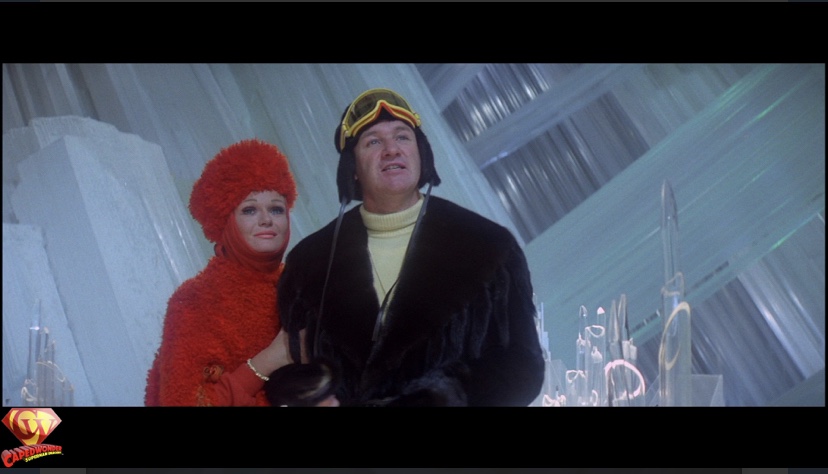
0:36:47 – 0:37:12: During the first sequence set in the Fortress of Solitude, Luthor accesses Jor-El’s interactive discussion about the history of the Phantom Zone. Once Jor-El states that he had no choice but to exile Zod, Non, and Ursa into the Phantom Zone for all eternity, Luthor asks, “No possibility for parole?”
Jor-El: “We have, of course, thought long and hard about that question.”
Luthor: “I asked the right question.”
Jor-El: “The one danger we considered was that the Phantom Zone might – we cannot know – it just might be cracked by a nuclear explosion in space. I cannot say that… that I am glad you asked me that.”
Luthor: “I didn’t ask anything.”
For some reason this brief portion of Donner’s footage is not present in the final version, though it is clear that Miss Teschmacher steps away from Luthor and the discussion. The segment is brief, a total of 25 seconds in length, yet it is not present in the final version of the Donner Cut. It appears that this was cut to differentiate the film from the original theatrical release, which used a different take of Donner footage with Gene Hackman and Valerie Perrine, combined with Lester footage of Susannah York as Lara.
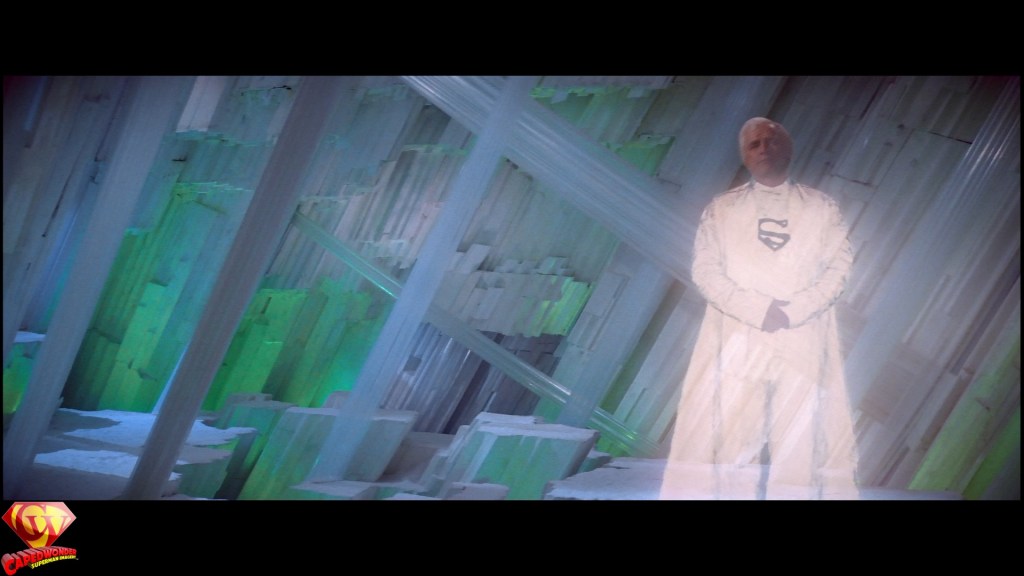
0:37:32 – 0:38:31: Once the Jor-El program ends, Luthor is left to muse about the possibility of aligning himself with the Phantom Zone villains. He then inquires about Miss Teschmacher’s whereabouts, when she responds, “I found it! I think.” We then hear a non-Kryptonian toilet flush, followed by her terrified scream to an unidentified occurrence. Luthor then simply comments, “She found it,” before he leaves.
More differences occur between the full version of the scene and what appears in the final Donner Cut. Once the program ends, the scene switches to a silent shot of Luthor at the console, followed by his thoughts, “Think of it. Three super villains. Three! Count them, three!” This long shot of Luthor was edited from the film, and the dialogue is instead placed over the shot of the disappearing program.
The end of the scene has also been re-edited in the final version of the film. First, once Luthor says, “It’s too true to be good, right?” we hear the toilet flush, then Luthor asks where Miss Teschmacher is. Then we hear her response, “I found it! I think.” End of scene.
Why Thau made these cuts to Donner’s footage, and whether Donner authorized these cuts to his own footage, is unclear as of this writing. All we know is that the final version of this ending runs 56 seconds in length, with 48 seconds of Donner’s footage lost in the re-edit.
In the next installment I will address some of the edits made to Richard Lester’s footage for the Donner Cut. More to come…
 Superman: The Blog