For any film or television series, the marketing campaign is one of those key components that will determine the success of such a project. For decades such projects were limited to press interviews, theatrical trailers, and television and radiospots. The more successful the campaign, the more successful the film. Over the decades into the 1970s, this was how the formula worked.
By the time Star Wars arrived on the scene in 1977, the face of marketing campaigns for films had dramatically changed. The film was an unknown commodity and a huge risk for both 20th Century Fox and the film’s creator George Lucas, but word of mouth soon made the film the highest grossing motion picture for the next several years. Today we look at the Star Wars franchise in terms of all of the films, the different animated series, the numerous television series on Disney+, and the many books, comics, toys, and officially licensed products that have followed. This is because Lucas wisely had control of the marketing of the films and all of its ancillary products, which guaranteed him creative control of it all, and which he channeled back into the franchise and his own production facility.
At the time, however, Star Wars was caught with its proverbial pants down in terms of marketing. All it had going into the release were a novel based on the film (released the year before) and the Marvel Comics adaptation in six issues. Everything else came in the months that followed. Even the toy licensing came the following year.
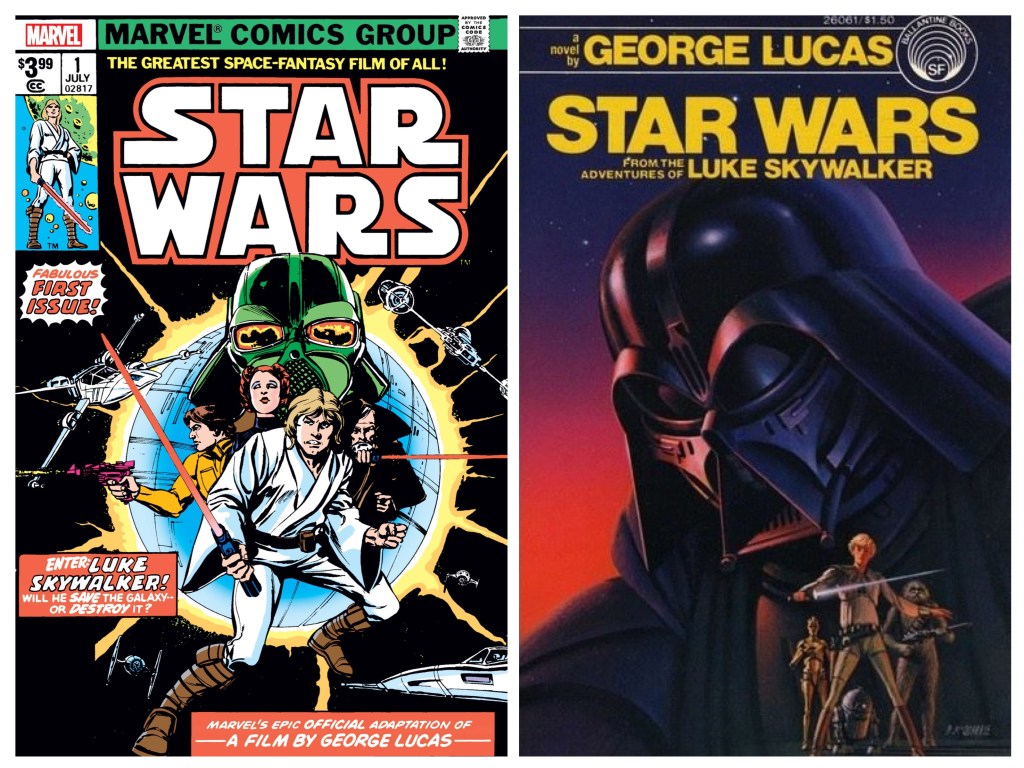
We now look at Star Wars as a brand name that guarantees a certain level of quality to its products and its films. Decades before, other creative minds had similar control of their respective productions and tie-in products. Filmmakers such as David O. Selznick and Orson Welles took control of their films and the marketing campaigns, and today we look at Gone With the Wind and Citizen Kane as classics because there were no models before them. Even the announcement trailers teased something special for filmgoers. And over the decades, properties such as Mickey Mouse, Coca-Cola, and Nike, to name but a few, had to be built from the ground up and maintained with integrity to ensure their respective successes in the world.
Which brings us to Superman.
By 1978 the character had celebrated its 40th anniversary and seen its share of numerous marketing campaigns which included toys, Halloween costumes, books, clothing, balloons at the Macy’s Thanksgiving Day parade, animated series, radio shows, movie serials, television series, and thousands of comic books. Superman was clearly established in the public’s collective mind by now, and people had their own perception of who and what Superman should be.
Everything changed with the release of Superman: The Movie on December 15, 1978, which culminated the 40th anniversary of the character, and Warner Bros. was determined to pull out all of the stops to ensure that this new film version not only honored the past but also paved the way for the future of the Superman franchise itself. And that extended to the marketing of the film as well.
It all began in August 1974, when Alexander and Ilya Salkind and Pierre Spengler met with Bernard Kashdan of DC Comics to discuss their intention to make a feature film version of Superman. One of the concerns expressed during the meeting, and the weeks of negotiations that would follow with Bill Sarnoff, was character integrity. Everyone wanted to see Superman portrayed on movie screens accurately and not in the campy manner of the Batman series during the 1960s. Oddly enough, Warner Bros. could have made the film at any time. According to Ilya Salkind, “it was a miracle we could get (the rights). Warners thought Superman was dated (and) past its time.” Ultimately, Warner Bros. had faith in the Salkinds to get Superman right.
Over the next three years, it would take multiple scripts, multiple directorial prospects, and an exhaustive casting search for all of the right elements to come together before shooting officially began toward the end of March 1977. Even during the pre-production process, Variety, the leading trade publication about the Hollywood scene, began to promote Superman extensively through a series of full-page trade advertisements. Not a month didn’t go by when an advertisement appeared in print announcing writer, director, and casting choices for the film. Even at this, word was getting out to the public about what Variety called “the super-film of the 70s”.
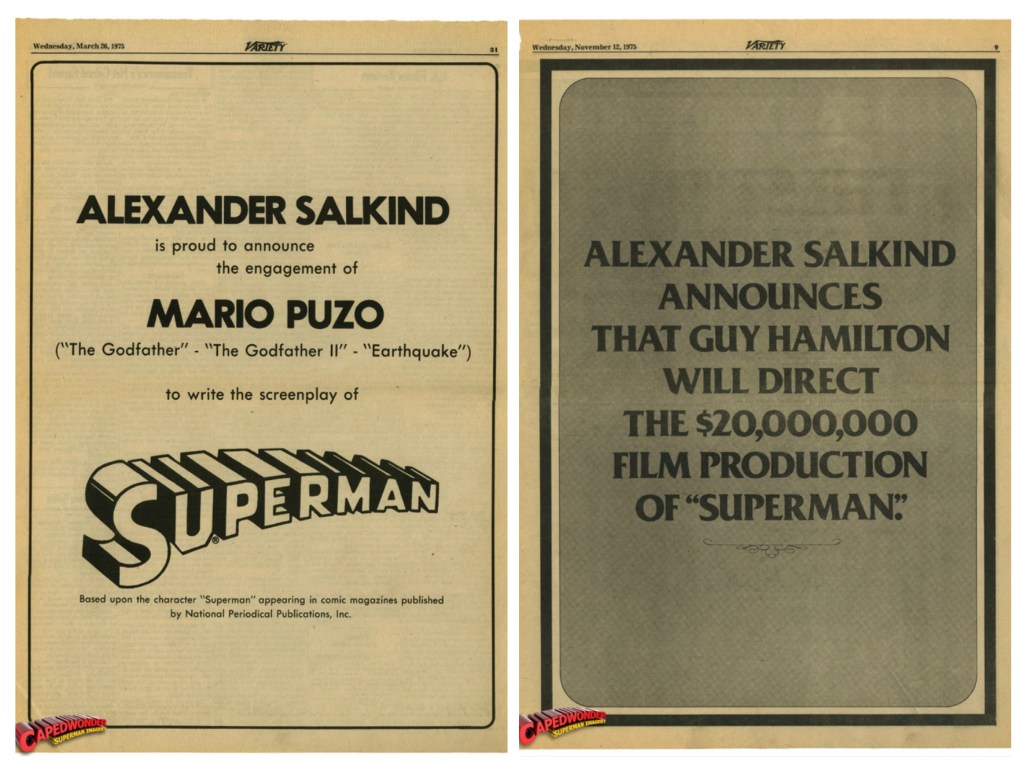
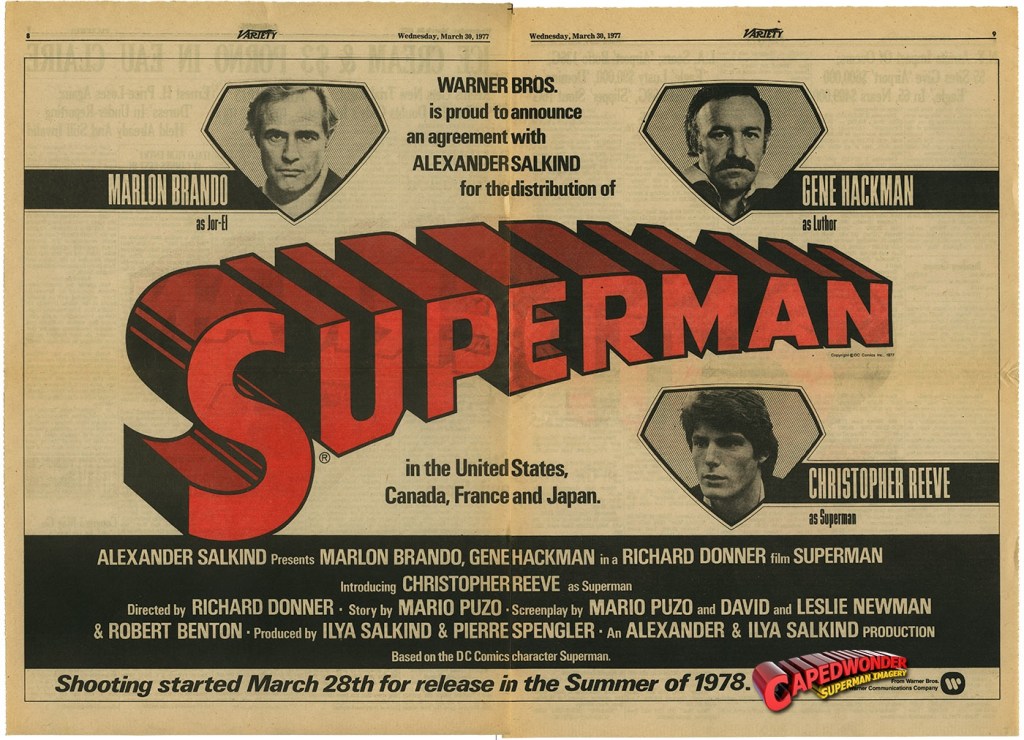
Among the most prominent Variety trade advertisements were those announcing the cast members of the film. One prominent two-page ad from 1976 announced the casting of Marlon Brando and Gene Hackman for the film. Another from March 1977 included a shot of Christopher Reeve alongside Brando and Hackman.
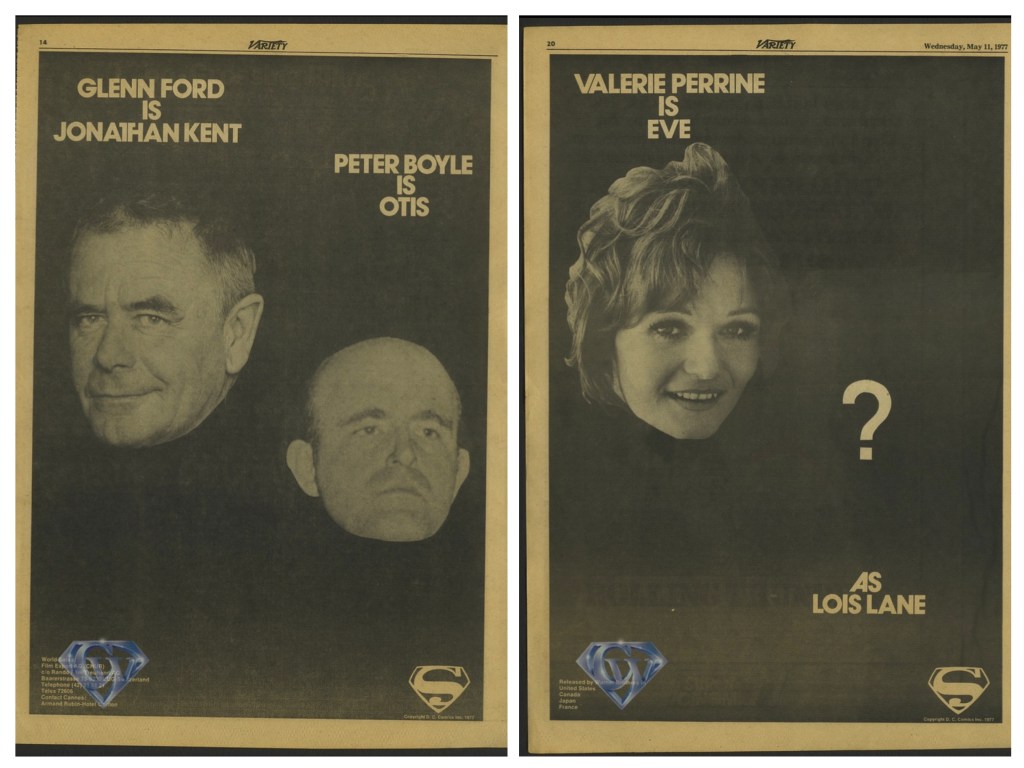
And in May 1977 readers were given a multiple page spread announcing much of the entire cast. What makes that series of ads unique is the announcement that Peter Boyle was set to portray Luthor’s henchman Otis – only later did we learn that a salary dispute resulted in his departure from the project before he shot any scenes, and that the part was recast with Ned Beatty. Also unique is that no announcement was made here of who would portray Lois Lane. By this time the film had already begun shooting, and it would not be until the start of May that Margot Kidder was selected for the role, too late to make the Variety cast announcement ads the following week. But even in those early days, Variety was serious about marketing and promoting the Superman project.
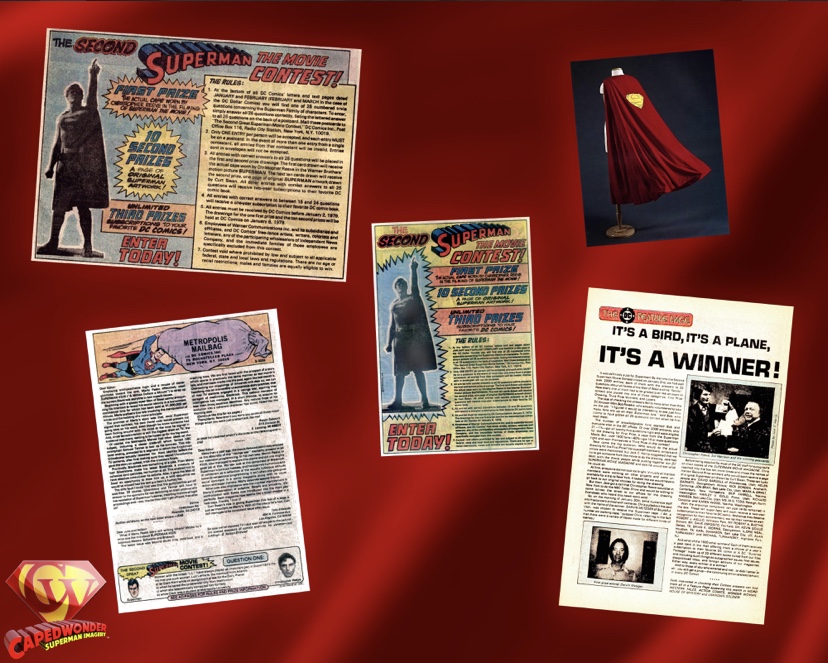
But Variety was not the only source for promoting the film. Naturally, DC Comics took charge in promoting the making of the film. As filming progressed, monthly reports were published in its line of comic books. DC also sponsored the first of two contests, where two lucky readers would win a walk-on appearance in the film. Ed Finneran and Tim Hussey would win the contest, appearing in the Smallville football scrimmage practice, which was filmed in August 1977. A second contest would later follow, where fans would collect letters from specific issue in the hopes of winning an actual cape worn by Christopher Reeve in the film. Reeve was on hand at DC Comics to select the winner from hundreds of entrants, and Darvin Metzger would win a number six walking cape from the contest.
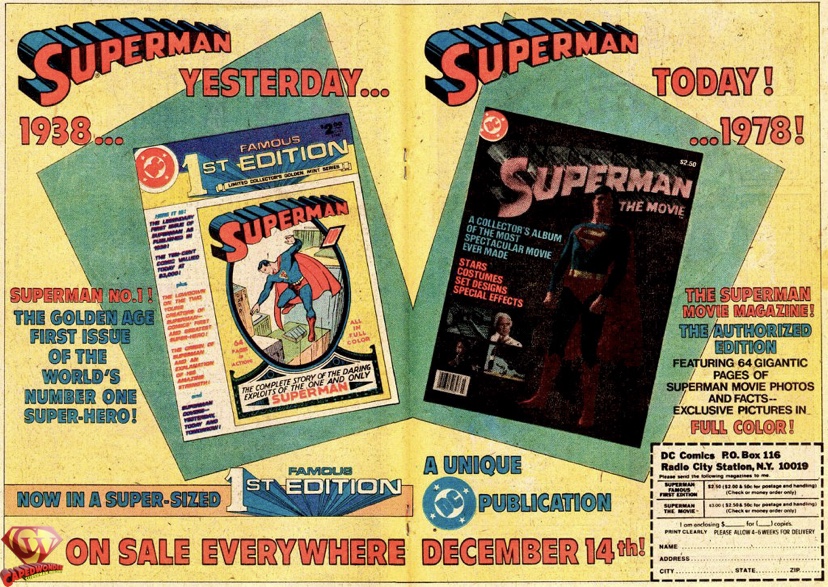
DC Comics would also publish two giant magazine specials, which were released on 14 December 1978, the day before the film’s release. One was a giant treasury edition reprinting the first issue of Superman from 1939. Over 500,000 copies would be published. The other was a special magazine promoting the making of the film, complete with interviews with the cast and crew and lots of photographs, which they would do again with Superman II in 1981.
During the middle of August 1977, while the production was on location in Alberta, Canada, shooting scenes of the infant Kal-El’s arrival on Earth, Ilya Salkind began to consider ideas for theatrical teaser trailers to promote the film. He would travel to Los Angeles and meet with the marketing department of Warner Bros. to come up with effective ways to promote the film in theaters months in advance of its release.
By November, he would meet with Richard Greenberg of R. Greenberg and Associates to discuss a theatrical trailer campaign for the film. And the question is an obvious one: how do you promote a film without revealing a single piece of footage? Greenberg would devise an initial teaser trailer using stock film footage of a skyline that had been shot from an airplane. From there, Greenberg incorporated the names of each main cast member streaking across the sky. He also used the classic S shield streaking into the stars within the context of the teaser, both of which would be used for the final main title credits at the start of the film. When the teaser trailer premiered in theaters in January 1978, audiences across the United States were enthusiastically excited about the potential of the film. For months this was the only trailer to market the film, but it would not be the last. A film of this scale needed more than just preview trailers to get the word out. It needed a full-scale marketing campaign to let everyone know that Superman was coming. It could not afford to catch up to the fans as Star Wars had done the year before. Executives were also concerned about the marketing campaign of the failed King Kong remake, which openly included footage of the creature. To catch people by surprise, it was decided not to spotlight any footage of Christopher Reeve in flight as Superman. They had to work around it in order to maintain the integrity of the film itself.
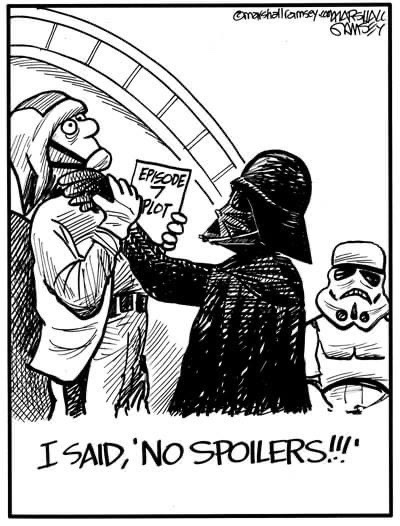
To this day the original announcement trailer for Superman stands alongside classic announcement trailers for films like Gone With the Wind and Citizen Kane as effective promotional tools for films without revealing a single piece of actual film footage to convince and interest moviegoers to see those particular films. It had come a long way since those early announcement banners flown over the skies of Cannes in the previous few years. It’s a blessing that Superman was not filmed in today’s times. Photographs shot during production, iPhone recordings of behind the scenes moments, and endless news reports would have endlessly streamed online months before the film’s release, as with the case of the newest Indiana Jones film, all of which would have resulted in spoiler-filled theories about the film. And for that we have Ilya Salkind to thank. During test filming of the Fortress of Solitude scenes in May 1977, Salkind issued a memo stating that the shooting of the elaborate visual and flying effects were to be treated as top secret, thereby eliminating the need for people to spoil the surprises to come.
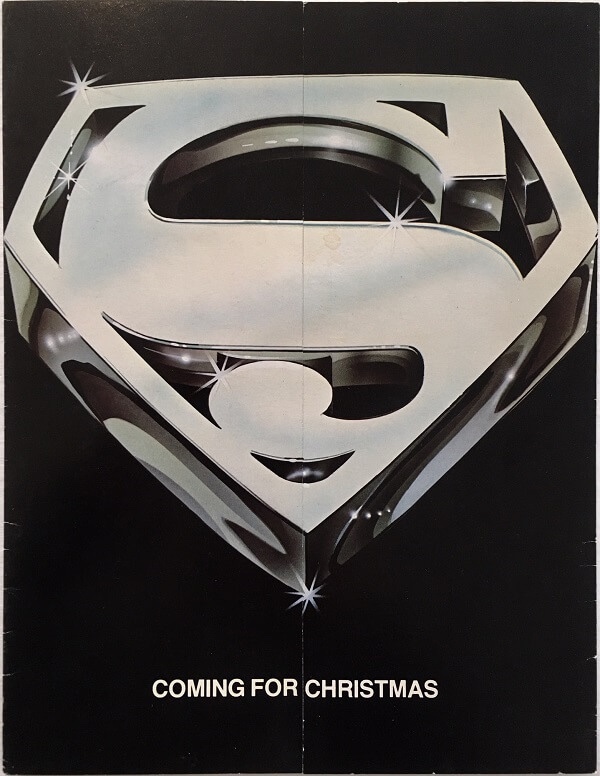
On 16 August 1978, over five hundred theater, merchandising, entertainment industry, and press representatives gathered at the New York Hilton Hotel to attend a three-hour Superman presentation and luncheon hosted by the executives of Warner Bros. Among those who attended the presentation included Ted Ashley chairman of the board of Warner Bros.; executive producer Ilya Salkind; Steve Ross, chairman of Warner Communications; Bill Sarnoff, chairman of Warner Publishing; Howard Kaminsky, president of Warner Books; Jerry Wexler, senior vice president of Warner Bros. Records; DC Comics president Sol Harrison; Joseph Grant, president of Licensing Corporation of America; Terry Semel, executive vice president and chief operating officer of Warner Bros.; and Andrew Fogelson, executive vice president for worldwide advertising and publicity for Warner Bros. Everyone was present to discuss the most ambitious marketing campaign for Superman: The Movie, one which would involve hundreds of licensees manufacturing and marketing thousands of products with the Man of Steel’s likeness. During the meeting, they announced a series of tie-ins with point of sale and theme accessories, which would include teaser trailers, audiovisual kits, slides, stills, streamers, posters, and floor display units, among others. In that meeting, something unusual happened. According to those who were there, altercations reportedly broke out over possession of the silver and black S centerpieces. Ted Ashley got so carried away by all the commotion, he divulged many of the secrets regarding the film’s highly secret ending.
For years Sol Harrison had been the keeper of the Superman property at DC Comics. He was very serious about how Superman was marketed to the public. For every successful licensed product there were hundreds of requests he rejected to cash in on the character. He didn’t want to see the Superman name or image slapped onto just any product. Like Ilya Salkind and Bill Sarnoff, he, too, wanted to maintain the integrity of the Superman property. “No one gets a blanket contract to go ahead and do what they want with Superman,” Harrison said. “It’s only that kind of care that has kept him alive for forty years.”
Terry Semel pointed out, “Usually when a movie catches on, merchandising catches on along the way. What we hope to do this time is to give our various divisions ample lead time to do what should be done. The difference between this and other films is that all these things are taking place up front.” And he was right. Star Wars had to catch up months after its 1977 release and into 1978. Superman had been in development for four years by this time and had decades of pre-built marketing already in place. The trick was taking it to the next level.
Those involved in the film knew the risks. Ilya Salkind commented, “It’s a question of whether it will be a medium blockbuster or an enormous blockbuster. Because of the sheer mechanics of the distribution, it can’t make less than $40-50 million, but if that’s all it does, the cost of the film would make that a catastrophe.”
Another insider who had been involved in the making of the film over the past four years pointed out, “This is a high stakes gamble business, and Superman is just the biggest roll of the dice in history. Make it, and you make it beyond your wildest dreams. Miss and it’s the pits.”
Next time, we’ll look at more of the marketing ideas for the film.
(Images in this blog appear courtesy of CapedWonder.com.)
 Superman: The Blog