Last Thursday we received news that Christopher Reeve’s version of Superman would appear in the forthcoming film of The Flash as the film’s title character makes his way across the DC multiverse, encountering other incarnations of characters such as George Reeves’ Man of Steel from The Adventures of Superman, Michael Keaton’s Batman, Christian Bale’s Batman from the Dark Knight trilogy, Ben Affleck’s Batman from the recent Justice League and Batman vs Superman films, and numerous other interpretations. This is particularly exciting because this is the first time we will get to see Christopher Reeve back on the big screen as Superman since the 2006 premiere of Superman II: The Richard Donner Cut and his final turn in the role in 1987’s Superman IV: The Quest for Peace. Even if it’s borrowed footage, the fact that Earth-789 (as it is now referenced in DC Comics lore – the 78 a reference to the 1978 premiere of the first Superman film) is included in the film is an indicator of just how important and recognized the four Superman films are not just in the superhero film genre but in film itself.
But this is not the first multiverse genre crossover where Superman is concerned.
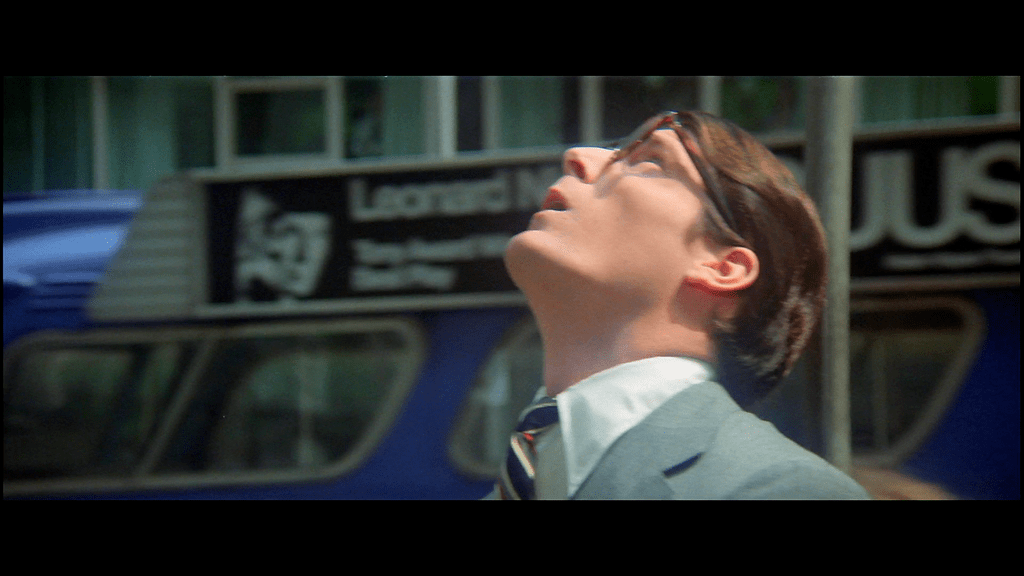
During filming of the fruit basket sequence for Superman II on July 11, 1977, director Richard Donner and cinematographer Geoffrey Unsworth captured a most unusual crossover indeed. At one point we see Clark Kent racing to the sidewalk and using his super breath to slow Lois Lane’s fall from the windows of the Daily Planet before using his heat vision to open the awning and bounce her into the fruit cart. As he does this, a commuter bus goes right behind him, and for a fleeting moment we can spot an advertisement on the top of the bus for the Broadway play Equus featuring Leonard Nimoy.
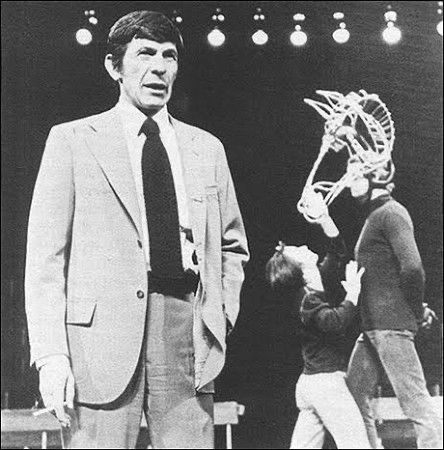
Equus was the brainchild of writer Peter Shaffer, who wrote about the attempts of child psychologist Dr. Martin Dysart to treat a young man’s fascination with horses while trying to determine his own sense of purpose in his life. The play originally ran in London’s National Theatre from 1973 to 1975 before moving to Broadway’s Plymouth Theater, where it ran from October 24, 1974 to September 11, 1976, with Anthony Hopkins as Dysart and Tom Hulce as Alan Strang. It then moved to the Helen Hayes Theater and ran from October 5, 1976 to October 2, 1977, for a total of 1,209 performances.
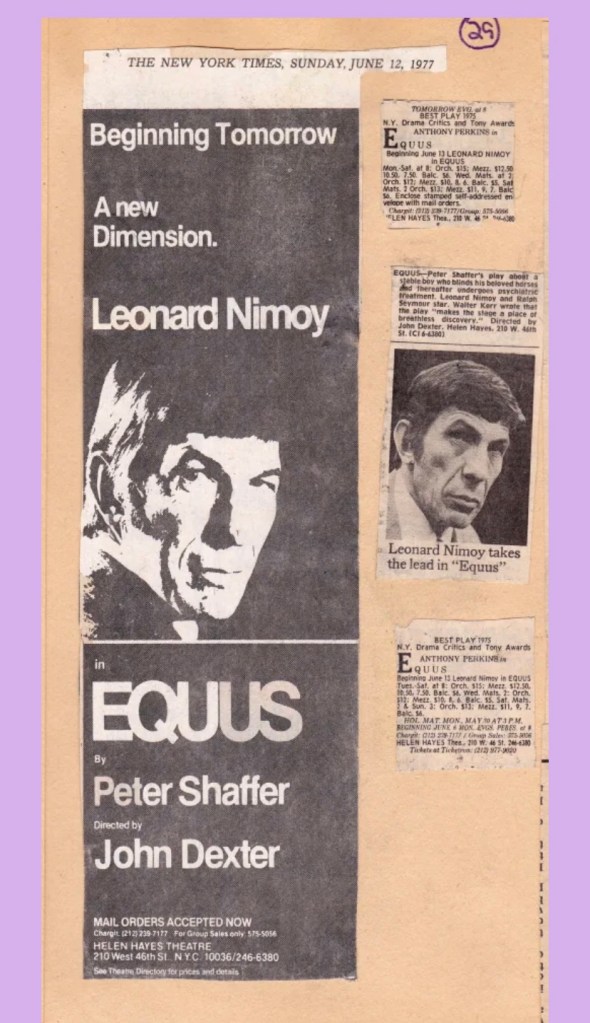
Leonard Nimoy succeeded Richard Burton in the role of Dysart, and his run began on June 13, 1977, on Broadway. At the time, Nimoy was not scheduled to return to his most famous role of Mr. Spock for the planned Star Trek: Phase II television series, and he was doing all he could to distance himself from the role that made him a household name.
When filming on the fruit cart sequence occurred on July 11, 1977, Nimoy’s run in Equus was into its first month, and the reviews were picking up speed by that time. So it was a serendipitous moment that Richard Donner and Geoffrey Unsworth captured this shot of the bus advertising Equus on film, further grounding the two Superman films with its sense of verisimilitude, that sense of reality within a fictional environment, although it would be 29 years before the shot would finally be seen by the public at large in Superman II: The Richard Donner Cut.
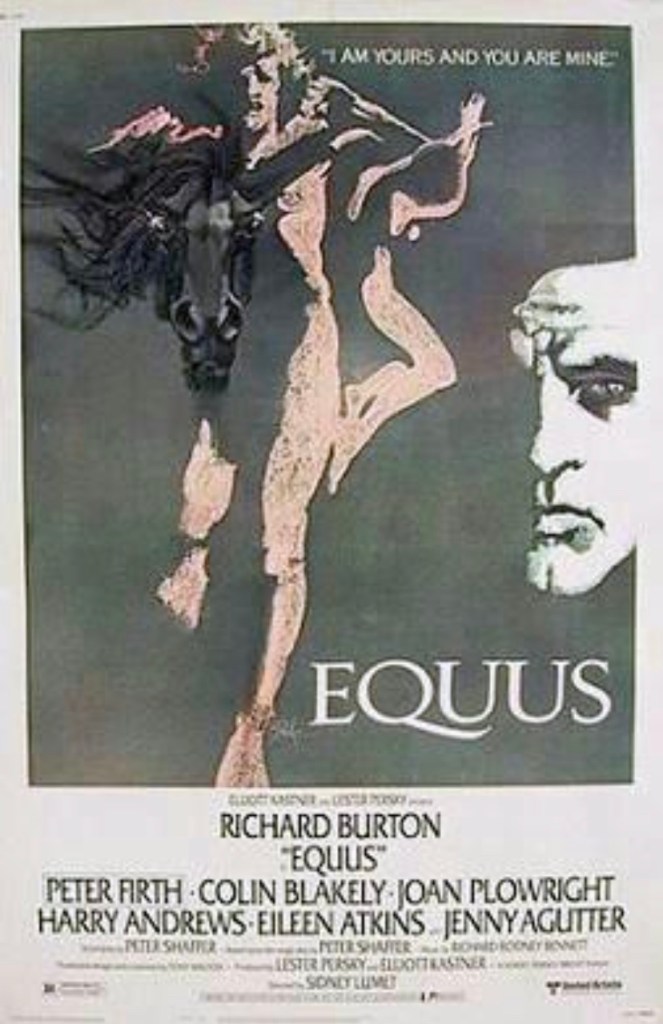
Nimoy would later be succeeded by Anthony Perkins for the remainder of the Broadway run until its conclusion in October 1977, and Shaffer would adapt his script into a feature film that would be released two weeks after the conclusion of the Broadway run, directed by Sidney Lumet with Richard Burton and Peter Firth.
Granted, a bus advertisement such as this makes the two Superman films dated for its time, as does the shot of the World Trade Center early in the Donner Cut. But for one fleeting moment we get to bear witness to a brief crossover featuring the world’s most famous Vulcan and the world’s most recognizable mild-mannered reporter. I don’t know if Christopher Reeve and Leonard Nimoy ever met in real life or not, but it makes the possibilities, as Spock would say, quite fascinating.
It wouldn’t, however, be the last.
(Screenshot courtesy of CapedWonder.com.)
 Superman: The Blog