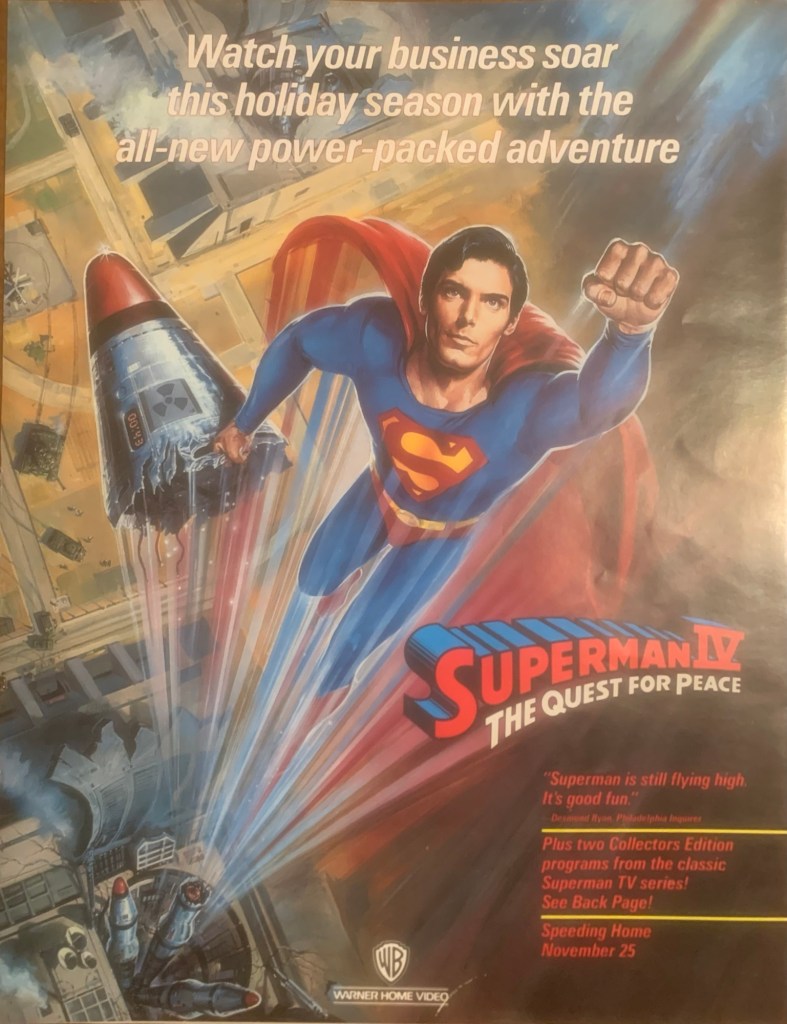
After the critical and commercial failure of Superman IV: The Quest for Peace at the box office, it wasn’t long that Warner Bros. would gear the film up for its eventual release on VHS and laserdisc. By the fall of 1987, the window between a movie’s theatrical release and its debut on home video was shrinking, and movies became more and more affordable to the masses. At this point Betamax had gone the way of the dinosaurs, leaving only VHS and laserdiscs as the two leading formats in the home video market wars of the time. So it was no surprise that the fourth (and final) installment of the Christopher Reeve film series would make its debut on home video rather quickly after its theatrical run.
When you think about it, four months is not a long time for a film to arrive on home video. At that point in the 1980s, such a window began to shrink. Take Purple Rain, for example. The 1984 summer movie which marked Prince’s film debut earned over $70 million at the box office on a very modest $7.2 million budget, making it one of that year’s biggest hit films and generating a hugely successful album with several hit songs that still stand out to this day. When the movie came out on VHS, it was still playing in theaters, and Warner Home Video was quick to capitalize on its success. I want to say that it came out on video in September of 1984, as my parents got the tape for me for my birthday when I turned 18, and it was priced at a very affordable $29.98 MSRP for its time, one of the very first home video releases to do so in such a short period of time. Nowadays it’s not uncommon for a movie to go to digital or Blu-Ray within a month or two at most, regardless of its success or failure, but back in 1984 this was truly unheard of. (Oddly enough, last year I found the film on Blu-ray at the local Big Lots for all of five dollars!)
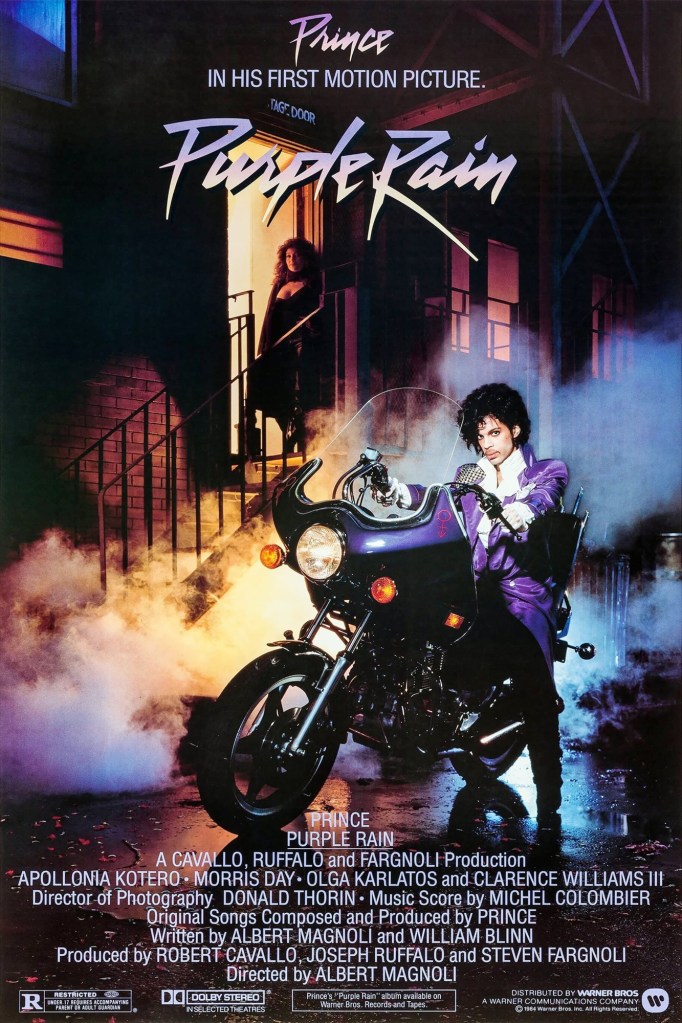
But Purple Rain was not the first movie to hit home video at an affordable price. Other movies, including the second, third, and fourth Star Trek movies; Raiders of the Lost Ark; and Top Gun all made their home video debuts at relatively low prices. And by early 1985 Paramount Home Video began selling individual episodes of the original Star Trek on VHS at insanely low prices. Eventually, older movies which were initially priced anywhere between $70 and $90 were being re-released at much lower prices, making them more affordable for home video fans who didn’t want to shell out the big bucks for just one movie. (Tell that to the kid who went to the local Camelot Music at Metrocenter and shelled out 70 bucks for the first VHS release of Superman: The Movie in 1980, four years before we got our first VCR!) And it wasn’t just for hit movies or classic television shows. It was now across the board.
In the case of Superman IV, Warner Bros. executives knew that they had to try to recoup their losses somehow after its disastrous box office performance. That meant putting it out on the rental market at first to gauge moviegoers’ responses. Because the film had failed and disappeared from theaters in a matter of weeks—I remember it leaving my hometown of Jackson, Mississippi, after only four weeks at the Metrocenter Cinema 4, where the previous Superman movies had premiered—there were obviously some people who either didn’t get the opportunity to see it during its theatrical run or chose not to go, given the overall negative reception from film critics and casual audiences (imagine how it would have played out during the social media era). I still recall seeing a group of kids around seven or eight years old each who were all into wanting to see Robocop, which had been tuned down from an X rating to an R rating because of the excessive amount of violence in the movie. Superman didn’t interest them, but Robocop did.
And part of the publicity strategy was to emphasize those reviews that played up to the film’s strengths rather than its flaws. Unfortunately, there were not a lot of positive reviews of the film upon its release. I recall my local newspaper, the Jackson Daily News (the evening version of the Clarion-Ledger) publishing a review, and while I do not have a copy of it anymore, I seem to recall it saying that Superman was starting to look a bit threadbare. I may be wrong, but for some reason I specifically recall that word in the review. Another review called the film “Superman on a Shoestring”, and even Christopher Reeve himself wrote in his 1998 autobiography Still Me, “The less said about Superman IV, the better.” He went into further detail about the film’s low budget and the compromises that were made in filming the scene of Superman’s arrival at the United Nations, commenting how Richard Donner would have spared no expense to make the scene look right. Given that the production had occurred at a very low point in his professional and personal life, it’s understandable why he made such a comment and wanted to distance himself from the negative memories associated with the film, even years after its release. But there had to be some positive reactions out there somewhere, right?
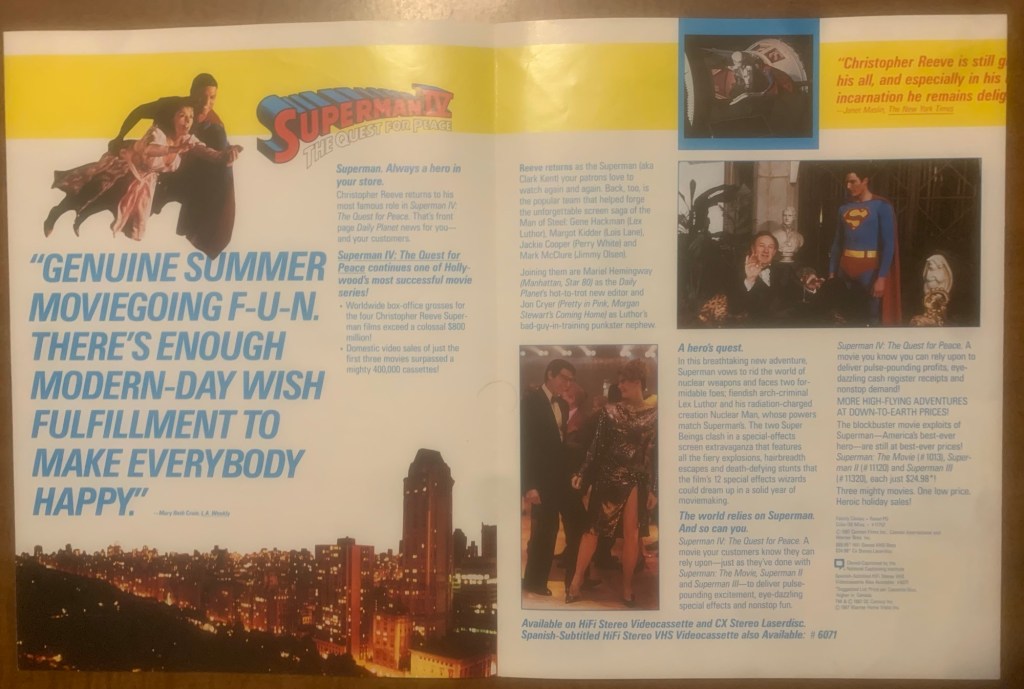
The most prominent positive excerpt comes from Desmond Ryan’s review in the Philadelphia Inquirer when he wrote, “Superman is still flying high. It’s good fun.” This excerpt is prominently featured on the VHS and laserdisc releases.
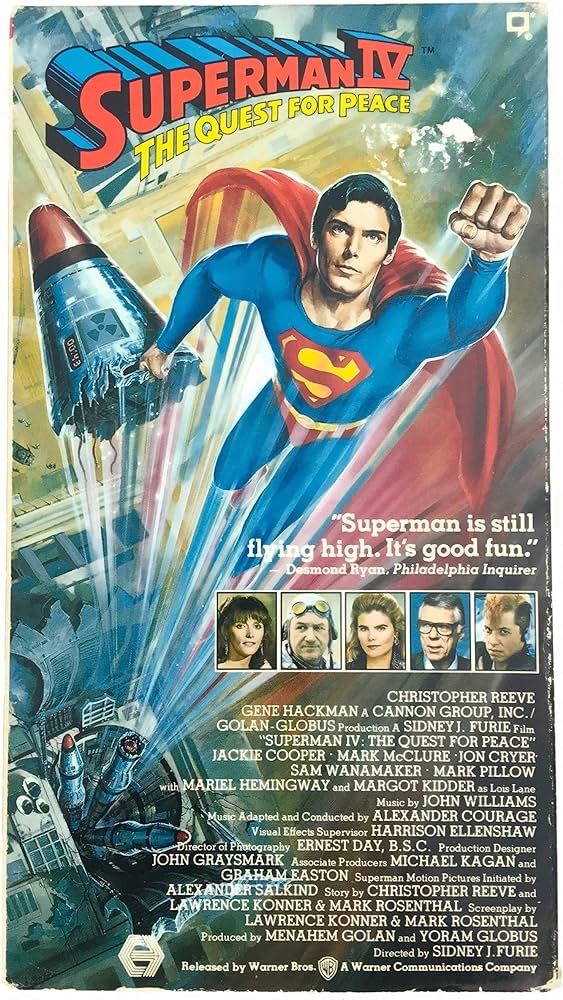
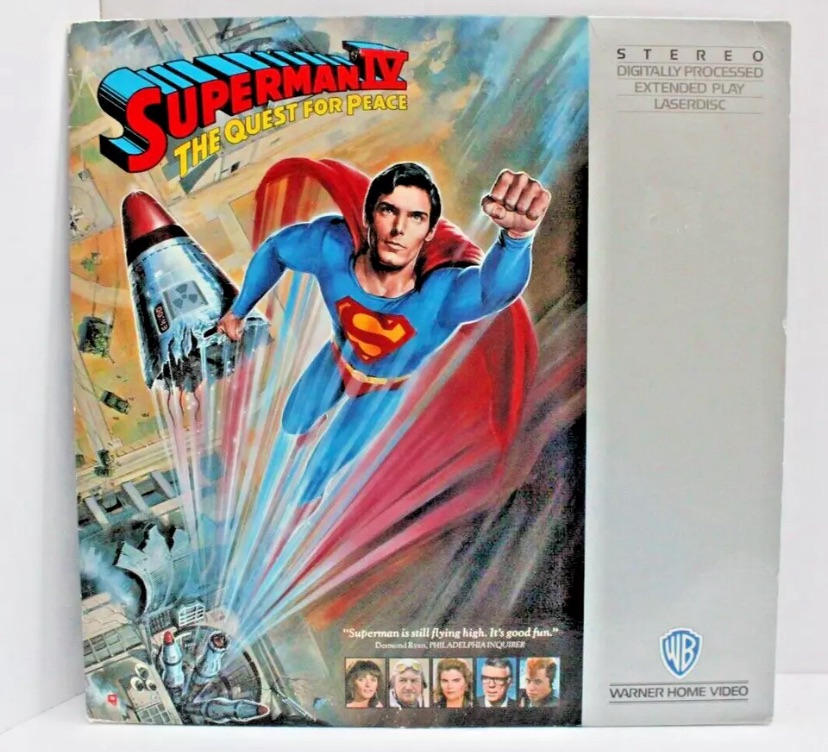

But that’s not the only positive comment that’s out there. Janet Maslin also had some kind words about the film in her review for the New York Times: “Christopher Reeve is still giving this character his all, and especially in his bumbling Clark Kent incarnation he remains delightful.”
And in her review for the L.A. Weekly, Mary Beth Crain commented, “Genuine summer moviegoing F-U-N. There’s enough modern-day wish fulfillment to make everybody happy.” If only more reviewers had been kinder to Superman IV at the time. I’m sure there probably were, but at the time those were few and far between.
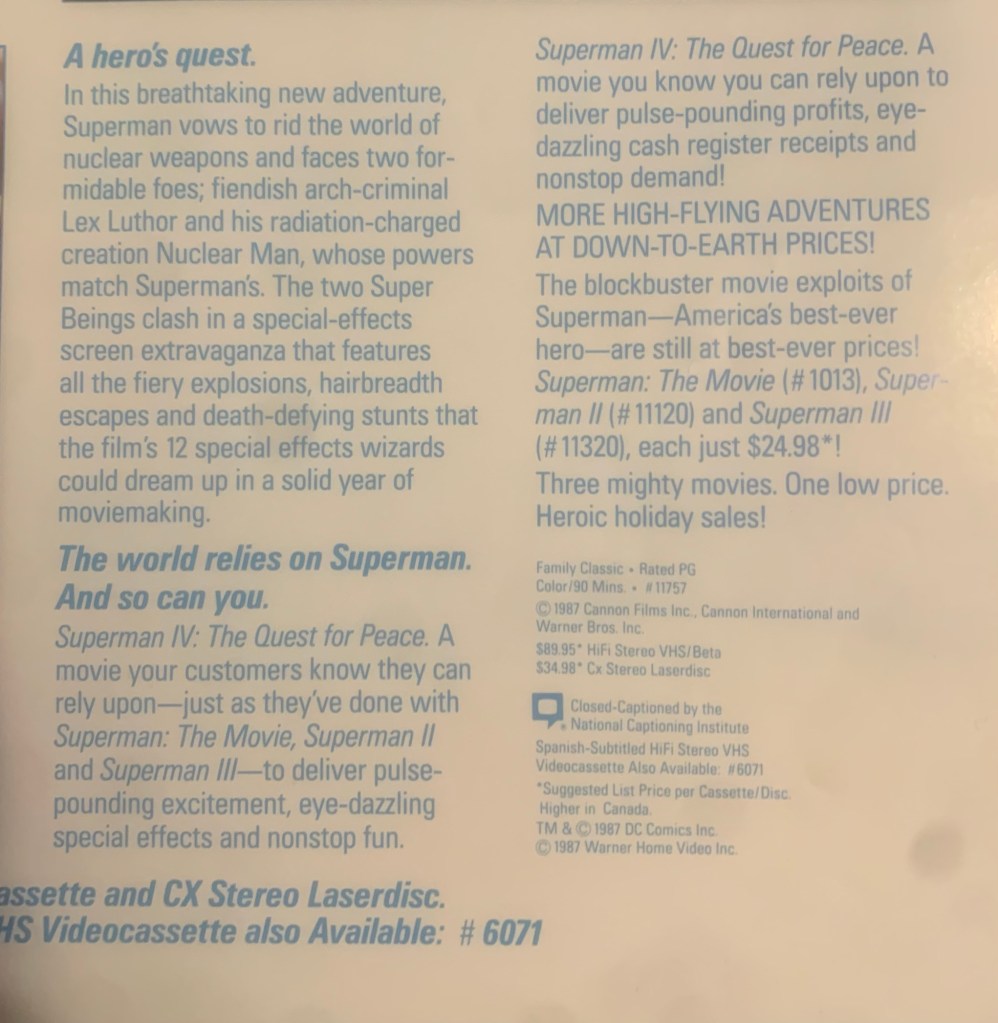
It’s based on the strengths of these three comments that Warner’s marketing team wanted to play on the film’s positive appeal in their attempt to get viewers and fans excited about the film’s release on home video that fall. And in their marketing strategy they included these excerpts in a promotional flyer that would be sent to video stores across the United States.
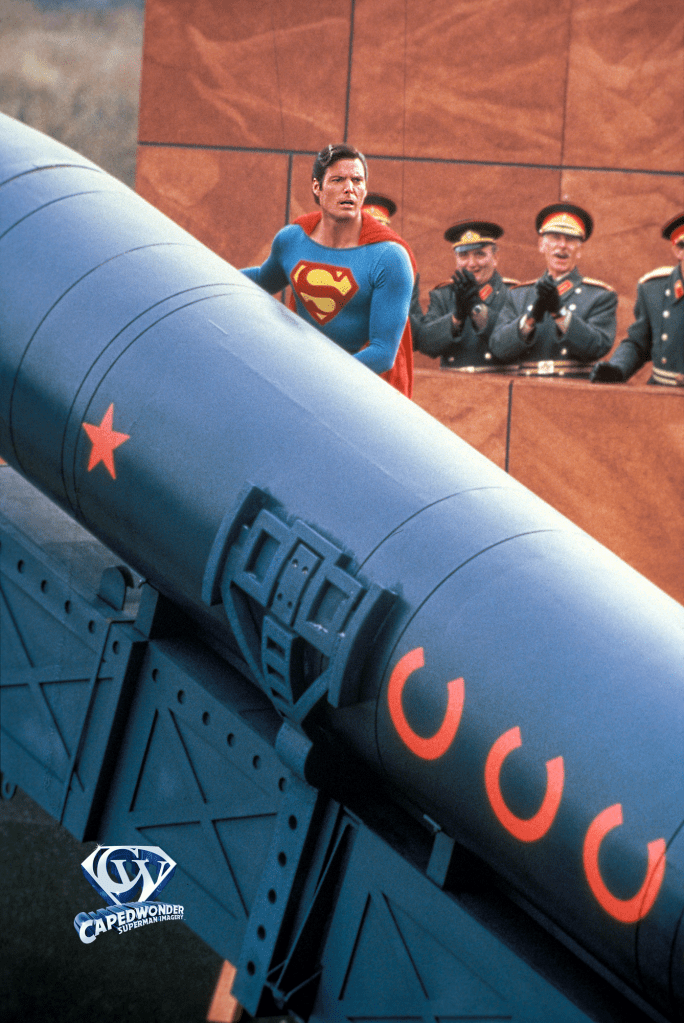
What makes the flyer interesting is that the Warner marketing team used images from scenes that were not featured in the theatrical release at all. One such image is the scene of Superman saving Red Square from a nuclear missile going awry. (It would be included in the Cannon Films international release, but American audiences wouldn’t see the sequence in its entirety until the syndicated TV broadcast beginning in April 1990.)
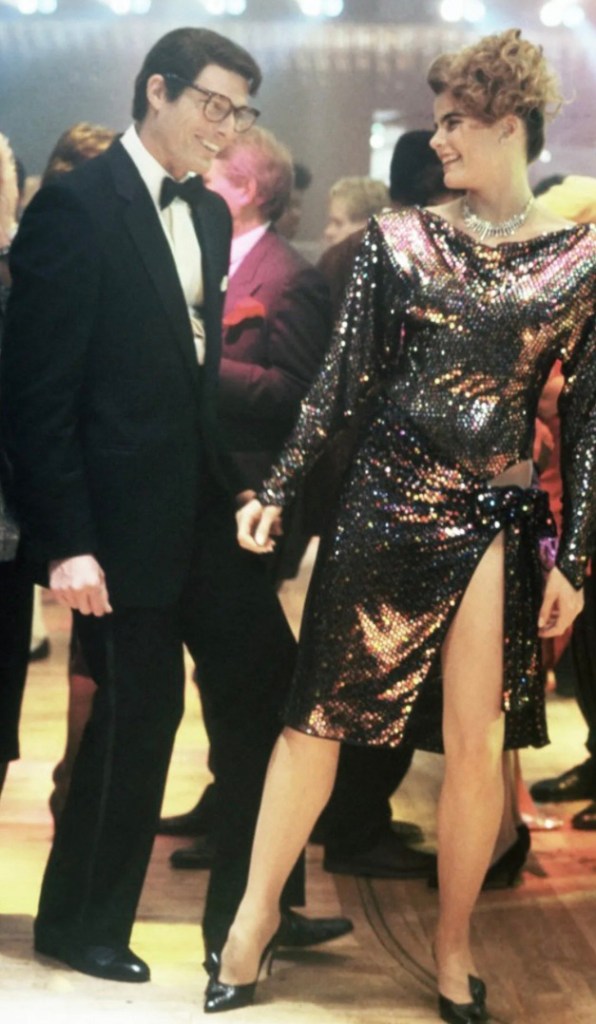
Even worse, they also included a shot of Clark and Lacy dancing together, which was taken from the lost Metro Club sequence, which has not been seen since its lone sneak preview screening in Orange County, California, in June 1987.
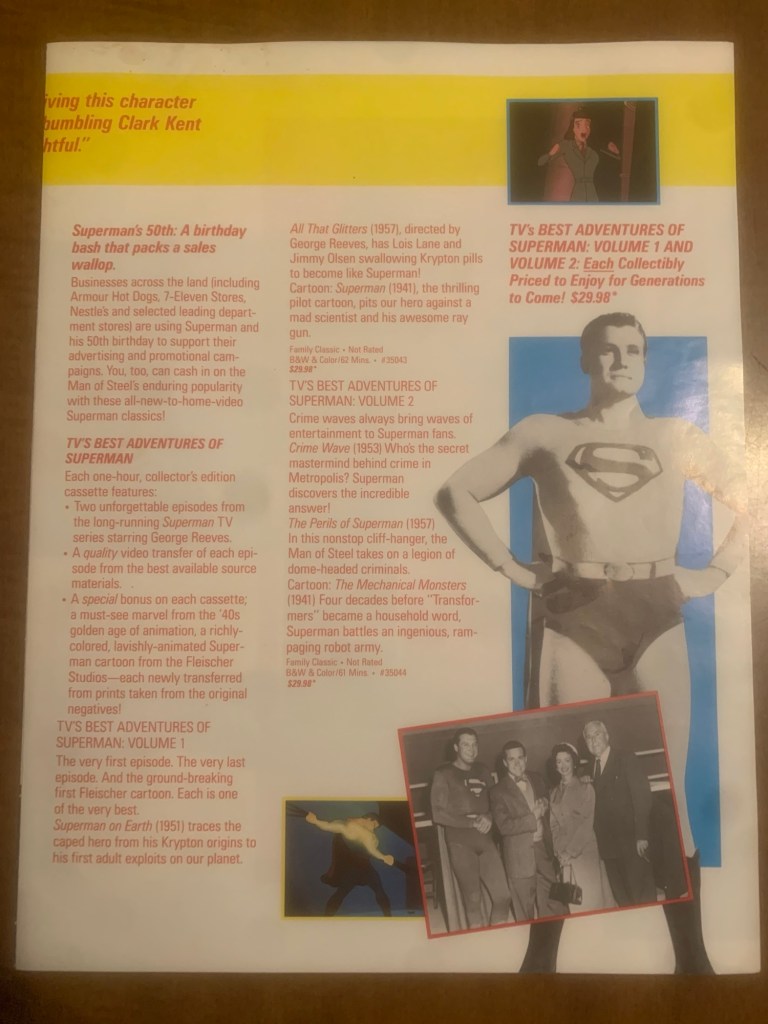
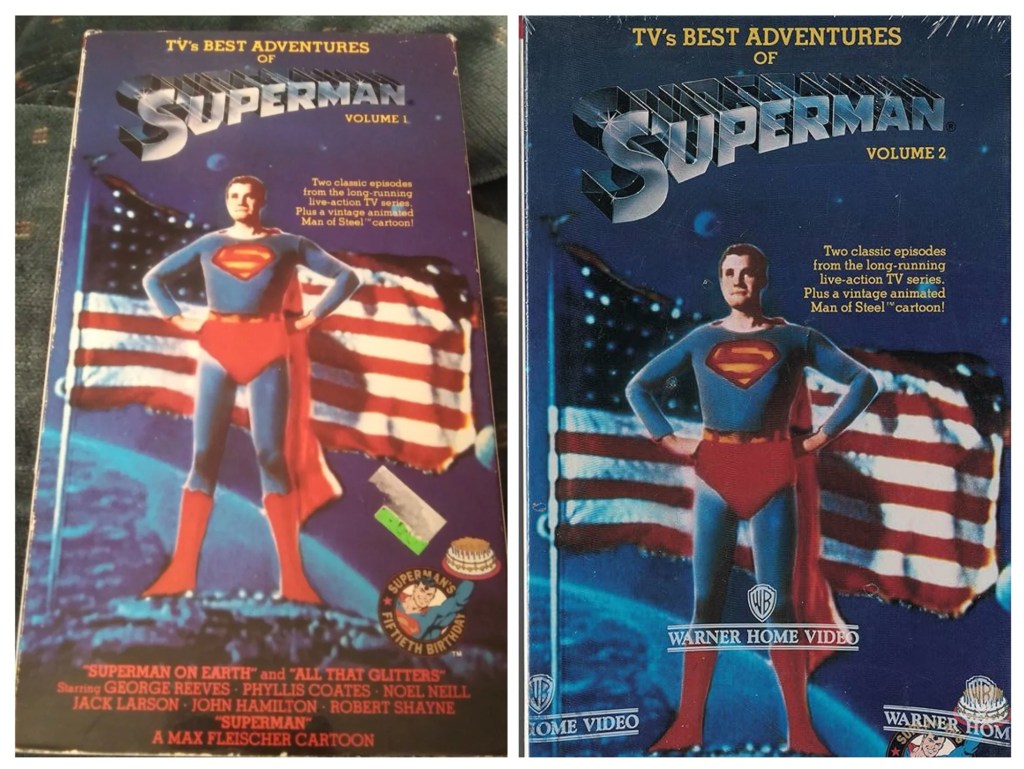
But that’s not all. Warner Home Video also promoted the first two volumes of The Adventures of Superman, the classic 1950s series featuring George Reeves as the Man of Steel. Each tape featured two episodes of the series, one from the first season and one from the final season, along with a segment of the 1940s Fleischer Studios animated theatrical series. Priced at an affordable $29.98 each, Warner Home Video would release two further volumes in 1988, along with the first-ever video release of the uncut 1951 feature film Superman and the Mole Men.
But here’s what’s interesting about the home video releases of Superman IV. The MSRP for the VHS release was set for a whopping $89.98, while the laserdisc was priced at a much more affordable $34.98. This was clearly a marketing strategy designed to gear the VHS for rental first, to drum up interest again for the movie, until the rental stores phased the tapes out and recycled them into their bargain bins for mere pennies on the dollar a couple of years later. Laserdiscs, however, were the higher-quality parlor products through the 1980s and the 1990s prior to the advent of DVD.
Of course, by now the first three Superman movies were re-priced at a much more affordable sell-through price of $24.98 apiece. That means you could have scored the first three films for less than what you’d have shelled out for Superman IV! (Then again, I am that kid who spent $70 of his hard earned allowance to get the first movie on VHS in 1980, but by the fall of 1987 I was a broke college student who couldn’t have afforded to shell out 90 dollars for a single tape! Priorities when you’re 21!) Don’t get me wrong, I’m sure there were some people who went all out and spent the 90 dollars for the VHS tape. I just wasn’t one of them.
By 1989 Superman IV would reach the movie networks, with HBO and Cinemax scoring the first broadcasts. And it would be at least another 12 years before we would see the first-ever DVD release of Superman IV in its original theatrical aspect ratio, and another five and a half years before we would see a plethora of those lost scenes on the deluxe edition release. And somewhere in a Warner Bros. film vault sits the complete 134-minute cut, in exactly what condition nobody knows.
But it’s interesting to see how the marketing team at Warner Bros. were serious about going all out to recoup the money they lost with Superman IV. As with the film itself, at least their attempts were sincere.
(Some of the images in this blog appear courtesy of CapedWonder.com.)
 Superman: The Blog