-
This week’s 4K update…
There’s been lots of news and reports about Warner Home Video’s plans for 2023, so let’s get right to the nuts and bolts of it all…
Last week Warner Bros. announced its plans for its 100th anniversary in 2023 which will encompass its vast library of films, television series, animation, digital releases, and home video, including many new 4K releases for the coming year. One release that was mentioned in particular is the Superman 5-film collection.
What do we know about this release? For starters, all of the Christopher Reeve films are currently being remastered by a top master colorist at Warner Bros. to give the films top color quality and to remove any dirt and wires that may be noticeable in the films. The 2018 4K release of Superman: The Movie, while it may have looked good, didn’t live up to fans’ expectations because of a number of color differences between that release and earlier versions on Blu-ray and DVD. This time around, it’s being done right, so we should expect a high quality release that will honor the film.
As for the collection itself, it’s expected to contain the four theatrical releases and Superman II: The Richard Donner Cut. The set will not include the 2001 special edition, the 2017 extended TV cut, or the extended versions of the sequels. Furthermore, there have not been any announcements from Warner Home Video regarding a 4K release of Superman Returns at this point, despite some fans questioning whether or not it will be included.
Since we’ve already seen Blu-ray releases of the TV cut of Superman and the international version of Supergirl, again we have to remember that the Warner Archive handled both releases, so any future Blu-ray releases of the extended versions of the sequels will likely be handled by their division. As for the 4K releases, I’m hopeful that their reception and success will play a role in the Blu-ray releases of the sequels, so keep your fingers crossed.
Many thanks to Jim Bowers for keeping everyone updated. As more news becomes available, I’ll pass it on to you. Until then, to borrow from another famous Warner Bros. icon…
-
For Valerie…
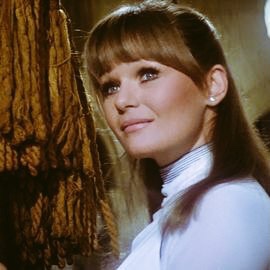
One of the silver screen’s most beautiful and talented actresses, Valerie Perrine has lit up the screen with her warmth and humor and diverse range. From portraying Dustin Hoffman’s wife in Lenny, to films such as Can’t Stop the Feeling with the Village People, to a memorable cameo as a female police officer in The Cannonball Run, to her title role in Lady Luck, her career has spanned five decades and countless film and television appearances.
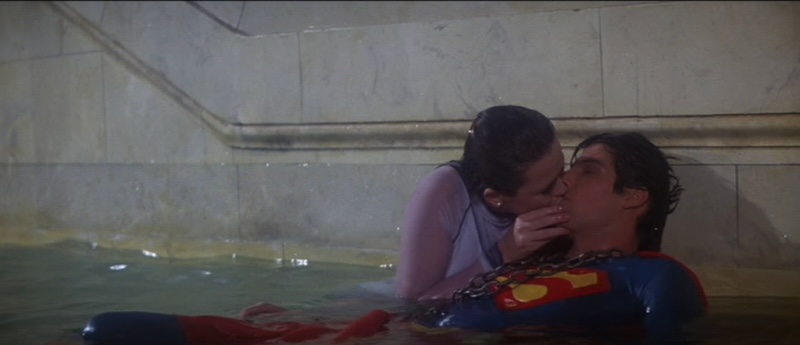
Of course, her most memorable role is of Eve Teschmacher, Lex Luthor’s girlfriend, in Superman: The Movie and Superman II. Interesting thing is that her character is never referred to as Eve on screen, only Miss Teschmacher. (To this day I have always wondered why.) And in one sweet moment, she gives Christopher Reeve’s title character his first on-screen kiss. It’s not until Superman II: The Richard Donner Cut that we get to see a more hot and heavy loop that prompted Donner to say, “I want a short, sweet high school kiss!”
Despite her allegiance to Lex Luthor, Miss Teschmacher is a good girl at heart. And her attire through the film is every sort of haute couture from 1950’s tacky to 1960’s businesswoman to sultry and finally 1970’s modern, which reveals that her character is looking for identity and validation and approval from Luthor, despite all of his negative comments towards her in both films in a bit of an abusive relationship. Ultimately, Miss Teschmacher finds her way back to her heart during her brief encounters with Superman. This is what prompts her to ask, “Why is it I can’t get it on with the good guys?” Superman sees that potential in her, and so do we, the audience. Even after Superman saves her mother and her hometown of Hackensack, New Jersey, from an aborted nuclear missile, and even after he saves her from being killed by Luthor’s babies, she still remains loyal to him throughout her time in Superman II.
When Christopher Reeve passed away in 2004, Valerie penned a beautiful tribute to him for the New York Post in which she shared her memories of working with the iconic actor in 1977.
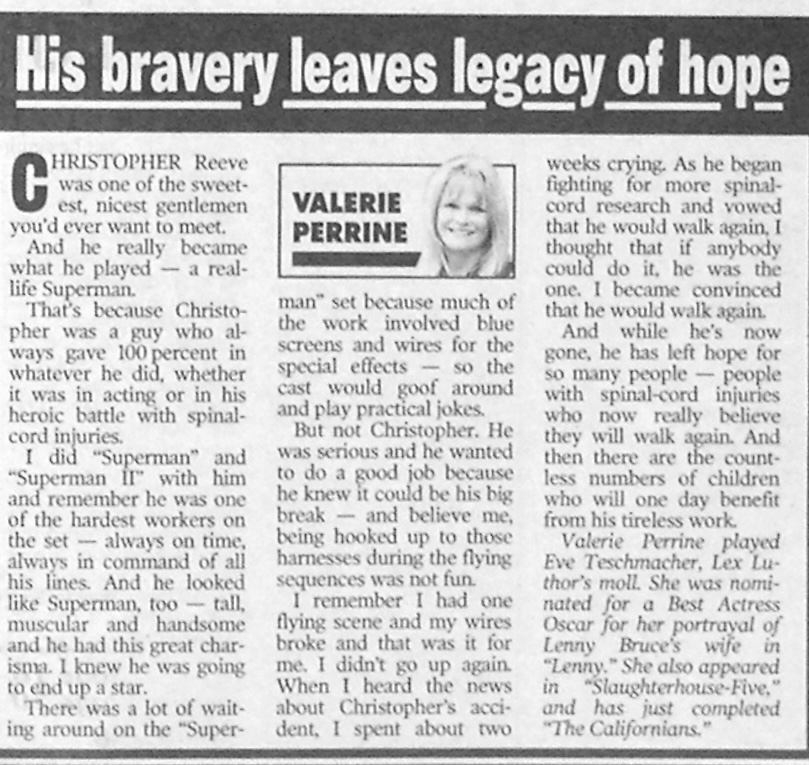
From the New York Post, dated October 12, 2004. That’s how beautiful and sweet her heart is. And in her interactions with fans, she has the same giving heart that has brightened up people’s lives everywhere.
But life has a way of twisting and turning in ways we don’t see coming.
For the past several years, Valerie Perrine has been fighting Parkinson’s disease. Named for Dr. James Parkinson, who wrote the first study of the palsy-like disease in 1817, it’s the same brutal neurological disease that claimed the life of famed boxer Muhammad Ali and has also affected the lives of actors Michael J. Fox and Alan Alda and over 6.2 million people in the United States alone. I have seen the effects of Parkinson’s firsthand in my life, losing my dad to the disease in 2002 after a six-year downhill struggle. It affects the speech and the body but not the mind. And it has affected Valerie as well.
A couple of years ago, Stacey Souther produced a wonderful documentary on Vimeo about her called Valerie, which features interviews with George Hamilton, Jeff Bridges, Loni Anderson, Sarah Douglas, and the late Richard Donner sharing their thoughts about working with her and knowing her. It’s sweet, and it’s sad, because she is a bright light in this world, and Parkinson’s is a cruel disease. Anyone who has walked this path knows what she’s going through, and seeing it personally in my life, my heart goes out to her.
In order to raise money for her continued care, Valerie has offered a number of her personal items for auction through Julien’s Auctions, including the iconic red dress she wore in Superman during the missile hijacking sequence. The auction runs this weekend at julienslive.com, so bid high and bid often.
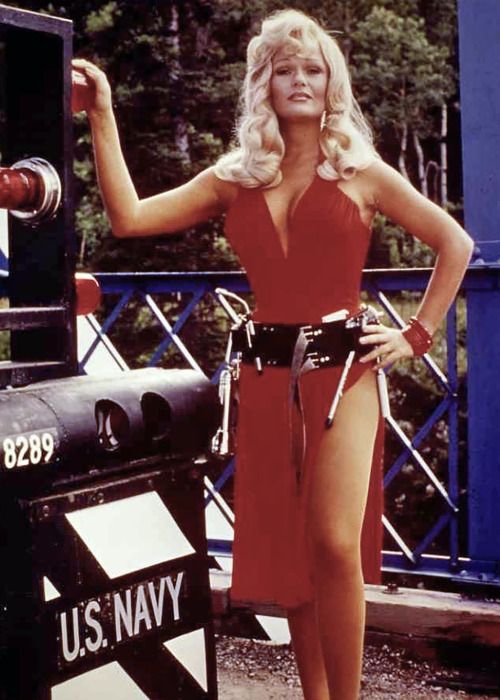
Bid in the auction. Get the documentary. Reach out on social media. Offer your prayers, thoughts, and well wishes. All of it amounts to the same message…
We love you, Valerie.
-
Superman: The 8 Millimeter Movie
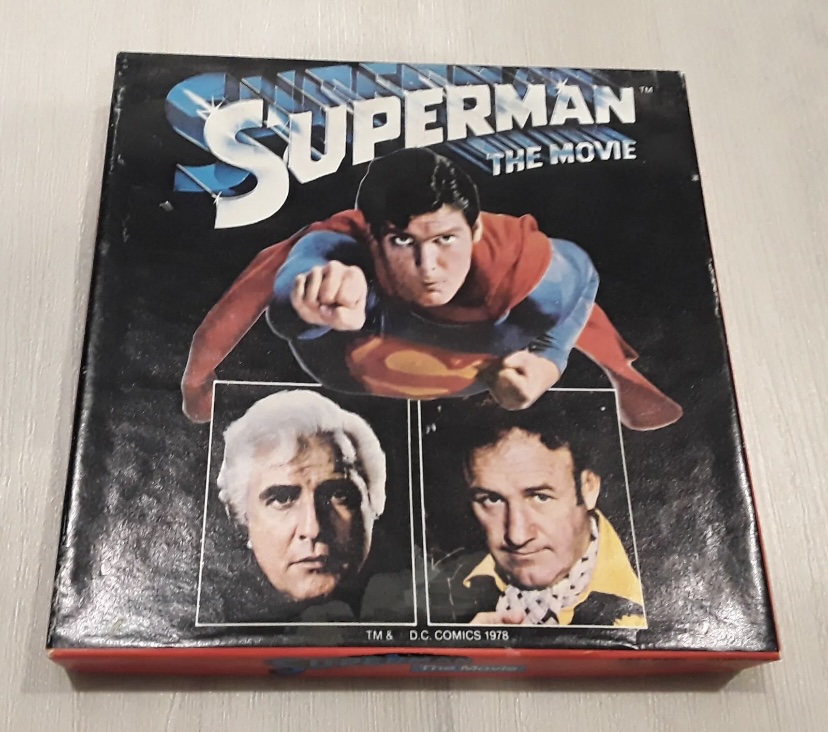
In my last blog I commented about the many ways I have watched Superman: The Movie over the years – theatrically, television, VHS, laserdisc, DVD, Blu-ray, streaming – but there’s one I’d like to talk about that goes way back to my youth in those pre-VCR days.
If you’re of a certain age like me, you probably grew up with an old reel-to-reel projector in your parents’ house. They would take their 8-millimeter camera and film different things and make little home movies, and if you wanted to watch them, they’d haul out the big movie projector from the attic or the closet. My parents would hang a big white sheet over the side door leading to the den of our house, plug up the movie projector, and we’d watch our little home movies. It was a huge effort for just a few minutes.
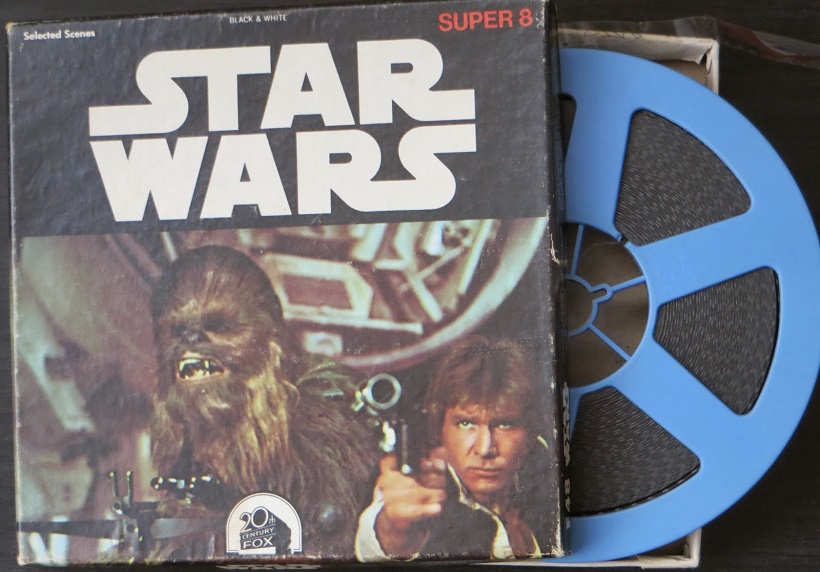
The first 8-millimeter movie I ever owned. For Christmas in 1977 my parents got me an 8-millimeter home movie of Star Wars. It ran eight minutes and consisted of two sequences: Ben Kenobi telling Luke Skywalker of his days as a Jedi Knight while trying to convince him to join him in rescuing Princess Leia, and Ben’s death and the TIE fighter attack on the Millennium Falcon. It was silent and had subtitles, but I didn’t care. I watched it numerous times in my youth to the point where I could have charged admission to my friends. Ken Films made several versions of the Star Wars home movies, including silent and sound versions, and one that was a whopping 20 minutes long. There would even be one for The Empire Strikes Back.
They also did one of Superman: The Movie a couple of years later in silent and sound versions and an even larger one similar to Star Wars. There was even one released in Japan that I just found out about.
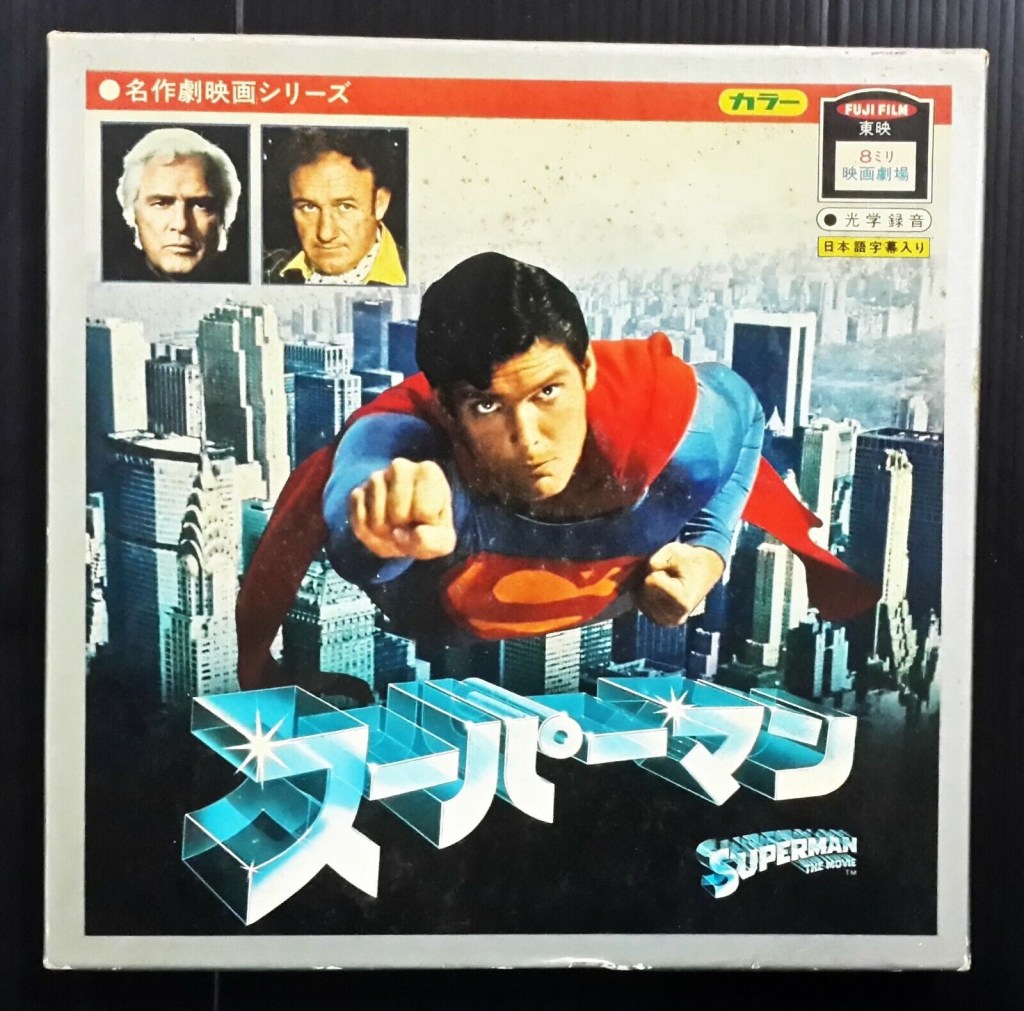
The Japanese 8-millimeter home movie reel. It would be a good twenty years or so before I came across the 8-millimeter reel in an eBay auction, and even though I had VHS and laserdisc players at the time and had not yet moved to DVD format, those were the days when I owned a WebTV dialup box that I plugged into the phone lines and could go online without having to use a computer. Gotta love DIY technology! I got into a bidding competition with one other fellow over that Superman 8-millimeter reel, and in the end I won. He would email me shortly afterwards and congratulate me on my victory, and we talked about it in a lighthearted and respectful manner. That led to many conversations by email, message boards, phone, texting, DMs, and Facebook that have turned into a wonderful friendship over the years.
Who was that competitor, you ask? None other than my friend Jim Bowers.
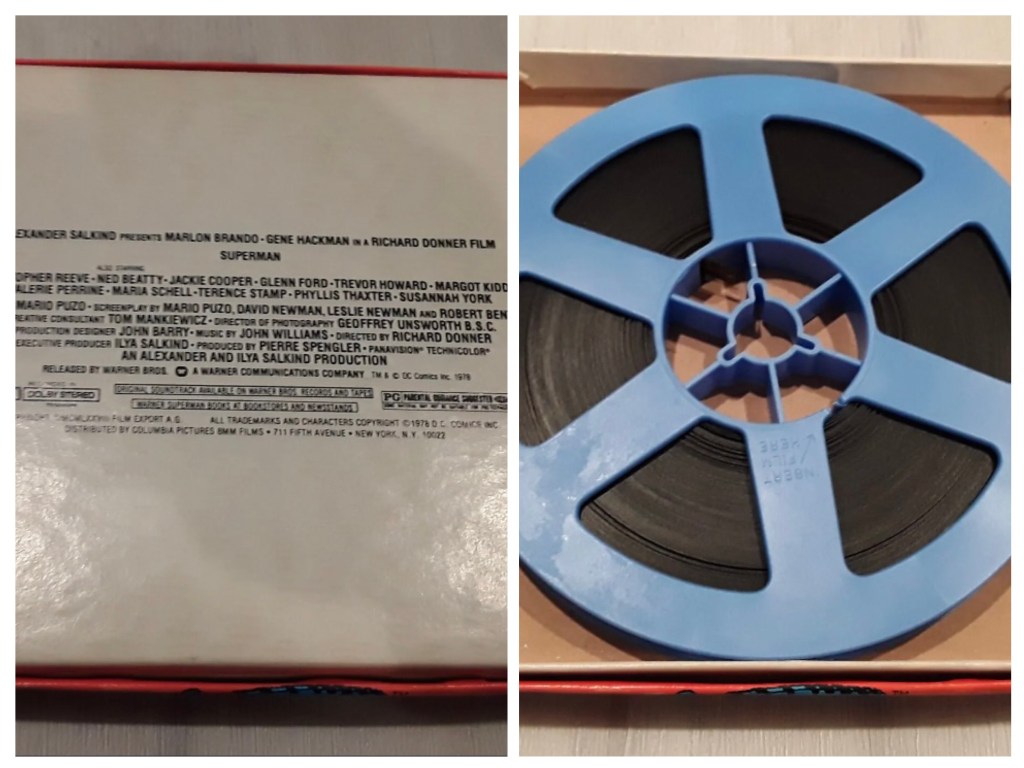
Many years afterwards, in 2010, I had to clean out my parents’ house in Clinton, Mississippi, to put up for sale to pay for my mom’s nursing home and prescription bills. One thing I did was take my 8-millimeter reels to Deville Camera in north Jackson to inquire about transferring them to DVD. The ones my parents shot were no problem. Star Wars and Superman, however, they couldn’t do because of copyright issues. I was left with no choice at the time but to throw them out.
Since then I have sought out anyone who has transferred those 8-millimeter reels to disc or uploaded them to a video file, but with no success. Even those reels would have made great little extra features on DVD, Blu-ray, or even 4K discs. But someone out there managed to get their reels filmed and uploaded to YouTube. The quality is not good, but at least they’re better than nothing.
If anyone has a better quality version out there, let me know! Memories of the good old days. Gotta love them. Even in 8-millimeter.
-
It was 44 years ago today…
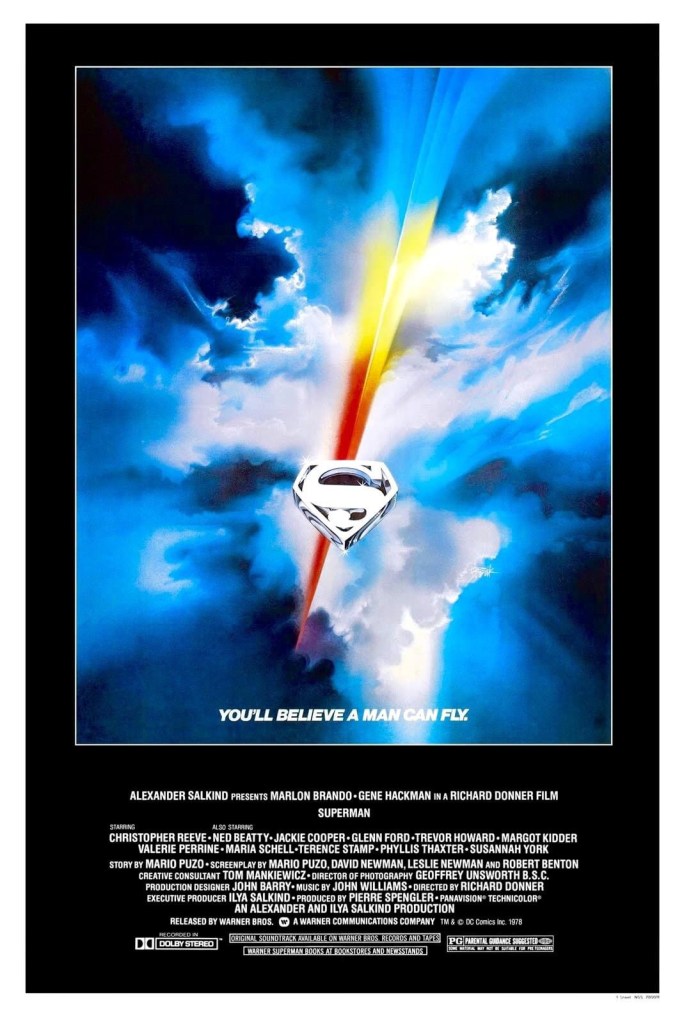
Some movies just impact your life forever. You’re in the right place at the right time, and a certain movie just grabs hold and stays in your mind and heart and never lets you go. For me in my generation, there are two such movies. One is the original Star Wars, without all of the “Episode IV” retitling, CGI makeovers, Slim-Fast Jabba, and “Maclunkey!”
The other is Superman: The Movie.
I had not seen very much footage from the film back then prior to its release, maybe an announcement trailer or a TV spot at most, something to wet my whistle at that. Chances are, you did, too. Maybe this one…
Or maybe this one…
Or maybe you were like me, reading about the reports in DC Comics or Starlog or Fantastic Films and getting any scrap of information that you could. Imagine having to wait month after month just for a photograph or a line or a quote from someone about the film… and this was years before the advent of the Internet.
And then there was this little book…
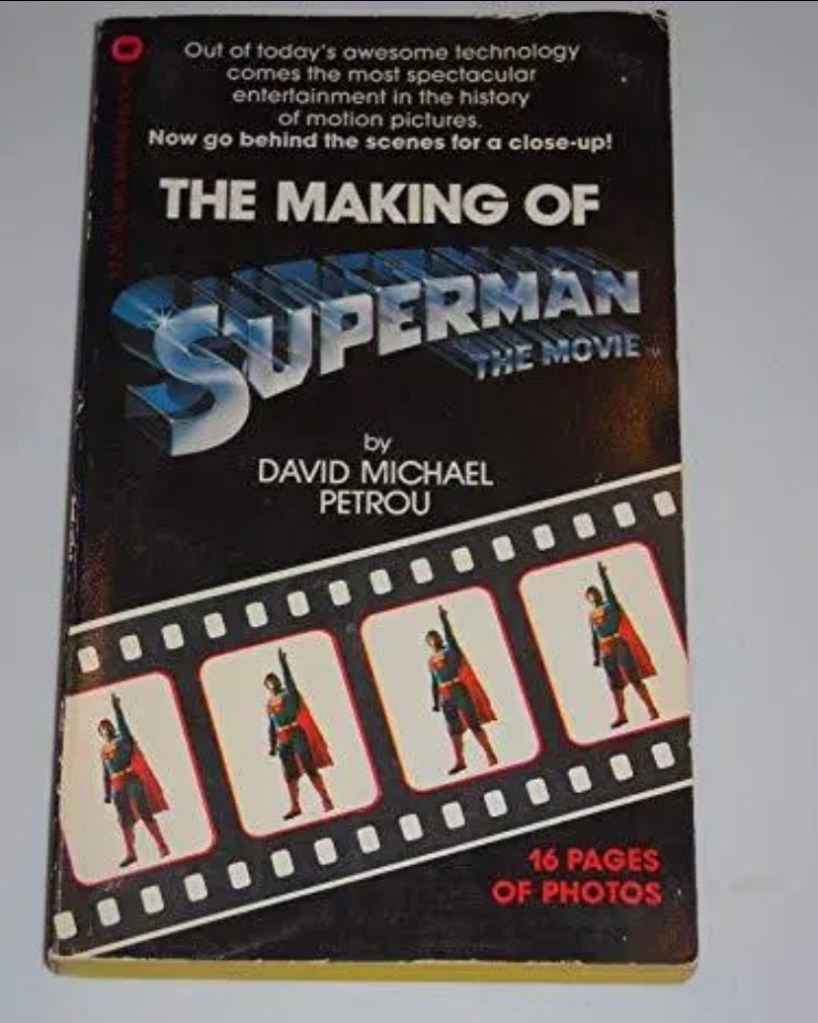
Still the gold standard about the making of a film to this day. I can’t tell you how many times I read that book over and over again to the point of my copy literally falling apart at the seams.
I was all of twelve years old and living in my hometown of Jackson, Mississippi, when Superman came out. My parents took me to the newly opened Metrocenter Cinema 4 in west Jackson to see it. I still remember the other movies that were shown at that theater: Grease, Foul Play, and Oliver’s Story. But none of them mattered to us or the crowds of theater goers that night. Everyone waited for Superman. So much so that we got there for the 7:00 showing that night, and it was sold out, so we had to wait for the 10:00 p.m. showing instead. But we didn’t mind.
And then it hit.
The comic book opening shot, the credits swooshing by, the Superman shield appearing on screen bigger than life, and the John Williams music… no movie before then had ever done so much with its main title credits to hook the viewers in. And this was just the first five minutes of the film.
From that point on, I was all in.
It was a perfect blend of photography, visual effects, location shooting, set design, and acting. It didn’t matter that we had to wait an hour before we finally got to see Superman appear on screen and do his thing.
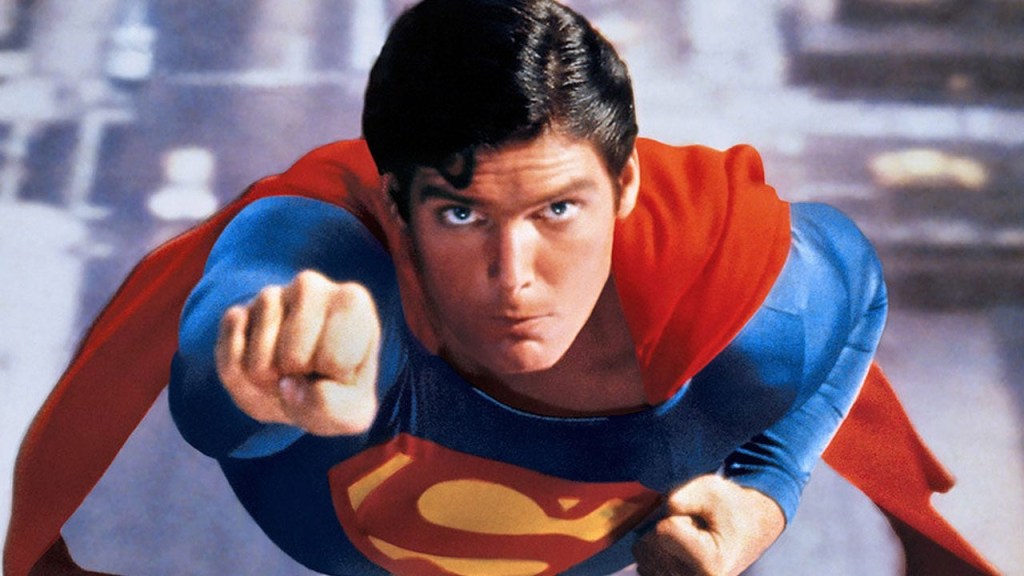
Still the icon to this day. And what can we say about Christopher Reeve that hasn’t already been said? I’d grown up with the comic books, the Saturday morning Super Friends cartoon series, reruns of the George Reeves Adventures of Superman TV series on WAPT Channel 16, and the syndicated comic strip The World’s Greatest Superheroes (there definitely needs to be a compilation of this comic strip!). But nothing prepared me for how Reeve embodied the character, not with fake rubber muscles, but by working out and adding the muscles himself. I’d shown a picture of him to my seventh grade teacher Suzanne Davis and said, “When I grow up, I want to be like him.” Six foot four and full of muscles, to borrow from Men at Work. Other guys around me wanted to be like Burt Reynolds or Billy Joel or Terry Bradshaw. I wanted to be like Superman, like Christopher Reeve.
I would go back several times over the coming weeks to see Superman at the Metrocenter Cinema 4. Five times, I think. And then when it made second-run showings at other theaters such as the Meadowbrook Cinema 6. I still remember a brief skip in the film when Valerie Perrine said her line, “I know I’m going to get rapped in the mouth for this, but… so what?”
My mom tried to get me the movie poster from the theater manager at the Metrocenter Cinema 4, but he wouldn’t let her have it. It would be five years later when I would find it at a comic book convention in Memphis, Tennessee, and I paid all of twelve dollars for it. I would have it framed and mounted in a customized silver frame when I turned 28, and I had it for the next sixteen years until I had to sell my parents’ house in Clinton to pay for my mom’s nursing home and prescription bills, and I sold it to a consignment store owner so he would give it to his grandson. Sharing the love and the passion to future generations. I have a copy of it again in my office in my home in Alabama.
And how many copies of the film did I get over the years on home video? It was my first VHS tape that I bought at Camelot Music for 70 dollars. Chances are, you probably had that tape, too. Running 127 minutes long, with the film sped up, sloppy panning and scanning at times, missing footage, and abbreviated end credits all to fit the movie on one tape at the time. I had bought it four years before we got our first VCR, but I didn’t care.
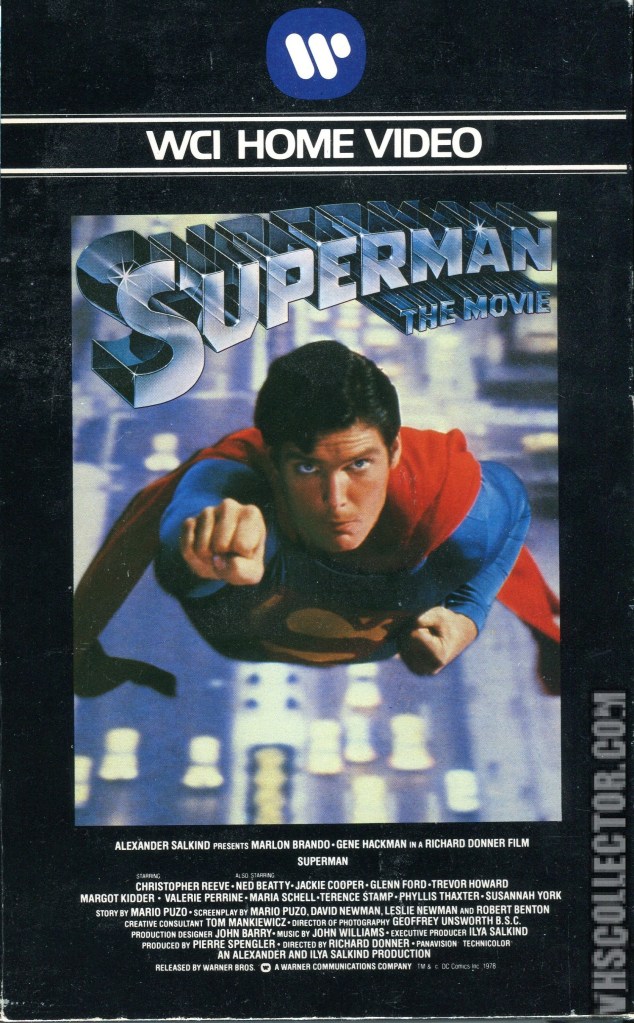
Today you can find copies of this on eBay or on Archive.org. I remember recording the audio of the film when it premiered on HBO in October 1980. It was 142 minutes long, and there were some minor skips in the film, but I didn’t care. Sometimes HBO would have their own pan-scan versions of films that were different from the VHS releases. The original Star Wars, Supergirl, St. Elmo’s Fire, Tootsie, and Victor Victoria were others that I remember. I would love to find copies of those HBO edits again.
It was my second laserdisc. The full widescreen version from the 1990s. What was my first? Superman III. I would later get the special edition DVD from 2001, the Ultimate Collector’s Edition DVD set three times (and there’s a story behind it for another time), the Blu-ray anthology, the Warner Archive Blu-ray of the extended TV cut with the somewhat altered main title music, and the digital streaming version of the extended version with the corrected monaural audio track.
And it set off a chain reaction everywhere. Before long, other studios and producers said, “Get me one of those!” It would take ten years for Batman to come to the screen, thirteen years for the first Spider-Man film, and nearly thirty years for Iron Man to ignite the Marvel Cinematic Universe. Whenever Kevin Feige gets with directors, writers, and cast members for a new Marvel movie, he encourages them to go back and watch Superman to see how they got it right.
Next year we will see a new remastered version of the Christopher Reeve Superman films in 4K in a new five-film collection from Warner Home Video. While the 2018 remaster wasn’t everyone’s cup of tea, I’m hopeful that they will do the films right in terms of color balance and sound, and that they will include all new extra features to go along with the existing legacy features in the same way that Paramount did with their release of Star Trek: The Motion Picture earlier this year. New interviews with surviving cast members and crew, more outtakes and deleted scenes and alternate takes and production footage – what we currently have is the tip of the proverbial iceberg. If they give us that, I would be quite happy.
And the influence has carried on even within the Superman legend. The look of the Fortress of Solitude, Smallville, the short-lived Krypton series, even a couple of quick winks in the Super Friends animated series. The episode “Lex Luthor Strikes Back” is sort of a sequel to the film complete with his underground hideaway, a Lois Lane that resembles Margot Kidder, and the bumbling henchman Orville Gump that may or not be Otis’ brother or cousin. Check out these clips and see for yourself!
And who can’t forget when Richard Donner co-wrote several issues of Action Comics?
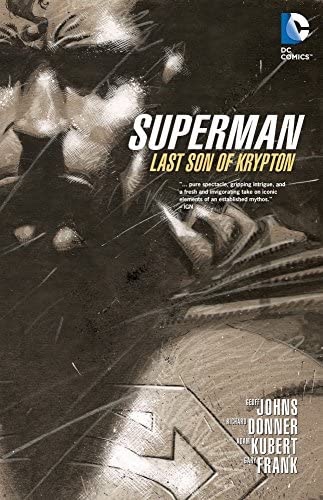
I’m 56 now, but whenever I put on one of my copies of Superman: The Movie on disc, I’m immediately reminded of the times when I was twelve years old, and life was simpler, and anything in life was possible. It hasn’t always been easy, but I’m thankful for everything.
-
Happy birthday Sarah Douglas!
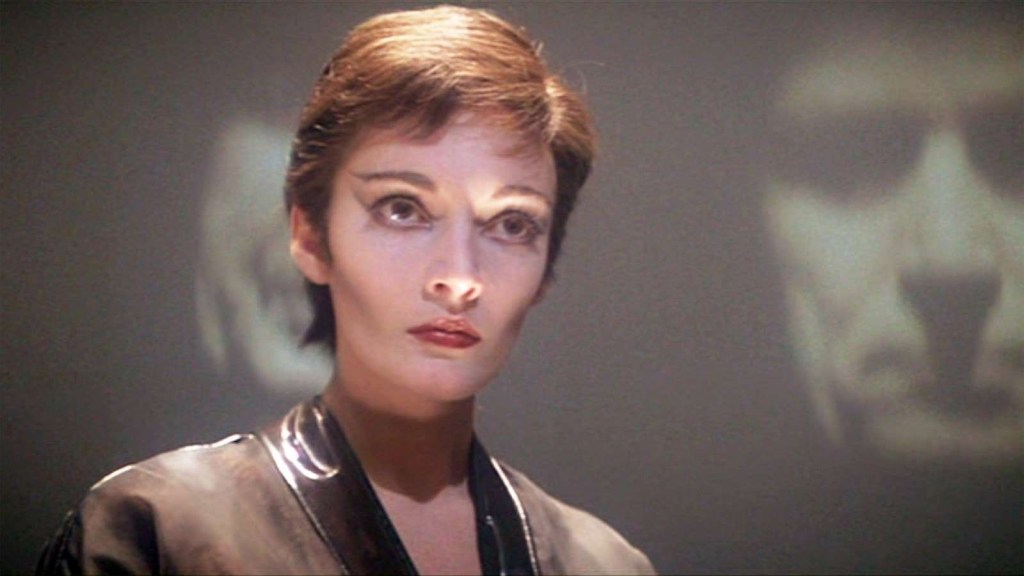
When we think of Sarah Douglas, one role immediately comes to mind: the villainous Ursa in Superman and Superman II. While we saw very little of her in the first film, mainly relegated to the opening trial on Krypton and her banishment to the Phantom Zone, it wasn’t until Superman II that Sarah’s full range came to light for fans everywhere. Her character was created by David and Leslie Newman in 1976, and several other actresses had tested for the role in 1977, but it’s clear that we cannot envision anyone other than Sarah Douglas in the role.
And yet she’s had a versatile career with roles in films such as Conan the Destroyer, The People That Time Forgot, and The Return of Swamp Thing, and her TV work such as V: The Final Battle, Falcon Crest, and the Christmas Prince trilogy, proving she’s much more than the consummate villain on screen. She’s warm, funny, a storyteller with lots of memories of her work in her career, and she has also shared stories of living in Stratford-upon-Avon, the home of the legendary William Shakespeare.
I’ve had the pleasure of meeting Sarah, and I can tell you that she is indeed a warm and generous person. Her stories with Jack O’Halloran of working on the Superman films are filled with laughter and memories, as heard on the CapedWonder Superman Podcast and in person at events.
I almost had the opportunity to meet Sarah back in 2017 at the Superman Celebration in Metropolis, Illinois. She and Margot Kidder were among the celebrities who were slated to appear that year, along with James Marsters and Dean Cain. But only a couple of weeks before the event, I lost my mom to Alzheimer’s disease. All of a sudden, my plans changed, and instead of going to Metropolis I had to return to Mississippi for her memorial service. Everything I had saved up for for the Metropolis trip went to food, gas, and lodging in Mississippi, and I was forced to cancel going to Metropolis.
Flash forward to February 2022. When I first heard about the Christopher Reeve Legacy Reunion in Detroit at the Motor City Comic Con, something inside me said, “Go.” Sarah would be there, along with Jack O’Halloran, Marc McClure, Aaron Smolinksi, Mariel Hemingway, Mark Pillow, and Damien McLawhorn. It was the first time that the Motor City Comic Con would be held since Covid, and the first time a large group of actors from the Superman films would come together since WonderCon in 2015.
So I started making my plans. I worked extra hours and saved all of money to cash flow my trip. That included food, gas, lodging, admission to the convention, getting the actors’ autographs, getting the convention exclusive version of the first issue of Superman ‘78, a group photo opportunity with the cast members, and even some swag.
Of the cast members, I was most excited about meeting Sarah. That Saturday I shared with her about how I missed meeting her in 2017, and she took my hand in hers and expressed her sympathy and how it was wonderful to finally get that chance. Echoes of “Let’s just hold hands”… and it didn’t tickle. She is indeed warm and genuine and gracious indeed.
And she signed my copy of the Superman Richard Donner Years coffee table book which was designed by my friend Jim Bowers.
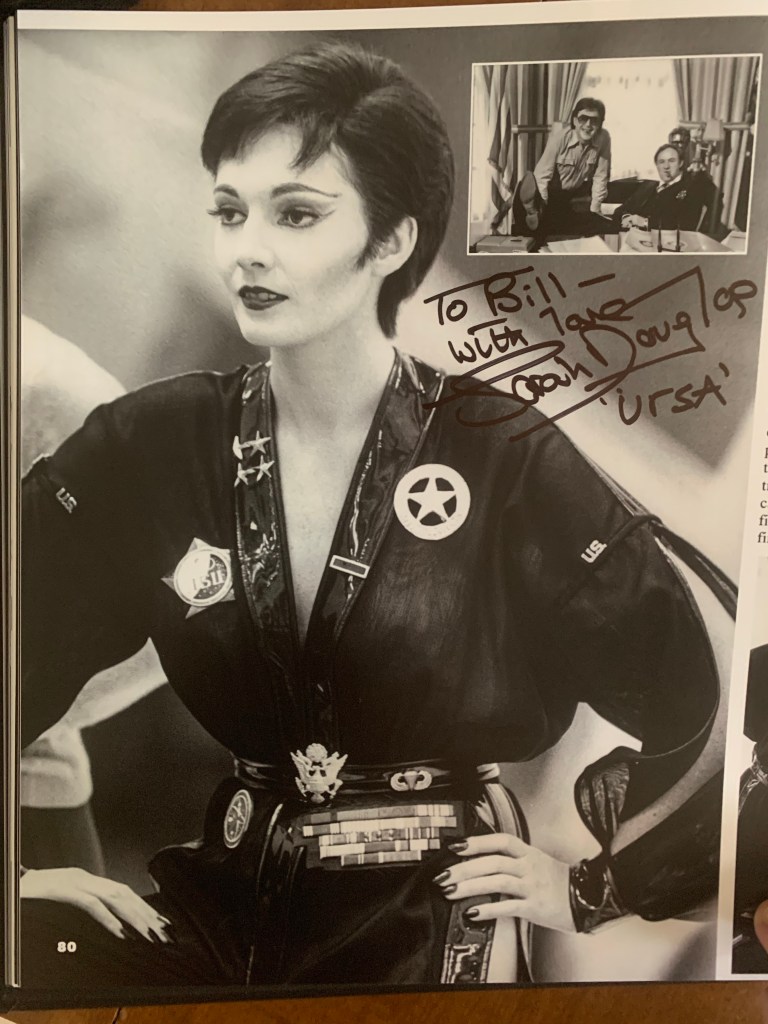
So on this day, I want to send happy birthday wishes to one of the nicest, sweetest people around! Happy birthday Sarah! 🎂🎂🎂
-
The Case of “Superman V” – Part 2
“You had one job!” How many times have we seen memes or gifs of comical mistakes or huge gaffes that cause us to laugh? Like seeing a Star Wars pendant in Star Trek packaging? Or the guy who drives a forklift into a shelf and causes multiple shelves and products to tumble down like a row of dominoes, and it gets caught on camera? Which in my nutty mind produces this response…
Menahem Golan and Yoran Globus of Cannon Films had one job: breathe new life into the Superman franchise. They bought the film rights from the Salkinds and had one shot to bring back the quality that Christopher Reeve, Richard Donner, and company had given to the first film, while steering the franchise back in the right direction after the middling reception of Superman III. The end result was like watching a train wreck in front of you, turning into a critical and commercial disaster.
By the fall of 1988, things had changed, Cannon was out as a result of their unfortunate bankruptcy, and the rights to the Superman franchise had come back into the hands of the people who had breathed life into the franchise in the early 1970s: the Salkinds.
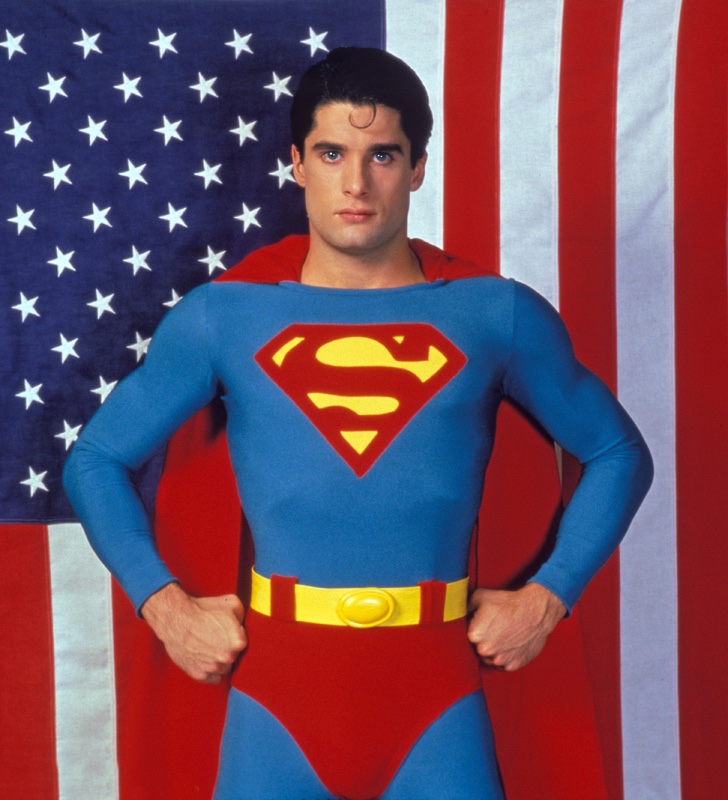
John Newton as Superboy in the series’ first season, 1988-89. In October 1988 the first season of the Superboy television series debuted in syndication, produced by the Salkinds with relative newcomer John Newton in the lead role. The series’ first season focused on a college-bound Clark Kent in his days at Shuster University, and while the first half of the season was a bit rough around the edges at times, the show picked up speed and became more successful as time went on. Superboy came at a time when first-run syndicated dramatic television series were a new thing and had been proven successful as a result of Star Trek: The Next Generation, and before long more dramatic series went straight to first-run syndication, some with success and some not so successful. I remember Superboy running on Sunday afternoons at 12:00 on the local Fox affiliate WDBD-TV 40 in Jackson, Mississippi, usually after TNG and pared with lesser fare (Super Force, anyone?), and if I didn’t remember to set the VCR to record it while I was at church, I would have missed it altogether.
By 1989 the Salkinds began considering bringing Superman back to the big screen, and some of their early ideas included a film with an ecological theme, and a Young Superman film with John Newton. That concept changed in 1989 with Newton’s departure from the series as a result of salary disputes, and Gerard Christopher was brought in to replace Newton for the second season of Superboy that fall.
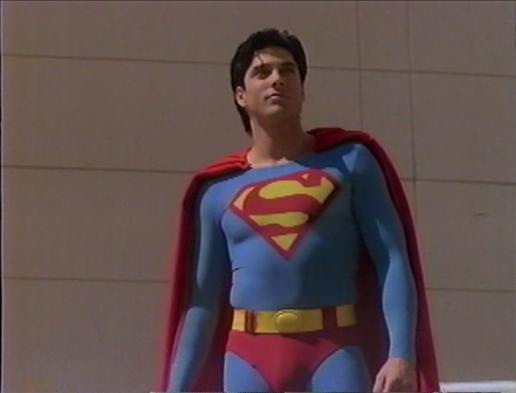
Gerard Christopher, who would portray Superboy from 1989 until the series’ end in 1992. As the Superboy series grew in popularity and took on a darker tone as a result of the success of Batman, the Salkinds again started considering a fifth Superman film, which they called at the time Superman: The New Movie. Ilya Salkind began working with Mark Jones and Cary Bates, two of the writers on the Superboy series, to develop a script which would have brought the villainous Brainiac to the screen, though it was not the first time this had been tried. Salkind’s original treatments for Superman III back in 1980-81 had centered on Brainiac, and he was determined to bring him to screen.
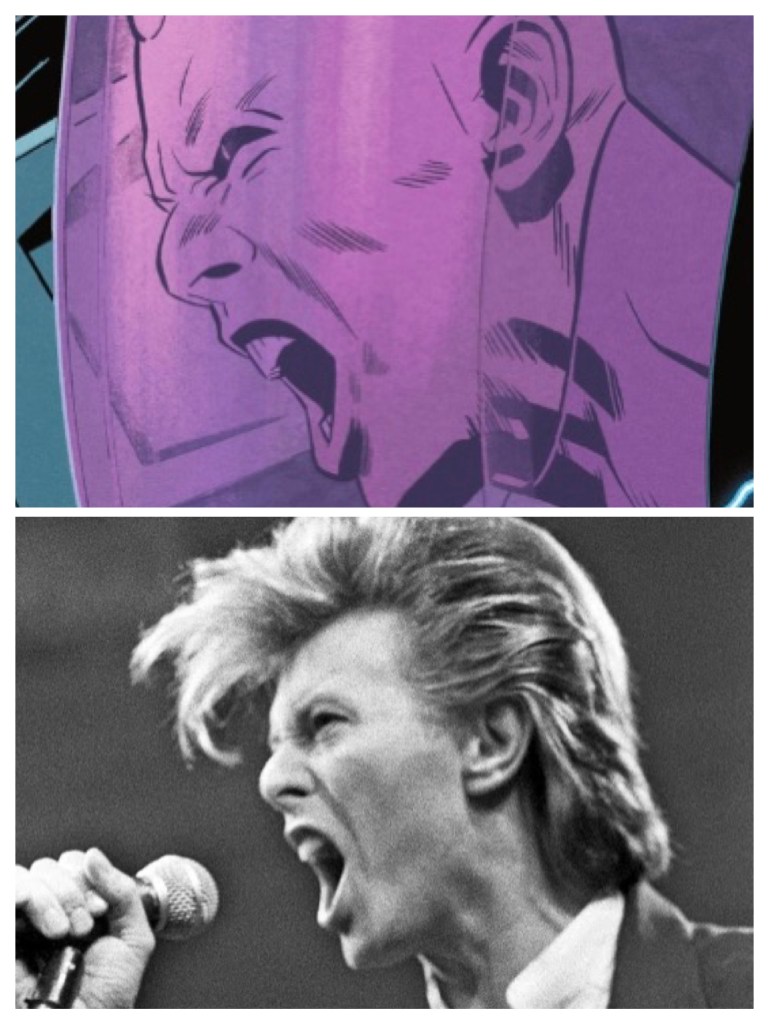
Brainiac a la David Bowie, from the Superman ‘78 comic book series. The new script, now known as Superman Reborn, also focused on Clark Kent’s relationship with Lois Lane, as well as the bottle city of Kandor, along with one element that would have repercussions in the Superman franchise a few years later, of which we have recently noted the 30th anniversary of its occurrence: the death of Superman.
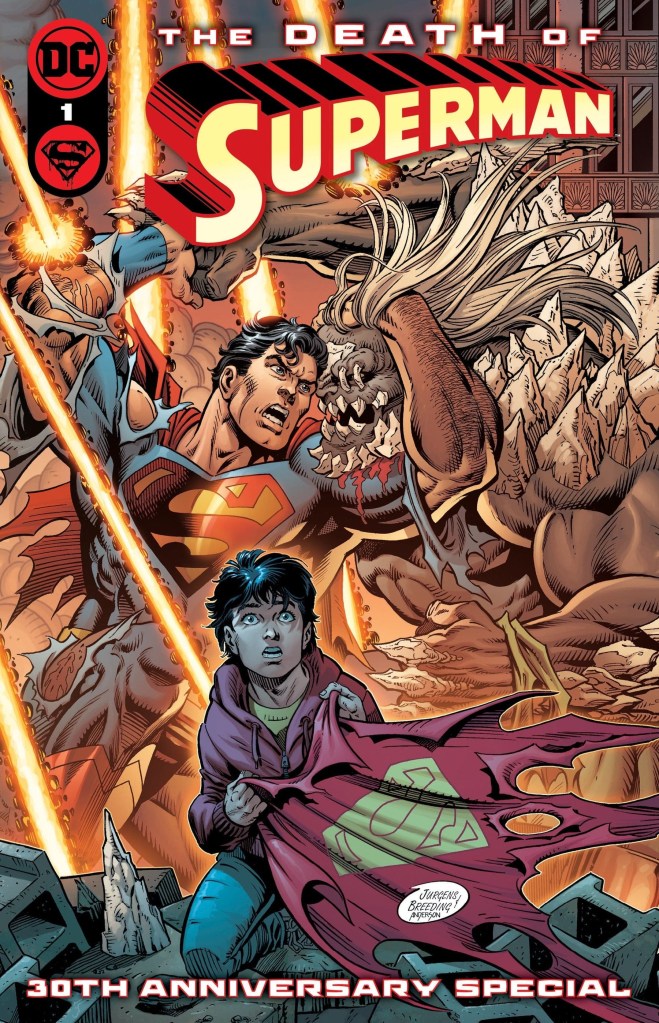
The script also had a very controversial element included that would have seen Lois Lane become pregnant and give birth to the new Superman, who would grow up to maturity as a 21-year-old young man. That element would not have gone over well with a number of longtime Superman fans, although in the 2006 film Superman Returns we find out in one freak, not-so-surprising moment that Lois’ son Jason is in fact Superman’s son as a result of their time together in Superman II.
Unlike Cannon Films’ poor attempt at a film, this version made more headway. The script went through no less than three separate passes, with the first draft dated July 23, 1990, and a later third draft dated August 23, 1992. Cary Bates would later state in an interview with the Comic Book Movie website, “The intent was to leapfrog over Superman III and especially IV, and return the series to the high mark achieved in 1 and 2. It was our desire to do a fully developed, balls-out science fiction story pitting Superman and Brainiac against each other mano a mano.”
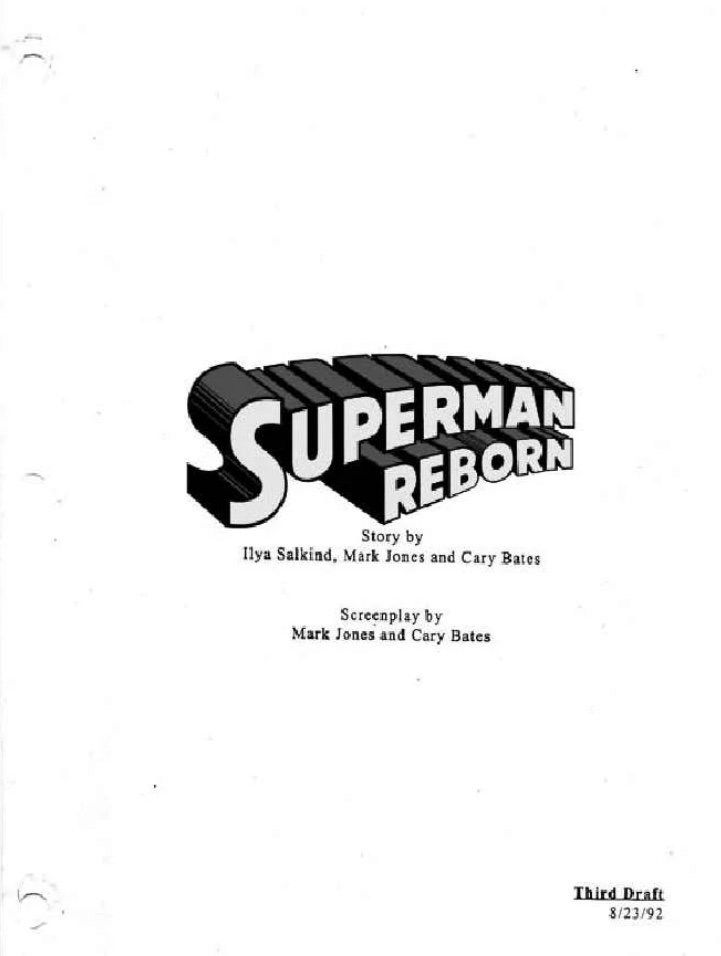
I read this script at one point, and it’s actually not that bad. In February 1990, Ilya Salkind announced at a press interview that pre-production had begun on not one but two new Salkind film projects: Superman Reborn, and a new film account on the voyage of Christopher Columbus. Both projects would be helmed in Florida, and the Christopher Columbus film would be released in 1992 to commemorate the 500th anniversary of Columbus’ voyage to the Americas, while Superman Reborn was slated for a Christmas 1991 release, thirteen years after the release of Superman: The Movie.
While the Columbus project steamrolled forward with returning Superman veteran Marlon Brando as Torquemada, and a script by Mario Puzo, Superman Reborn seemed to make some further progress later in the year. It was budgeted at a healthy $35 million, which, according to Pierre Spengler, was essential to handle the visual effects. At this point the script was under development, the project was under the banner of “Kandor Productions”. And a visual effects team was in place, headed by Richard Edlund, who had worked on the original Star Wars trilogy, Star Trek: The Motion Picture, the original Battlestar Galactica, Raiders of the Lost Ark, Ghostbusters, and even Cannon Films’ Masters of the Universe. (Imagine what kind of work he could have done for Superman IV instead!)
Yes, Richard Edlund designed that famous logo. Along with Edlund, the visual effects team included Don Fly, Ellen Somers, Ned Krepeta, Dave Jones, Jim Rygiel, and Mary Johnston. Rygiel would go on to help design many of the spectacular visual effects for Peter Jackson’s Lord of the Rings trilogy a decade later. Greg Vonseca was tapped as the film’s production designer, and Bruce Miller was brought on board as the film’s art director. In a memo dated October 22, 1990, the team had met to discuss the film’s visual effects, and Vonseca had hired a design team to work on a starship model that would be delivered a couple of days later, on October 24, 1990. What that ship design was, nobody knows, but I’m concluding that it was likely a ship design for Brainiac.
The team also discussed the final showdown between Superman and Brainiac. According to the memo, they had rejected the notion of putting a man in a suit. Instead, they would have shot the fight in the style of the Biblical story of David versus Goliath. At the time it would have required compositing the images of the actors in the camera frame to achieve such an effect. Set positioning and placement of the actors and any needed props in films such as The Lord of the Rings or Elf, and filming everything in camera practically, can achieve similar effect without having to resort to optical effects.
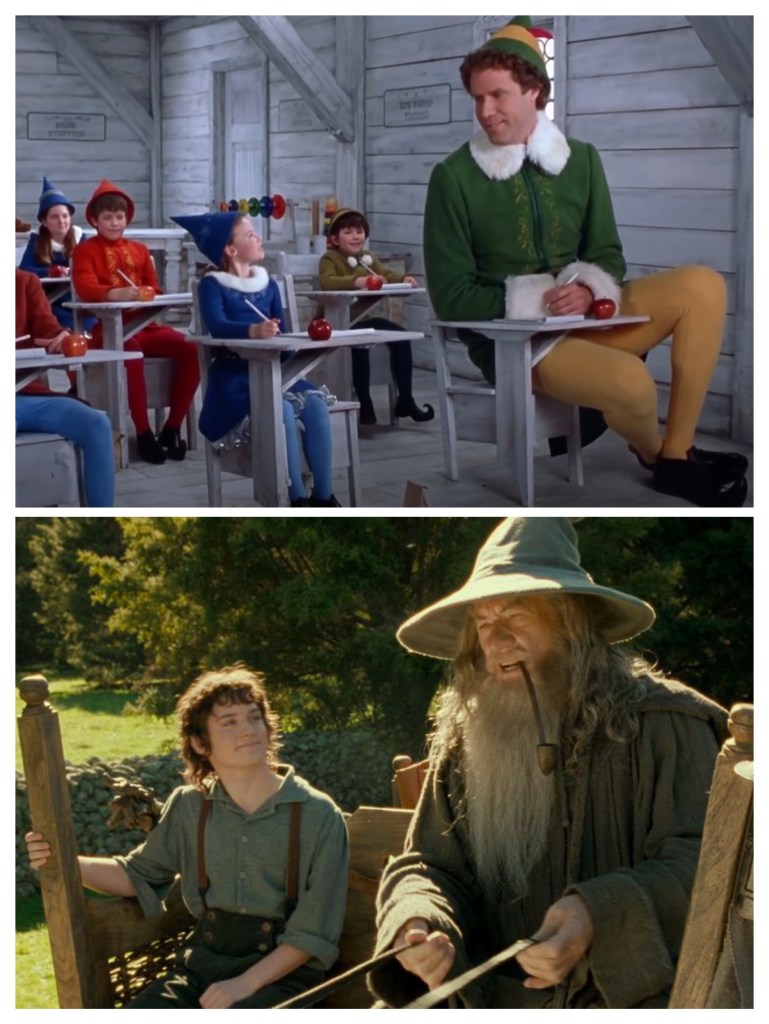
Scenes such as these in Elf and The Lord of the Rings can give us an idea of the size differential and in-camera filming effects that could have been achieved in the battle between Superman and Brainiac. Legal discussions between executives from DC Comics and Warner Bros. moved forward at a brisk pace, and before long Mark Jones and Cary Bates began to make revisions to the script that met with everyone’s satisfaction. Gone I believe was the controversial element of Lois giving birth to the new Superman. Instead, Superman would be brought back to life in the bottle city of Kandor.
In addition, there was no director attached to Superman Reborn at the time, though there were two names on the short list: Phillip Noyce and Stephen Herek. The Welsh-born Noyce had directed such films as Dead Calm and Blind Fury by that time, and he would later go on to direct the adaptations of the Tom Clancy novels Patriot Games and Clear and Present Danger with Harrison Ford as Jack Ryan. Herek was best known at the time for Bill and Ted’s Excellent Adventure, and he would later direct the dramatic classic Mr. Holland’s Opus and the live-action version of Disney’s 101 Dalmatians. Both directors were known for their work with visual effects, so obviously Ilya Salkind and Warner Bros. saw a good thing about them.
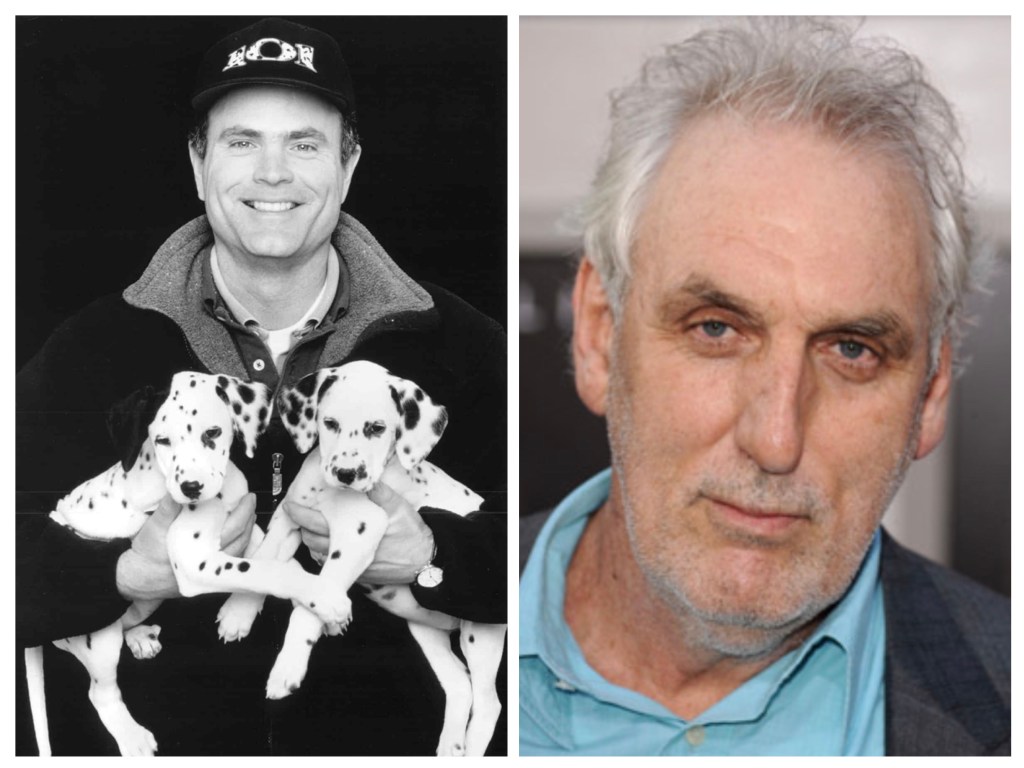
Who would have made the better director for Superman Reborn, Stephen Herek or Phillip Noyce? Let’s hear your thoughts! By November another member of the Superman film crew was back: Robert Simmonds, who had worked as a production manager and location manager on the first three films, as well as a line producer on Superboy and a co-producer on the Salkinds’ Christopher Columbus movie. On November 1, 1990, he received a fax from a visual effects company regarding price quotes for projected visual effects work on the newest Superman film. We do not know which studio had sent the fax, unfortunately.
It was during the film’s development process in early 1991 that Ilya Salkind met with Christopher Reeve over lunch at the Carlisle Hotel in New York to discuss the possibility of returning to portray Superman once again, and Salkind’s offer to Reeve was, “Name your price.” Reeve obviously had his concerns. He had been burned by the entire debacle of Superman IV, and his career was changing from leading actor to featured actor. In a People magazine interview from May 1995, shortly after his tragic accident, Reeve had jokingly commented a few years earlier about a potential return to the role: “I’m in fantastic shape. But it’s obvious nobody wants to see a spare tire hanging over Superman’s belt.”
But Reeve had more realistic comments about the story, which he shared with Salkind and later stated in an interview: unless the script returned to the quality of the first film, he couldn’t see himself returning to the role. And he had said in a Superman IV press junket in 1987, “Superman is supposed to be permanently 30 years old, and I’m starting to slide well past that.” Age wouldn’t have been an issue. Kirk Alyn was nearly 40 when he first played Superman in the serials. George Reeves played the role from 38 until well in his mid-40s. And Henry Cavill recently returned to the role in the post-credits scene of Black Adam at age 39. So it was not about age but about the script. It was at that point that Reeve walked away from the project altogether, and it would be the last time that Ilya Salkind would see Reeve walking.
Christmas 1991 arrived, and no Superman Reborn. The Salkinds would push the release date ahead to some point in 1994.
By the summer of 1992 the landscape had changed once again. The Superboy series had ended, and USA Today had posted a quick news blurb announcing that a series of reunion movies were in the works. Around the same time Starlog Magazine posted a news blurb about who they thought would be cast in the next Superman film: a possible unknown, Gerard Christopher, or an actor who had not only starred in the role but was also interested in writing and directing the film. The Starlog blurb ended, “Or does Christopher Reeve really want to return?” Nothing materialized from either report.
(Interestingly enough, when Warner Bros. announced their plans to launch Lois and Clark: The New Adventures of Superman, Gerard Christopher auditioned for the role. When the producers and casting director learned that he had previously played Superboy, he was quickly rejected. It’s a shame. I for one would have enjoyed seeing him graduate from Superboy to Superman.)
Even into the spring of 1993, the film was still in pre-production. The budget had increased to $40 million, and it was under the banner of “Great Krypton Productions”. And despite the critical and commercial failure of Christopher Columbus: The Discovery, which earned only $8.2 million at the box office, they continued to push forward with their plans for Superman Reborn.
But the Salkinds soon faced serious problems from none other than Warner Bros. themselves. The studio had filed a lien against the Salkinds to reclaim certain property rights to the Superman franchise and produce Lois and Clark and future Superman films. Ultimately, Warner Bros. took back full control to produce all future Superman film and television projects, including live-action and animation, and in November 1993 the studio released a full-page advertisement in Variety announcing their intentions.
As a result of the Warner Bros. takeover, Ilya Salkind and Studio Canal retained the rights to the Superboy series, while Warner Bros. held the home video and international distribution rights to the series for years. In 2006 we finally got the first season of Superboy on DVD, and it would be several more years before the remainder of the series would be made available for video on demand (VOD) from the Warner Archive and on streaming platforms such as Amazon.
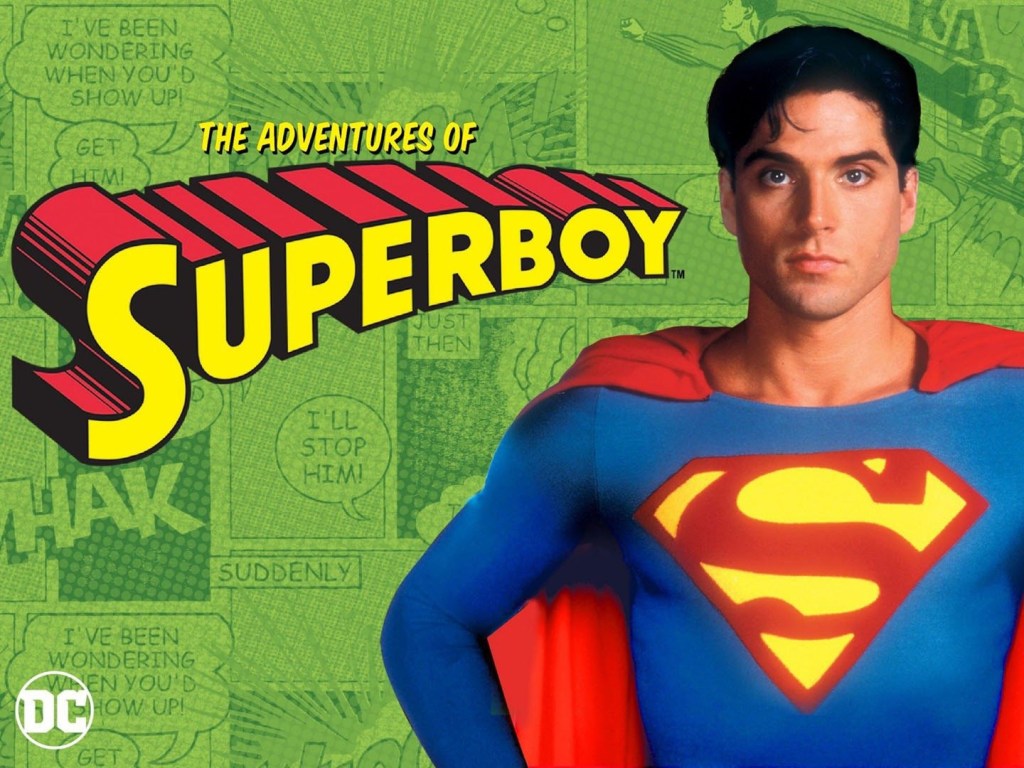
With the Salkinds’ rights to the Superman films at an end after twenty years, and three films, a Supergirl spinoff movie, and 100 episodes of Superboy under their belt, it would be another thirteen years before the Man of Steel would make his long-awaited return to the big screen. But the development of Superman V, aka Superman Reborn, was long and languished at that, and remains a lost final chapter to the Christopher Reeve series.
How would it have played out? This video pretty much says it all…
-
The Case of “Superman V” – Part 1
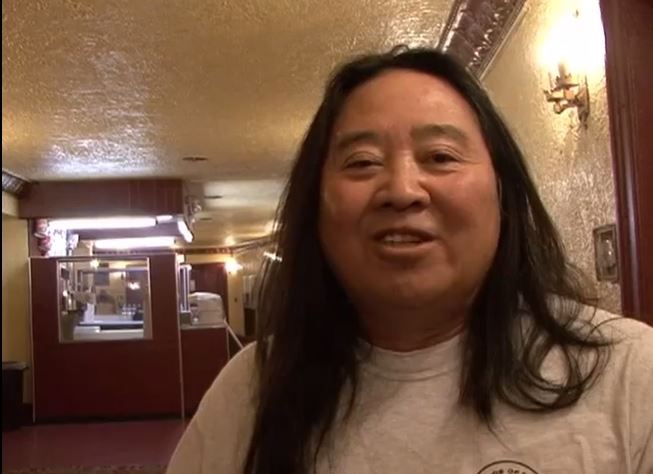
Albert Pyun (1955-2022). In late November we lost film director Albert Pyun at the age of 66 to multiple sclerosis. In his career he directed numerous B-grade films including The Sword and the Sorcerer, Alien from L.A., Cyborg, and the first film version of Captain America, among others. And yet it seems unusual that he was at one point in the late 1980’s attached to a Superman film project. And yet he apparently was.
After the critical and commercial failure of Superman IV: The Quest for Peace, Cannon Films heads and co-producers Menahem Golan and Yoram Globus were intent on producing a Superman V for theatrical release in the summer of 1989. They had begun pre-production in the fall of 1987 and, like all of their other movies, began to seek out foreign backers for financial support to raise the money for the film. They made their presence known at the Cannes Film Festival in May 1988 with banners for their proposed film projects, which apparently included Masters of the Universe 2, and they distributed flyers announcing their intentions to produce Superman V for release in 1989.
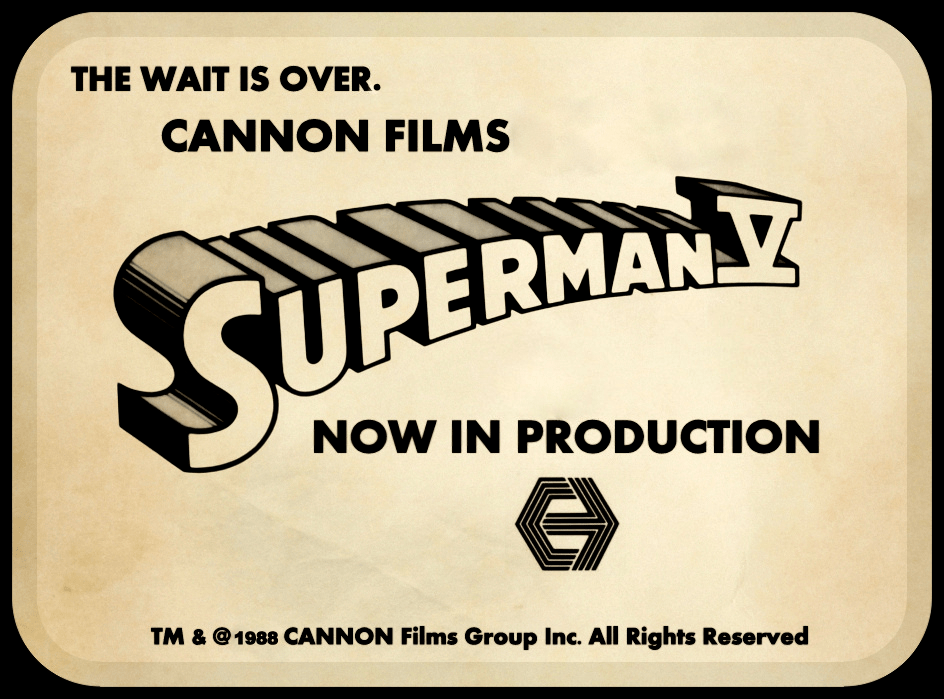
This wasn’t a fluke by any means. Their intentions were genuine. And they had considered Albert Pyun to direct the movie. Granted, he had experience with numerous science fiction films and could have brought that element into a Superman film, as the first two films had science fiction elements to them with the planet Krypton, the green crystal that was key to both films, and beings with powers and abilities far beyond those of mortal men. So it would have been in his purview to handle Superman.
But we have to remember that the first three Superman films had been produced with larger scale budgets, and as Pierre Spengler commented, one of the key ingredients of the Superman films was special effects. And with the budget on Superman IV a rather paltry $17 million, and given Cannon’s penchant for producing low budget movies, it’s possible that Albert Pyun would have had to work on a small scale budget with Superman V as well. Then again, it probably wouldn’t have been a problem with him when you look at his 80s films. The Sword and the Sorcerer was produced with a $1.5 million budget, and Cyborg came in with a $500,000 budget, mere peanuts compared to Superman.
But this is where it gets even wonkier.
Golan and Globus also considered using some of the deleted footage from Superman IV as the basis for Superman V. When you look at the deleted scenes on the DVD or Blu-ray, there’s not much that could be incorporated into a potential story… with the exception of one sequence.
As we know, part of the story dealt with the creation of a prototype Nuclear Man, played by Clive Mantle. Lex Luthor tasked him to “Destroy this man!” This led into the entire Metro Club sequence, which, except for numerous still photographs over the years and a few songs on the Superman IV soundtrack, has never been seen in its entirety. Granted, we have those photos, the novelization, and the comic book adaptation to give us an idea, but nothing beats the actual footage. This led to the showdown between Superman and the prototype Nuclear Man, which was budgeted at approximately $6 million. All in all, the footage totaled around 10-15 minutes in length and served as part of the story of Superman IV.
So apparently the villain of the story would have been the prototype Nuclear Man, who in this incarnation bears resemblance to another comical villain in the Superman canon, Bizarro. Beyond that, there’s very little else that would have made it into such a story.
Which created another problem. Golan and Globus had considered replacing Christopher Reeve, whom they felt was getting a bit too expensive. He had earned a $4 million paycheck for appearing in Superman IV, in addition to co-writing the story, directing the lunar fight sequence, and also getting his film Street Smart produced. By this time in his life Reeve’s career was shifting, and his status as an above-the-credits actor was at an end because of back-to-back film failures with Superman IV and Switching Channels. To Golan and Globus, replacing Reeve would have made sense in keeping with their status as low-budget film producers.
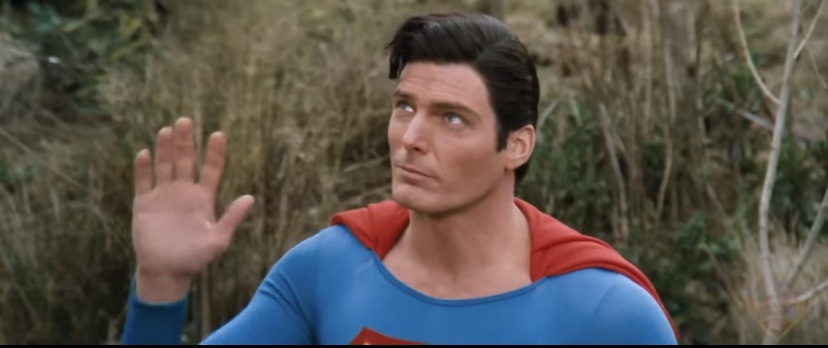
But that would have also meant potentially replacing Gene Hackman as well. Pull one string of a fabric, and ultimately the whole thing unravels. Had they considered that? Possibly.
Furthermore, releasing the film in the summer of 1989 wouldn’t have been a prudent idea. That was the year lots of films came out to varying degrees of success… Lethal Weapon 2, Ghostbusters 2, Star Trek V: The Final Frontier, The Karate Kid III, Licence to Kill, and Indiana Jones and the Last Crusade all fought their way to the top, only to be dominated by the one movie that exploded like gangbusters everywhere – the long-awaited film version of Batman. How would Superman V fared in that lineup – success or failure? Given how IV bombed, likely failure. When you add it up, it makes sense that their version of Superman V never saw the light of day.
Next time, an unlikely hero arrives on the scene… or does he?
-
Who Shot What: A Look Inside the Development of the Fortress of Solitude for “Superman” and “Superman II”

This report is dedicated with all of my love to the memory of my mother Billie Elizabeth Carter Williams (1922 – 2017). When I first wrote this commentary back in 2017, it had come at a most difficult time with the passing of my mother. As I tended to her final arrangements and my return to Mississippi for her memorial service, this commentary became an escape for me at times. I was able to handle both accordingly: hence, the dedication. Since then, more information has come to light, which I have modified and updated accordingly, but I have retained the spirit of the original writing.
“Here in this… this fortress of solitude… we shall try to find the answers together.”
It is one of the most original and spectacular sets in the history of films. On screen it is an irregular combination of ice and crystal that is both earthly and otherworldly. But behind the scenes it was the brainchild of a talented group of artists, production designers, carpenters, and technicians that made it come to life.
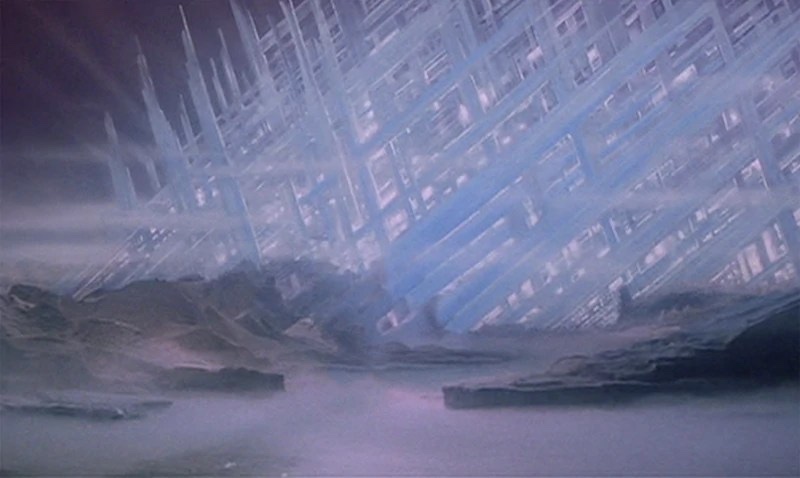
Until the production of Superman: The Movie and Superman II in 1977, the Fortress of Solitude had been a part of the Golden Age of DC Comics history. Behind its mountainous exterior lay a high-tech collection of computers, monitors, creatures from a thousand galaxies, a shrine to the history of Krypton, the bottled city of Kandor, and more than enough memorabilia to compete with the Batcave. Only a giant golden key could open it. For the better part of thirty years it was the first and most memorable rendition of the Fortress.
Enter John Barry. The soft-spoken, celebrated production designer who brought the first Star Wars film to the screen was tasked with bringing both a new vision of Krypton and the Fortress to life. No longer would it be a product of the Flash Gordon and Buck Rogers era. Barry conceived the environment to be a mixture of crystal and ice, a natural by-product of its home world, with organic and technological properties only imagined and assumed on film. The final result is both alien and earthly, where the environment is both freezing yet warm and comfortable at the same time.
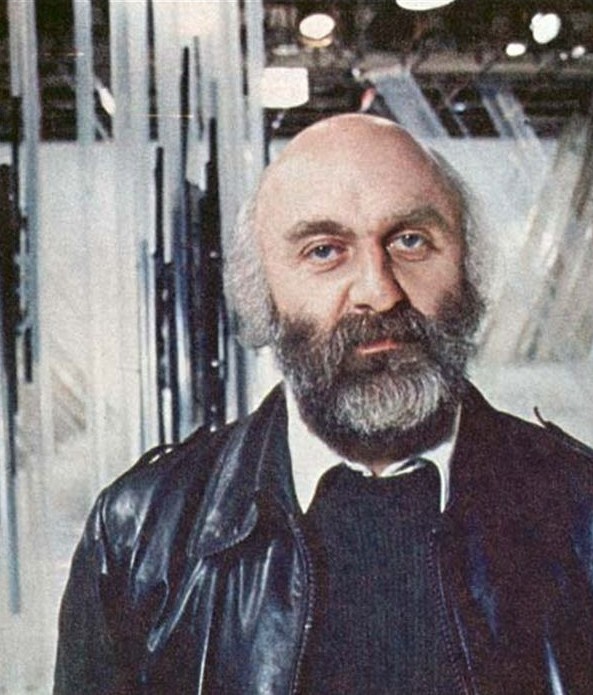
Not only did John Barry design the cavernous interior of the Fortress, he had to design its gigantic exterior as well. Work on the interior of the Fortress occurred at Shepperton Studios in England, while a portion of the Fortress’ gigantic exterior was constructed in the 007 Stage at Pinewood Studios in London. The rest would be filled in with a series of beautiful matte paintings that seamlessly blended with the sets.
Much has been discussed and debated about the filming of the Fortress sequences, leading some fans to incorrectly conclude that certain sequences were filmed at one point or another for the films. Let us look a little closer at the production history and set the record straight.
On 13 April 1977 Richard Donner worked with Christopher Reeve and Marlon Brando in bringing the first Fortress sequence to life, that of Jor-El sacrificing his last amount of energy in restoring Clark Kent’s powers. Ironically, this moment was not filmed in the Fortress set but on a relatively small blue screen set at Shepperton. The elements for this crucial sequence for Superman II would not be seen by the public at large, except for still photos in various media, for the better part of twenty-five years until November 2006 with the release of Superman II: The Richard Donner Cut, where the raw footage would be combined with visual effects and matte paintings to complete the illusion.
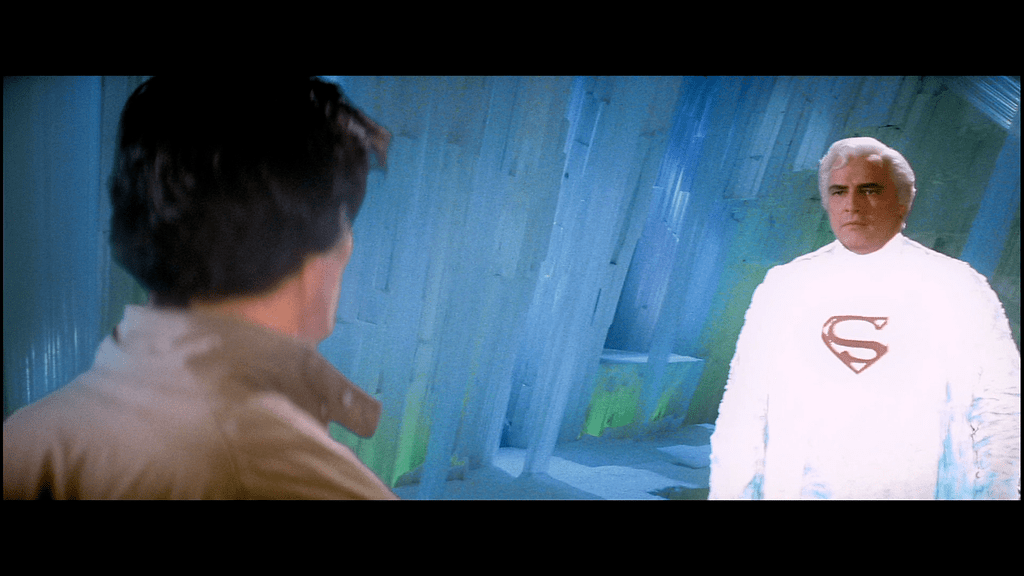
Throughout May 1977 Richard Donner filmed many of the Fortress interior scenes in the giant set at Shepperton Studios. It was here that Christopher Reeve and Margot Kidder filmed their costume and makeup tests on 2 May and 5 May, respectively. What is most notable about Reeve’s tests is that this marked the first time Reeve appeared on set in costume as Superman.
Simultaneously, Jeff East, who was cast as the young Clark Kent, filmed his first scene for the film of Clark entering into the interior of the Fortress and using the crystal console to activate the interactive lessons with Jor-El. Continuity photographer Bob Penn would produce a number of still photos of East inside the Fortress set.

Reeve would continue filming his portions of the scene of Superman sacrificing his powers for Lois, and of a beaten Clark returning to the Fortress, for two key scenes from Superman II, on 6-7 May 1977. Kidder would also shoot further makeup and costume tests on the Fortress set at the same time. Continuity photos and production photos would later attest to the sequences being filmed, though the footage itself would remain unseen until 2006 for the Richard Donner Cut of Superman II.
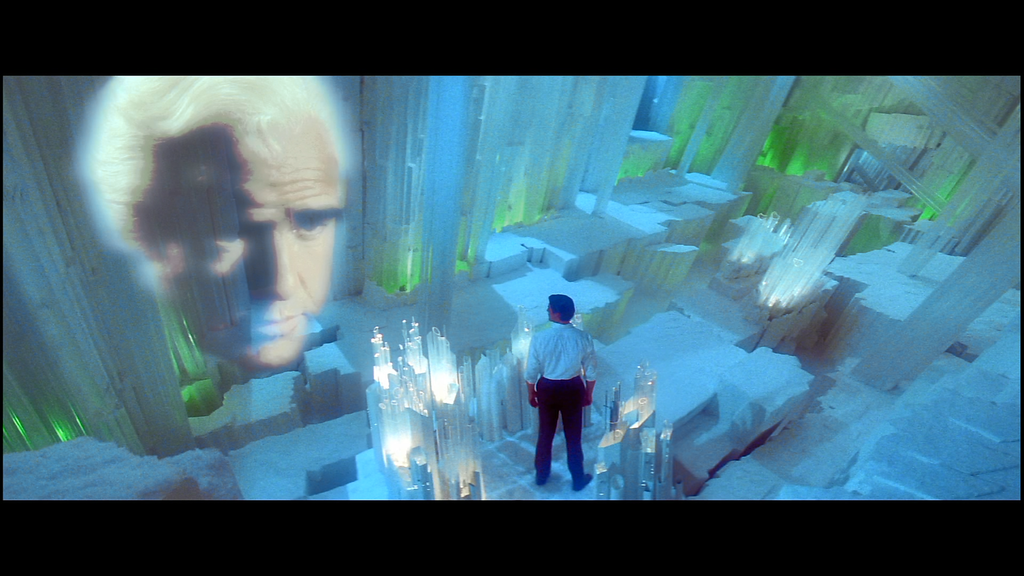
Reeve and Kidder would also shoot their portions of a key sequence from Superman II, in which Lois witnesses Superman’s willingness to give up his powers for her. A few production photos would attest to the sequence being filmed, though it would be discarded and reshot two years later.
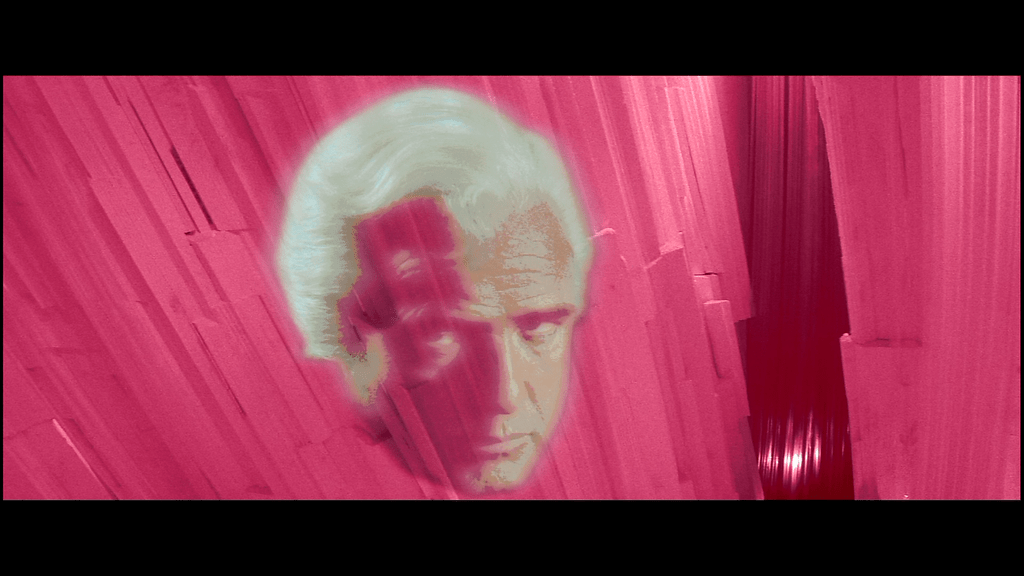
That glare from Marlon Brando says it all. On 12 and 15 May 1977, flying tests were conducted in the Fortress interior set of the villains’ arrival inside the Fortress for the key scene of their confrontation with Superman in Superman II. At this point, word was leaked out to the press of the uncertainty of the visual effects, causing executive producer Ilya Salkind to issue a memorandum stating that the film’s production would be kept top secret.
Another key sequence shot around this time was of Superman’s discussion with Jor-El over his feelings of vanity. Only Christopher Reeve was needed for filming, as Marlon Brando had filmed his portions the month before. Ultimately, the scene would be cut from the final film and remain unseen until 1994, when it was first shown in the longest known extended version of Superman on KCOP-TV in Los Angeles; and then later in 2001, when a slightly modified version was restored for the film’s first DVD release; and finally on the Warner Archive extended TV cut Blu-ray in 2017.
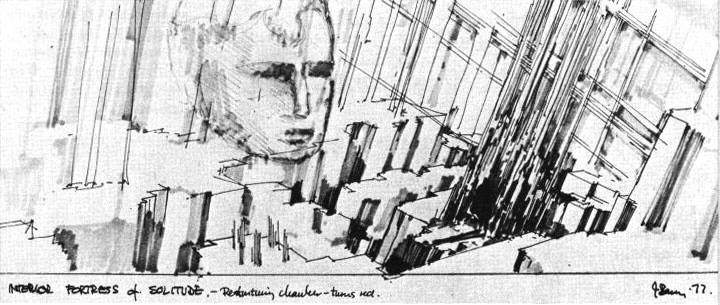
One of the fabulous storyboards of the Fortress of Solitude, which would be brought to life in 1977. If the villains’ flight into the Fortress caused some concerns among the production crew regarding the flying effects, all of their concerns were laid to rest when Christopher Reeve took flight when he filmed his now-memorable scene of Superman’s departure from the Fortress. As Richard Donner put it in 2001 for the DVD’s documentaries, “It was Chris who made it work.” Instead of the rigid flying style used by George Reeves two decades before, Christopher Reeve, an avid pilot in his own right, banked his body at certain angles, giving Superman a believable flight that left the production crew in tears and cheers. They had succeeded in their objective of making a man fly.
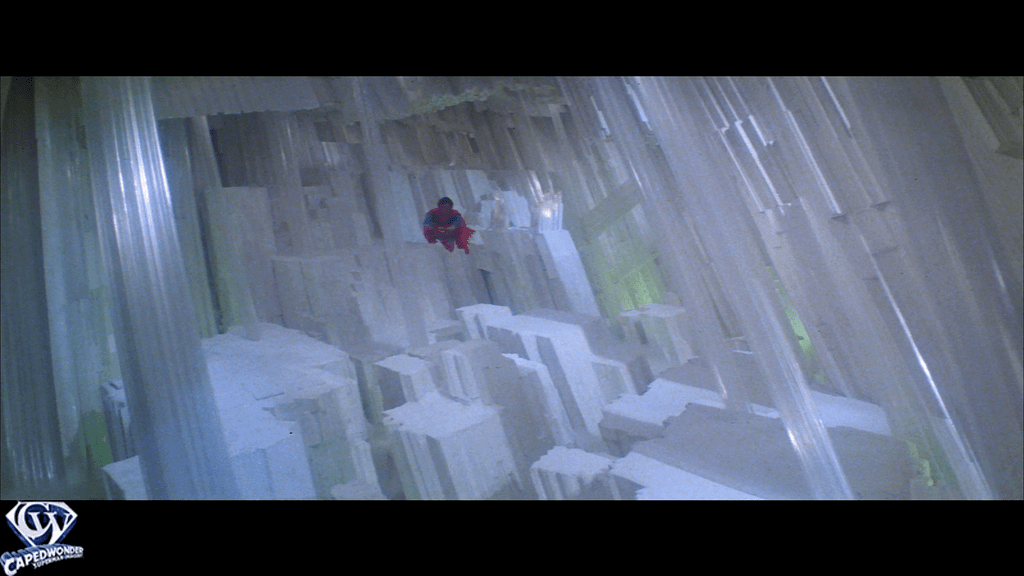
In an episode of the CapedWonder Superman Podcast from October 2019, Marc McClure commented that he was present at the Shepperton set when this scene was filmed. In the second half of the month, Gene Hackman and Valerie Perrine would shoot their first scenes for the production, of Lex Luthor and Miss Teschmacher entering the Fortress for Superman II. Their portions of the scene were shot over multiple takes, with two or three versions of certain shots filmed and used in the 1980-81 theatrical version, the 1984 extended TV broadcast, and both versions of the Richard Donner Cut prepared in 2006.
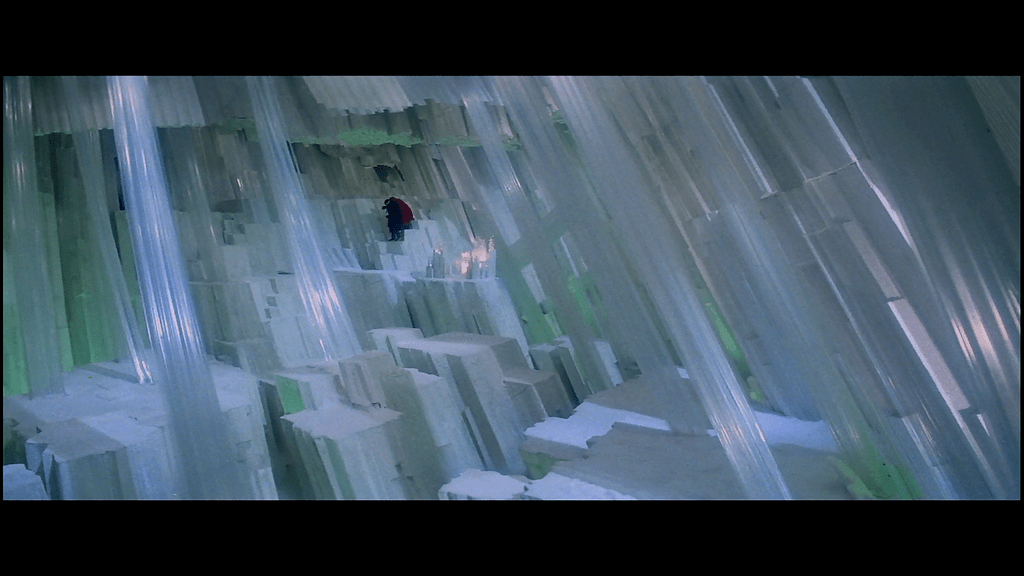
“It’s fantastic!” Hackman, Reeve, and Kidder would be joined by Terence Stamp, Jack O’Halloran, and Sarah Douglas for one of the sequel’s most dramatic scenes, the villains’ confrontation with Superman in the Fortress. Once again, a significant amount of footage from the sequence would be discarded and reshot in 1979, while the second half of the scene would be used for the theatrical version. Other portions would be included in the 1984 TV broadcast, while the Richard Donner Cut would see the majority of the scene restored, with alternate shots used in various places.
On 25 May 1977 continuity photos of Christopher Reeve as an unconscious Clark Kent by the crystal console were produced. It is possible that the scene may have been reshot. This would mark the final sequence that would be filmed in the interior Fortress set at Shepperton Studios. From there the Superman production crew would move to Pinewood Studios in London to continue filming.
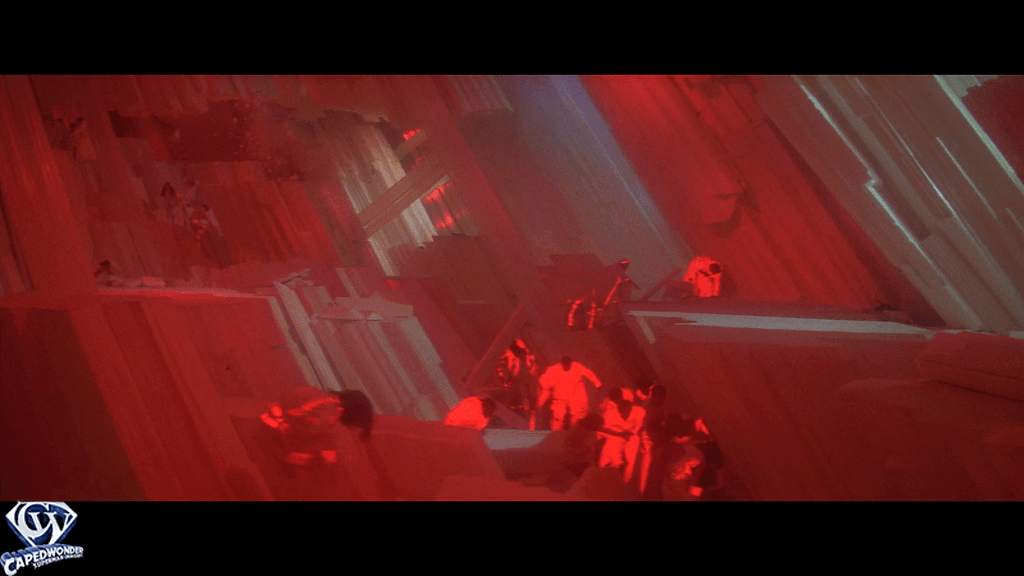
But that’s not all. Certain scenes of the destruction of Krypton, with some of the planet’s people trying to escape certain destruction, were filmed on the Fortress set around this time as well. The entire set was relit in red to convey the sense of destruction awaiting the entire planet. One only needs to notice the walls and the floorways of the set in the sequence.
Once shooting had been completed on a number of scenes on the Daily Planet and White House sets, construction work began on the massive exterior portions of the Fortress set in an equally massive soundstage, the 007 Stage at Pinewood. Commissioned only a year before for the gigantic submarine sequence for The Spy Who Loved Me, the 007 Stage would be used to great effect in portraying the Arctic Circle. A combination of backdrop paintings, styrofoam boulders and rocks, salt, water, and other materials, the exterior of the Fortress had to match what had already been filmed at Shepperton Studios. Once again, John Barry stepped up to the plate and delivered a fantastic set that would be enhanced with equally stunning matte paintings. One needs to really look hard to see exactly where the set ends and the painting begins.
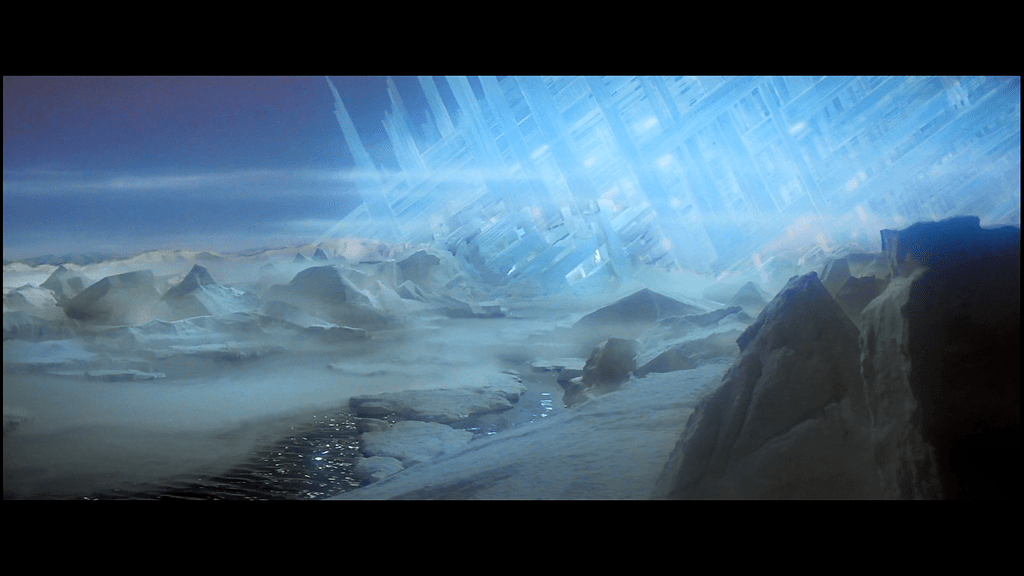
It would not be until October 1977 that Richard Donner and his cast would begin filming on the exterior Fortress set. All of Jeff East’s scenes of young Clark Kent’s arrival at the Arctic Circle, as well as his construction and approach to the Fortress, were filmed at this time. These shots would later be completed with detailed model work spotlighting the stunning construction of the Fortress for a memorable dramatic scene. (In an interview for the CapedWonder Superman Podcast in August 2019, Jeff East stated that it has been Richard Lester who directed him for this sequence. There is no proof that confirms his statement, but I cite this for historical reference.)
Donner also filmed all of the exterior Fortress scenes for Superman II during this time. These include the villains’ arrival with Luthor and Lois, Non’s failed attempt to break through, the villains’ successful attempt at breaking in, their arrest by the U.S. Arctic Patrol, Superman’s destruction of the Fortress, his discussion with Lois about the end of their relationship, and Luthor and Miss Teschmacher’s arrival at and eventual departure from the Fortress. Surprisingly, most of this footage would not be used in the theatrical version except for a brief portion of the villains’ arrival, Superman and Lois flying away, and a quick shot of Luthor and Miss Teschmacher arriving at the Fortress. The remainder of these scenes would be included in the various extended TV broadcasts around the world, while the Richard Donner Cut restored only a portion of these moments, relegating the uncut versions of the scenes in a supplemental section on the DVD and Blu-ray releases.
For most of the cast and crew, their work on the numerous Fortress scenes were completed, with the exception of Christopher Reeve and Margot Kidder. They, along with Richard Donner and cinematographer Geoffrey Unsworth, would return on 15 March 1978 for additional work (possibly a reshoot) on a portion of the Fortress exterior set. Later that day, they would meet with Steven Spielberg over lunch. This is where it gets further complicated.
Exactly one year later, the Salkinds would send Richard Donner a telegram informing him in no uncertain terms that his services on Superman II were no longer needed. They brought in Richard Lester, who served as a go-between to both parties, to rewrite and reshoot much of the sequel, eventually earning him sole directorial credit on II, even though some of Donner’s footage would be used in the final film. All of Marlon Brando’s footage was cut as a result of a lawsuit due to unpaid royalties. In his place, Susannah York and John Hollis were brought in to reshoot two of the three Brando moments.
However, when work resumed on Superman II, two key creative personnel were no longer alive. Geoffrey Unsworth had passed away on 28 October 1978 after suffering a heart attack in Paris, France, while working on Roman Polanski’s film Tess. Superman would be dedicated to his memory. On 31 May 1979, while serving as a second-unit director on The Empire Strikes Back, John Barry succumbed to a 104-degree fever and passed away the following day, 1 June 1979, from meningitis. Their deaths were a tragic blow to the Superman family, so the Salkinds and Richard Lester brought in Bob Paynter and Peter Murton to fill the two slots and help complete the work on II. They were tasked with continuing what Unsworth and Barry has begun, and to their credit they did an admirable job not only in emulating their styles but also bringing their own sense of direction to the sequel. This extends to the different Fortress scenes as well.
Much of Hollis’ and York’s work for the revised scenes were essentially reworded versions of the original Brando line readings shot against blue screen and superimposed against a haphazard interactive monitor designed to replace all of Brando’s “floating head” discussions which had been filmed in April 1977. These shots were then inserted into the Donner footage of Luthor and Miss Teschmacher in the Fortress from May 1977 to form the first of the Fortress scenes for II. As of this writing it is not known exactly when these scenes were filmed, but it is believed to be circa October 1979.
The new scenes of Superman and Lois at the Fortress were shot at the same time as well. The dinner sequence, in which Superman and Lois “abandoned the orange juice for once,” was filmed on 18 October 1979, and the segment of Lois looking for a place to change was omitted from the theatrical version but restored for the TV broadcasts. When you compare the Murton set design and the Paynter photography, the differences are obvious, especially in the lighting and camera arrangements.
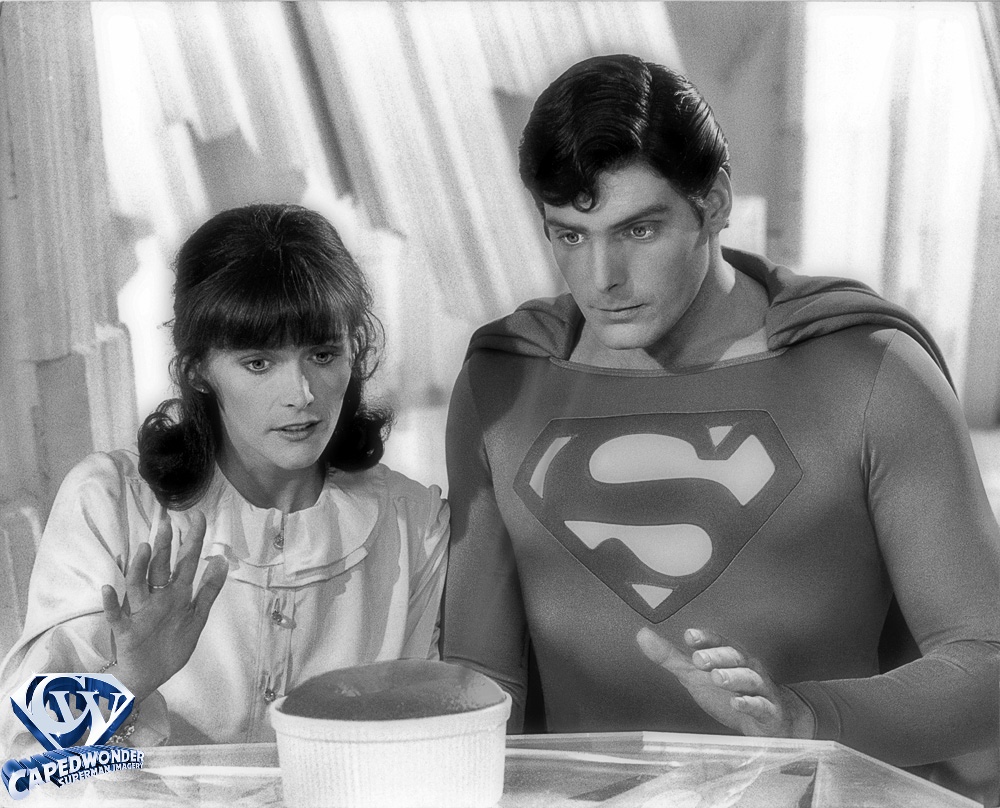
Filmed at Pinewood Studios in October 1979. Also around the same time, Superman’s discussion with Lara about his love for Lois was filmed. In this reshot sequence, we see a new version of the crystal chamber that replaced the original, more mysterious chamber used on the Shepperton set from May 1977. The shot of Lara “emerging” from the interactive monitor was lifted from the moment in which Jor-El appears before Clark and sacrifices the last of his energy. All of the shots of Superman in the crystal chamber and the division into two beings were a replacement of the more mysterious and implied moments of him losing his powers in the original version of the scene.
Another original set design from Murton is Superman’s bed, which was also filmed around this time. It had been reported that some of the footage of Superman and Lois making love was so sensual, it would have given the film an R rating. Instead, we have a tastefully handled moment of the two simply asleep. An unused outtake of Lois momentarily opening and closing her eyes was used in the 2006 Donner Cut.
Next, we have a powerless Clark’s return to the darkened Fortress, which was also shot under Lester’s tenure around this time. Here, Christopher Reeve delivers a more subdued performance as Clark tries to reach out to his parents and soon finds the green crystal. Some have suggested that Reeve’s performance had matured by this time, as opposed to the somewhat awkward delivery from two years before.
Finally, we come to the confrontation between Superman and the villains in the Fortress. The showdown, while showcasing unusual powers such as energy beams, disappearance, replication, and holographic trickery, was filmed on the new Murton set in the fall of 1979. In these moments a body and voice double for Gene Hackman was used, as he was no longer needed for the reshoots. The majority of the reshoot constituted the first half of the sequence, up to the point of Luthor pointing at Superman and asking, “Him?” For the reshoot, Terence Stamp used the same line readings he had used two and a half years before on the original Shepperton set. Portions of the scene were cut from the theatrical version but would be restored for the TV broadcasts. Insert shots at the end of the sequence were also filmed, of Superman entering and exiting the crystal chamber, of Superman and Lois embracing after winning the fight, and a quick exchange as Luthor attempts to talk his way out. This would mark the last of the Richard Lester scenes filmed on the revised Fortress set in October 1979. But the story doesn’t end there.
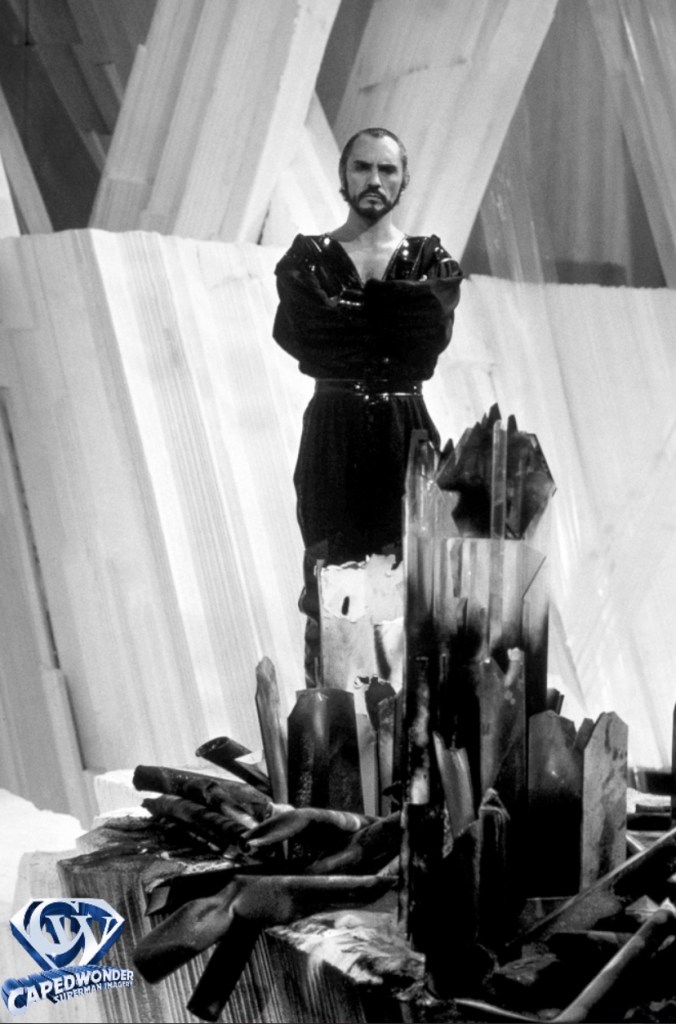
“The son of Jor-El will be my slave… forever.” Once Bryan Singer purchased the rights to the unused Marlon Brando footage from II for usage in Superman Returns, the door was opened for a complete restoration of Richard Donner’s original version of II in 2006. Under the supervision of Michael Thau (who had overseen the restoration of the first Superman film for its DVD release in 2001), screenwriter Tom Mankiewicz, and Donner, nearly all of Donner’s original footage from 1977 was restored, including many of the original Fortress sequences. Some scenes, however, Donner was unable to shoot because of the differences with the Salkinds, which left Donner feeling hurt in the process. This included some of the Fortress scenes that were filmed in October 1979. They had no choice but to use those scenes to bridge necessary gaps in the film’s narrative.
For several needed insert shots of Superman inside the crystal chamber, Thau used a body double wearing a latex mask and wig designed to resemble Christopher Reeve, as Donner had not shot any footage of Reeve inside the chamber. This also required a newly constructed version of the crystal chamber to resemble the original version used in the May 1977 shoot. To this day we do not know the identity of the body double, as he may have requested that his identity be kept secret as his way of giving to the film without any credit to himself.
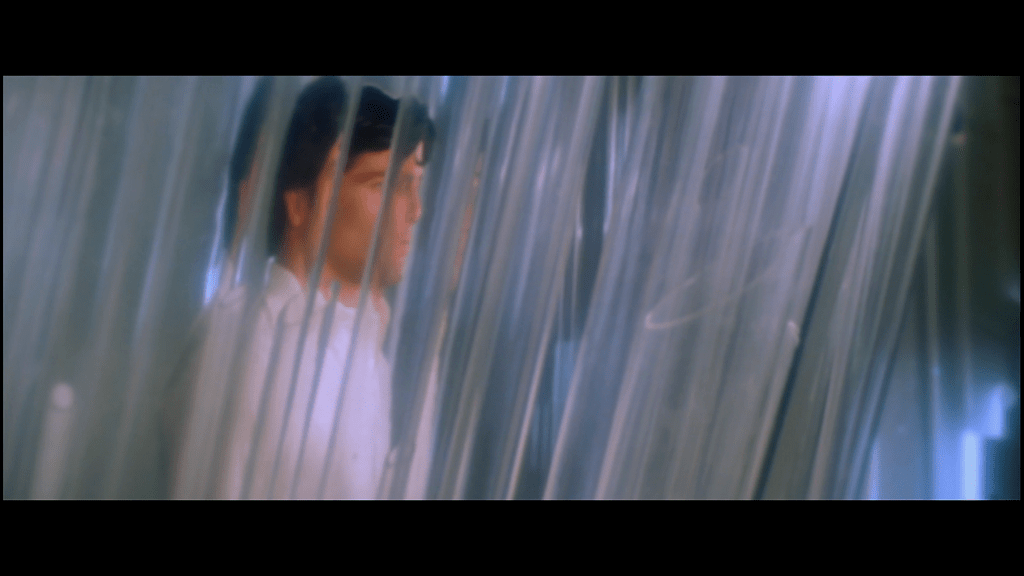
Not Christopher Reeve. For the key sequence of Jor-El sacrificing his energy to restore Clark’s powers, other portions of the Fortress set were rebuilt for needed insert shots. In some instances of hand close-ups, it is Michael Thau’s own hands in the shots. For the final version, new CGI effects were inserted to give all of the Fortress scenes a look and style similar to the pre-digital effects from 1978.
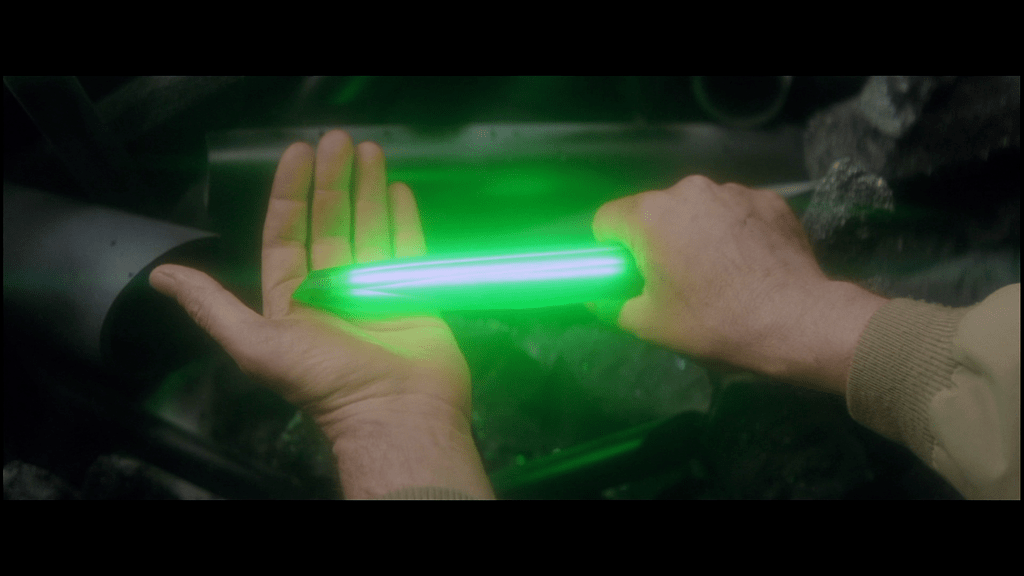
When examining the sequences of the Fortress of Solitude for Superman and Superman II, it becomes clear who shot what and when. To this day, the original design work by John Barry has inspired others to follow in his footsteps, with similar approaches used in the Superboy TV series (1988-92), Smallville (2001-11), Superman Returns (2006), and many of the DC Comics publications from 2006 to modern times. And, like young Clark Kent, one only needs to look at the Fortress to find the answers.
(Some of the photographs and screenshots in this commentary are courtesy of CapedWonder.com.)
-
The History of “Superman II – Restored International Cut” – Part 2
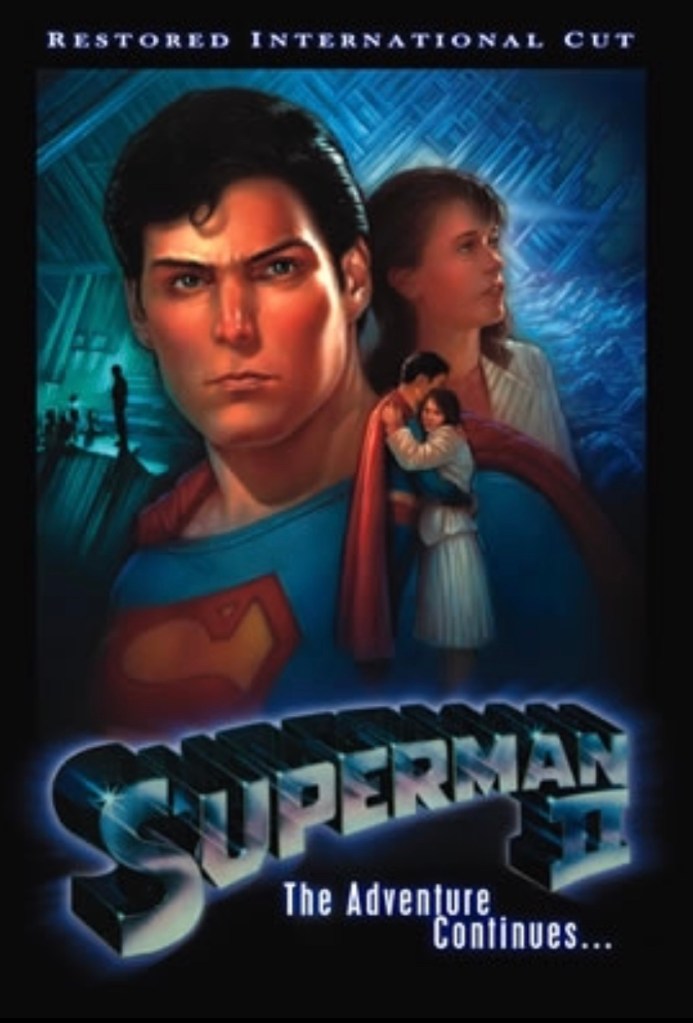
Artwork by George L. Pilcher III. It began with one person’s dream to bring the film back to its original sensibility. Before long, people began to contribute their time and resources to make Superman II: Restored International Cut a reality. And this was at a time before terms such as crowdfunding and GoFundMe entered our lexicon, some with success (The Chosen) and some with colossal failures (Axanar, anyone?)
This is where I come in.
Through Superman Cinema, the editor put out the call once again for any fans with copies of the extended version on tape to contribute to the project. When I saw the announcement, I stepped up to the plate and made contact with the editor. Not only would I contribute my first-generation VHS recording of the broadcast, but I would also provide a copy of the footage analysis I had been working on for a few years at that time. My contributions were extremely generous to the editor, with many key scenes making their way into the final product, and the footage analysis used as an optional text commentary during the film. Another contributor, Todd Kluss, also provided his first-generation VHS recording as well. Both versions would be used in the final product.
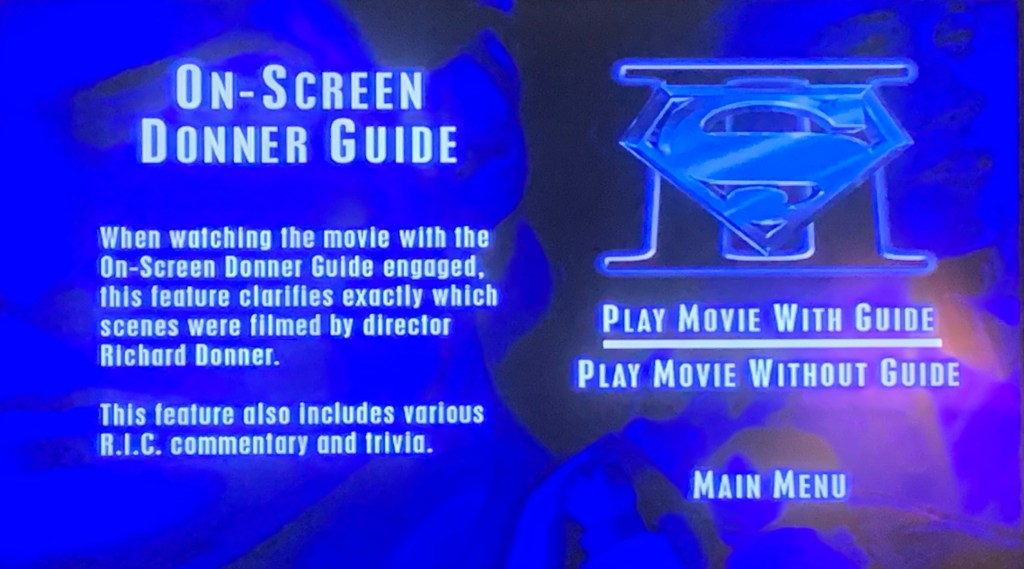
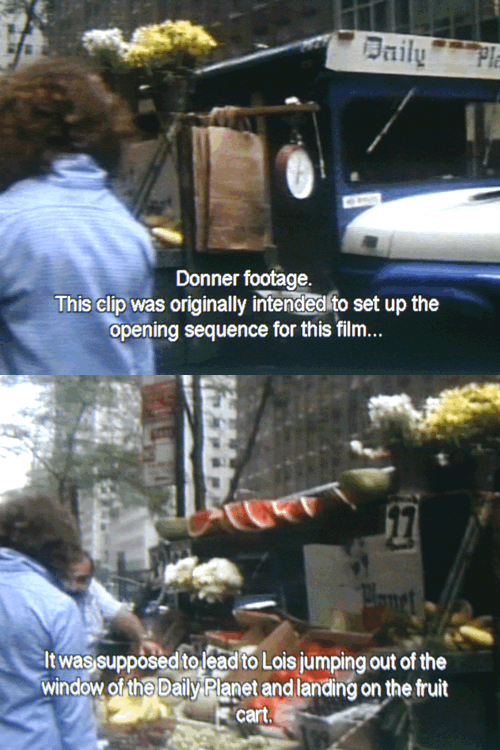
Some of the running text commentary that accompanies the film, courtesy of yours truly. Other contributors made significant contributions to the project. One fellow suggested to the editor that the DVD contain numerous bonus features on the disc, which the editor took to heart. Jim Bowers of CapedWonder.com submitted numerous production photographs for three key sequences Donner had shot in 1977: Lois attempting to trick Clark into becoming Superman by jumping from the Daily Planet, the original version of Superman sacrificing his powers for Lois, and Jor-El returning one final time to restore Superman’s powers.
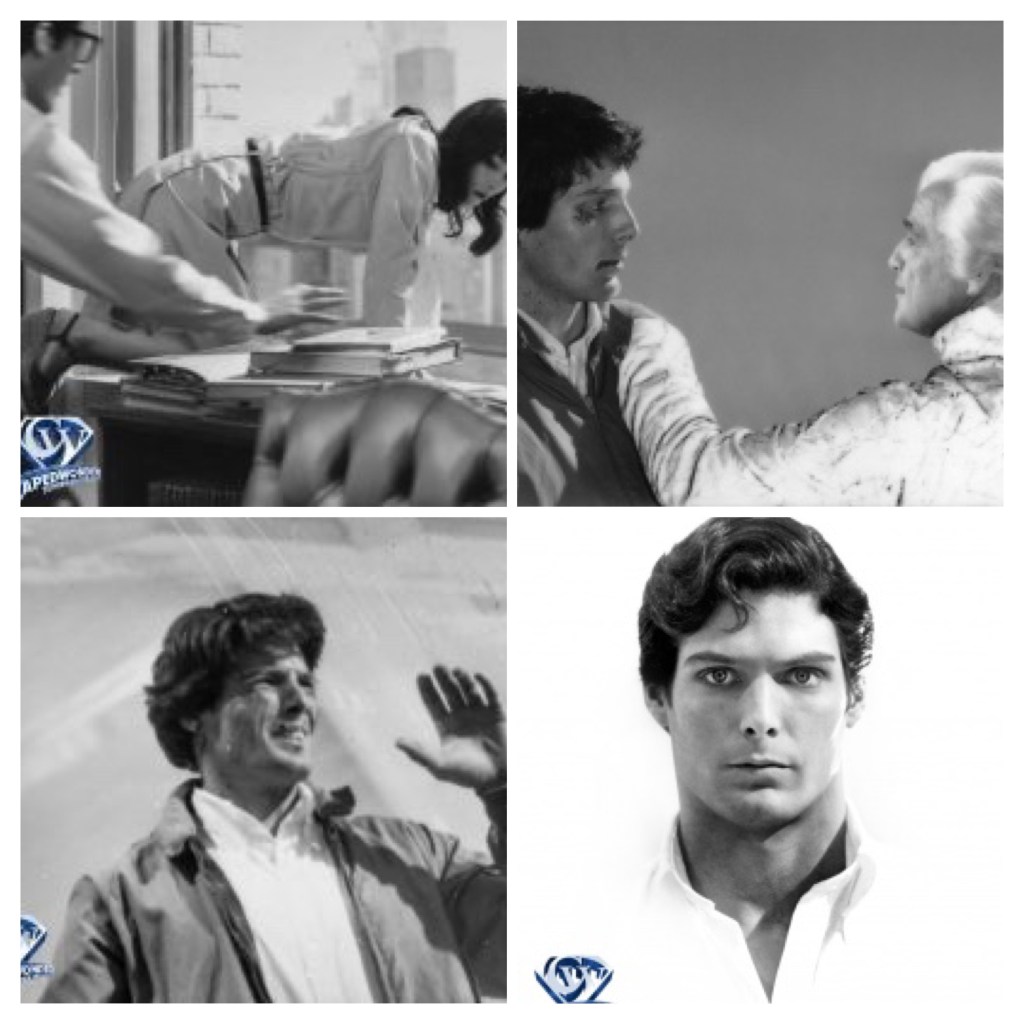
Some of the photographs that appeared on the Superman II Restored International Cut lost scenes gallery, courtesy of CapedWonder.com. A few scant photographs had surfaced in the public years before, but only now were we seeing more behind the curtain, so to speak.
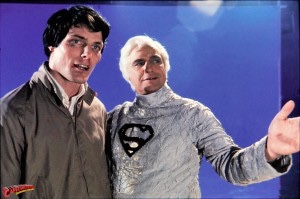
“One day, my son, all of this will be yours.” “What, the curtains?” (Superman a la Monty Python!) Another fan, identified as “Xeno Galaxian”, provided a copy of the Making of Superman II documentary for the project (a few years before its inclusion in Warner Bros.’ Superman Ultimate Collector’s Edition box set). Conor Rooney provided a copy of the original Ken Thorne soundtrack album to the project (another precursor to the Superman: The Music – 1978-1988 CD box set). Another fan, George L. Pilcher III, provided both the DVD menus and the artwork for the release. Still other fans, among them Kevin Skinner, Russell Dodd, J.B. Ross, and “Pineapples 101”, provided the encouragement and support the editor needed to bring the project to completion.
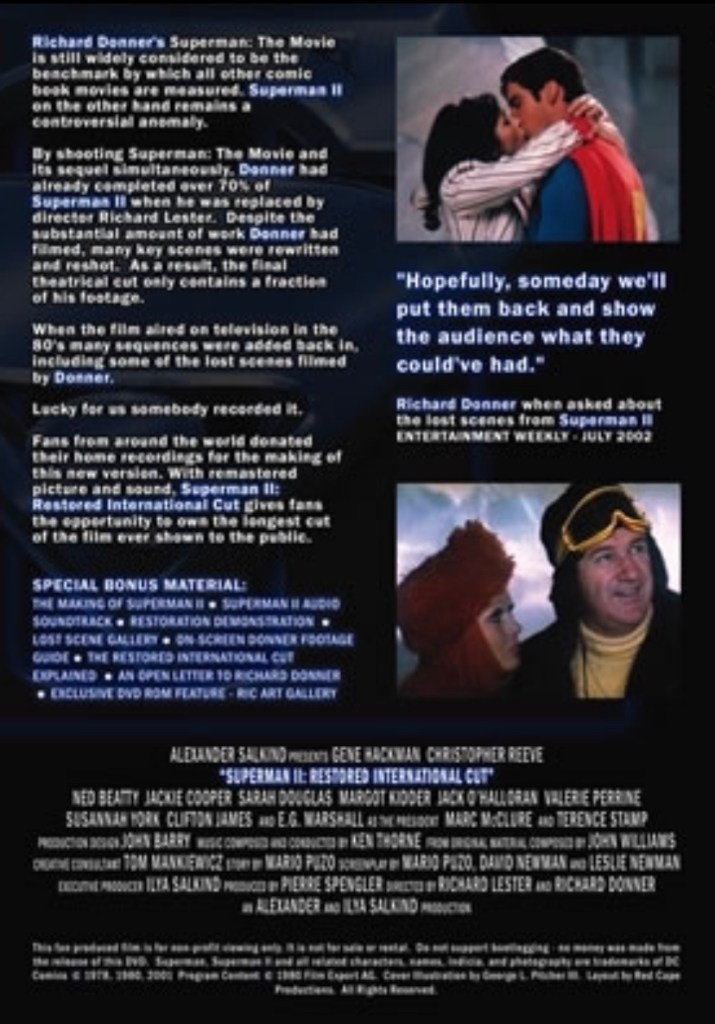
The back of the RIC DVD cover. At one point the editor sent me a copy of his work in progress, which he had shown to a group of his friends, and I could see his intentions. I gave him honest feedback about his work, which he received with enthusiasm. One part I remember was how, in the added footage of Ursa on the moon, he and his sound mixer barreled down Ursa’s voice when she says, “Men… to kill!” It felt more matched up with the theatrical footage now. In addition, I remember how that added footage didn’t exactly sync up with the theatrical footage because of an obvious jump in the pan-scan process during the television broadcast. This was very obvious when you look at Zod. Now it seemed much smoother. I couldn’t spot any jump or loss of footage or sound. The editor’s reception to my comments were confirmation that he was on the right track. “At last! Someone finally gets it!”
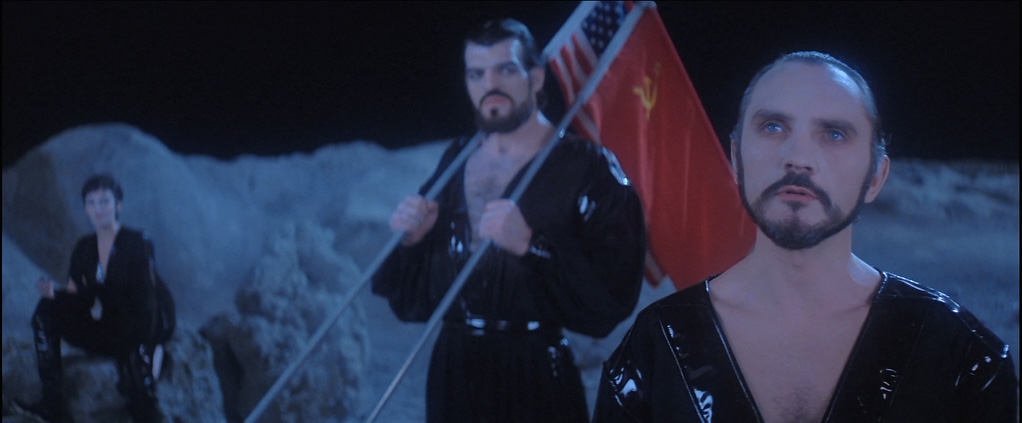
Will we see an official release of the rest of this scene? My fingers are crossed! The other thing I remember was his cliffhanger break at the end of the first disc. It was during the first diner scene when Lois and a powerless, beaten Clark watch Zod’s threat on television when he says, “Come and kneel before Zod!” The disc ended at that point, and the second disc resumed at exactly the same point and continued forward. In my opinion it wasn’t the best place for a natural break in the film during the shot, or the scene for that matter. I still remember to this day seeing The Empire Strikes Back at the old Deville Cinema in Jackson, Mississippi, and the intermission occurred during the scene when Luke enters the dark cave with his weapons against Yoda’s advice. And that was a two-hour movie in the theater. So seeing that break in the editor’s work in progress on the RIC brought back those memories. I don’t recall if I pointed it out to him or not, but I want to say that I did. Nonetheless, it was something he would go back and work on in his update. In the final version, the break in the film occurs after the end of the villains’ invasion of the White House.
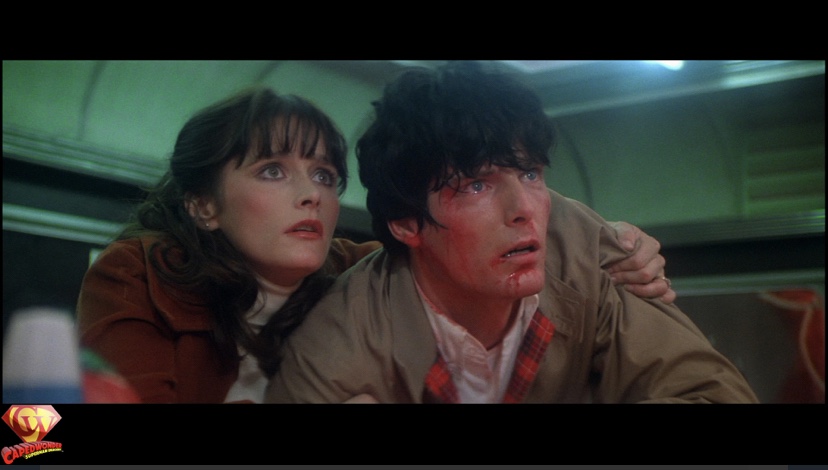
This is where the work in progress stopped at the end of the first disc and started on disc two. Screenshot is from the Blu-ray of Superman II: The Richard Donner Cut, courtesy of CapedWonder.com. But there was one significant hurdle that had to be crossed: how to get the project out to fans who wanted to see the RIC without setting off any alarms with Warner Bros.? The editor included an open letter to Richard Donner, stating, “Your work is not forgotten. This project, the Restored International Cut, exists as a tribute to your work and efforts. It’s been more than twenty years, and your fans are still patiently waiting for the real Superman II. Many of us have gone to great lengths to get a glimpse of the film we’ve been longing to see. While we still wait for an official release, the bootlegging community has shown no qualms in charging fans extravagant prices for low quality reproductions of footage known to exist. It is our hope that this project will offer fans a more reasonable way of obtaining those scenes.
“This Restored International Cut has two main purposes. First, to give fans the opportunity to see those scenes in the best possible manner, without having to pay inflated bootleg prices. This whole endeavor has been done as a labor of love and is strictly non-profit. Second, to let you, Warner Brothers, and anyone else with influence know that the fans are still eager to see the rest of your lost work on Superman II.”
His openness and honesty sent a clear message to Donner and Warner Bros. officials: he was not in it for the money, nor was he making a name for himself. He was a fan who, like so many others, wanted to see Donner’s version of the film completed and released in an official capacity.
In short, the editor told me, he created a project that was intended to be destroyed.
His plans were reasonable. Twenty master copies sent out, with fifty copies made from each master copy and freely distributed, would result in one thousand copies. One thousand more voices to be heard by the studios to petition for an official release. I remember seeing the final project on DVD toward the end of October 2004, a couple of weeks after the untimely passing of Christopher Reeve. The film looked and sounded fantastic. All of the bonus features were incredible, including a before-and-after restoration of footage. Even seeing my name in the credits brought a huge smile to my face, knowing that I helped in making something special.
A year later, the editor had plans for a third phase of the RIC. His intentions were to include enhanced visual effects in certain key sequences to make the film even more visually exciting, and a trailer was prepared…
Unfortunately, as the saying goes, the road to hell is paved with good intentions.
Somehow, somewhere, bootleg copies of the RIC made their way into the public for sale, either at a comic book store or at a convention, I cannot recall reading where. Someone was determined to wrongly profit off the editor’s hard work. This in turn alerted Warner Bros. to contact the editor and advise him to formally kill the project – which, ironically, was the editor’s intention. By this time Bryan Singer had secured the rights to Marlon Brando’s footage from Superman: The Movie and Superman II for inclusion in Superman Returns, which in turn opened the door for Richard Donner, Tom Mankiewicz, and Michael Thau to begin work on bringing Donner’s version of Superman II to completion in 2006.
I lost contact with the editor. Fortunately, I still have his work on disc, along with the memories of what he shared with me, even though I no longer have those e-mails. I recently came across an interview he gave with Entertainment Weekly shortly after the project was killed that sums up his feelings about the entire process:
“Details of this fan restoration have been removed because Warner Bros. have contacted me. I think as a collective group, we’ve achieved what we set out to do, that is to raise awareness of Donner’s work on Superman II. It is imperative that the wider audience learns about Donner’s work on Superman II… It’s not about me, it’s about the film. When you get down to its core, it had a great story that even Richard Lester couldn’t screw up.”
When you compare all of the versions of Superman II that are out there, there are bits and pieces of footage, including deleted scenes, alternate angles, and trims that are exclusive to the extended version and are not in either the original theatrical release or either version of the Donner Cut. Amassing all of the footage would be similar to the work done on the 2002 and 2010 Kino Lorber releases of Fritz Lang’s Metropolis or the Criterion Collection’s 2006 release of Orson Welles’ Mr. Arkadin (aka Confidential Report). The differences are endless. I’ve done it in my head and on paper.
In recent years Warner Bros. has commented that they in fact have a complete widescreen print of the extended TV cut in their vaults. The proof is there in all of the added scenes that are featured in both versions of the Richard Donner Cut, including the deleted scenes section on the DVD and Blu-ray. Because the Warner Archive release of the extended TV cut of Superman: The Movie was a huge success, it only makes sense that they should do an official release of the extended TV cut of Superman II, thereby further superseding the RIC. And with the forthcoming 4K releases of the Superman films next year, it may give further incentive for the Warner Archive to offer the film on Blu-ray. Time will only tell.
But one thing is clear: the Superman II Restored International Cut fills in a key gap in the Superman franchise which we are thankful for, all due to the efforts of one fan with a dream. To the editor, if you’re out there reading this blog… thank you.
Some of the photographs and screenshots in this blog are courtesy of CapedWonder.com.
-
The History of “Superman II – Restored International Cut” – Part 1
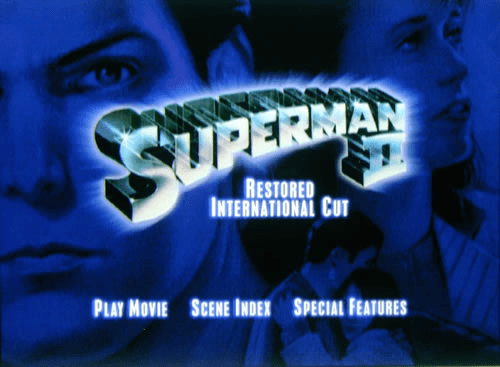
When we think of fan films, we think of underground projects done with very little to almost no money, done for the love of the project with a tip of the hat to those films that inspired us. For me the very first one that comes to my mind is Hardware Wars, a hilarious takeoff of the original Star Wars that in and of itself became a cult classic. (“You’ll laugh, you’ll cry, you’ll kiss three bucks goodbye!”) In the 1980’s three boys set out to make their own homemade version of Raiders of the Lost Ark, which they did over the course of seven years and only in 2015 were able to finally complete. So much so that it impressed Steven Spielberg himself.
By the time of the Internet and digital era, fan films took on a new life, with projects such as Star Wars: The Phantom Edit leading the way for the slew of restorations, fan-made extended versions and recuts of beloved films that expanded upon or shortened films for those people with selective tastes (or distastes) for certain projects.
And then there was Superman II.
We are all familiar with the many production troubles that befell the sequel during production in 1977 and later in 1979 and 1980, when Richard Donner was unceremoniously removed from the production and replaced by Richard Lester. His directorial bent towards comedy resulted in a shift in tone for the sequel in numerous places, which to this day are still noticeable when going to the debates. In 1984 fans were first introduced to the extended version of Superman II on ABC, which saw some fifteen minutes of footage added to the film’s broadcast. Over the next few years different versions of the film would appear in various markets around the world, containing even more unseen footage shot by both Donner and Lester.
By this time my parents and I had our first VCR, and I was very fortunate to have recorded the ABC broadcast of Superman II in its second airing in 1985, and then in its third and final broadcast in 1987. For some reason, something inside told me that I should record the third broadcast – and my instincts were right. In that third and final broadcast, even more footage was included toward the end of the film that had not been seen in its two previous broadcasts. (In later years, during the Internet era, some fans would argue that the added footage at the end of the film was there all along in the first ABC broadcast, but I remember better, for in those pre-VCR days I had recorded the audio from the film, and the footage was not there.) Little would I know at the time how important recording that final broadcast would be.
During the Internet explosion of the 1990s, it was not uncommon to go onto eBay and find auctions for the extended versions of Superman II on sale. Fans could purchase their own copies, see how much footage was left out of the theatrical version, and make their own conclusions as to which footage from which director was better, Donner or Lester. It was in 1997 that I first discovered the now-defunct Superman Cinema website, hosted and run by Dharmesh Chauhan, known in those days first as MegadethDC and then later as GandalfDC. This led to a lengthy research project that continues to this day: the most definitive breakdown of footage from Superman II and the identification of who shot what and when. And it led to communication with fans across the world, some of whom I have developed good friendships to this day.
But through it all, the good and the bad, the fun and the drama, the discussions and the negative drama that ensued, there was one question that everyone seemed to agree on: when would we get to see the rest of Richard Donner’s original concept for the film? The proof was there in the theatrical and the extended versions, the Tom Mankiewicz script, and behind-the-scenes production photos that started to fill in the gaps in places.
This is where the editor comes in. (In time I would learn his identity, but out of respect I have held that information to myself to this day and will respect his anonymity through the entire history of his involvement.)
In 2001 this anonymous fan took it upon himself to produce an introductory concept reel that would be the starting point for what he called Superman II: Green Cut. His intention was to restore as much of Richard Donner’s original style and influence to the sequel, add new effects, re-edit the film, and include select extended scenes. Most importantly he would attempt to bring back Marlon Brando’s presence to the sequel as much as possible. He would also restore the original film’s sweeping main title credits and John Williams’ stirring music, while tinting the credits green as a tip of the hat to the green crystal that would play an integral part in both films. Years later I saw the video, and while it looked in rough shape, I saw his intentions, and they were impressive indeed. (By the way, the video is no longer online.)
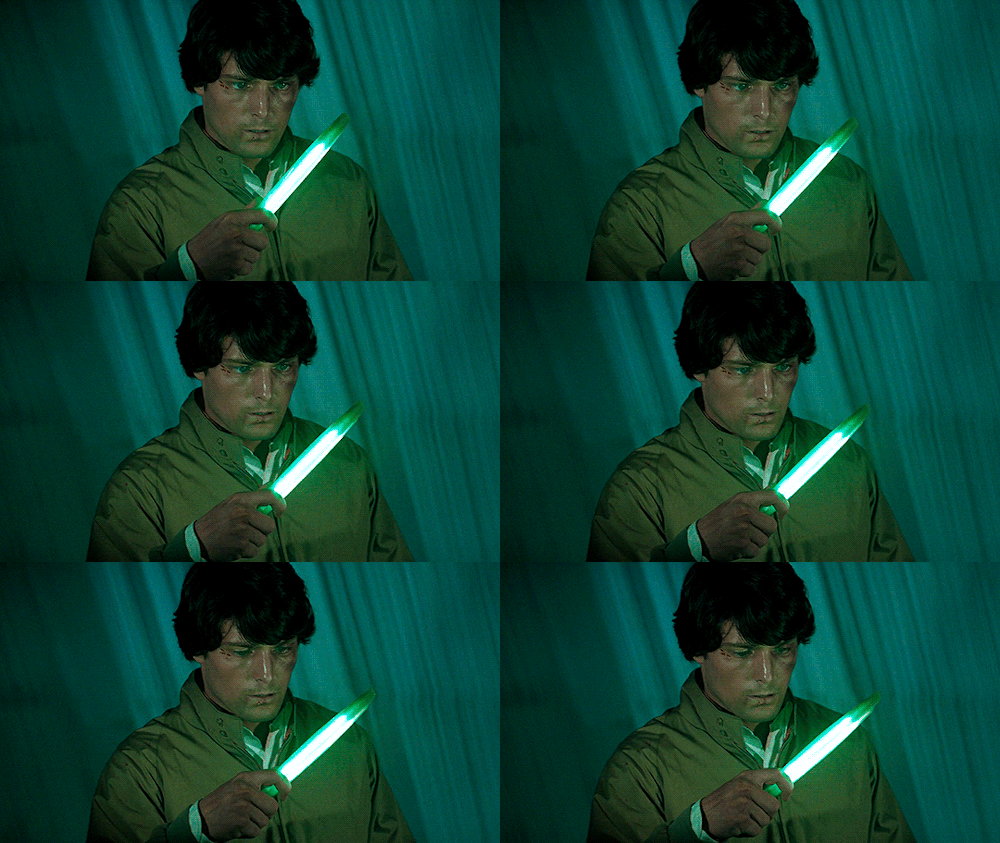
He would upload the eight-minute video to Superman Cinema…
And then, as he would later tell me, September 11th hit. Amid the chaos of that heartbreaking day, the video obviously got lost in the shuffle, and rightly so. We were more concerned about friends, loved ones, and where our nation was going from that point on than a little fan-produced video. But in time that little video would become the diversion Superman fans needed to take their minds off the tragedy and breathe once again.
From there he would be asked, “Why not do a full-on restoration of the complete extended version of Superman II?” Why not indeed, he reasoned. One of the key supporters of the project, Rennie Cowan, had encouraged him to do a full-on restoration of the complete extended version of the film. From there, the project soon took flight.
Through Superman Cinema he put out the call for fans to contribute their VHS copies of the film for what he would now christen Superman II: Restored International Cut. By now the film had been replicated and distributed around the world in varying qualities, some better than others, and others not so much. That was simply the technology of the day, when all you needed were two VCRs and a set of audio and video cables connecting the two – primitive technology indeed, but effective for its day – and yet even it would be superseded in years to come.

The first contributor to the project was Chance Bartels, who sent in his VHS master of the project. His version helped lay the groundwork for the original version of the Restored International Cut, or RIC. Another fan who stepped up to the plate was an Australian fan named Paul Naylor, who lent his Betamax copy of the broadcast from Australia for the project. It was a huge risk for him, one that would prove crucial to the overall success of the project. His version contained all of the added scenes that were necessary, in the best quality possible. At that time, Betamax was still superior to VHS in numerous ways (though the format was not as long-lived as its successor). Thanks to a fan identified as “Indo77”, Naylor was located, and his contribution proved successful.
Two other contributors sent in their personal copies, which were considered and either used or rejected for numerous reasons. In some cases station logos or subtitles (as in the Danish broadcast) took up huge portions of the television screen, which did nothing but distract fans. The editor wanted the best possible quality for the best possible format – DVD – without any detractions to the film itself. He spent countless hours and money out of his own pocket, nearly $2,000 he would later tell me, in editing, re-editing, re-coloring, and formatting the film completely on his own, using not only videos of the extended broadcasts but also a PAL transfer of the original theatrical version. He would also work with a sound expert in improving the sound quality of the numerous scenes, bringing everything into sync as much as possible.
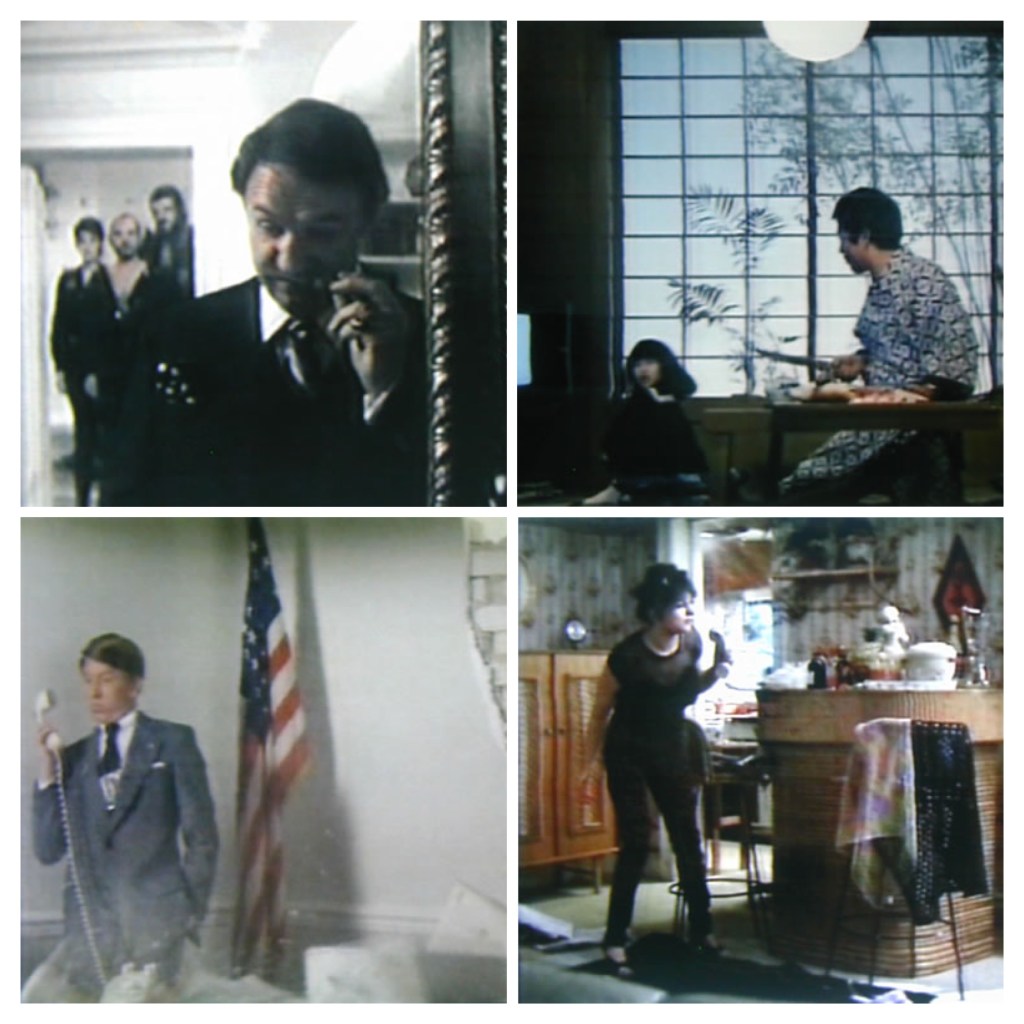
He and I exchanged numerous emails, and he detailed to me the lengthy process of bringing the Restored International Cut to life. While I no longer have those emails, I came across a comment from him circa 2004-05 on the Superman Homepage which lines up with everything he told me:
“I found out about the extended cut of Superman II on supermancinema.co.uk website 4 years ago. I sought out a copy on eBay, paid 75 bucks, and got a seriously lousy copy on VHS. I was very intrigued by what I saw, especially the two extra break up scenes at the end.
“Then… well… I had one of those quick silly thoughts most rational people ignore. What would happen if someone tried to rewrite history and make a better Superman II? Put back in some of the better Donner moments, take out some of the really awful Lester moments, add some new effects, that kind of thing. I was hoping to raise awareness about Donner’s lost work. Before I could do anything I needed to get the footage. Cutting out the long boring stuff… I got the footage, but found myself in the middle of a strange situation. If I put in some extra elbow grease I could do something else as well… reassemble the entire International Cut to make sure it doesn’t get lost. No matter how bad some of it is, there will always be those people who want to see everything, so I started there.
“I first finished RIC 2 years ago, but it just wasn’t as good as it could’ve been. Again, long story short, I took another crack at it, and you have the final results. In the end… the project took about 4 years, and roughly about $10,000 to make happen. Now that’s for everything mind you spread out over 4 years.”
By July 2002 Richard Donner gave an interview with Entertainment Weekly, and he made a statement that would have vast ramifications in years to come: “Hopefully, someday we’ll put them back and show the audience what they could’ve had.” While fans had been aware of a portion of the footage for nearly twenty years, that was the proverbial tip of the iceberg to what lay unreleased in film vaults.
Next time… the journey to the Restored International Cut continues.
 Superman: The Blog