-
Continuity Matters
And now we come to that one thing that is so much a part of every fanboy’s dream, whatever the franchise is… continuity. I don’t know where it began, or how, or with which franchise it started—it may have been the James Bond franchise, first with the Ian Fleming novels, then with the 1969 film On Her Majesty’s Secret Service, which provided a recap of key moments from the first five films before continuing with its adaptation.
Then it was Marvel Comics. Their look at storytelling allowed for not only continuity in their individual characters’ titles but also for smooth crossovers from one title to another. Then DC Comics followed in Marvel’s footsteps. Before long, whenever a revamp occurred, especially in the post-Crisis on Infinite Earths saga, continuity became a stricter adherence among all of the characters and their respective titles… that is, until the next revamp. And the next. And the next one after that.
And don’t get me started on the continuity of daytime soap operas! For some reason they would always play the card of having a child go off to summer camp for a couple of months, and the child was, like, eight years old, and then two months later they come back and they’re 16 years old! Where did they get sent off to, Camp LeJeune? Something’s definitely in the water there if soap opera producers could get away with that!
In the Superman films, there is a particular sense of continuity that occurs throughout all four films (five if you count the Richard Donner Cut of Superman II). What I’m going to do is break down a number of key events and moments in the film series and establish the continuity of the Christopher Reeve films. This isn’t going to be heavily detailed, but rather an assembly of broad strokes to give you an idea. Some events may be debatable, and there is plenty of room for such debates. I’m going to stick primarily to the events of the films themselves but will also look at some script information as well.
1887:
The Daily Planet is established. (STM)

This date is very straightforward. 1938:
Perry White begins his reporting career. (STM)
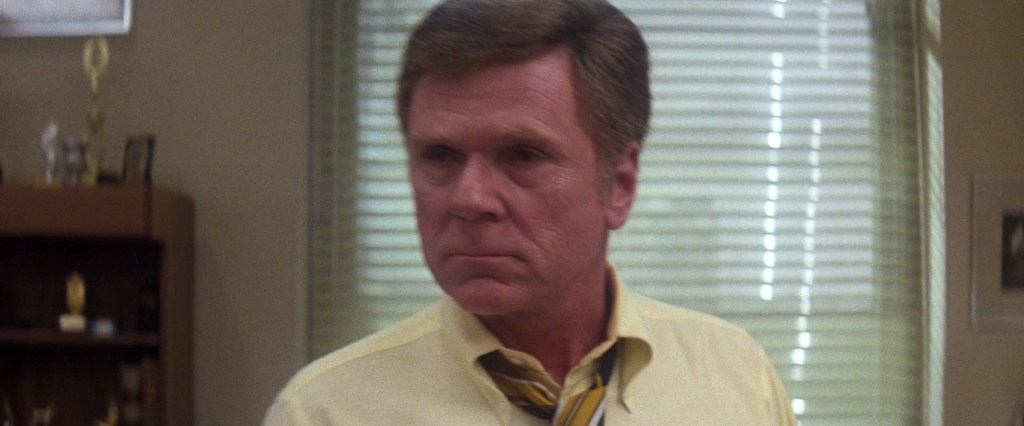
Perry White: “I’ve been in this news game 40 years, man and boy…” 1948:
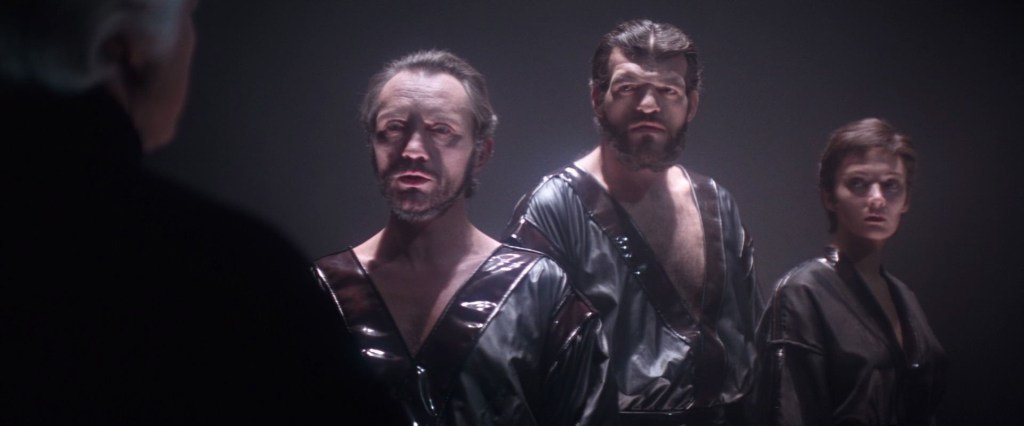
Jor-El banishes Zod, Non, and Ursa to the Phantom Zone. (STM, SII, S2RDC)
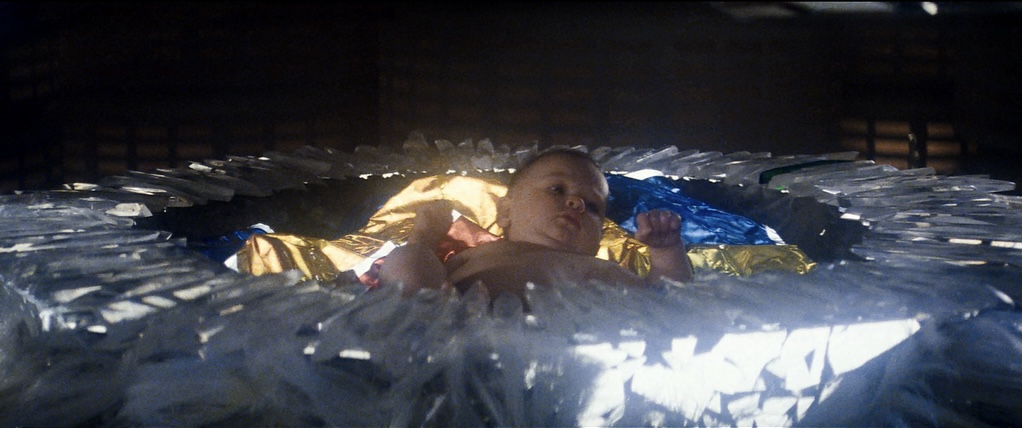
Jor-El and Lara place their infant son Kal-El in a rocket ship bound for Earth. (STM, S IV)
The planet Krypton explodes. (STM, SII, S2RDC, S IV)

Lex Luthor: “In the interview he says that the planet Krypton exploded in 1948.” 1951:
The crystalline starship bearing the infant Kal-El lands on Earth, where he is found by Jonathan and Martha Kent. (STM, S2RDC)
Lex Luthor: “The ridiculous little freak took three years in a rocket ship to get to Earth. Ergo…” 1958 (?):
Lois Lane, daughter of Sam and Eleanor Lane, is born.
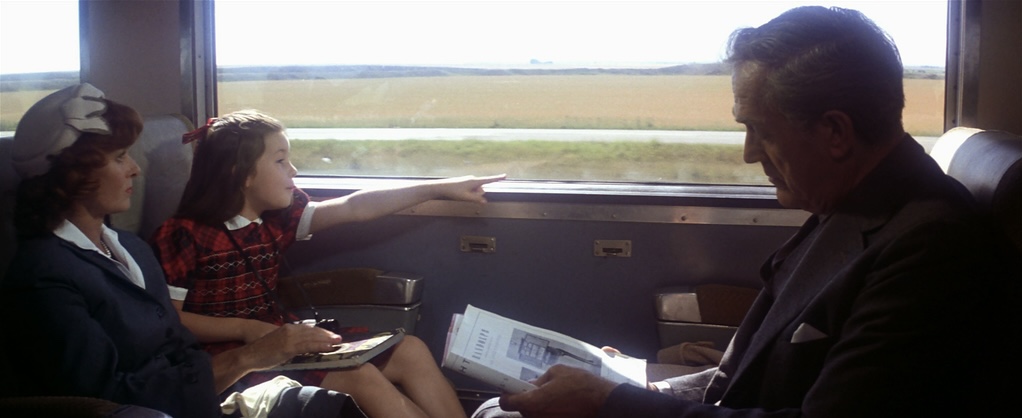
From the 1982 extended TV cut. This one is based on information gleaned in the Tom Mankiewicz shooting script from 1977 in which he states that Lois is six years old when she spots the teenaged Clark Kent racing past the Kansas Star commuter train.
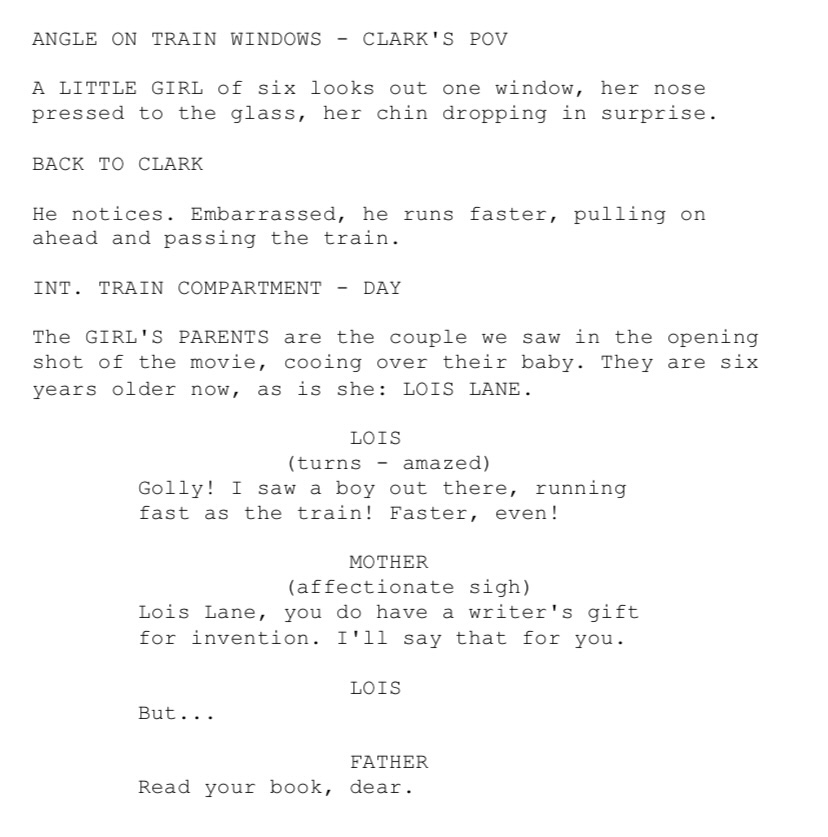
It seems a bit far fetched that Lois is ten years younger than Clark in the script, but this is what Mankiewicz wrote. Which means that if she’s only six at this point, then she would only be 20 years old in 1978! (There’s that Camp LeJeune water again!) Don’t blame me, that’s how he wrote it. If we go with this, then we have to go with the dating of this next collection of moments:
1964:
Clark Kent in high school. (STM)
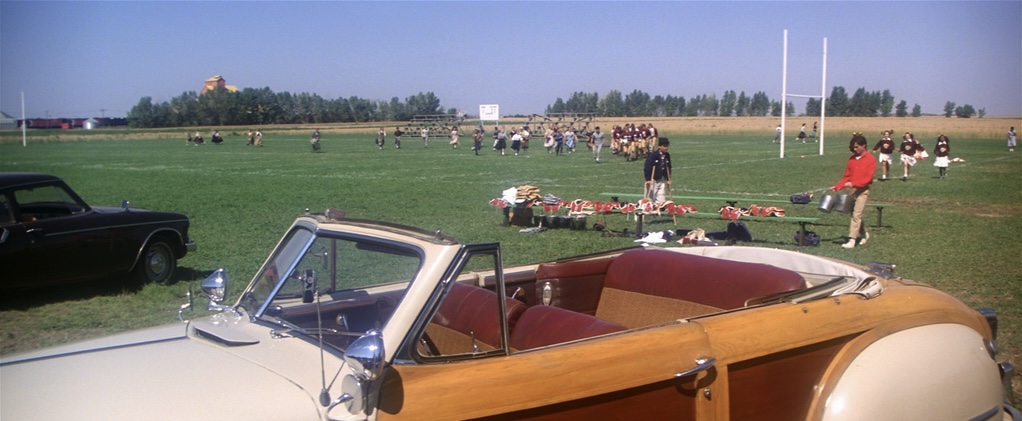
This I believe occurs in late August or early September 1964. This is very early in Smallville High School’s football season, based on their training and preparation for the game against Mount Vernon High School. Clark is 16 years old at this time, not yet 17, and it is equally believable that Clark is about to turn 17 early on in the school year, in September. (It happened to me too.)
Racing the train. (STM)
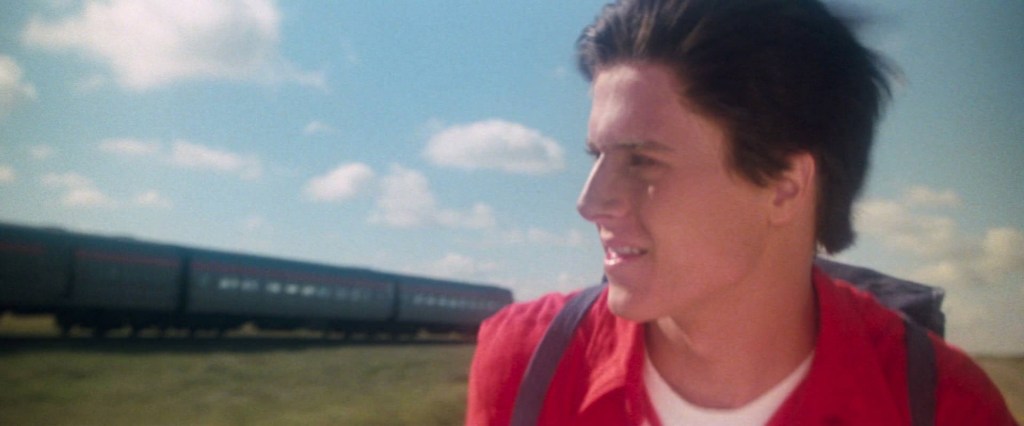
The death of Jonathan Kent. (STM)

May 1965:
Clark Kent, age 17, graduates from Smallville High School. Among the members of his graduating class are Lana Lang, Nancy James, Donald White, and Brad Wilson. (S III)
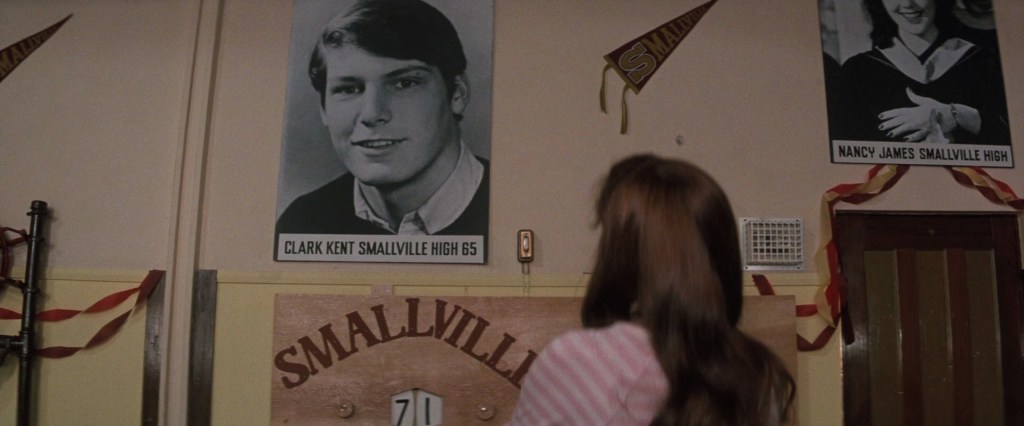
One thing that always struck me as odd is how Lana, as intelligent as she is, never put two and two together. 1966:
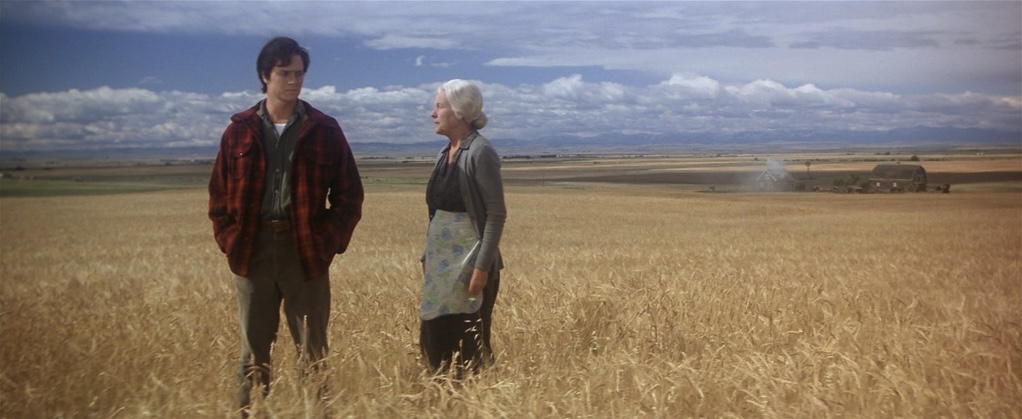
Clark Kent, age 18, discovers the green Kryptonian crystal in the remains of his rocket ship in the family barn. He soon leaves Smallville behind and heads north. (STM)
Once he reaches the Arctic Circle, he uses the green crystal to construct the Fortress of Solitude and interact with the educational crystals from his father Jor-El. (STM)
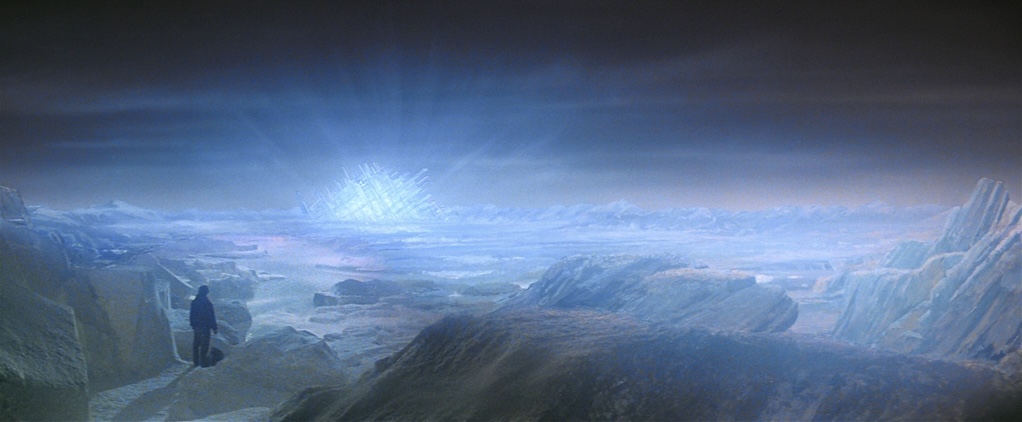
Jor-El: “By now you will have reached your eighteenth year, as it is measured on Earth.” 1978:
Clark Kent, age 30, leaves the Fortress of Solitude behind and heads out into the world as Superman. He will arrive in Metropolis, become a reporter for the Daily Planet, and fight for truth, justice, and the American way. (STM)
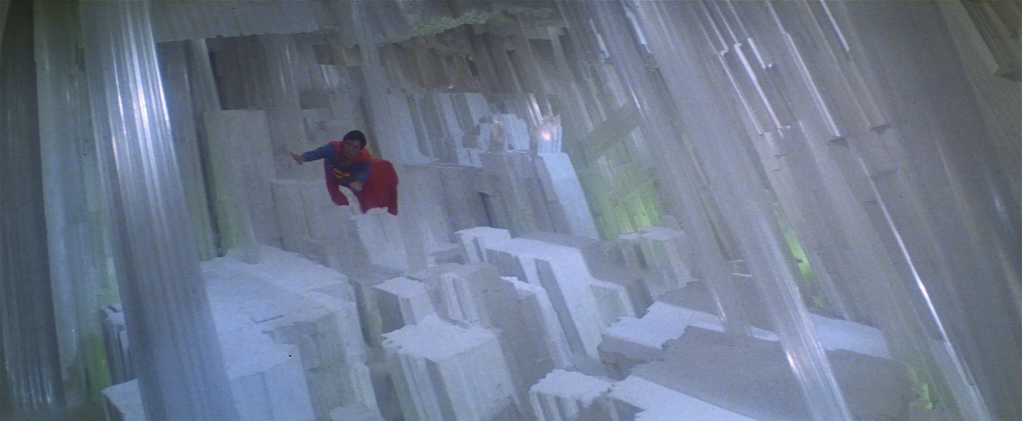
The events of Superman II occur.
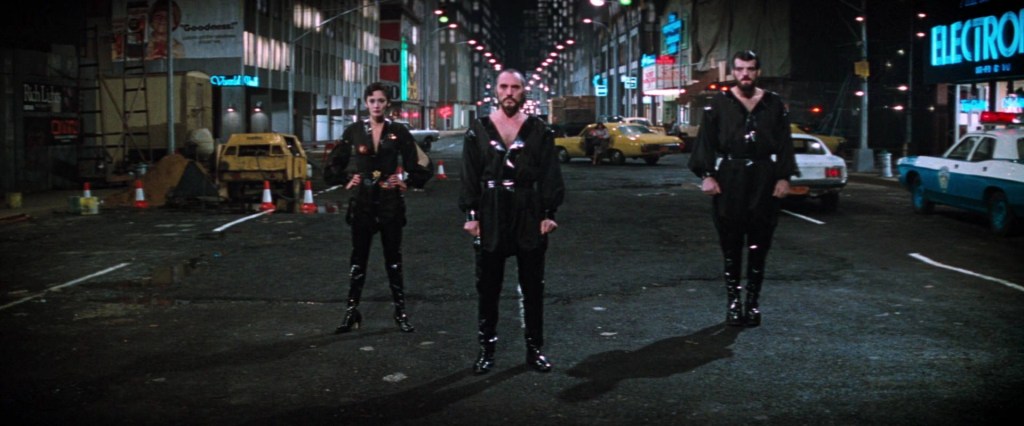
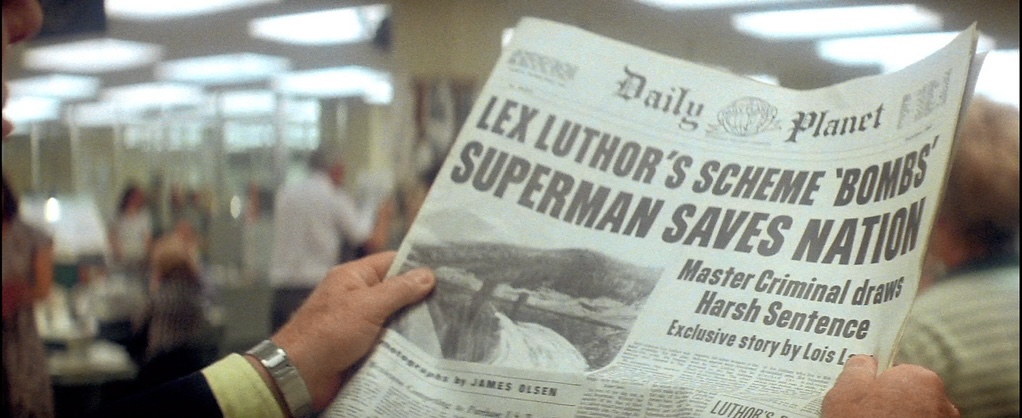
This one has a lot of leeway where calendar placement goes. According to Starlog magazine, the events of the theatrical version of Superman II occurred weeks after the end of the first film, and that dating is directly from the Starlog article itself. But with the release of Superman II: The Richard Donner Cut in 2006, the events of the film are moved up much closer to the end of the first film, as we see Perry White entering the Daily Planet reading the newspaper headline about Lex Luthor’s recent conviction and Jimmy Olsen’s photographs of the havoc at Hoover Dam. This obviously leads us to conclude that a very short amount of time has passed between films, only a matter of a few days.
“Ahhh, Luthor, you never looked lovelier.” June 1979:
Gus Gorman is hired as a delivery man and is fired after only one day for losing a two-inch Japanese television set. (S III)
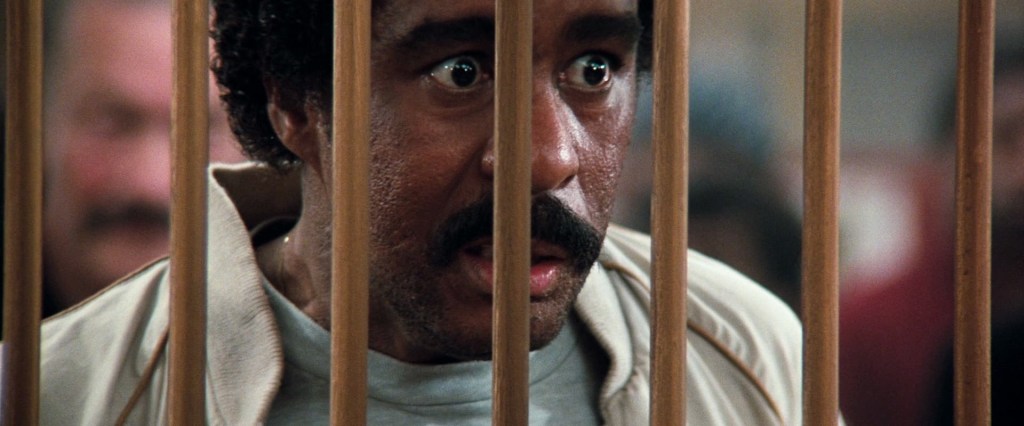
“They said I lost it. I didn’t lose it, it was stolen by a pickpocket…” This one’s an easy placement because Superman III is set in 1980, and the unemployment clerk says that this job occurred “last June”.
October-November 1979:
Gus Gorman is then hired at a fast food restaurant and quits after only 28 minutes. This begins a 36-week period of chronic unemployment and collecting unemployment checks from the city of Metropolis. (S III)
If we base this on the placement of Superman III as starting in early July 1980 and count backwards, we arrive at the approximate date for this event.
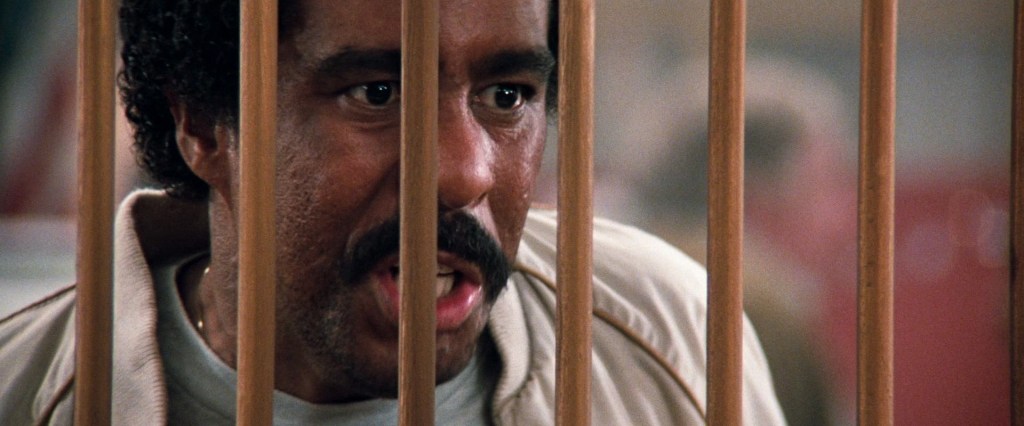
“They expect you to learn that stuff in one day. Can I have special sauce? I don’t want any sauce… two buns, no buns, some cheese, no cheese…” July 1980:
The events of Superman III occur, spanning three weeks.
I always preferred the way the title credits were used in the extended TV cut as opposed to being superimposed over the scenes at the start of the film. Aaron Price did a beautiful job recreating the opening credits in widescreen format. This one has a more grounded calendar placement than the previous films, and this is for one key detail: the 1980 summer Olympics. According to Wikipedia, the summer Olympics were held in Moscow, in the Soviet Union, beginning on July 19, 1980, which would allow for this moment in the film to occur:

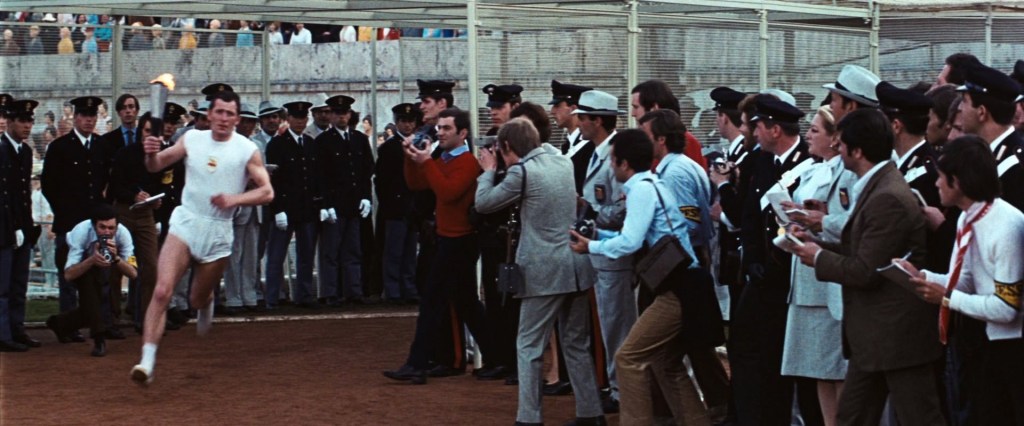
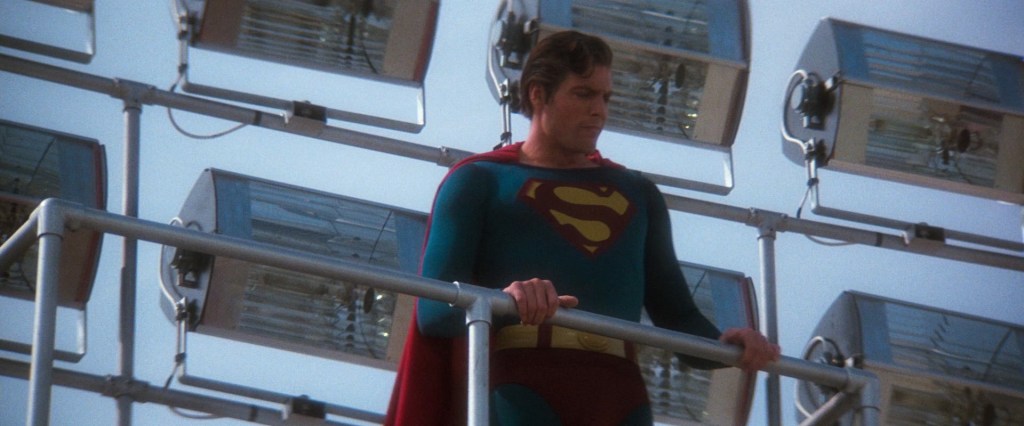
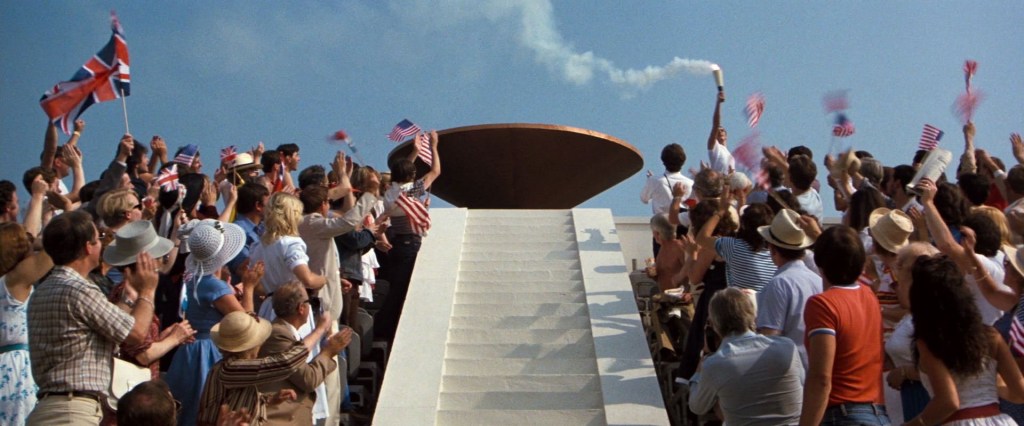
And this is also supported by a comment from Perry White to Lois Lane at the end of the film: “Who else could turn a three-week vacation into a story that’s going to blow the lid off of corruption in the Caribbean?”
1982:
For the first time in its publication history, the Daily Planet fails to generate financial profits. It will continue its downward financial spiral for the next three years. (S IV)
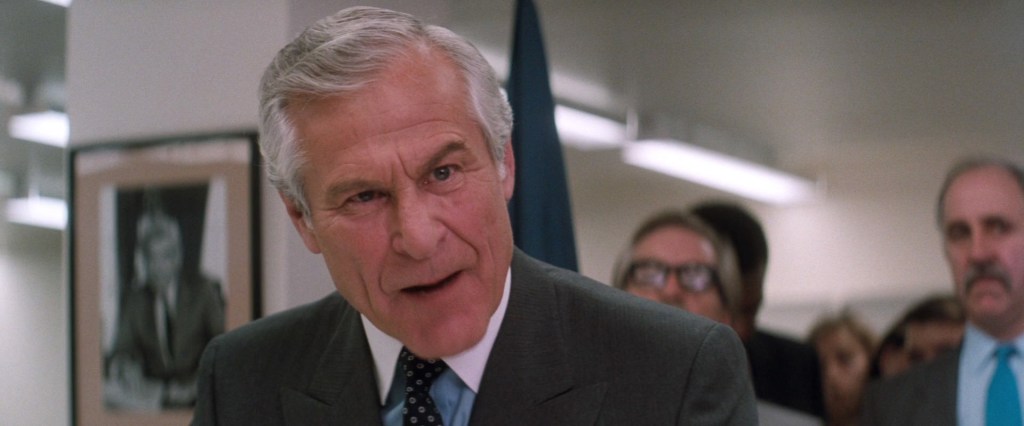
David Warfield: “The previous owners paid so little attention to the ledgers, and I bought the paper out from under them. The Daily Planet hasn’t made any money in three years!” 1985 (?):
The events of Superman IV: The Quest for Peace occur. The events of the film span several days (or is it weeks?)
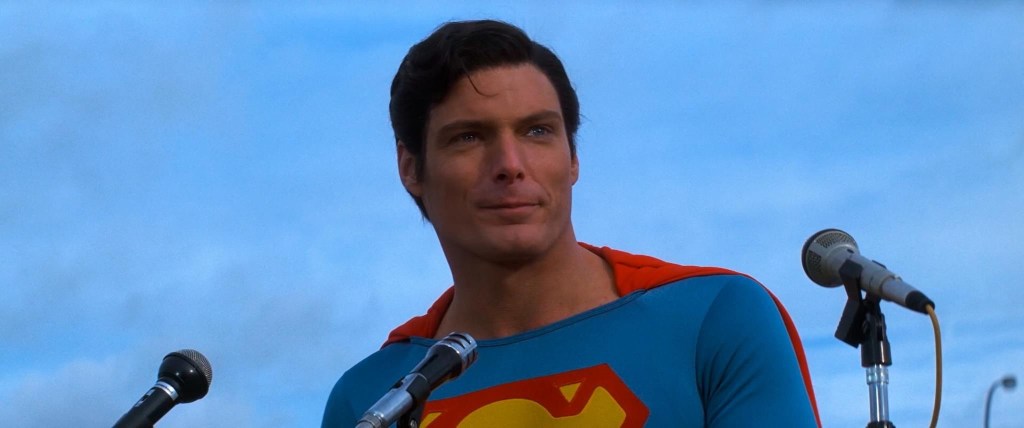
This one’s a bit wonkier where continuity placement goes, so you’re just going to have to roll with me on this one.
At one point in the film we have a definite date that appears on screen:
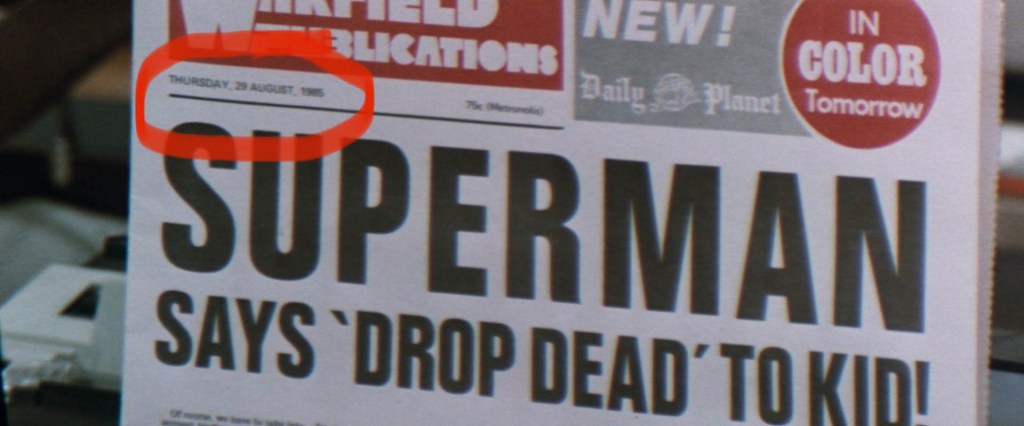
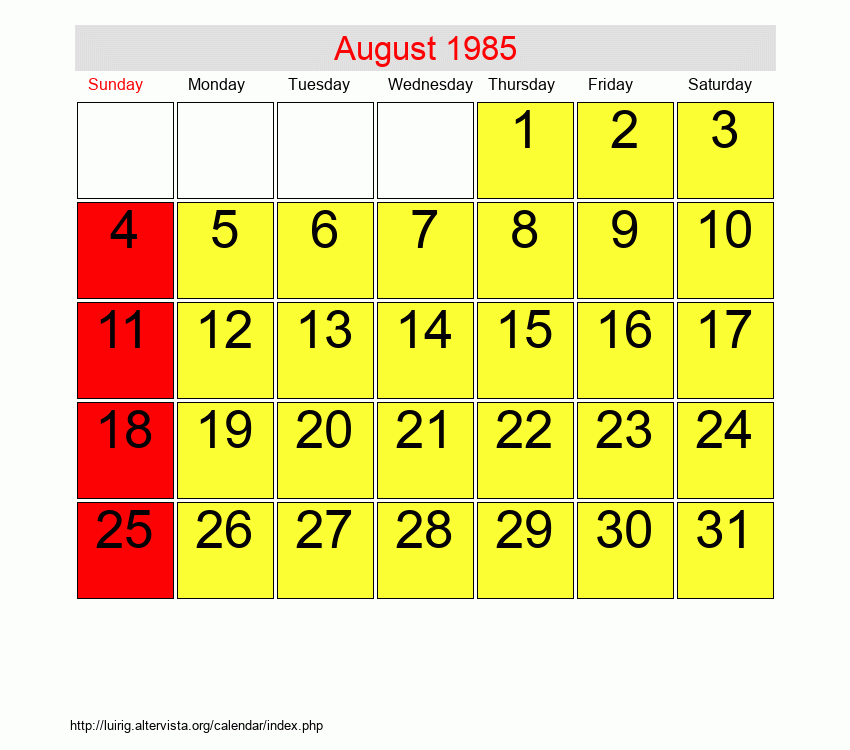
Thursday, August 29, 1985. This is confirmed by the actual August 1985 calendar from back in the day.
But here’s where it gets really interesting. Consider these events as they occur in the film:
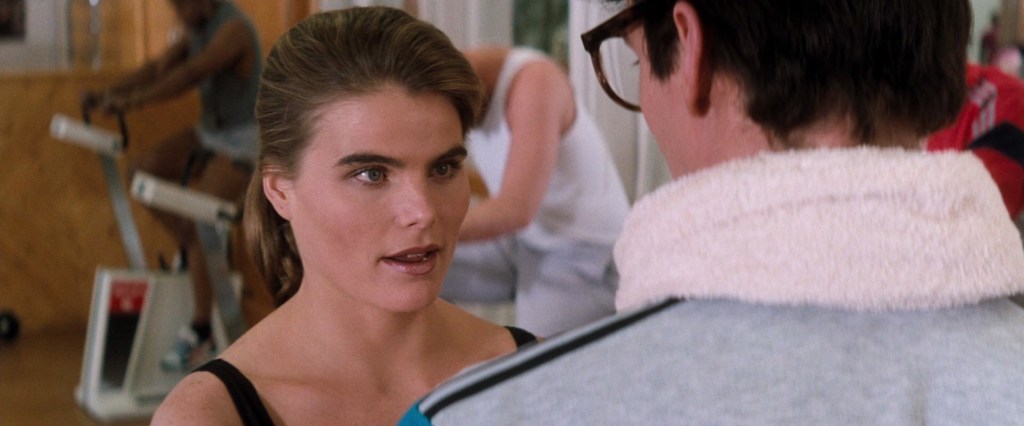
Lacy invites Clark to her penthouse that evening to join Lois and Superman for a double date over high tea. 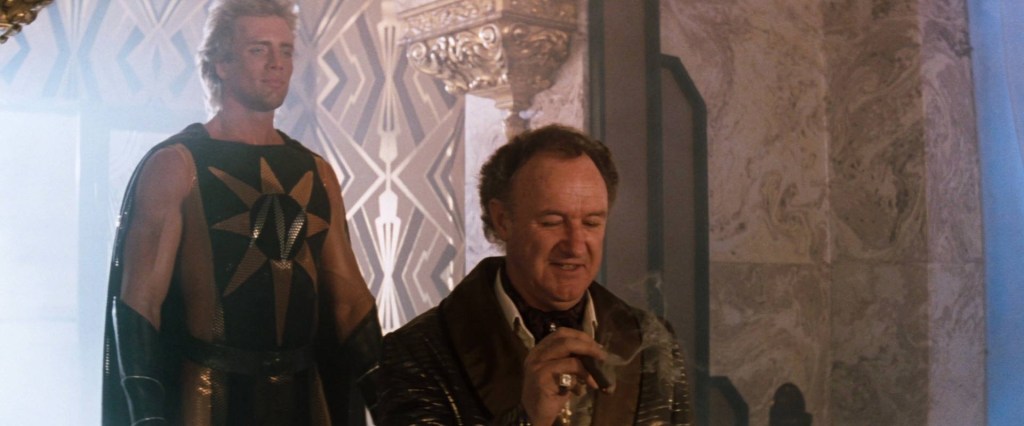
The second Nuclear Man arrives at Lex Luthor’s penthouse. 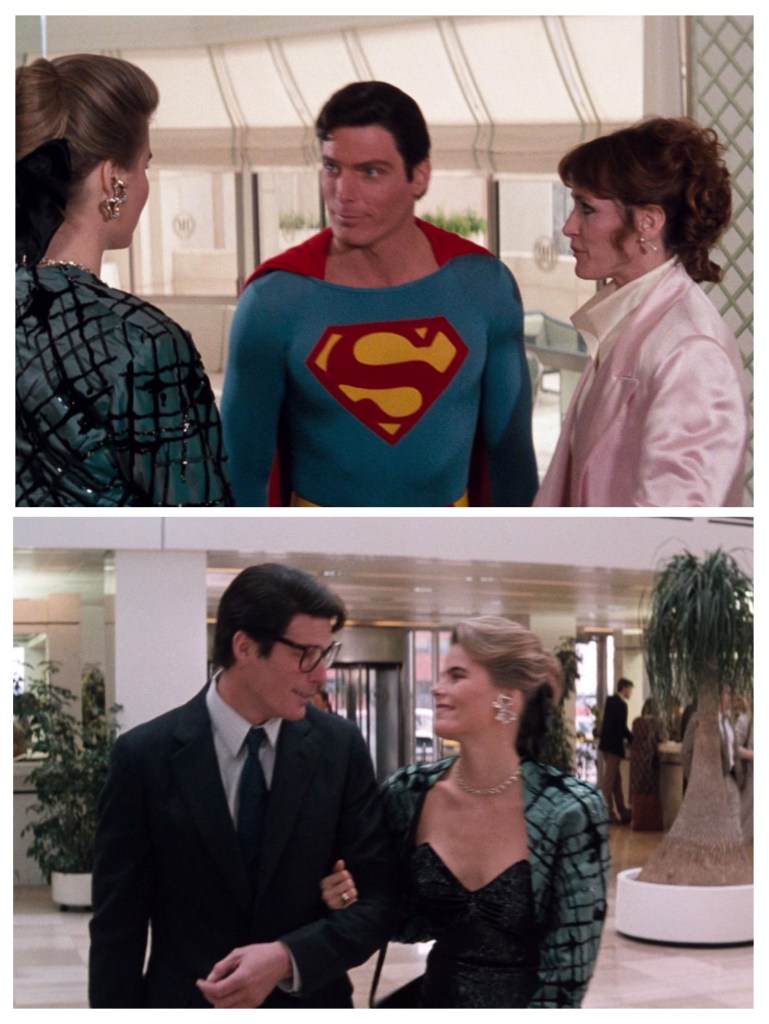
The double date to end all double dates. 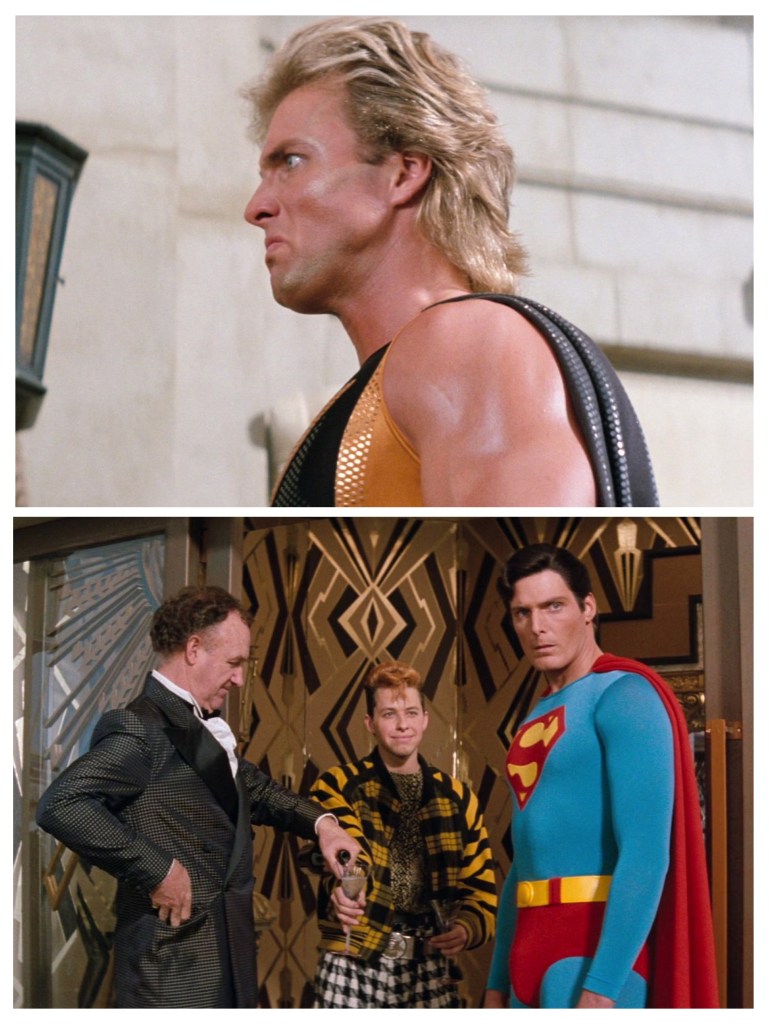
The confrontation begins. Now look at this particular moment during the double date when Lex Luthor contacts Superman via his private “Lex TV” frequency. Pay particular attention to the movie marquees at the bottom of the screen.
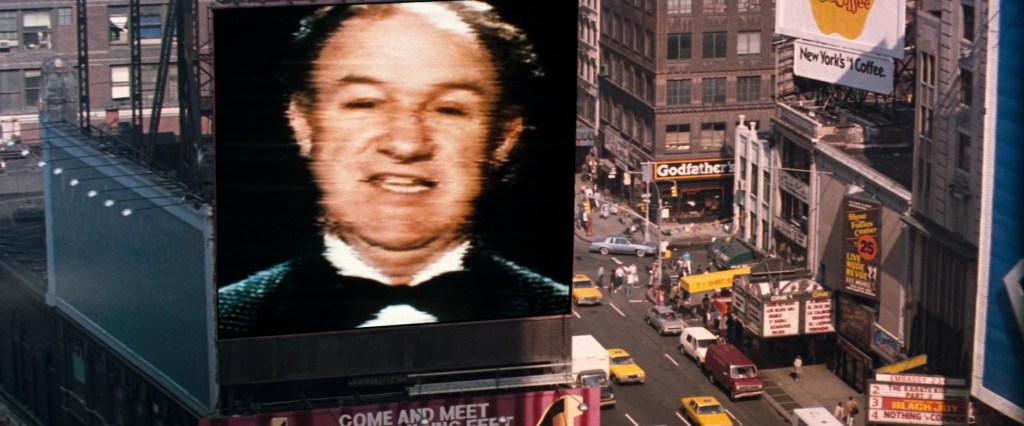
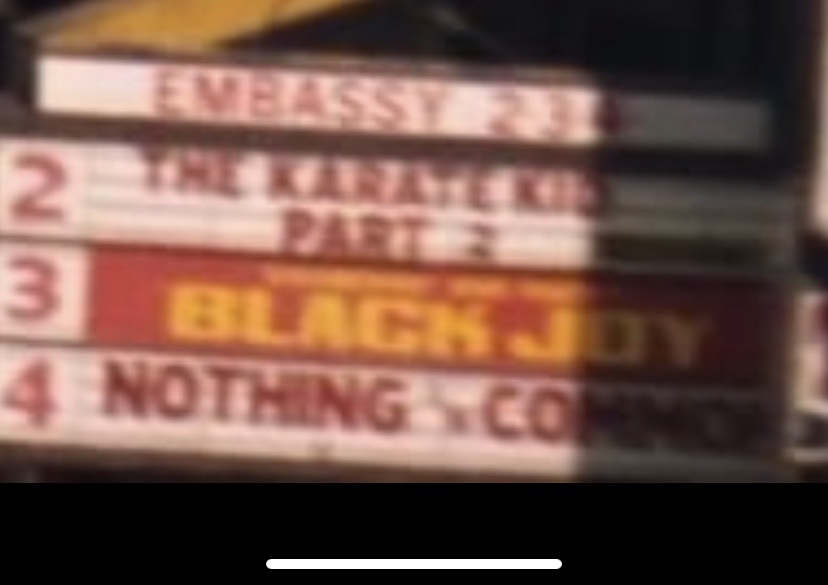
The Karate Kid Part II was released on June 20, 1986, while Nothing in Common was released on July 30, 1986. If we consider the above headline and the fairly quick placement of the events of the film, there’s no way that, barring the thought of the film spanning the course of a year, all of these things could happen shortly after August 1985. Time is out of joint indeed, to borrow from Shakespeare.
This should give you an indication of how the events of the Superman films are placed chronologically. You may have arrived at the same estimation that I have. Of course, your mileage may vary.
(Some of the screenshots in this blog are used courtesy of CapedWonder.com.)
-
In the Very Merry Month of May…
The month of May always brings about changes. The transition of weather from spring to the first hints of summer, graduations from high school and college, the start of the summer film season in theaters when those first big films that have been heavily awaited are released. Vacations planned or taken. The list goes on and on.
The Superman films had lots of activities occurring in the latter half of the month of May, so let’s take a look at a few of them over the years…
1977
As production on the first two Superman movies moved forward, filming had occurred at Shepperton Studios on all of the Krypton sequences and the Fortress of Solitude interior scenes. By the latter half of May 1977, filming was nearing an end at Shepperton, and the production crews were transitioning to Pinewood Studios, moving various departments to their new home over the month. But filming was still ongoing at this time on one critical sequence for Superman II.
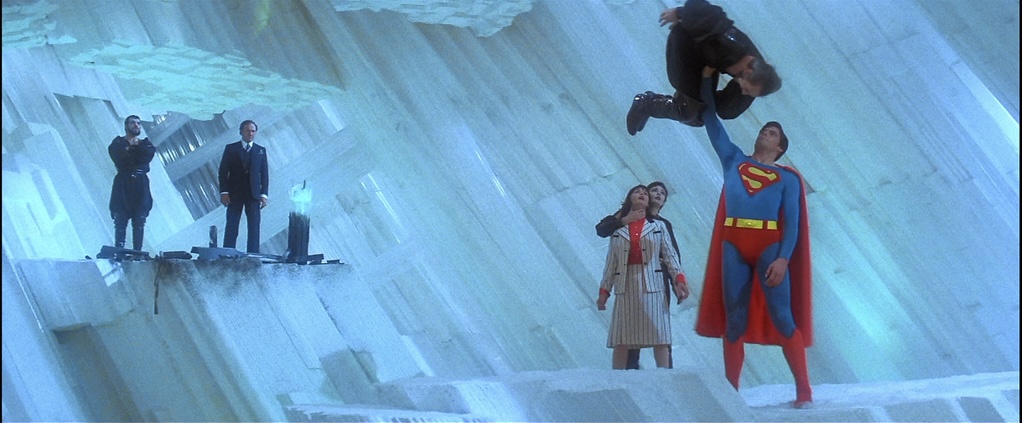
The final confrontation between the Man of Steel and the three villains from the Phantom Zone was one of the last major scenes filmed on M Stage at Shepperton before the production had fully shifted to Pinewood. The sequence called for wire work, stunt work, and carefully executed filming, with multiple takes of certain shots filmed from May 18-20 that year. About half of the sequence would make it into the final theatrical version of Superman II, while some trims and added pieces would later be included in the extended TV cut in 1984. (To this day we still await word from the Warner Archive of a complete Blu-ray release of the extended version.) The full version of the sequence would later be freshened up with alternate angles and the rest of the footage for inclusion in Superman II: The Richard Donner Cut in 2006. I personally prefer the version in the Donner Cut, as it has more psychological appeal to the verbal confrontation between Superman and General Zod.
But that would not be the final scene shot at Shepperton in May 1977.
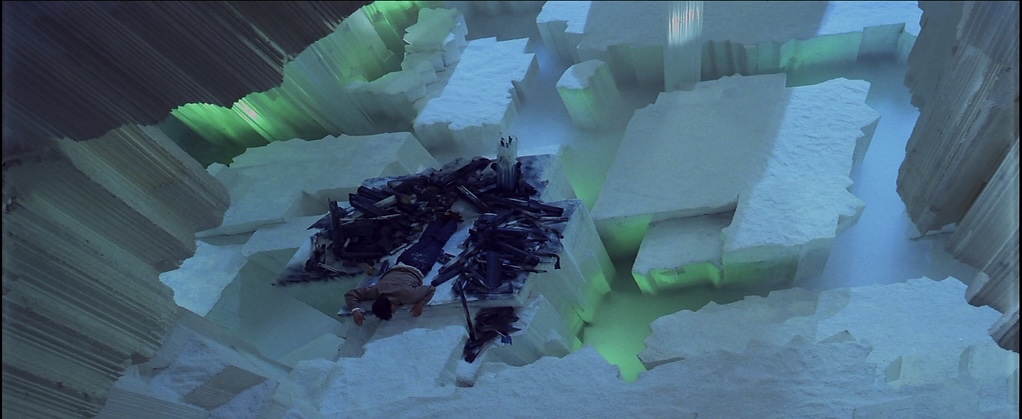
A few days later, on May 25th, Richard Donner would shoot some pickup shots of Christopher Reeve as an unconscious Clark Kent, having had his powers restored by the sacrifice of his father Jor-El, on the Fortress set. The rest of the scene had been shot the previous month, in April 1977, with Marlon Brando reading all of his lines against black velvet, followed by Brando and Reeve filming their portion together against a blue screen, followed by Reeve as a battered Clark Kent in the Fortress. All that remained were a few insert shots that were later done with Michael Thau’s hands in 2006 for the Donner Cut.
After that, the magnificent set of the Fortress interior was taken down, and the last of the crew and cast would make their way to Pinewood to continue work on the Superman films. Of course, other things across the pond were transpiring on the same day, as a little known film started making its way across US movie theaters, which had a certain influence on Superman and forever changed the way we viewed movies in the modern era. You know which one I’m talking about.
It definitely wasn’t this one. 1978
By May 1978, filming on Superman II had been shelved and was due to resume production after the release of the first film. Shooting was nearly completed, and the Salkinds had flown yet another plane across the Cannes Film Festival announcing that principal photography on Superman was finished. But not by a long shot. There was the film’s ending that needed to be completed. Many of the film’s elaborate visual effects still needed to be finished. Insert shots, pickup filming, plate filming, editing, music, the list went on and on, all to get the film out for its theatrical release in December 1978. The race was on.
By the latter half of the month, Richard Donner had already filmed the interior portions of the Air Force One cockpit and the live action portions of Superman holding up the railing of the broken train tracks. (The background plate for the latter shot would be filmed a few months later.)
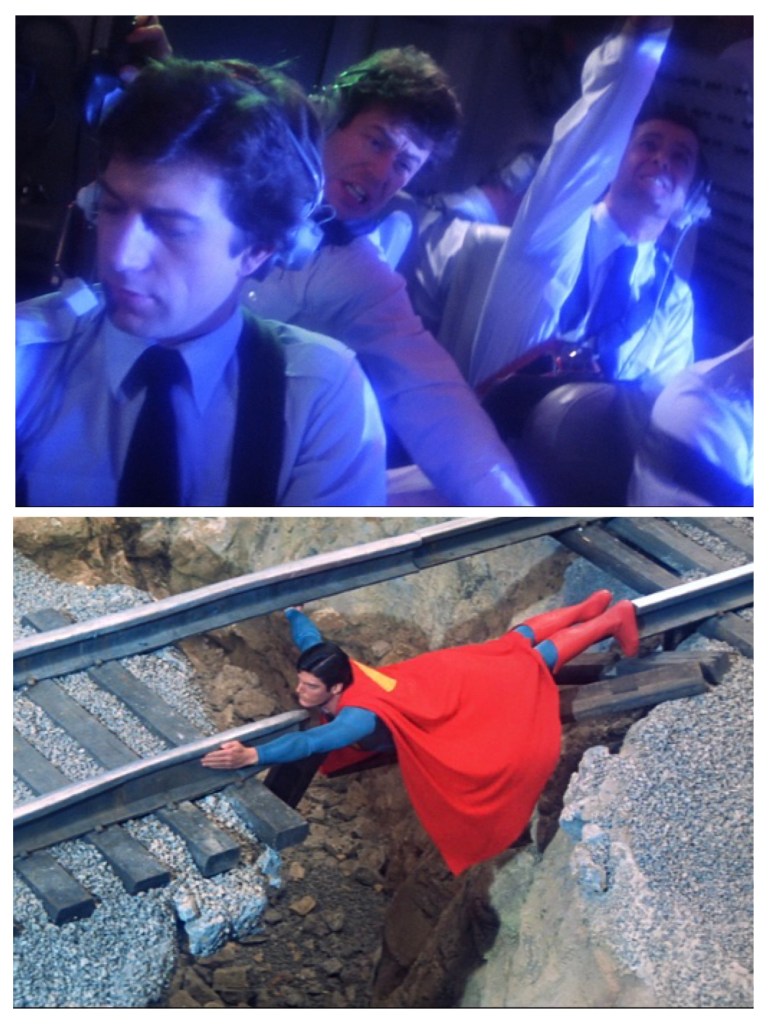
Now Donner was preparing to go out on location again, this time to Gallup, New Mexico for several spectacular shots that would comprise the film’s stunning climax. Months earlier, Tom Mankiewicz had rewritten the ending to the film to allow for the death of Lois Lane and for the most spectacular climax of the two films—Superman turning back time—to be moved to the end of the first film, thereby allowing an emotional payoff. Donner and Mankiewicz agreed that when they returned to work on Superman II, they would create a new ending for that film.
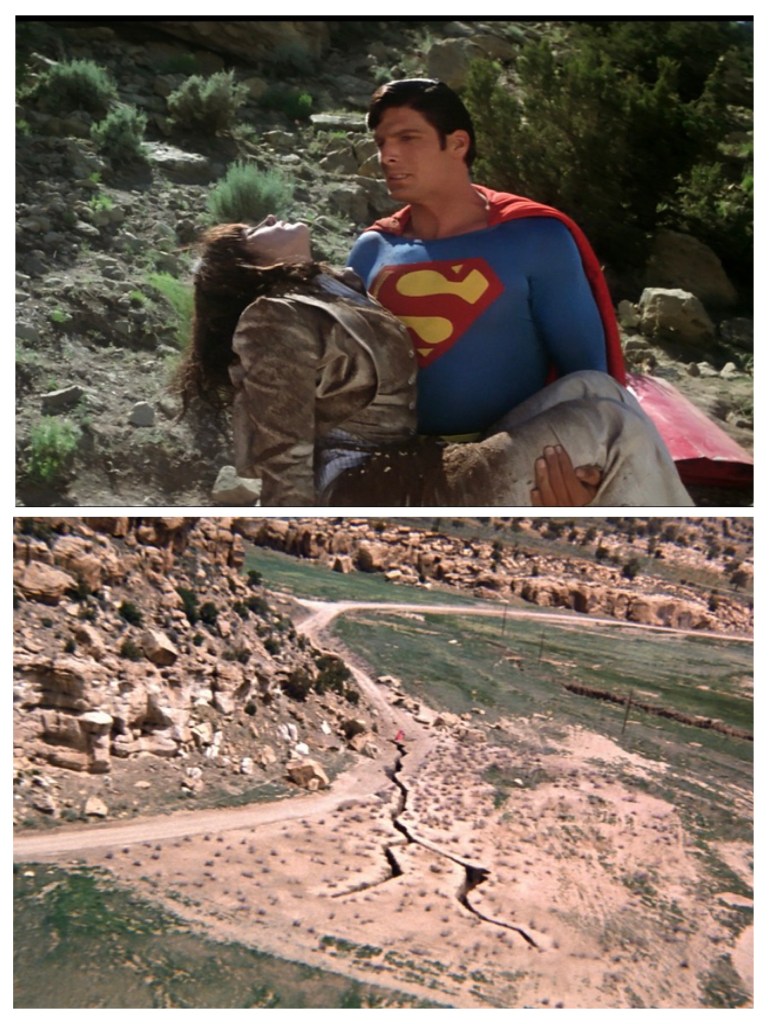
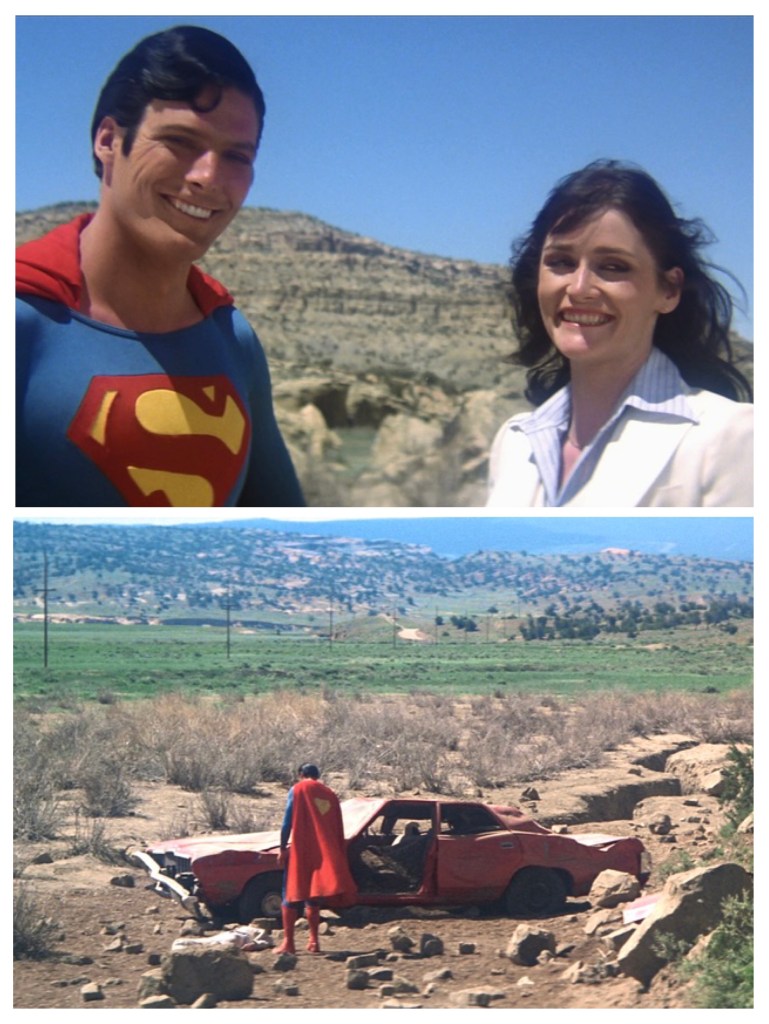
Donner, Christopher Reeve, Margot Kidder, Marc McClure, cameraman Robert Collins, still photographers Bob Penn and Curt Gunther, and a small team would travel to New Mexico for several days of on location filming for the ending, which further grounded the film in that sense of verisimilitude that Donner had strived for since he first entered the project. Today the location is known by fans as Superman Canyon.
1979
In May 1979, production had resumed on Superman II. The first film had proved to be a massive success, far beyond everyone’s expectations, and all of a sudden movie studios were like, “Get me one of those!” Which still further proves why Superman is the gold standard for the superhero film genre to this day.
But things had changed. Richard Donner was out, and Richard Lester was now in the director’s chair. Tom Mankiewicz refused to return for the sequel, citing his friendship with and loyalty to Donner. Marlon Brando had sued the Salkinds for licensing issues, and he would be written out of the sequel. Gene Hackman had chosen not to return as well, citing his loyalty to Donner as well. The ripple effect of Donner’s firing had affected the entire production crew. In addition, cinematographer Geoffrey Unsworth had sadly passed away before the release of the first film, and by June 1, 1979 production designer John Barry would pass away from meningitis while working as a second unit director on The Empire Strikes Back. (To this day I wonder which clips of that film were Barry’s.) Richard Lester had the unenviable task of bringing in Peter Murton and Robert Paynter to fill those roles, and we have to give credit where it is due, they had huge shoes to fill, and part of the success of Superman II is due to their work.
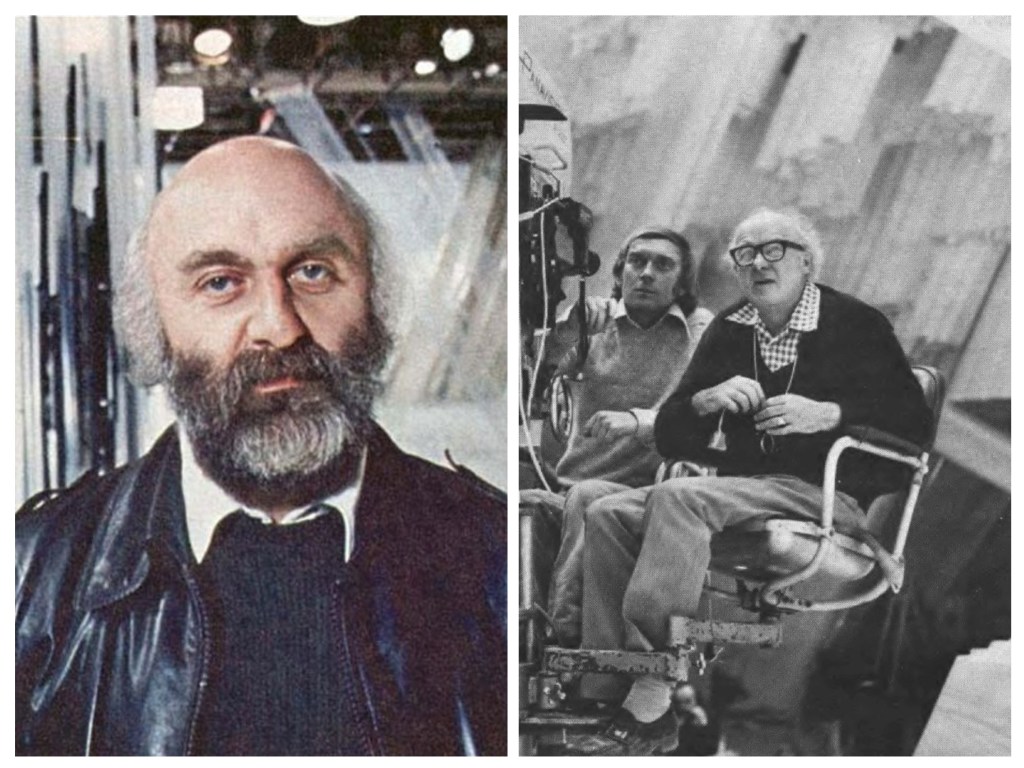
Two master craftsmen. Their work may be imitated but never duplicated. By this time David and Leslie Newman had submitted a revised outline for the script, which incorporated portions of the Mankiewicz script that were needed along with new material, and stunt coordinator Paul Weston began to sketch out ideas for the various flying sequences that would occur in the film, particularly the battle scenes in Metropolis. And Christopher Reeve had traveled to Mackinac Island, Michigan, to begin six weeks of filming his next film, a low budget romantic period piece that would become the timeless classic Somewhere in Time, before returning to work on Superman II.
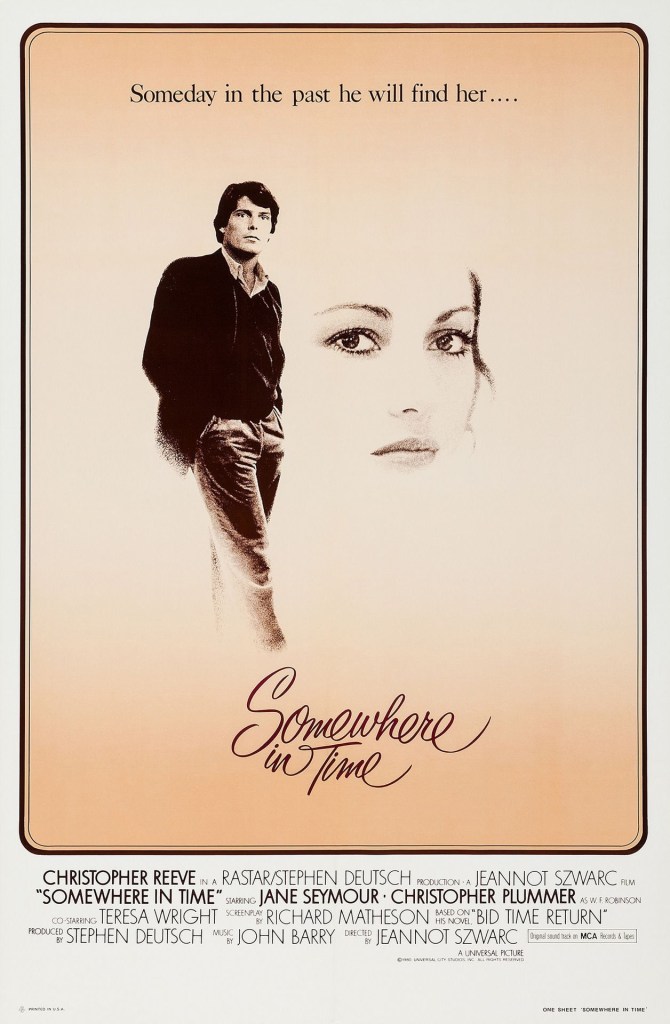
Also known as “How I Spent My Summer Vacation.” It would take several months through 1979 and into the first quarter of 1980 to bring the film to completion, and to this day fans and critics are divided between the different uneven styles of direction. And now with both versions of the film ready for viewing—four, if you count the extended TV cut and the longer 122-minute version of the Donner Cut on Amazon Prime—the debate is one that continues to draw comparisons and contrasts to this day.
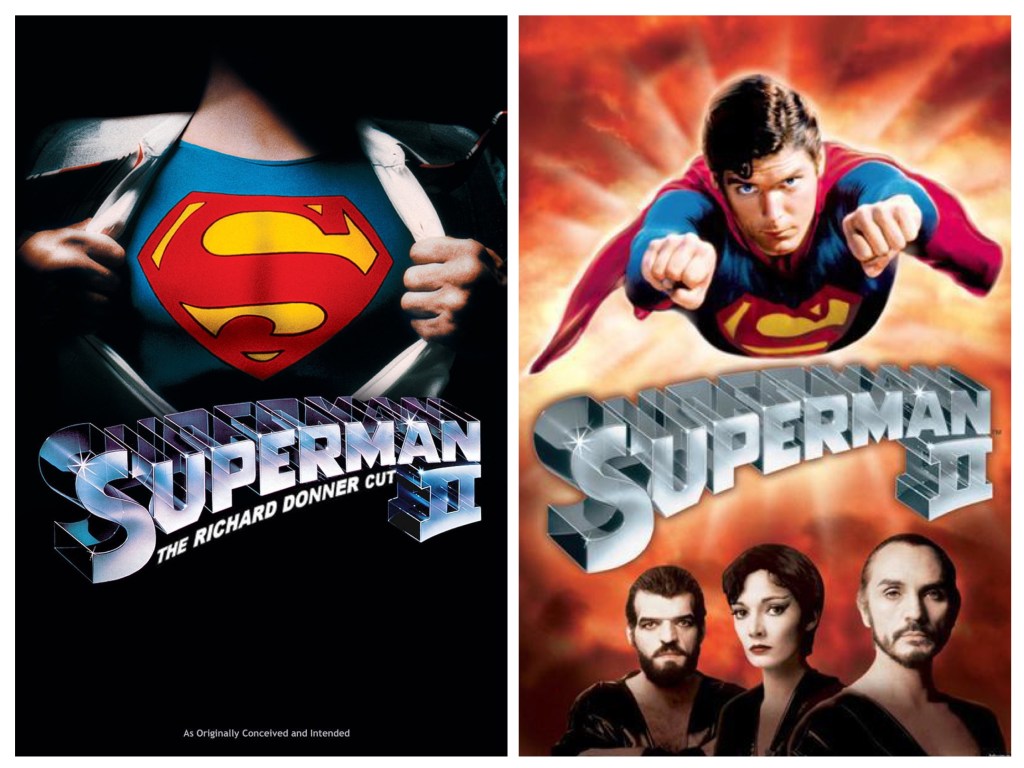
Pick your poison wisely before going to the debates. Three years into the life of filming on the two Superman movies. How time flies by indeed. And this is just a small sample.
-
Those Super Cameos! – Postscript
So I’ve been in the middle of my next blog for the site, as well as laying down the groundwork for a special Superman III 40th anniversary blog coming soon, and earlier today at work this thought crossed my mind…
There was one more cameo from within the Superman films that I completely forgot about! So allow me to correct that oversight right now, and this one’s a cameo that we are quite familiar with…
Aaron Smolinksi
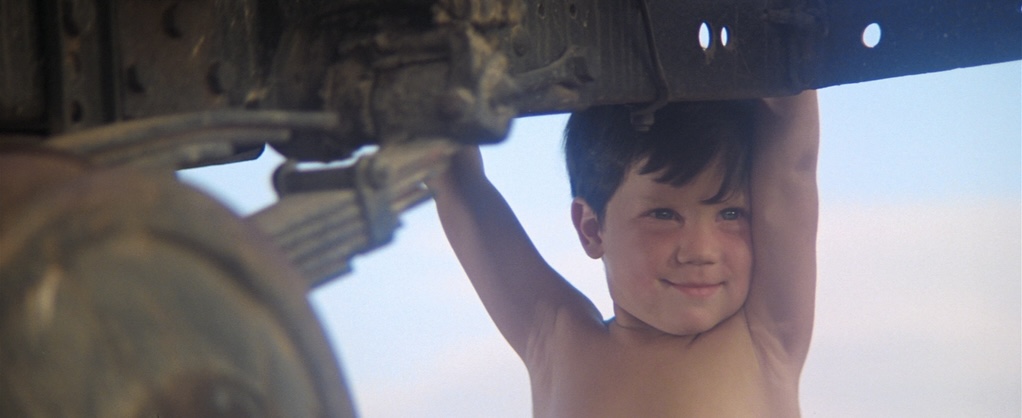
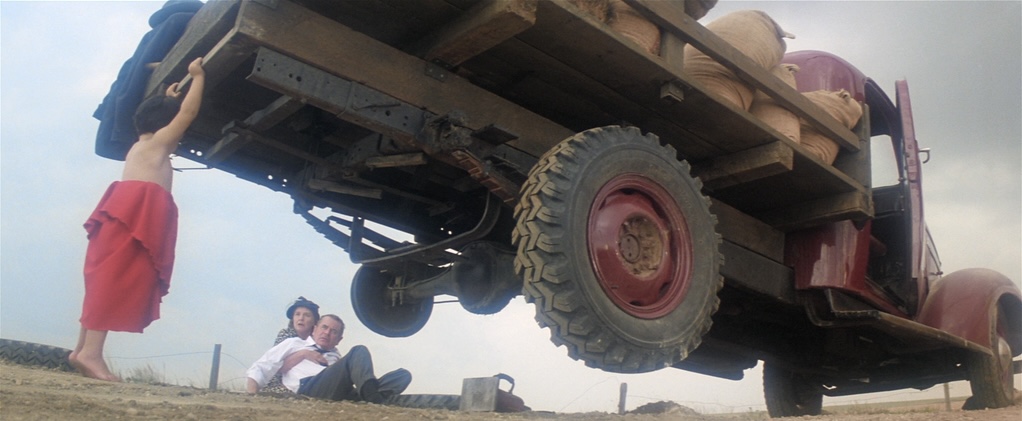
This young man first arrived on the scene—in his case, literally—in the first Superman film as the three-year-old toddler Kal-El with quite the memorable entrance, followed by one of the most iconic scenes in the film as he rescues Jonathan Kent from injury and almost certain death by lifting the truck over his head and standing on his tippy toes.
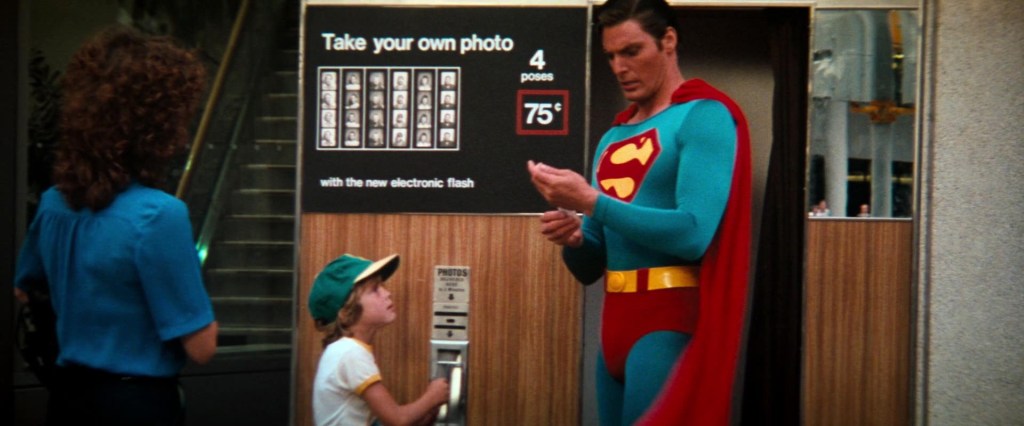
“When I grow up, I’m going to look like him!” Aaron would return four and a half years later (along with his parents) in a quick moment during the opening scenes of Superman III, as young Aaron asks his mom for some money to use a local photo booth to take a picture, when out pops the Man of Steel himself. Little Aaron is awestruck, while Superman realizes that his double identity is in jeopardy when the photo strip shows him changing from Clark Kent into Superman. He tears off the bottom photo and gives it to Aaron before taking off and saving a man from drowning in his own car. Aaron and his mom watch from the photo booth, while Aaron’s dad is one of the people who unsuccessfully attempt to save the man from drowning.
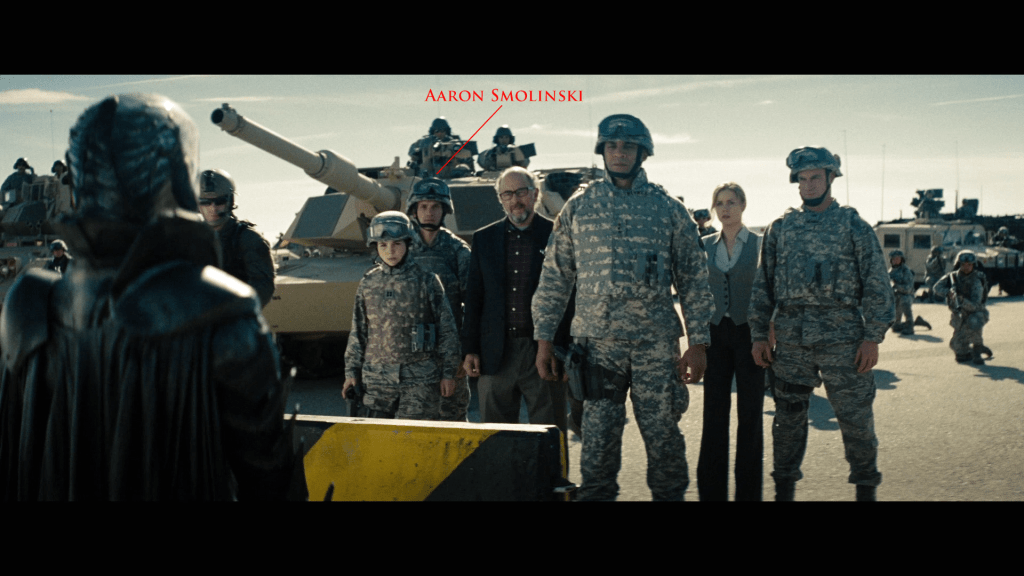
Thirty years later, Aaron would make yet another brief appearance in a Superman movie, this time as a military officer in the 2013 film Man of Steel during the sequence when the lead character confronts General Zod and his troops in the desert.
So I couldn’t go any further without mentioning Aaron’s Superman III cameo. Aaron, my friend, if you’re reading this, forgive me for my brain deficit in leaving you out! It was not intentional. Many apologies!
(Some of the screenshots in this blog are used courtesy of CapedWonder.com.)
-
The Legacy Reunion: One Year Later
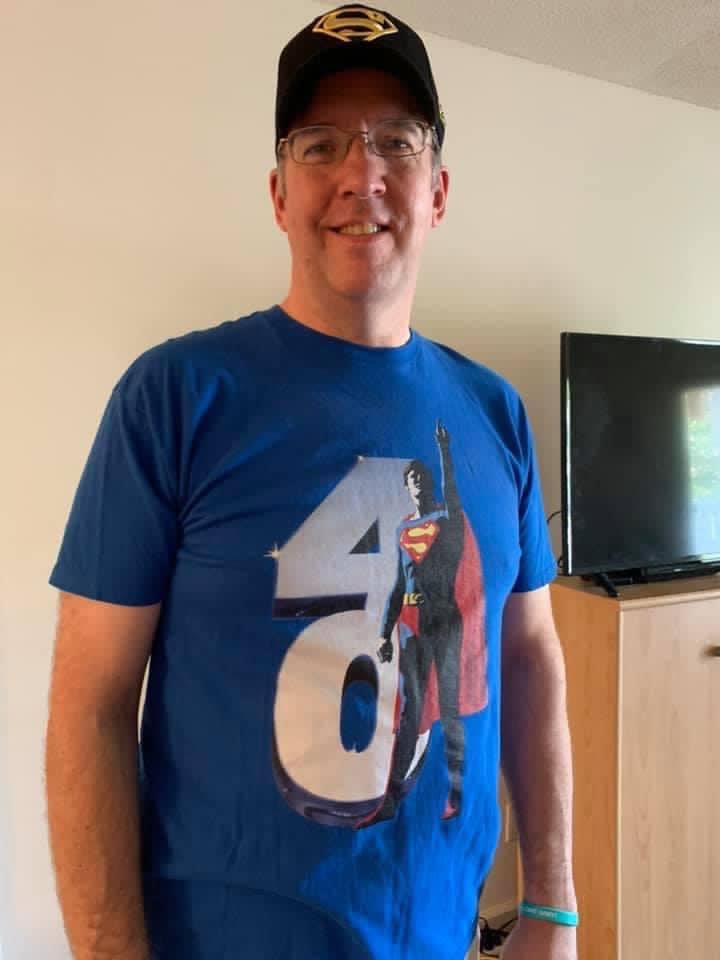
This is something that I’ve wanted to share for quite some time, and it would have come earlier in the week, but I’d battled a nasty stomach bug for a good part of the week, and only now am I strong enough to get this blog finished and ready to share with you. Sometimes you just have to take care of yourself first, and that’s okay.
It’s hard to believe that it’s been a year since the Christopher Reeve Legacy Reunion took place at the Motor City Comic Con in Detroit. And yet the memories are so thick, it’s like I was there yesterday.
The Legacy Reunion marked the first time since the 2015 WonderCon that a large assemblage of cast members from the Superman film series gathered together. And the 2022 Motor City Comic Con was the first time that a large comic con was held since the outbreak of Covid in the spring of 2020. So this was going to be a fascinating time for all.
I had first heard about the 2022 Motor City Comic Con from Jay Towers and Jim Bowers during a special broadcast of the CapedWonder Superman Podcast three months earlier, and what an announcement it was! There would be seven different actors and actresses from the Superman films all in one place. Sarah Douglas, Jack O’Halloran, Marc McClure, Aaron Smolinksi, Mark Pillow, Mariel Hemingway, and Damien McLawhorn – all in the same place. And joining them would be writer Robert Venditti and artist Wilfredo Torres, the creative duo behind the highly successful Superman ‘78 series. What a lineup indeed! And that was just for starters.
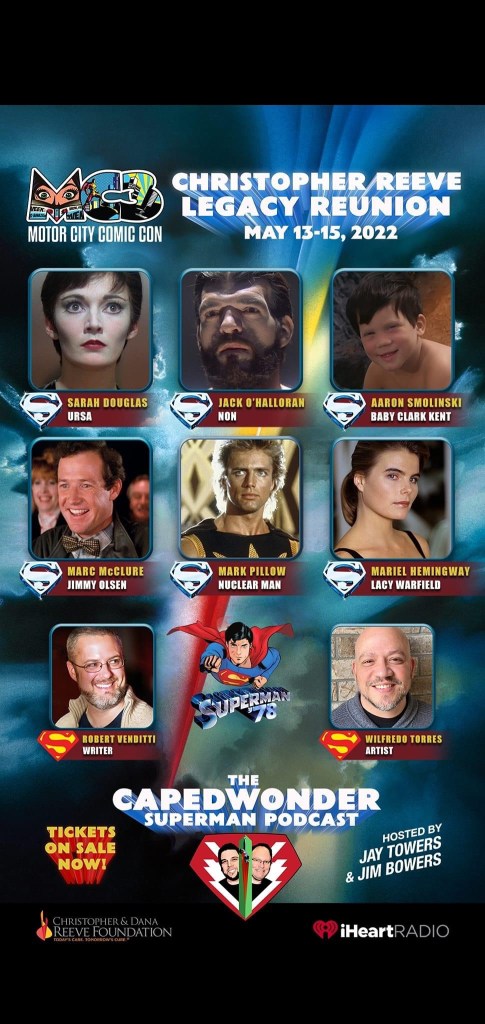
The super lineup. Somehow, something inside of me clicked. And I told myself, go. So I started working hard and saving my money for the trip. I worked as many overtime hours as I could to save for lodging, gasoline, food, admission to the convention, autographs from the actors, swag from the convention, and a photo opportunity with the cast. No credit cards. I’m sure a number of people had used their credit cards for numerous purposes that weekend, but not me. I was determined to pay for it all out of pocket and not worry about incurring any debt whatsoever for the convention.
One of the first things that would be a part of the Legacy Reunion was a special screening of Superman IV: The Quest for Peace at the Novi Theater close to the convention. I was determined to get there in time for the film. It would have been the first time since its release in 1987 that I would see the film on the big screen with an audience. At least that was the plan.
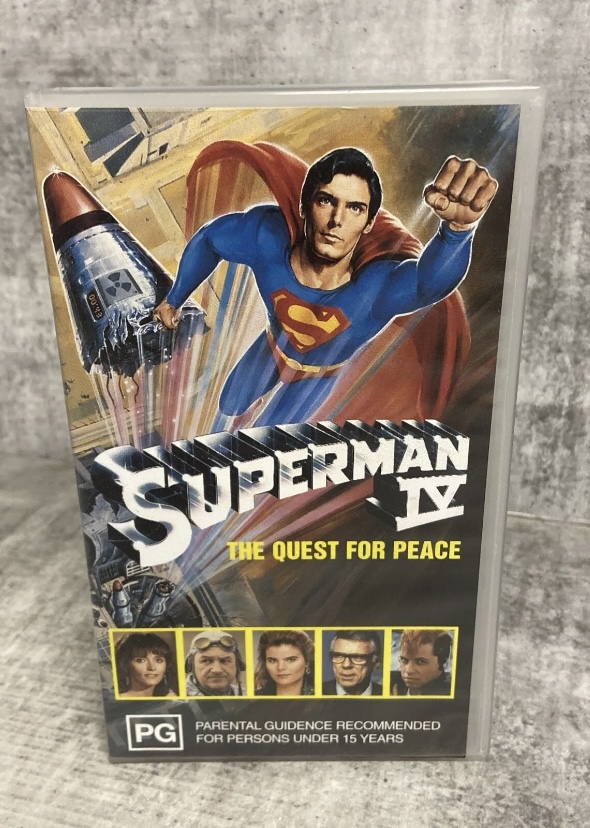
As the saying goes, the best laid plans of mice and men go awry. Apple Maps told me it would take me a little over ten hours to get from Alabama to Detroit. It took me thirteen hours and change because of slow traffic through Kentucky, and because of construction delays and a massive amount of 18-wheelers through Michigan on my way to Detroit. Ugh. It was like pulling teeth getting through all of that traffic. When I finally arrived at the Novi Theater, it was around 9:00 or 9:30 that evening. And the movie had ended. Ugh.
But it was there that I got to meet several fans and friends whom I had connected through Facebook and the CapedWonder Superman groups, and now we were together in the same place. Andrew Hanton and Martin Lakin had arrived from England for the convention. Ty Bjornson was there, along with Daniel Sanchez, one of the most prominent Superman cosplayers in the country. And Lynn Anderson, a fun wonderful lady who is also a Lois Lane cosplayer and who was friends with Christopher and Dana Reeve. And my friend Brad Day and his son Andrew had come all the way from the Gulf Coast in Mississippi. It had been four years since Brad and I had seen each other since the 2018 Superman Celebration in Metropolis, so it was wonderful to connect with him again.
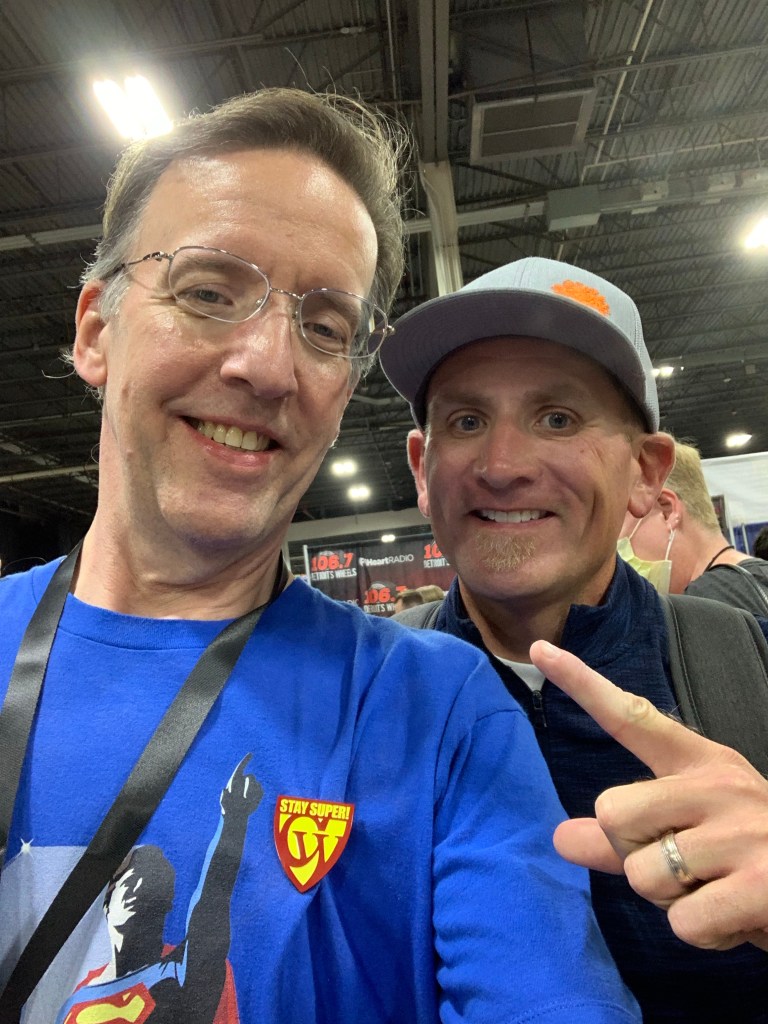
CapedWonder Southern boys representing! But it turns out that I didn’t miss much where the film was concerned. It had been the 92-minute extended version, according to Ty. It would have been the first time that I would have seen the extended version on the big screen. Oh well, it happens. But I was able to see a recreation of the teaser trailer for The Goonies, another fan favorite Richard Donner film. There was also a special trailer for a fan re-edit of Far and Away, which combined theatrical footage and clips from the extended TV broadcast.
But afterwards I got to spend some time with Ty, Lynn, Daniel, Damien McLawhorn, and two other fans, Dave Santia and Frank Berman. Frank had with him the actual photomat prop of Clark Kent changing into Superman from Superman III. I have a 1-1 replica of that photo strip, but to see the actual screen-used prop, complete with the rip that Christopher Reeve made on screen in the film, was even more impressive.

The real deal! If that Friday night was fun in and of itself, the real fun began the next day when I arrived at Motor City with Ty and Daniel. Right from the start the three of us bonded like we were old friends.
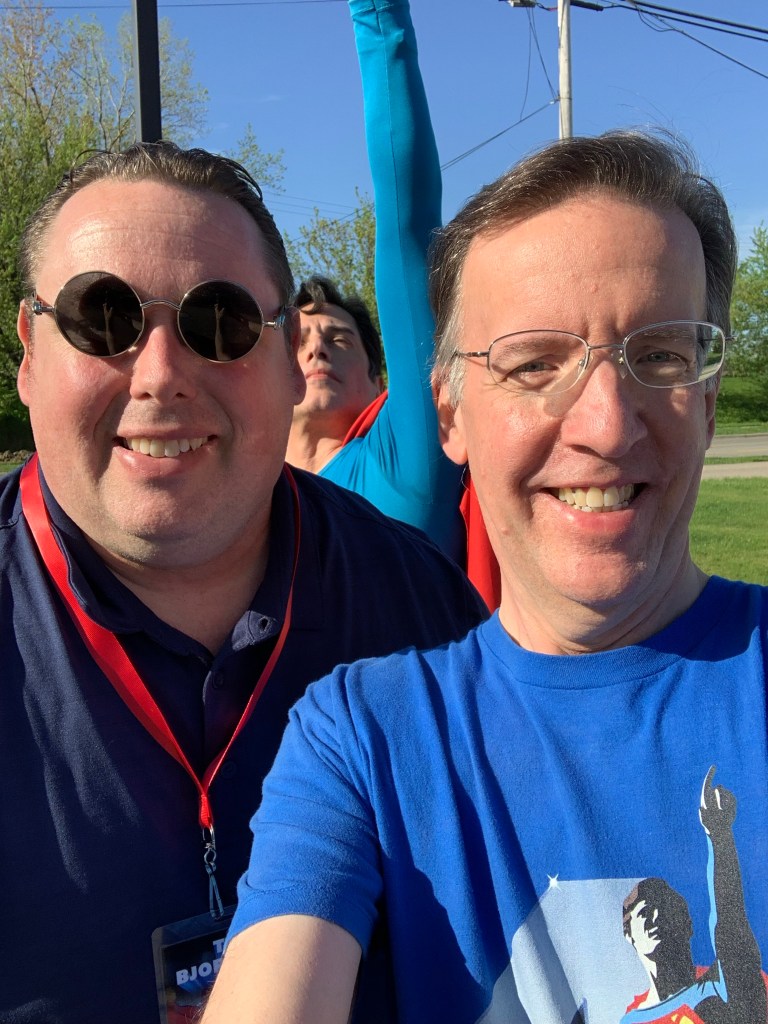
Once we arrived at the venue, the atmosphere was far beyond what I had imagined or even expected. Thousands of people in attendance to meet their favorite celebrities, comics artists and writers, and other fans. Booths as far as the eye could see with posters, comics, collectibles, you name it. And everywhere you turned, lots and lots of cosplayers from different films and television series. It wasn’t hard to spot a Darth Vader, a Lego Mandalorian, a Baby Yoda, numerous stormtroopers and Wookiees, and an assortment of droids. Of course, I spotted a fully functioning R2-D2, and I couldn’t help but feel like the boy who first saw Star Wars in a darkened theater with my parents back in 1977. I was that awestruck, I had to ask R2’s permission to have my picture taken with him. If you’re going to do it, do it right.
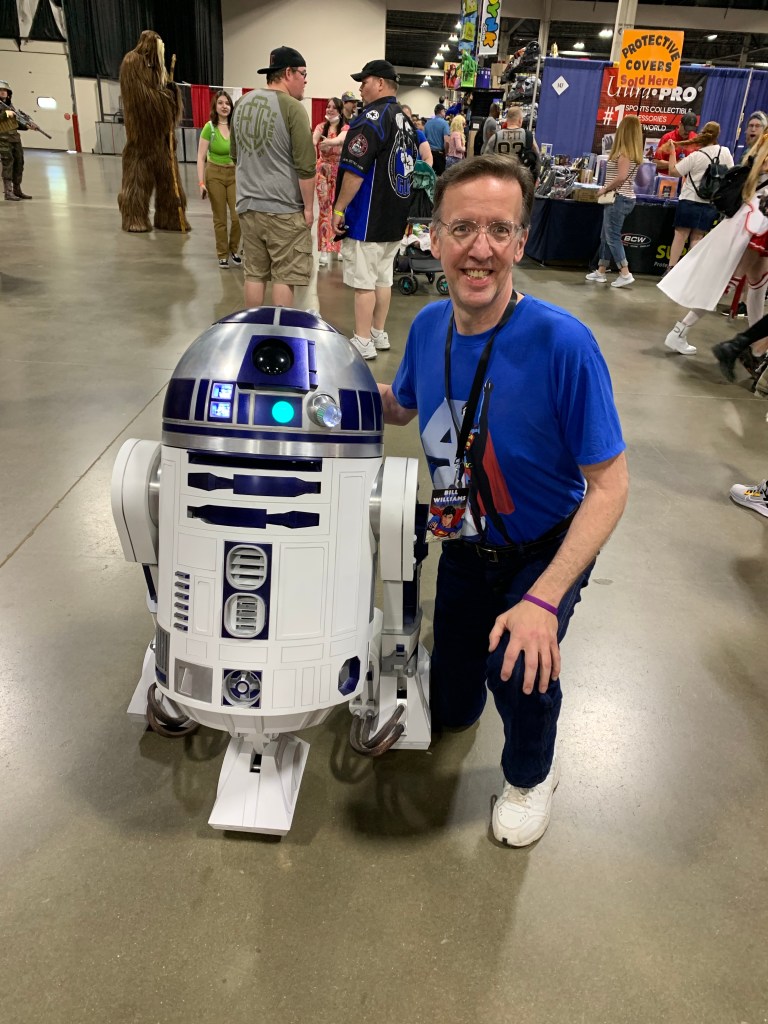
My inner ten-year-old was happy! And then there were these cosplayers… see anything familiar?
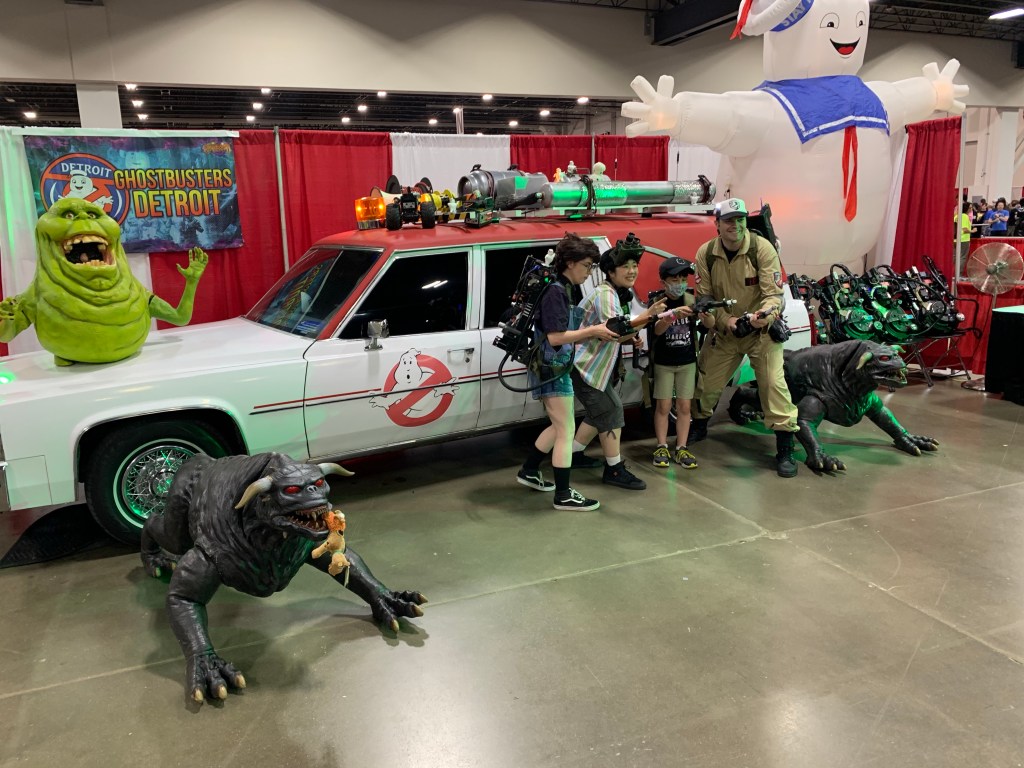
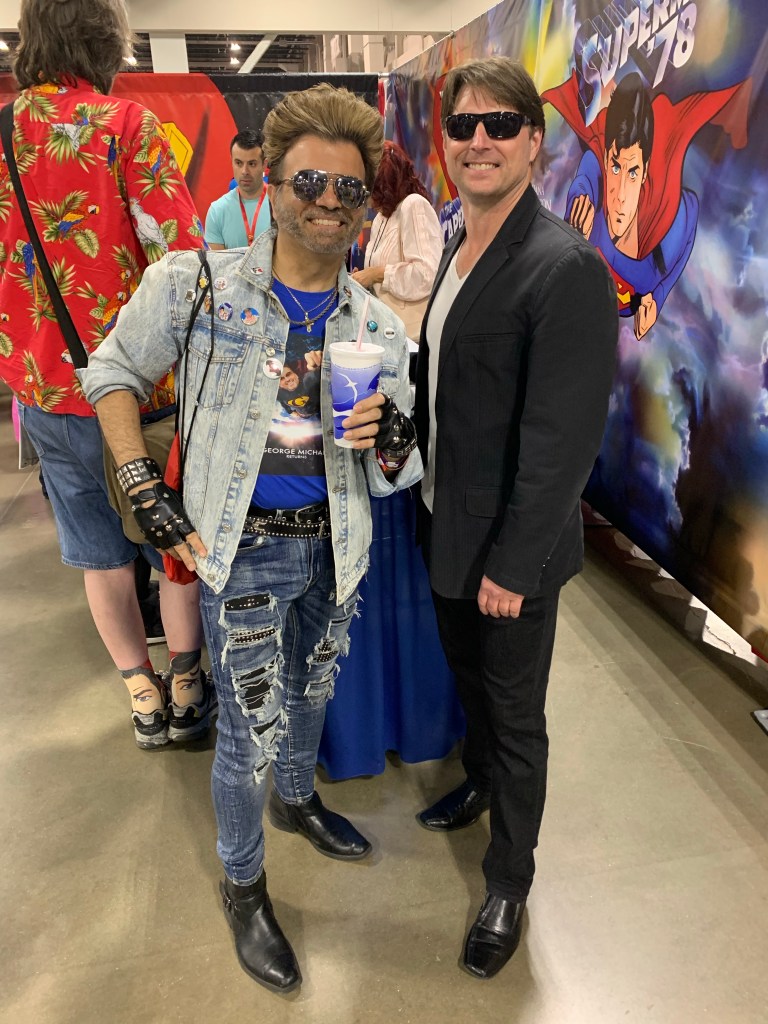
Total 80’s throwbacks! And then there was this cosplayer… perhaps the most creative one of them all that was there!
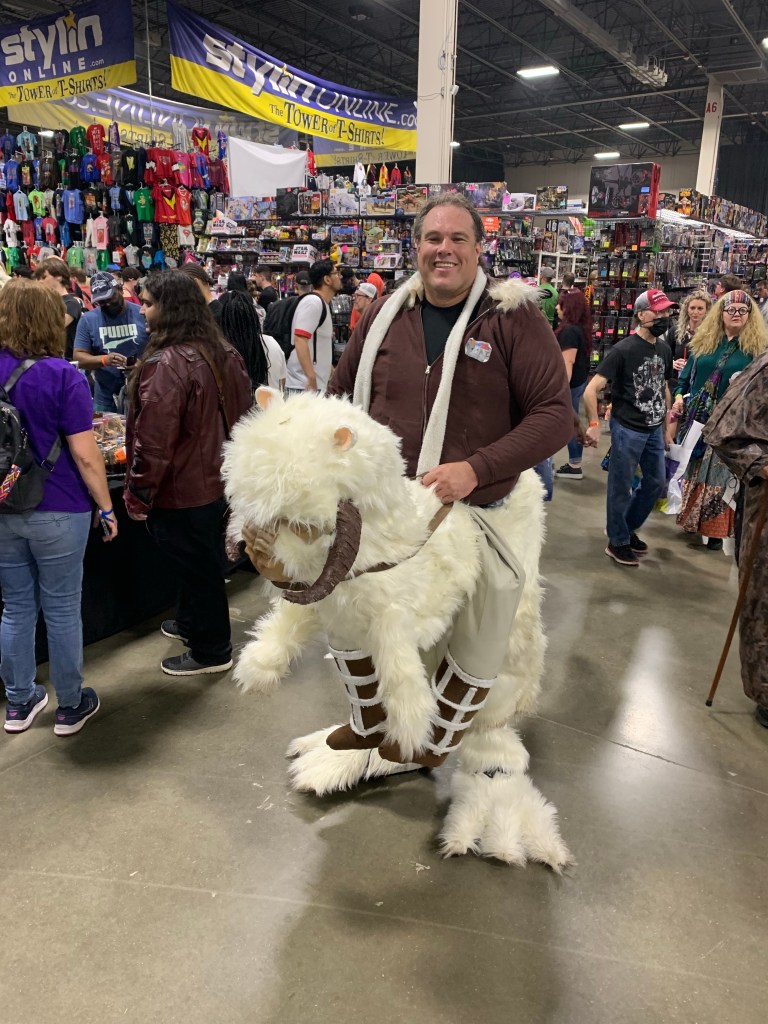
Suffice it to say, his tauntaun didn’t freeze before he reached the first marker. And there were other celebrities there as well. Cary Elwes from The Princess Bride and Robin Hood: Men in Tights was there. (Side note: Cary Elwes was Marlon Brando’s assistant in March and April 1977 during his work on the two Superman films, so it would have been interesting to hear stories from him about working alongside Brando.) Alan Ritchson from Smallville and The Hunger Games. Alicia Silverstone from Clueless. Christopher Eccleston from Doctor Who and Thor: The Dark World. Danny Trejo, who made a memorable guest appearance as the rancor keeper in The Book of Boba Fett. Freddie Prinze, Jr. and Matthew Lillard from the Scooby-Doo movies. (Zoinks!) And that’s for starters.
But my focus was participating in the Christopher Reeve Legacy Reunion. To say that the meet and greet booth was huge is an understatement. It was the largest booth ever, and to accommodate seven actors and the Superman ‘78 creators was a big undertaking at that. And yet it all felt so close knit and maneuverable.
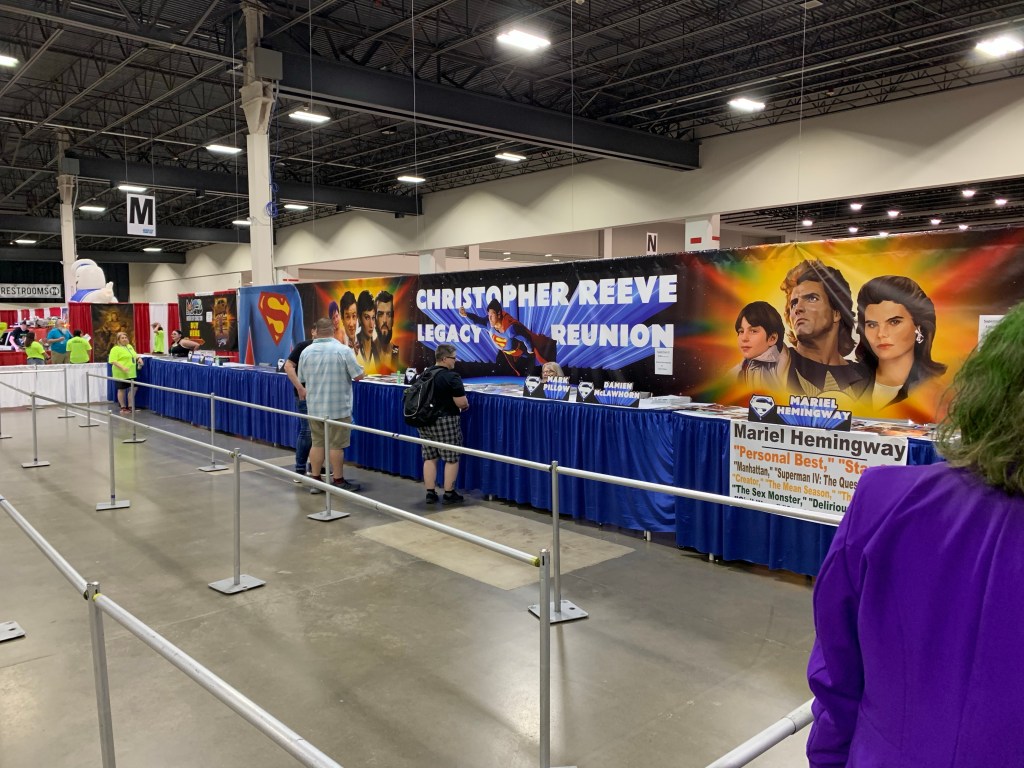
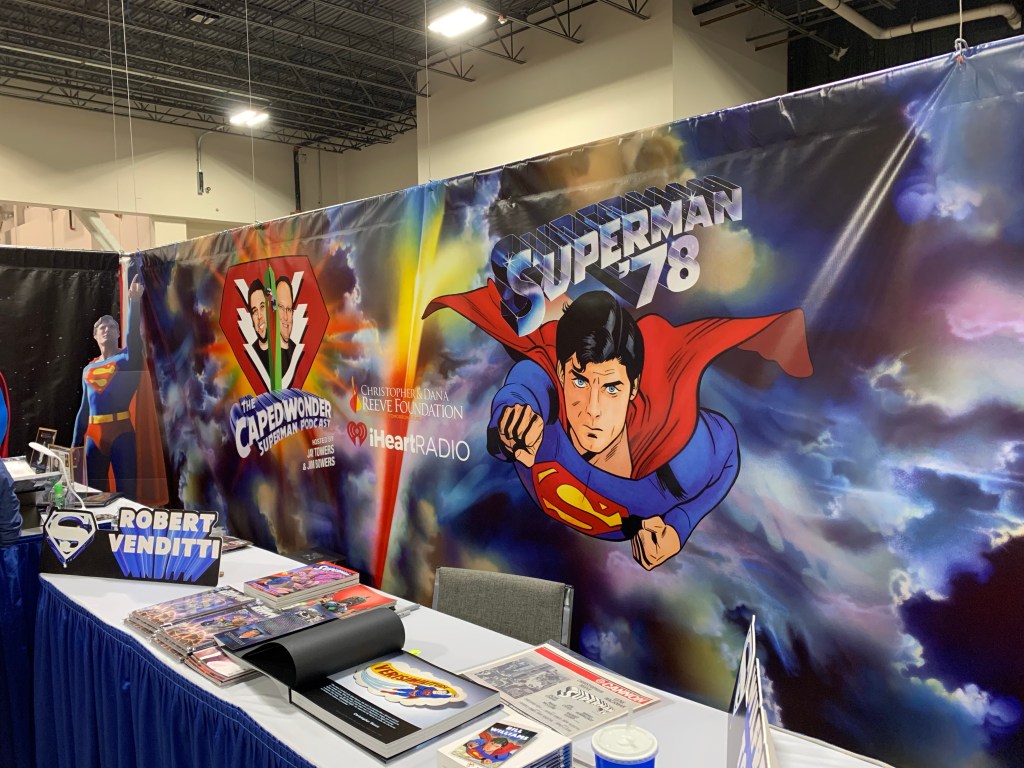
Of course, I also got to see my friend Jim Bowers again. We hadn’t seen each other since Metropolis in 2018, and even though we had texted and messaged and emailed each other and talked via Zoom for a couple of episodes of the podcast, it just wasn’t like being there with my friend. I first talked with Jim in 1997 through the Superman Cinema message boards, and that’s how our friendship began and continues to this day. He is as real and genuine and sincere in person as he is through all of the many forms of social media and instant messaging.
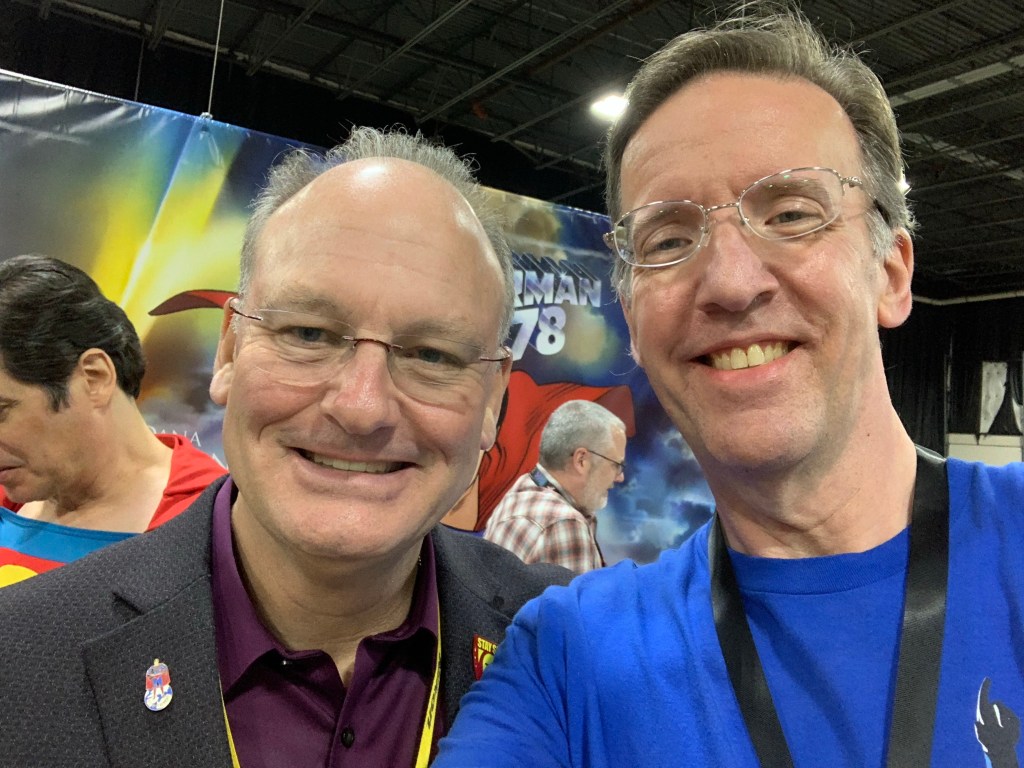
And then came meeting the actors. For a moment I felt awestruck because these were the actors and actresses who had all been on screen with Christopher Reeve for nearly ten years and across four films (five, if you count the Richard Donner Cut of Superman II). And yet these were real people, not larger than life except only on the big screen, giving of their time to meet the fans.
Marc McClure is, I would have to say, the most tenured of the actors who attended, having been in all of the Superman films and in the Supergirl spin-off film in 1984 (and even in an episode of Smallville). In one video on one of the Superman DVDs and one of the graphic novels he referred to Christopher Reeve as a teacher. He learned from Reeve’s example and has done his best to share those lessons with people to this day, just as all students become teachers and pass down their knowledge and experience to future generations.
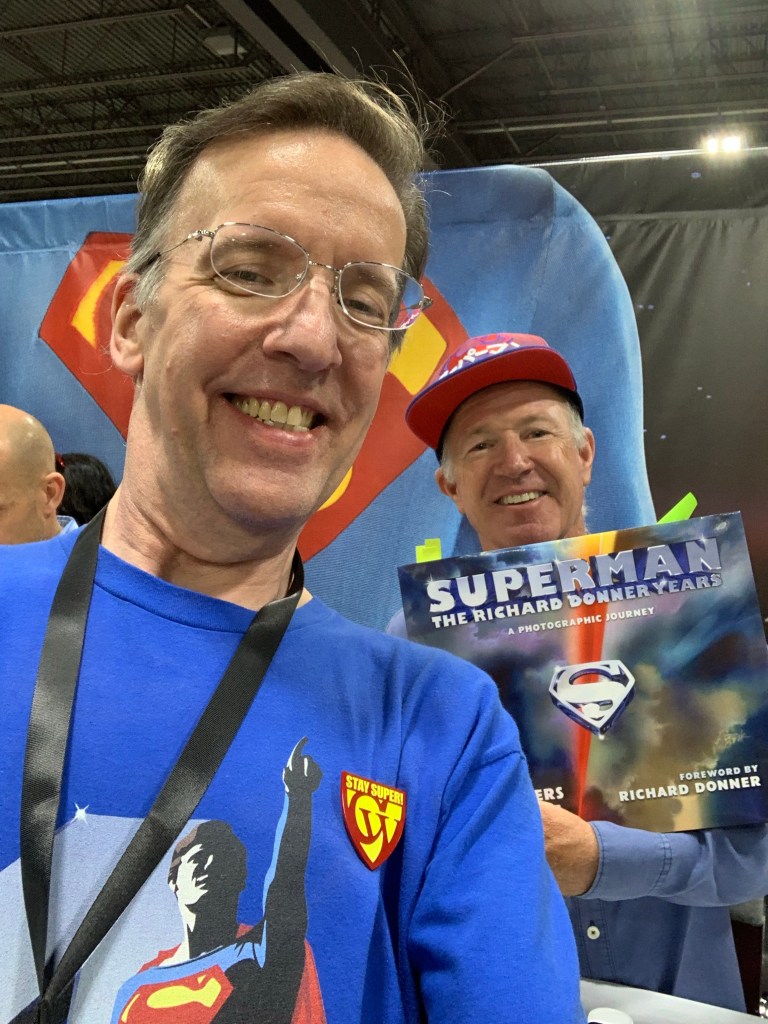
Jack O’Halloran… what a ball of fun he was! He is a fascinating storyteller and has such vivid memories of his boxing days and how he got into the acting business. He loves the fans that much, and we just give the love right back to him.
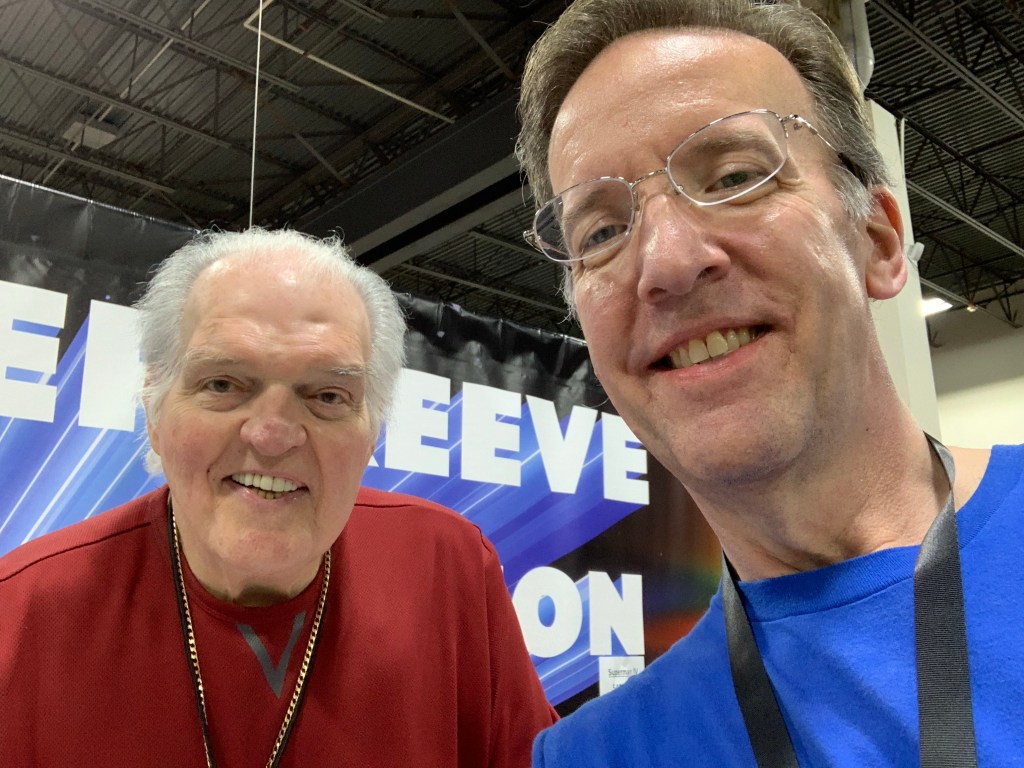
Aaron Smolinksi is more than just an actor from Superman and Superman III, he is a friend. We have connected with each other on Facebook and have shared similar life experiences with each other, and we have talked about those experiences with each other. And he is an encouraging soul, giving such positive outlooks to others both in person and on social media. That’s how much of a good soul Aaron is.
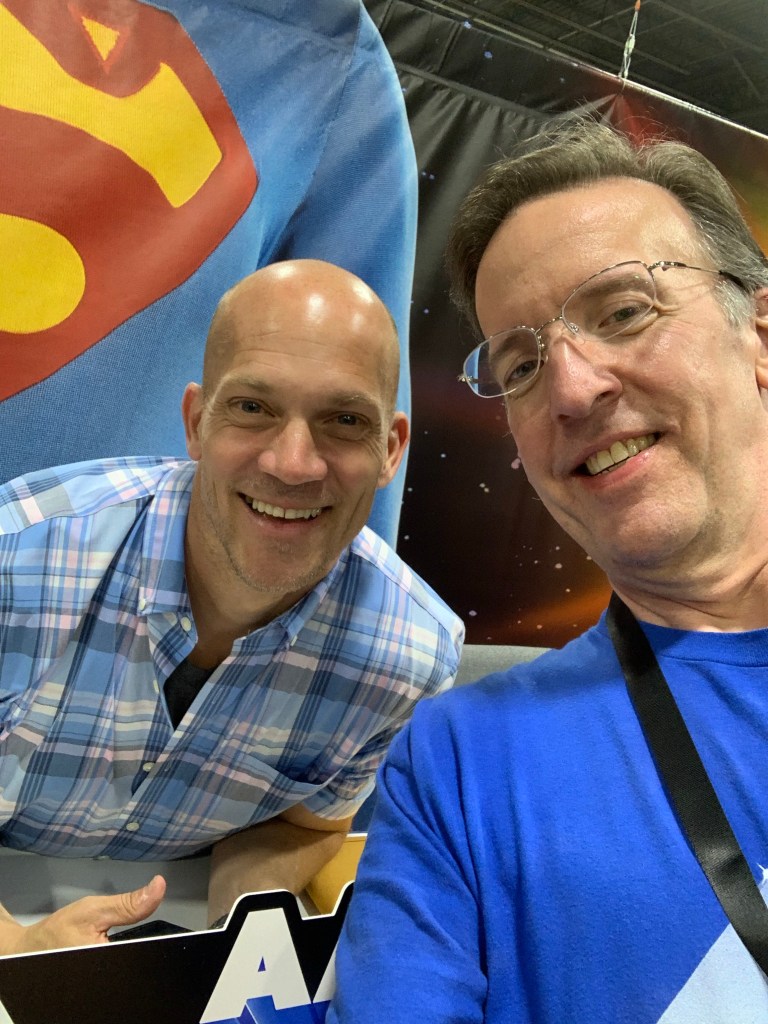
If there’s a single word that I can use to describe Mark Pillow, that word is humble. Granted, Superman IV was his only film appearance, but he has great memories of working alongside Christopher Reeve and Gene Hackman, even in the deleted scenes that appear on the DVD and Blu-ray. To this day he is thankful for the fans who remember him as the Nuclear Man. And believe me, he is as tall as I am, as tall as Reeve was.
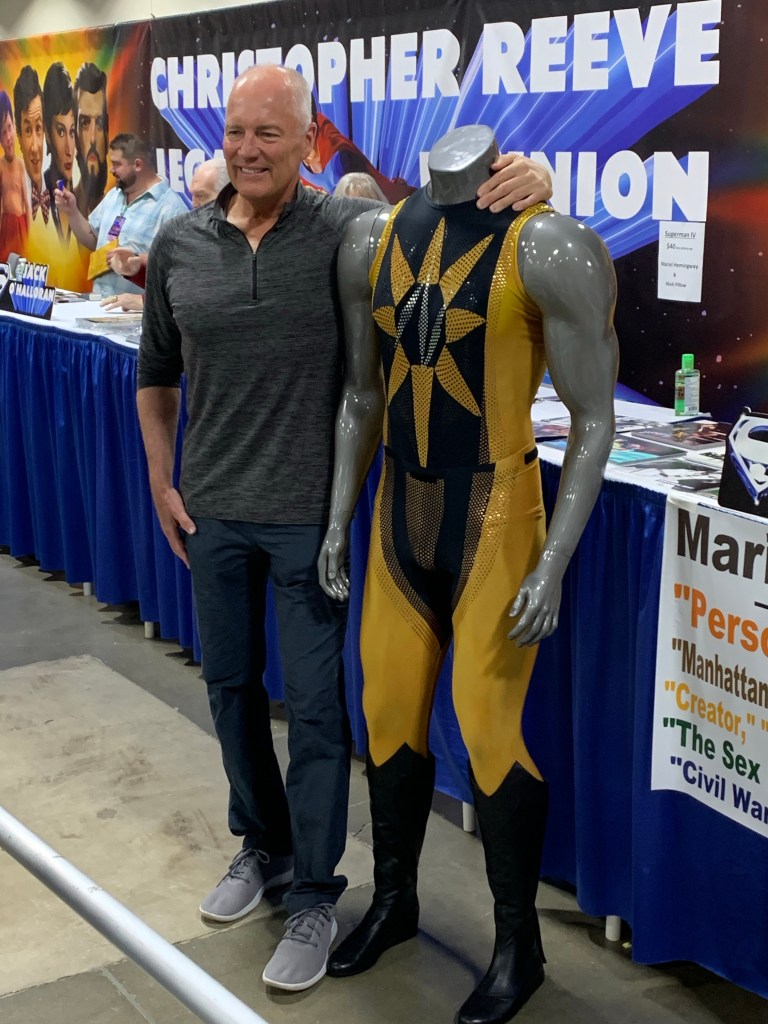
What can I say about Mariel Hemingway? The granddaughter of the legendary writer Ernest Hemingway, who was Lacy Warfield in Superman IV, she is fun and bubbly and full of energy! You can’t help but love her! I shared with her how I’d read The Sun Also Rises back in school and how I hope to read it again soon. And she’s really tall, too!

Damian McLawhorn was also a great person to meet and talk with. This young man, whose character of Jeremy was the catalyst for the events of Superman IV, is also thankful for his fans, even though a significant portion of his work on the film was cut from the final release. Thankfully we have all of his scenes on the DVD and Blu-ray, and we see how he sees the world without borders.
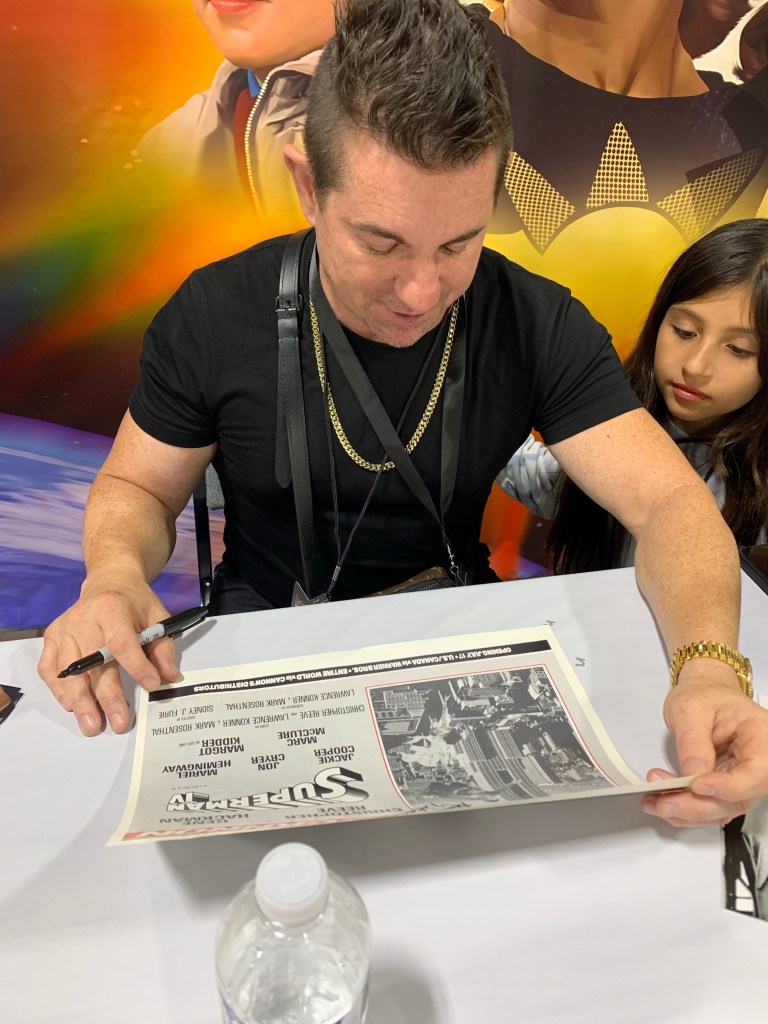
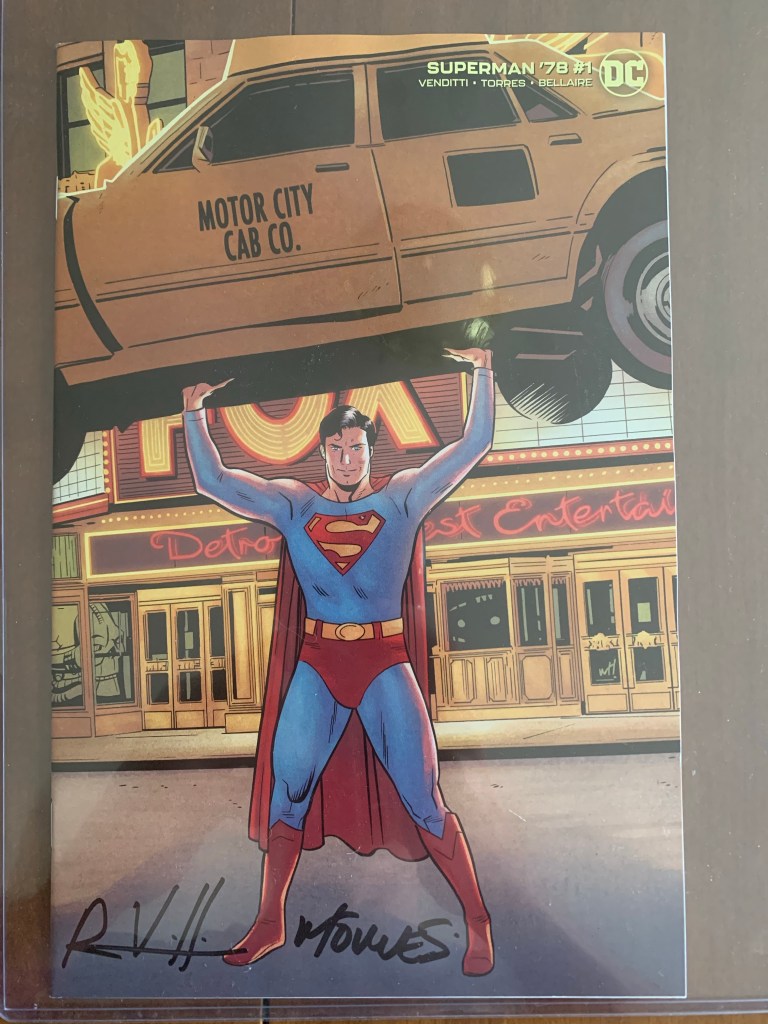
Damian, Mark Pillow, and Mariel Hemingway signed my print of the Superman IV advertisement from Variety magazine from May 1987. I was excited to meet Robert Venditti and Wilfredo Torres as well. I shared with them about finding so many written and visual Easter eggs that I’d come across in Superman ‘78, and while Robert was the more quiet of the two, and that’s not a bad thing, Wilfredo was more open and communicative with the fans. He also had pages of his original artwork from the series, and I got a special Motor City copy of the first issue, which they both autographed for me.
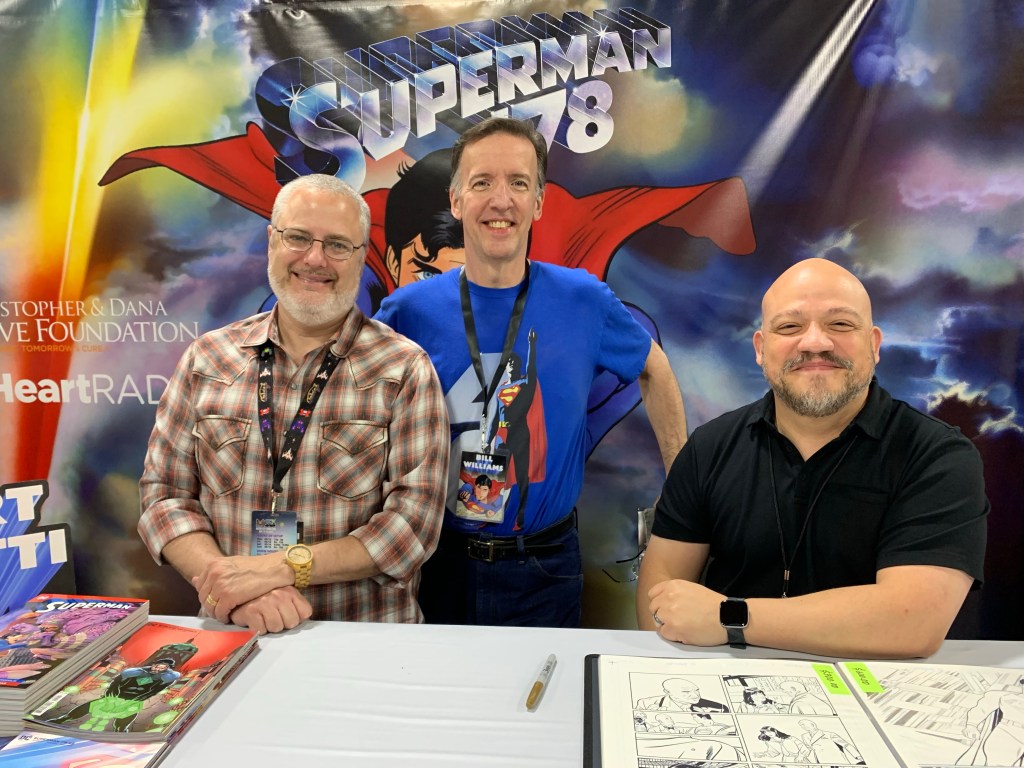
But if there was one person among them all that I wanted to most meet, it was Sarah Douglas. I had originally planned to go to Metropolis in 2017 for the Superman Celebration where she and Margot Kidder were in attendance, and I’d wanted to meet them, but just a couple of weeks before the celebration, I lost my mom after a nine-year downhill struggle with Alzheimer’s disease that ultimately claimed her life. All of a sudden, the money that I’d set aside for Metropolis was now spent in returning to my home state of Mississippi for fuel, gas, and lodging that weekend for her memorial service, and that left me with no choice but to cancel going to Metropolis that year. I simply had no means to get there. I shared my story with Sarah, and she was so supportive of me and held my hand in our conversation because she had gone through a similar experience in losing her mom too. Sarah is warm and genuine, a beautiful soul, so unlike her extremely memorable character of Ursa.
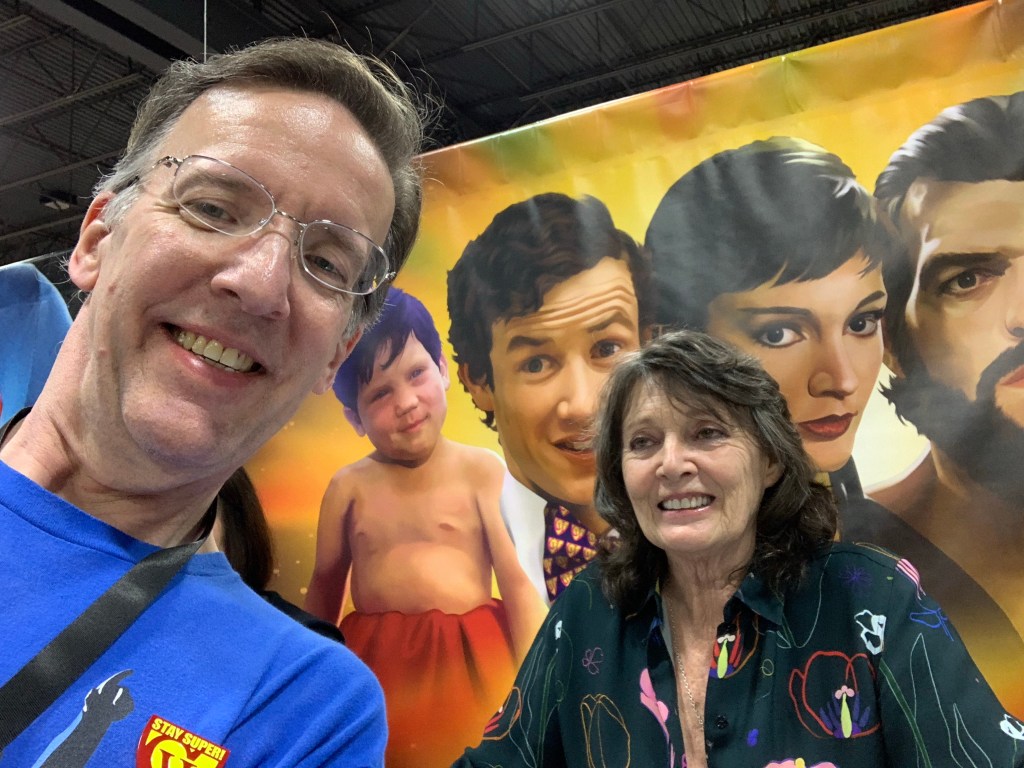
And yet there was one other celebrity there in Detroit that I had wanted to meet about as much as the Superman cast members. I had worked so hard to get there and saved my money—about a thousand dollars altogether—that I got my dream shot. This would be a once in a lifetime opportunity, and I got it. The icon who has been there, done it all, even to outer space and back, and still keeps going. I hope to be as active at 92 as he is.


The one and only William Shatner. No other words need be said. In addition to my Superman IV print, I asked the actors to sign my copy of Jim’s beautiful coffee table book Superman: The Richard Donner Years—A Photographic Journey, to which I had contributed written content. In addition to the actors, I got Jim to sign it, along with Ty, Daniel, Lynn, Brad, and several others as well. Before long, everyone was getting their copies signed by everyone all around, too. It was like getting your high school or college yearbook signed, because this was a special occasion for us all. This was all about making memories.
Afterwards we attended a special Legacy Reunion panel with all the actors and actresses, and each one shared their memories and experiences of working on the Superman films and alongside Christopher Reeve. A special video was played, with greetings from Will Reeve and Jon Cryer (Lenny from Superman IV), and they offered their thanks and support for the fans in keeping the legacy alive all of these years later.
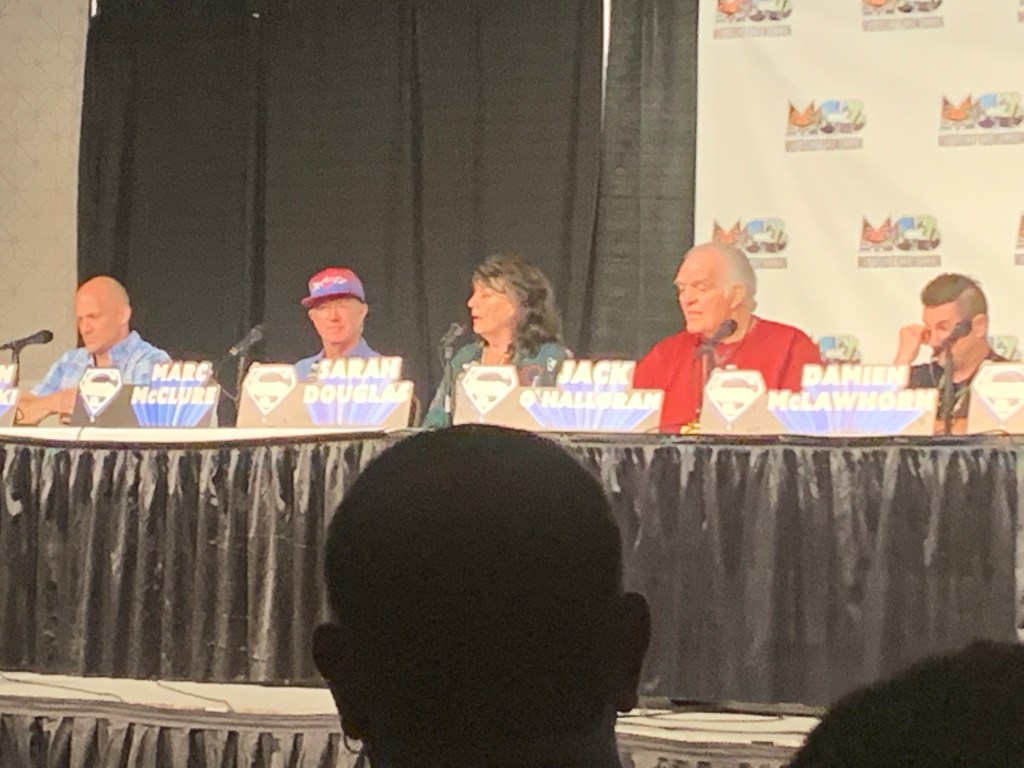
Later on that day I participated in a photo session with the cast members. The photographer said that I could have a couple of people join me for the photo shoot, and I could think of nobody better to join me than Jim and Jay.
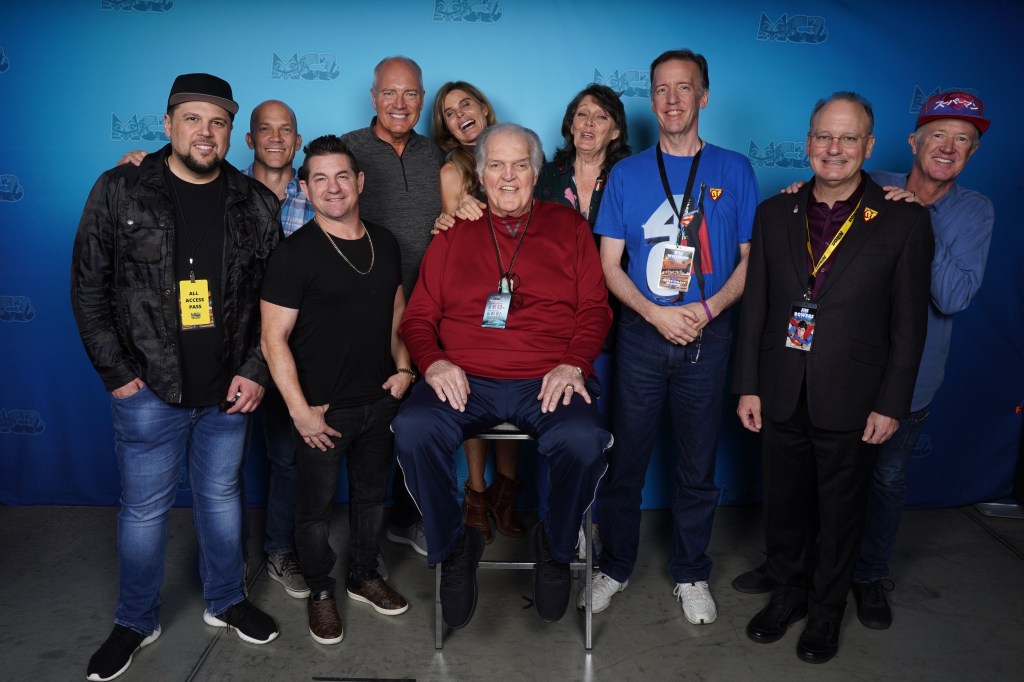
That evening a number of us went to a local pizzeria for authentic Motor City deep dish pizza and antipasto salad. A week earlier I had gotten a frozen Motor City deep dish pizza from a local grocery store to prepare me for this trip, but nothing, and I mean nothing, was like the real thing. Along the way one of us in the group, I want to say it was Mike LaMere, I forget, suggested pulling a practical joke on Jay Towers and charging up a thousand dollars of drinks and sending him the bill! It was all in good fun, and we had a blast together.
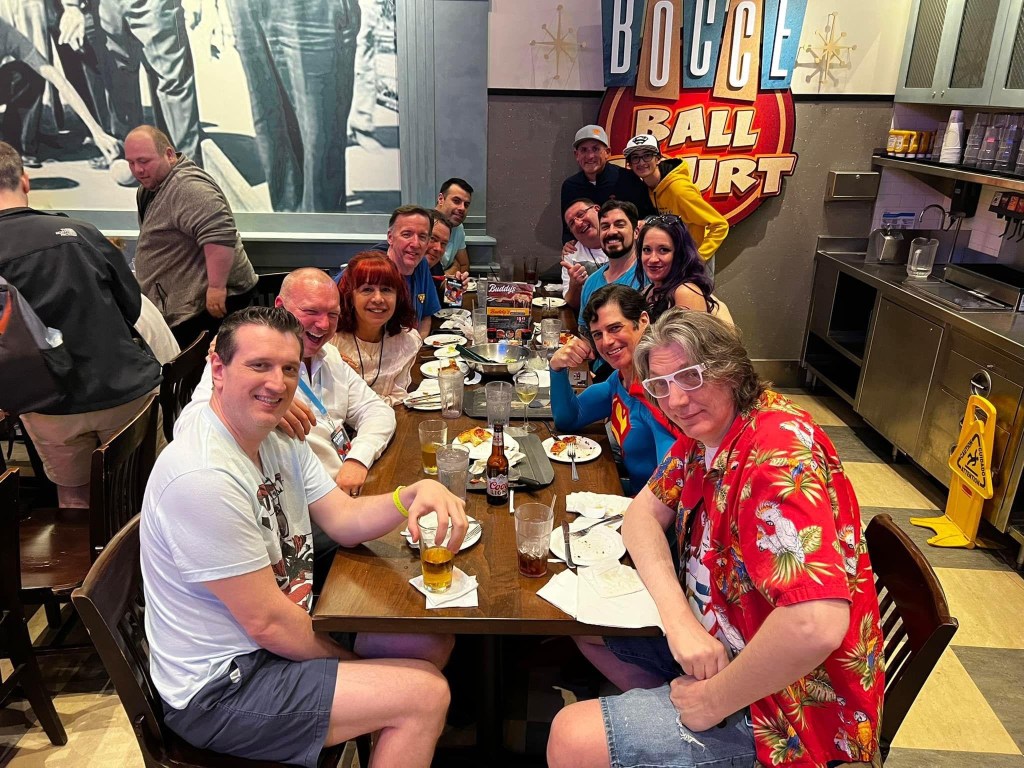
Super fans one and all! Sunday morning came, and I had heard from Ty and Daniel that everyone was going to get together for one last blast and a group photo before we left Detroit. It allowed me to get some more swag while I was there. Two Star Wars posters and a Superman II poster for my office. Sold!
And there was some fun moments with Daniel. At one point he wrestled a T-Rex, something that was right out of a Superman comic. Everyone could not resist seeing this showdown!
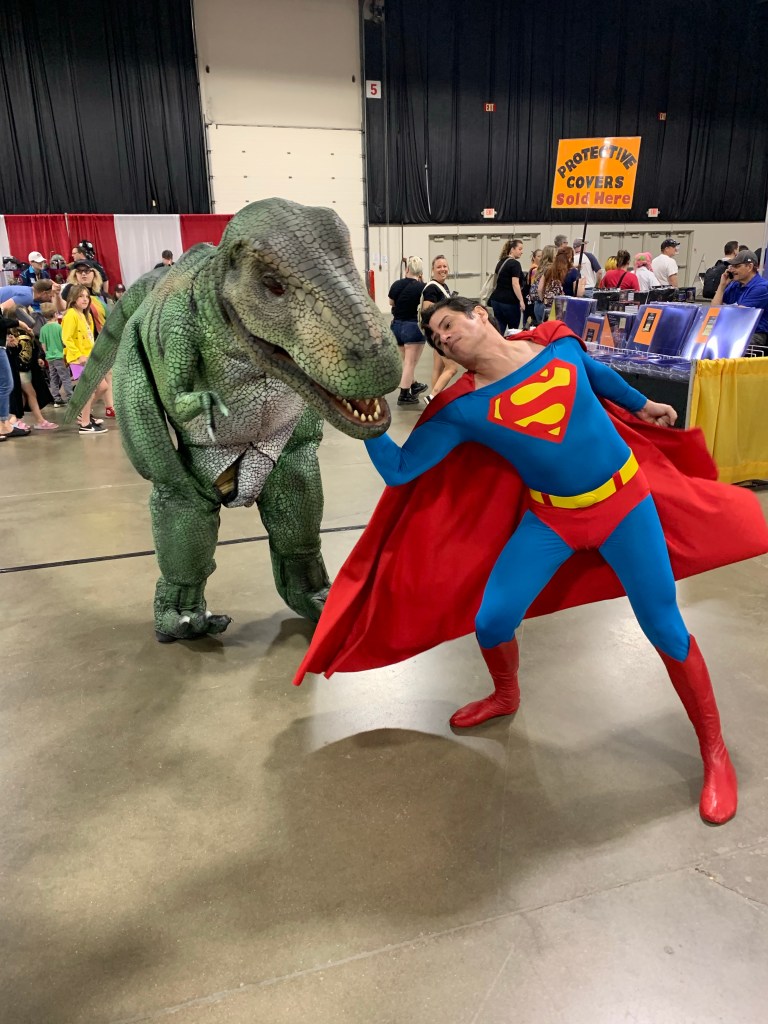
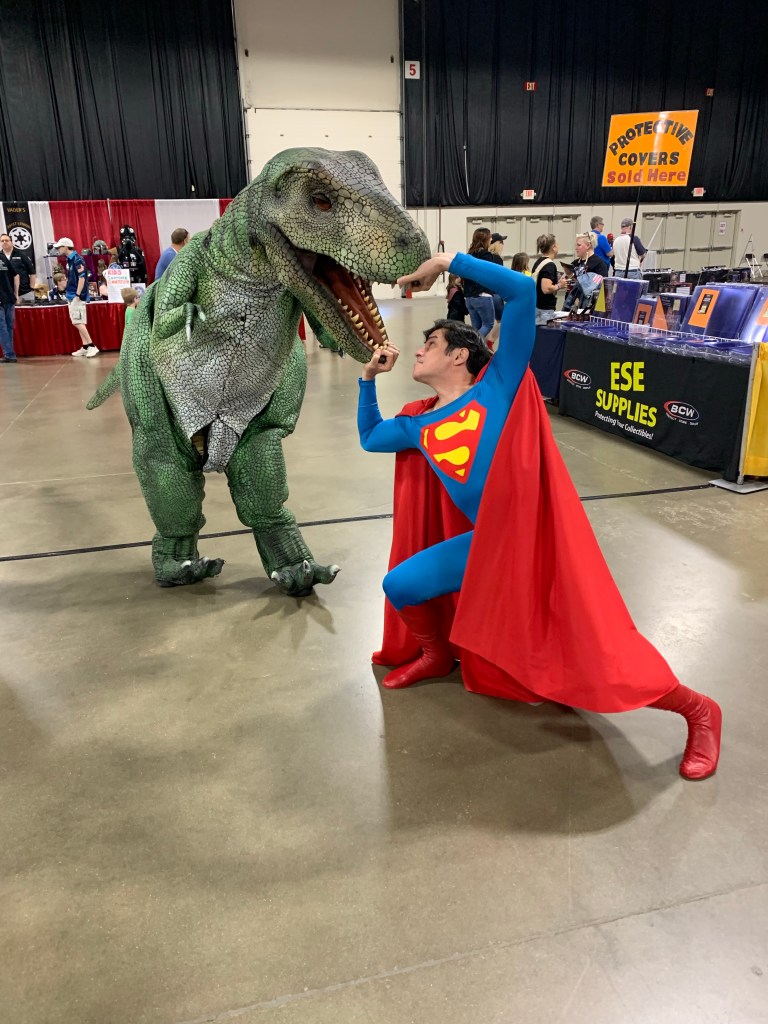
I wonder who came out on top in this contest… And then Daniel and Lynn, or should I say Lois Lynn, recreated one of the most iconic moments from Superman: The Movie. All that was missing was the classic John Williams music.
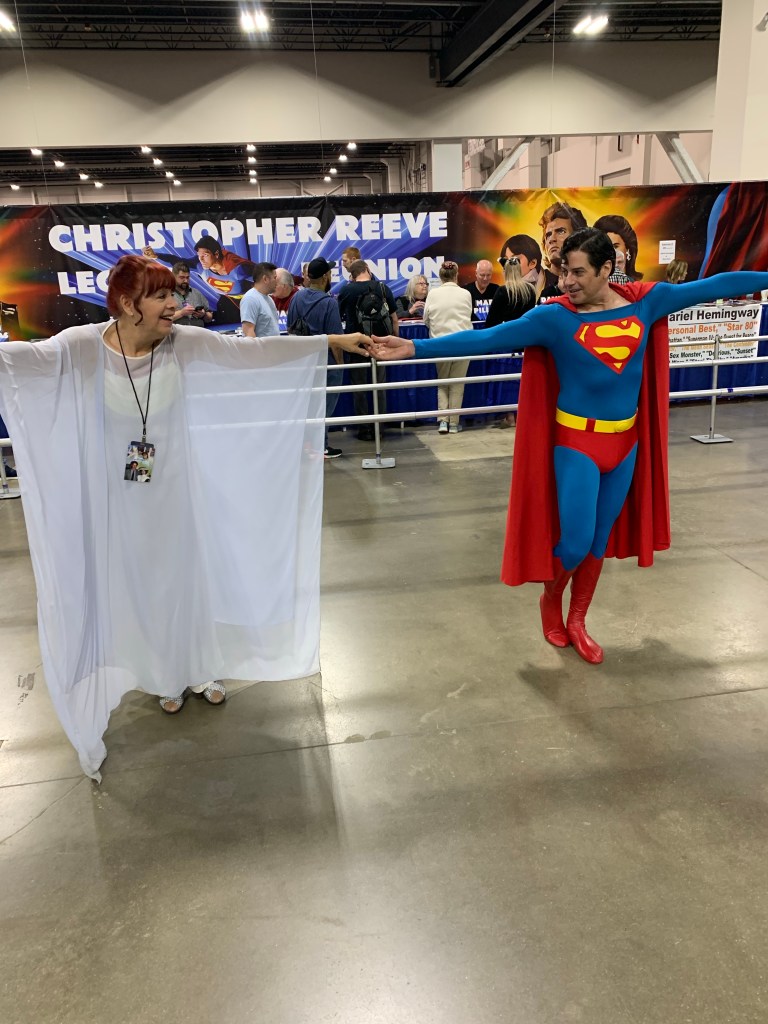
“Can you read my mind? Do you know what it is that you do to me?” Then we all came together for one final group shot. Actors, organizers, and fans alike. This was the moment that for a number of us like me marked the end of a most memorable weekend. Nobody wanted it to end. Nobody ever wants an experience like this to end.
We have stayed in touch with one another since then through texts, messages, emails, and Facebook. To this day we are there for each other in our own corners of this world. But nothing will ever compare to that weekend we shared together in Detroit.
More than friends… more than fans…
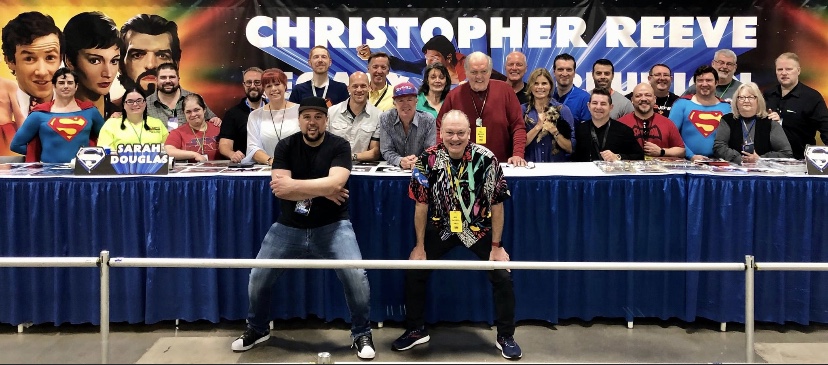
We are family. -
“Superman IV” Overseas…
So earlier in the week I noticed on Facebook that someone had a copy of the overseas version of Superman IV: The Quest for Peace on VHS. It was a German VHS tape with the subtitle Die Welt Am Abgrund, which translates to The World at the Abyss. That’s a much stronger translation than The Quest for Peace, if you ask me.
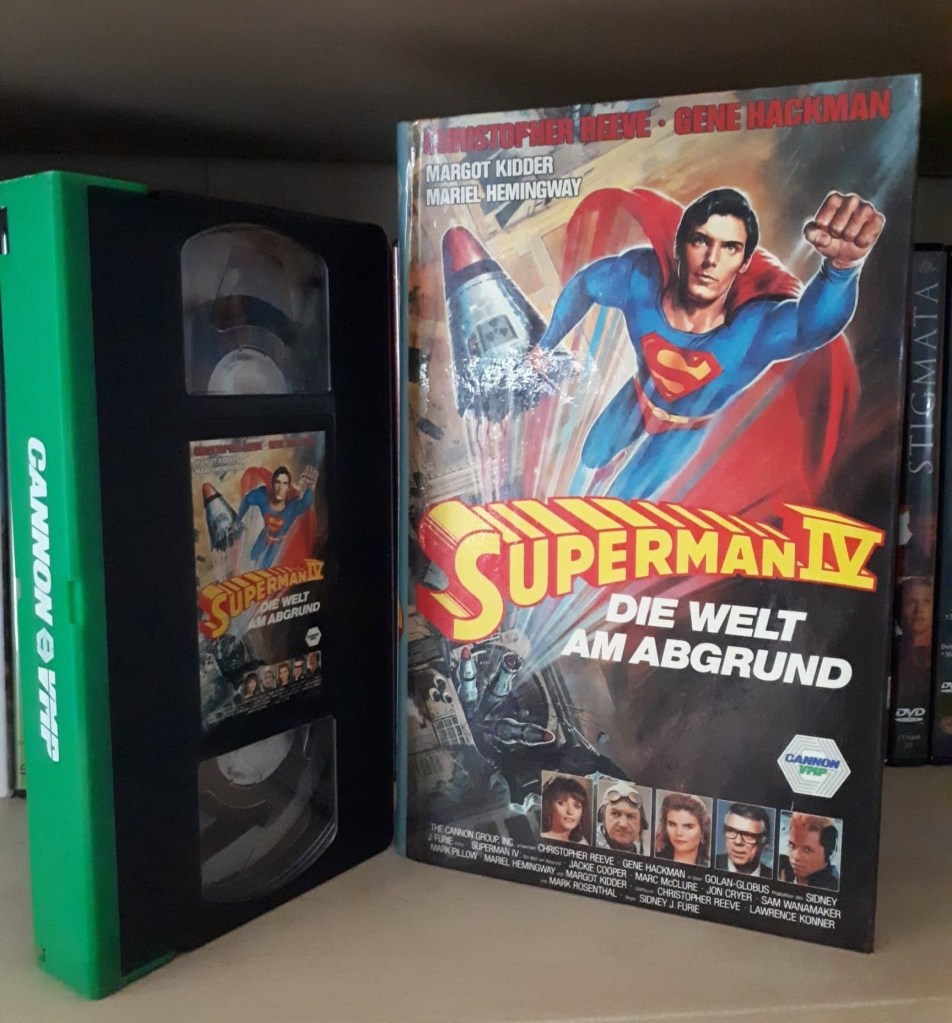
This German VHS contains the added scenes of the tornado rescue and the Red Square rescue that were featured in the international version of the film. And it got me thinking about some of the foreign home video releases that contain the longer 92-minute international cut that was released by Cannon Films. As you know, we in the United States have been saddled with the 89-minute theatrical cut sans those two added scenes. Thank goodness for Harrison Ellenshaw and his insistence to include those two scenes for the international cut! So here’s a few of them…
United Kingdom
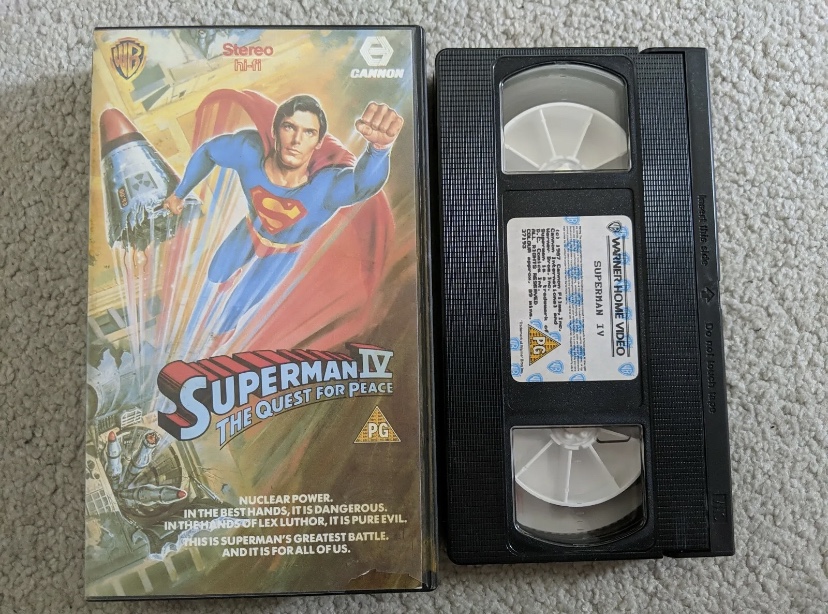
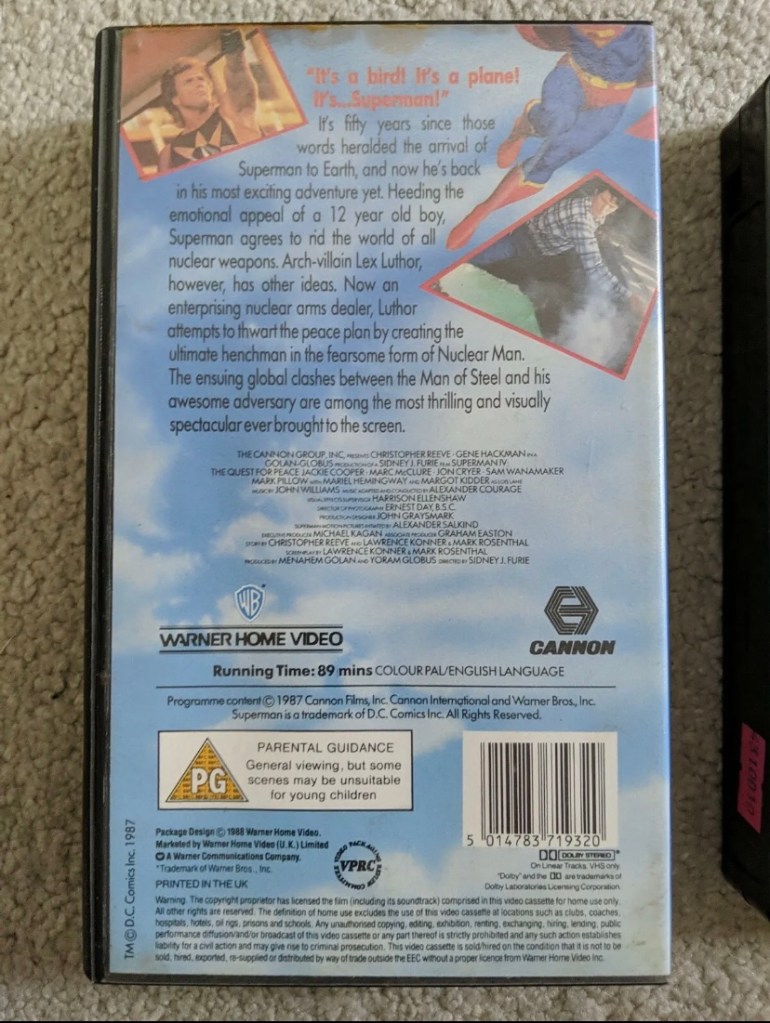
This version from Warner UK and Cannon Films says that it’s 89 minutes, but because of the PAL running speed of the tape it’s actually the 92-minute international cut.
Australia
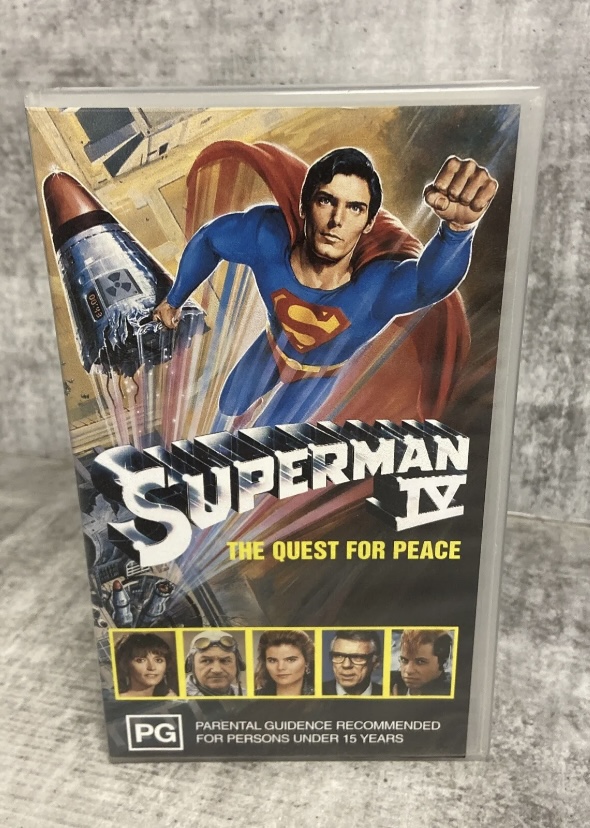
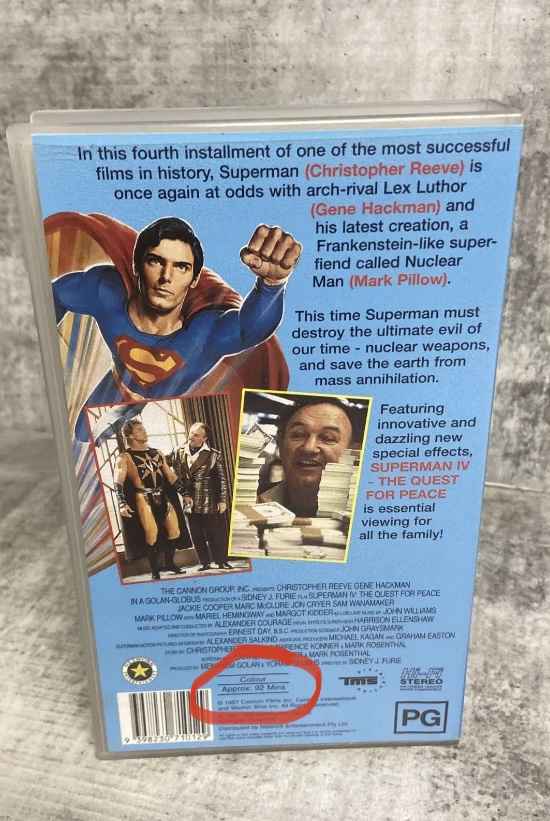
This one from the land down under indicates a 92-minute running time.
Japan
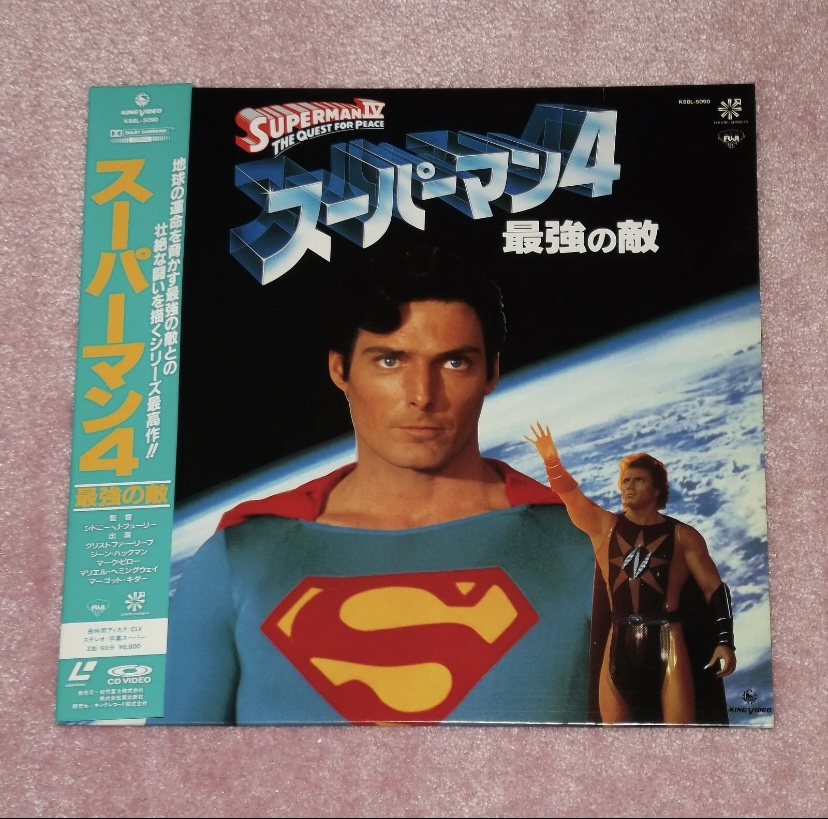
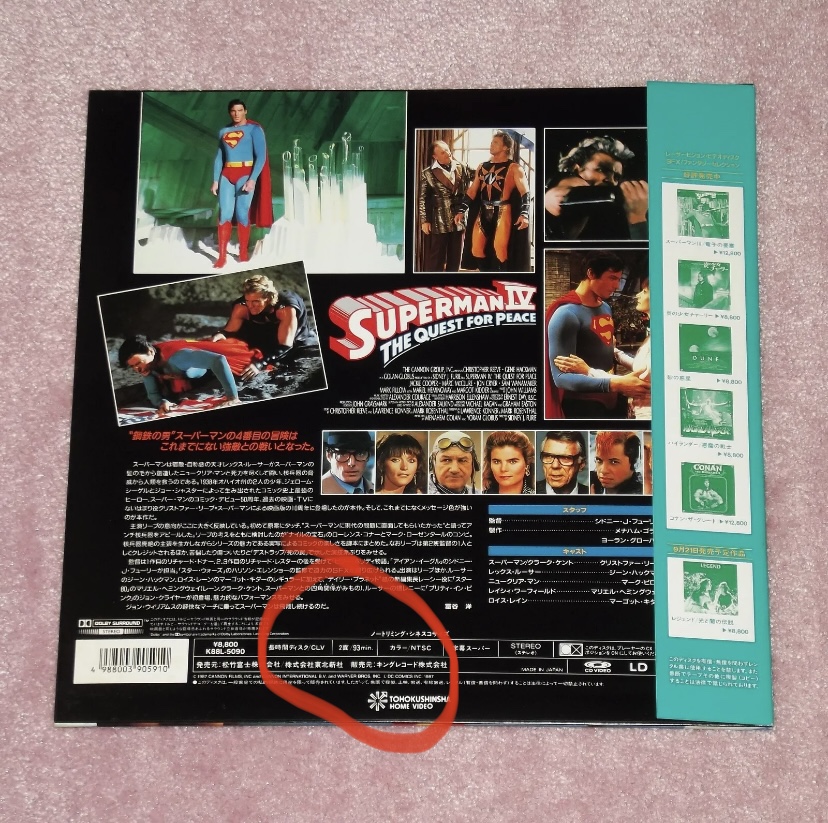
This is perhaps my favorite of the overseas editions in that it was released on VHS and laserdisc from Tohokushinsha Video and King Video with a running time of 93 minutes. The extra footage is solely the addition of the Japanese Kanji text for the film’s title logo before the start of the film and additional Kanji text at the end of the film. What makes this version unique is that until the 2001 DVD release in the United States, this was the only version of the film that was available in widescreen format, with a 2:1 aspect ratio, and the English subtitles in Kanji text superimposed on the right side of the screen. The laserdisc also contained a nice supplemental insert about the history of Superman and the development of the Christopher Reeve film series. This in my opinion is the best of the overseas releases.
I have fond memories of owning this laserdisc in my collection in Mississippi until I got married and moved to northeast Alabama in early 2005. Somehow, between the move and having everything in storage, it wasn’t until much later in 2005 that I discovered that only one of my laserdiscs had broken during the move. This one. That hurt. I had no choice but to throw it out. Thankfully I have a copy of a copy of a copy now, and while it’s not the best quality, it’s still watchable.
Then there’s this version…
Turkey
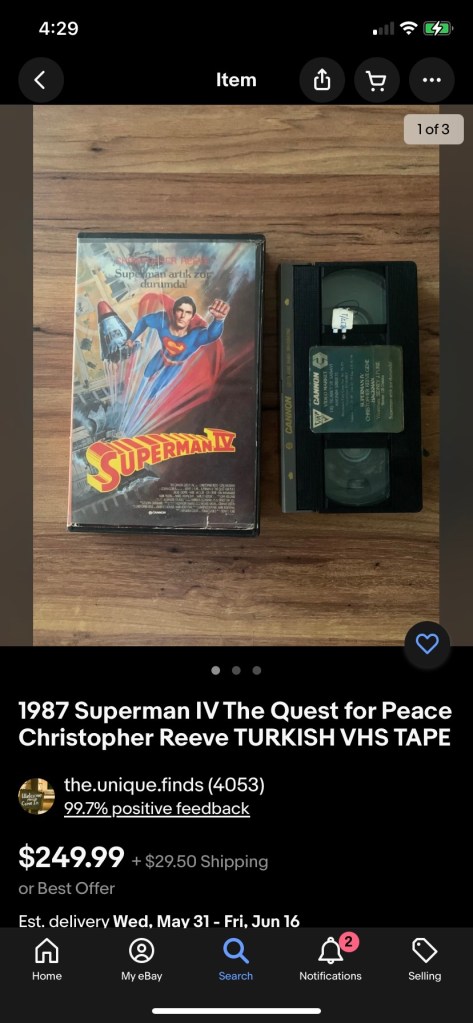
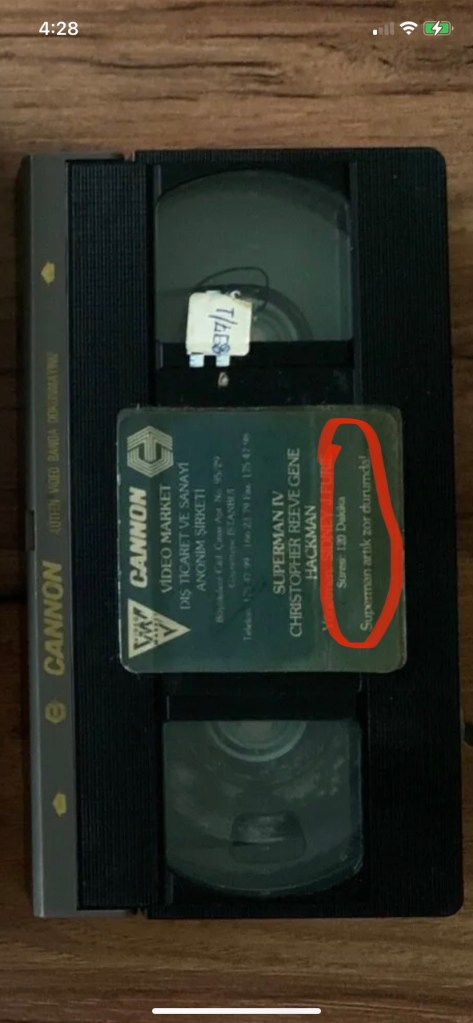
Pay particular attention to the running length on the right hand side of the tape. 120 minutes. How is this possible? It’s very likely a misprint, and I wouldn’t be surprised if that’s the case here.
At the end of the 1990s, when false rumors of people owning a copy of the original 134-minute version of the film ran rampant across the internet, hardcore fans like me began to investigate these rumors and debunk them from fact. One lead led me to contact a video store in the Netherlands which advertised on its website that they had a copy of Superman IV that ran 120 minutes long. I exchanged emails with the owner of the video store, and he verified that it was in fact 88 minutes long, which would have translated to a PAL transfer of the Cannon Films release.
Still, seeing that up for auction led me to go back to that question from the late 1990s: could a much longer cut of the film have escaped into the wild like that? And why in Turkey, of all places? All I know is that it’s no longer on eBay, but it was this past Friday for $250 plus shipping and tax, which would have pushed it close to $300. I myself would have taken the plunge, but I had to get the gaskets replaced on my car. Priorities. All I can say is that whoever got the tape, I hope you will speak up and present your findings to everyone.
Of course, there’s still talk that the Warner Bros. Archive has access to the original 134-minute pre-release cut of the film. In what shape the film is, nobody knows. But I’m believing that one day we will see it in all its unedited glory.
-
“Superman III” 40 Years Later
As we mark the 45th anniversary of the release of Superman: The Movie, 2023 also marks the anniversary of another Superman film with the 40th anniversary of Superman III, the third installment that was more of a lame comedy in the eyes of a number of fans than what they had seen in the two previous movies. Released on June 17, 1983, Superman III proved to be a departure from the first two films with a tone and style all its own.
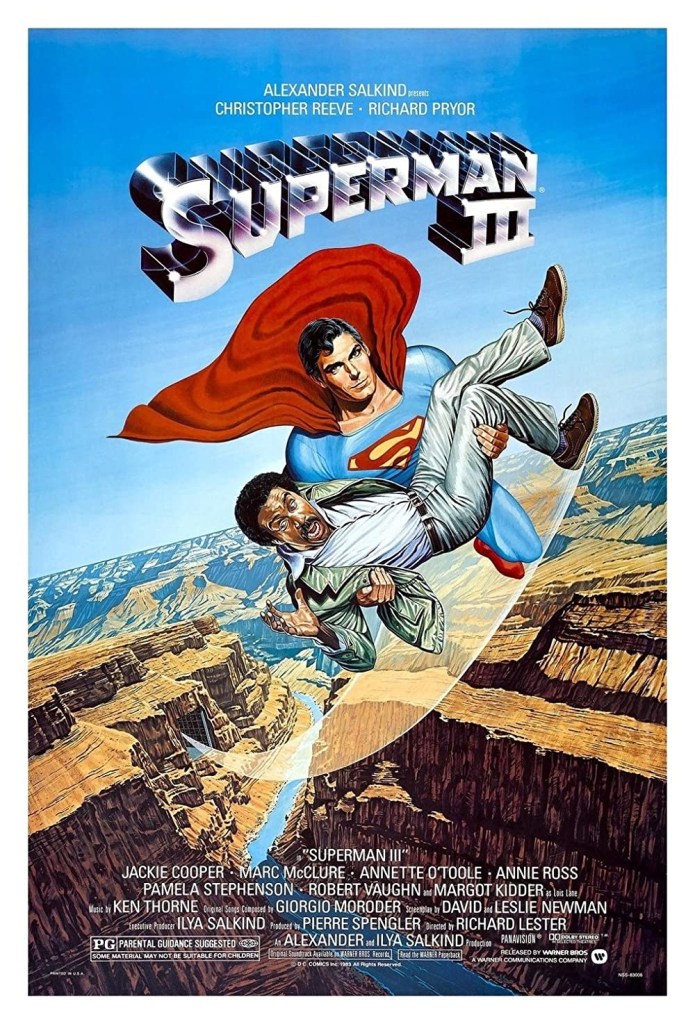
But the road to Superman III would take four years, numerous rewrites, and countless casting suggestions that would have taken the franchise into who knows what kind of direction that would have staggered even the most hardcore Superman fans.
The origins of Superman III began in early September 1979 during the filming of the Niagara Falls sequences, when Richard Lester and David Newman suggested a scene involving Clark Kent returning home to Smallville for his high school reunion. That would be the launching point for the story that would unfold.
From there Ilya Salkind would develop a treatment for the film that would include the characters of Lana Lang, Supergirl, Brainiac, and Mr. Mxyzptlk. After two tries, Warner Bros. would turn down both of Salkind’s treatments, although Lana Lang would be the only character from that treatment to survive into the final film. Four decades later, Neuverse Creative would produce a 15-minute audio narration of the Salkind treatment, and…
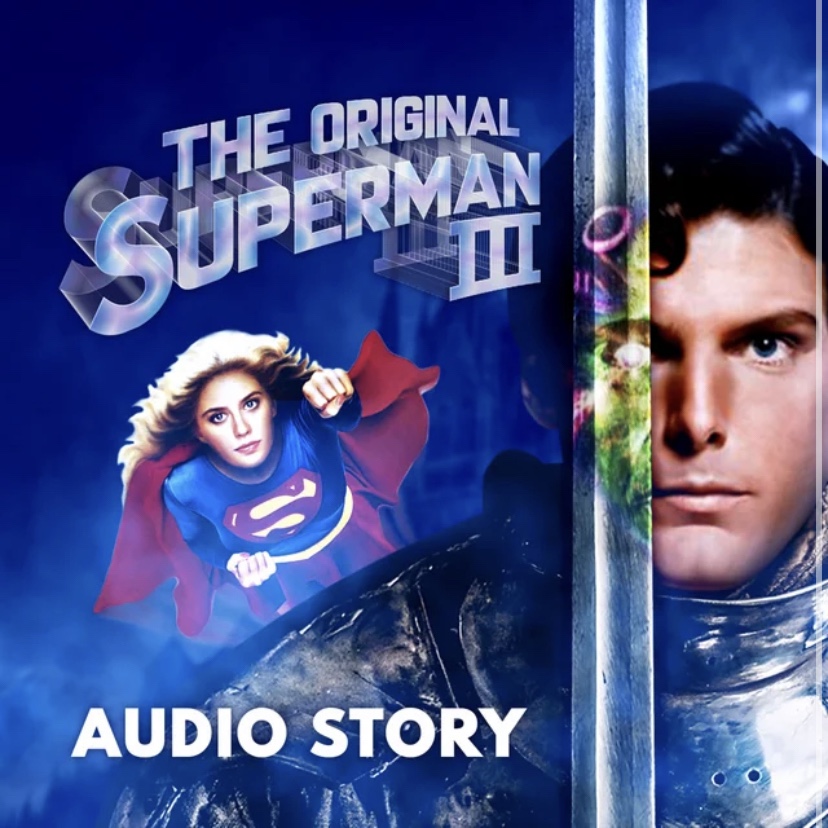
…well, you’ll just have to listen to it on Spotify and hear for yourself just how horrendous this is. See my earlier blog for the full story. Thank goodness for David and Leslie Newman returning to write this third installment. Even with the bent towards comedy, they still kept things consistent through all three of the Superman films. Leslie Newman would even make a cameo appearance in the film as Ross Webster’s secretary, which would not be seen until the extended TV broadcast in 1986.
As for the casting of Ross Webster, early candidates for the role included Frank Langella (who would go on to portray Perry White in Superman Returns in 2006) and Alan Alda of MASH fame. Ultimately the part went to veteran character actor Robert Vaughn, who would chew the scenery as much as possible.

Would Frank Langella or Alan Alda have worked as Ross Webster? What do you think? In my opinion I think Alda would have been a great choice to break out of his Hawkeye Pierce persona. Oddly enough, the character of Webster himself—a megalomaniac businessman—would influence the reimagined development of Lex Luthor in the post-Crisis on Infinite Earths version of the Superman comics beginning in 1986 with the Man of Steel miniseries and carrying forward into all future incarnations of the character.
But there were other casting options as well. Once Christopher Reeve protested Ilya Salkind’s story treatment for the third film, and because of their dismissal of Richard Donner from completing work on Superman II, he threatened not to return. All of a sudden the Salkinds were without their Man of Steel, and they began to mention other prospective names to take over, including John Travolta, Jeff Bridges, and Kurt Russell. They even temporarily locked in Tony Danza for the part.
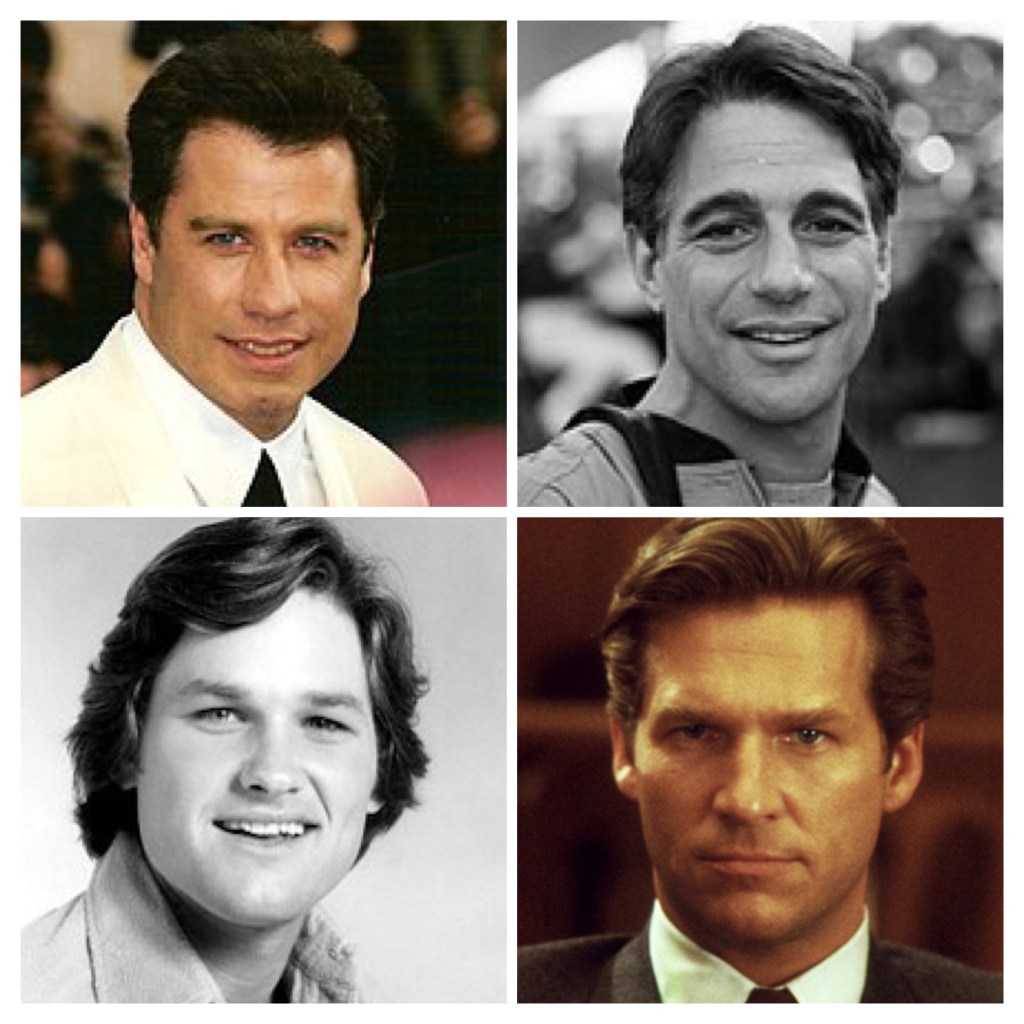
“So this is Superman?!?” These decisions mortified Richard Lester, who pleaded with Reeve to return. Reeve agreed only on the condition that the Salkinds and Newmans make substantial revisions to the script. Ultimately, the Salkinds agreed.
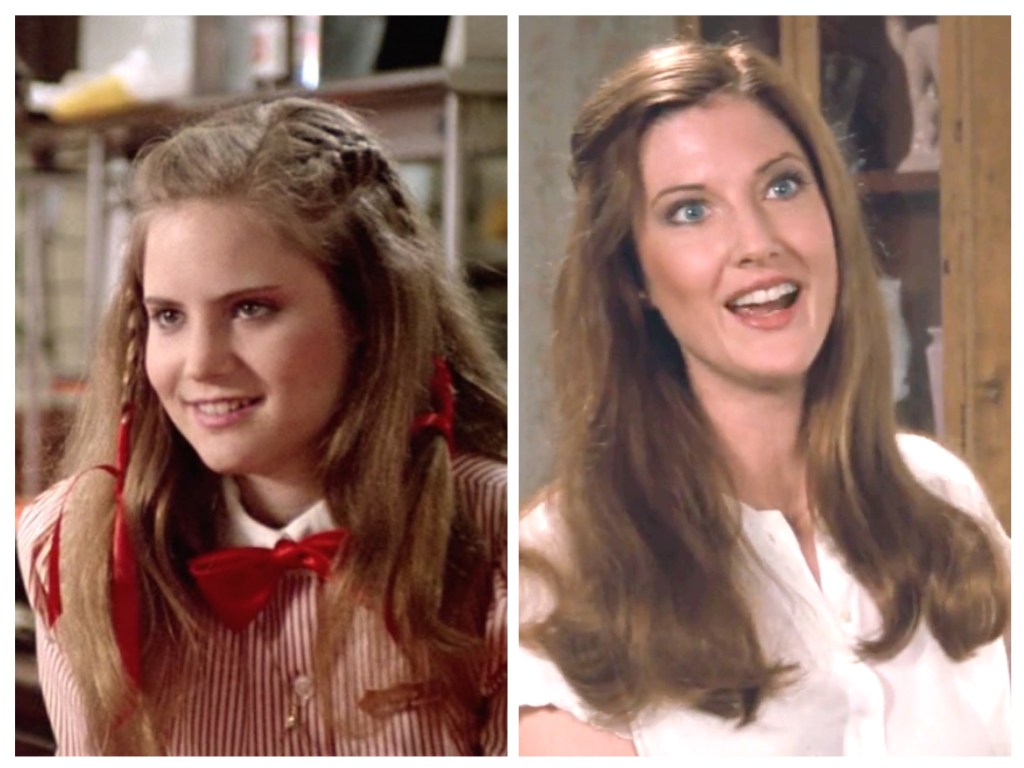
Another character addition to the script was Lana Lang, Clark Kent’s former high school crush. An early contender for the role was Jennifer Jason Leigh, best known for her breakout performance in Fast Times at Ridgemont High. Given that she was only 20 at the time, she felt herself too young for the role and bowed out of the project, a wise decision on her part. The role eventually went to Annette O’Toole, who was perfect. She and Reeve had a natural chemistry on screen and off, even though the relationship between Clark and Lana was a bit on the bittersweet side.
Another unusual casting choice was Richard Pryor in the co-lead role of Gus Gorman, a down and out job seeker who has a natural bent towards computers and is ultimately brought into Ross Webster’s fold to create a supercomputer to conquer the world and destroy Superman. Pryor had appeared on Johnny Carson’s late night show and expressed his interest in the Superman movies, which led to the Salkinds offering him the role. In this clip from June 1983, Pryor talks with Carson about his work on Superman III:
And to think that his character had evolved from the original concept of the human supercomputer Brainiac. Given that this was after Pryor’s near tragic accident, his style of comedy seemed to be a bit safer and not as edgy as it had been in the 1970s. At times he tended to overshadow Christopher Reeve, and in fact Pryor had more screen time in the film than the top-billed Reeve.
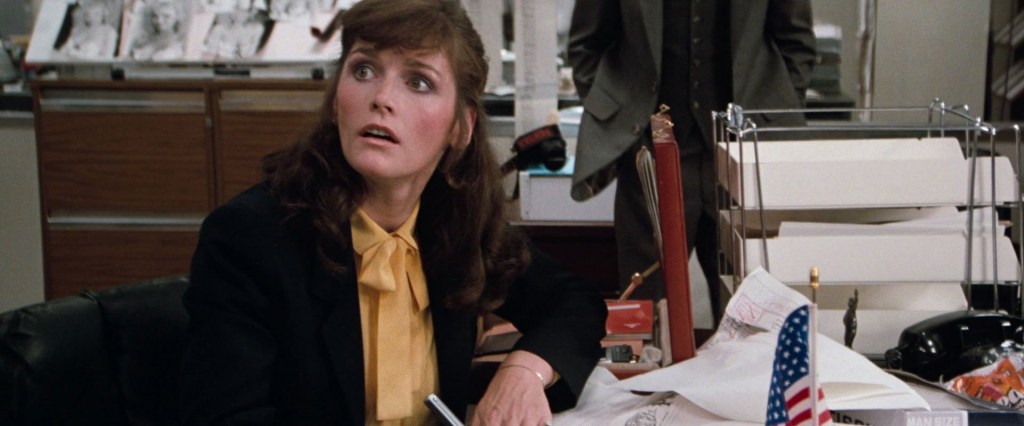
But the biggest casting casualty of the film was Margot Kidder. After her comments about the Salkinds in the British magazine Time Out in April 1981, referring to them as “beneath contempt” in their treatment of Richard Donner, and her lawsuit against the Salkinds for unpaid wages on Superman II, her role of Lois Lane was reduced to just twelve lines across two scenes in the early moments of the film and at the end. The Salkinds said that they wanted to pursue a different direction for Superman’s love interest in III, and this is even evident in Ilya Salkind’s original treatment for III in which Lois was present in only one scene at the beginning.
Filming proceeded smoothly through the second half of 1982, with shooting taking place in Calgary, Alberta, which doubled for Metropolis; over the Grand Canyon in the United States; and at Pinewood Studios in England, which included the memorable junkyard fight between Clark Kent and an evil Superman, and the Man of Steel’s showdown with Gus Gorman’s super computer which had the ability to detect anyone’s weakness.
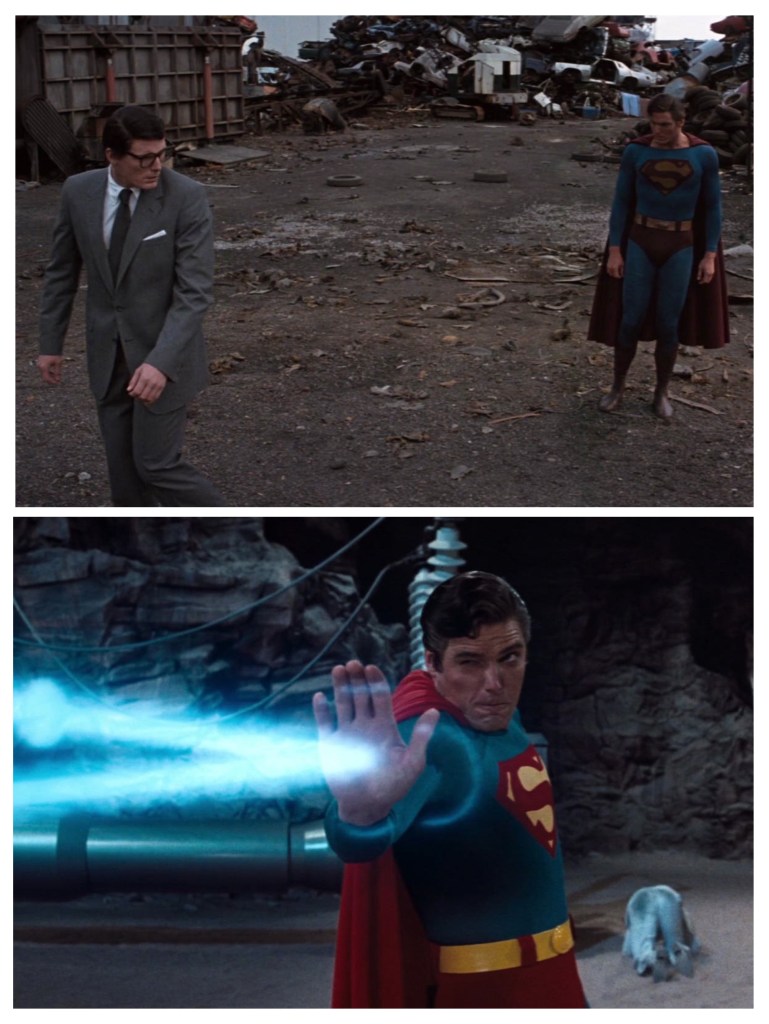
Two of the film’s most exciting moments. Superman III also contained some of the most realistic flying sequences of the entire series up to that point, both in terms of live flying and Zoptic mechanics. The live flying scenes were and still are some of the most believable shots ever filmed for a Superman movie, let alone a superhero movie at that, and it most certainly looked even more believable in the hands of the flying unit and Christopher Reeve himself. The shot of Superman flying over the city streets to rescue a man from drowning in his car was no small feat by any means. Coordinating with live traffic could have made it even more perilous if something had gone wrong, but the Superman crew prided themselves on as many safety precautions as possible and necessary to achieve such a stunt. And of course it goes without saying that the best special effect in the series was Reeve himself.
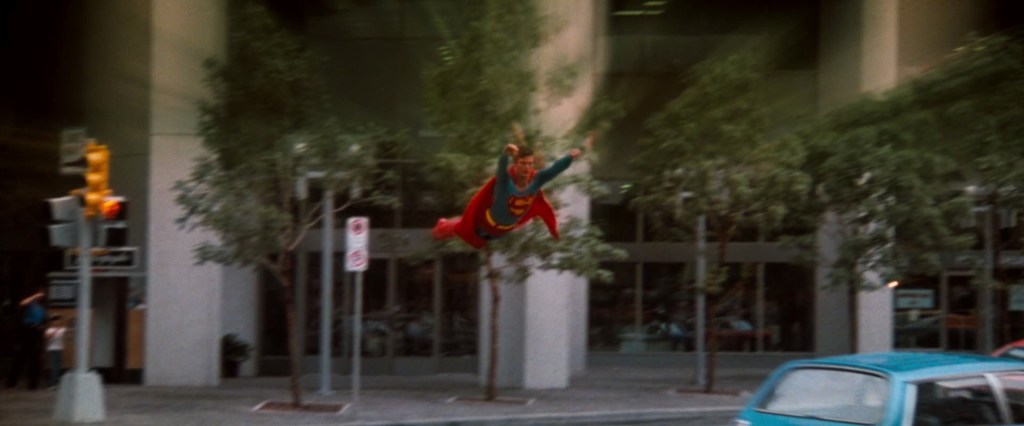
“Look Ma, no wires!” And some six years before the arrival of the Borg in the Star Trek franchise, Vera Webster found herself assimilated by the super computer and turned into the first female Borg in a moment that was almost chilling, especially for a Superman film. This itself was another callback to the Brainiac character, the humanoid computer being that Ilya Salkind first considered in his 1980 story treatment.
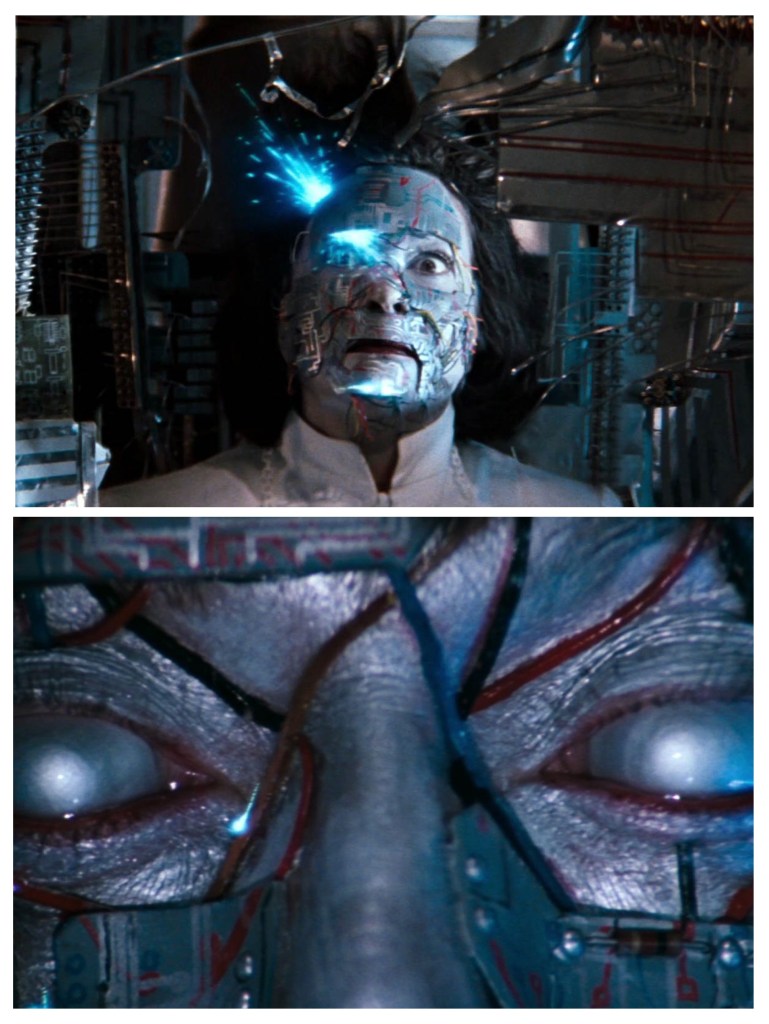
“I am Vera of Borg. Resistance is futile.” Four decades later, in the blockbuster Superman ‘78 comic book series, not only would we see cameos from Richard Pryor and Annette O’Toole, but we would also see a Brainiac that was directly inspired by none other than David Bowie himself.
But even as production continued, work was already underway on the Supergirl spinoff film, David Odell was at work writing the script, and in the first couple of drafts he had intended for Reeve to return as Superman in a cameo role. After five years and three films, Reeve had felt that he had done his time in the role and turned down the opportunity, which forced Odell to rewrite the script and include a cameo from Marc McClure as Jimmy Olsen. Given that Supergirl failed both critically and commercially, Reeve had made a smart decision. Then again, Leonard Nimoy had returned for cameos as Mr. Spock in the 2009 Star Trek film and 2013’s Star Trek: Into Darkness, so there’s plenty of arguments for and against a Reeve cameo in Supergirl.
Aaron Price recently created a fan edit of the climax of Supergirl which features a Christopher Reeve cameo. Does it work? In February and March 1983, composer Ken Thorne returned to conduct the score for the film, utilizing a number of John Williams’ original themes and motifs from Superman: The Movie as well as some new music to reflect the comic antics of Gus Gorman; the almost playful tones associated with Ross Webster, his sister Vera, and his “psychic nutritionist” Lorelei Ambrosia; and the warmer associations of Clark and Lana rekindling their friendship. Some 63 minutes of music was composed and conducted, with only two alternate tracks arranged. For the soundtrack album, some 17 minutes of Thorne’s music was used for the A side of the album, while the B side contained source music and instrumentals produced and arranged by Giorgio Moroder (the same composer who, four years earlier, won the Academy Award for his original score to Midnight Cowboy, beating none other than John Williams’ more memorable score to Superman). It would be another 25 years before all of Thorne’s music for the film was finally made available to fans in the Film Score Monthly box set Superman: The Music (1978-1988), followed by its re-release in 2018 from LaLaLand Records with the complete score to Superman II.
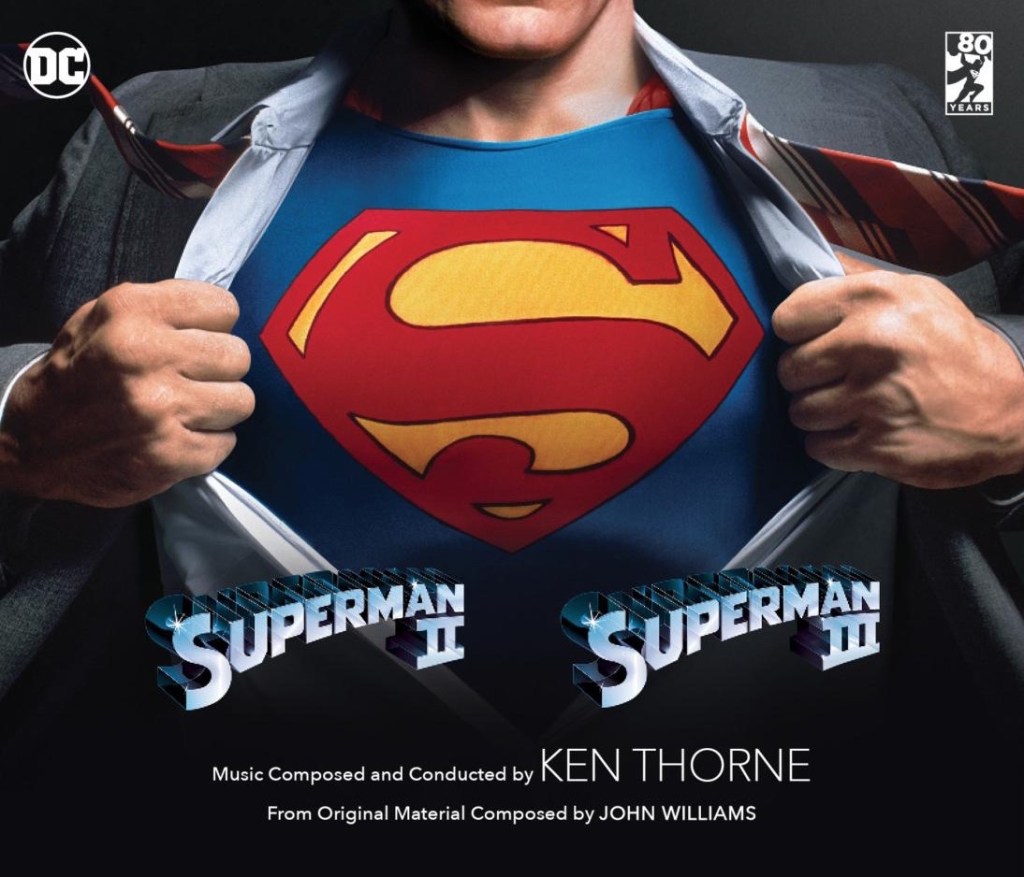
But one thing that was missing from this score—and the film itself—was an epic sounding main title in the vein of the first two films. Instead, the opening credits music was subtitled “The Streets of Metropolis”, covering the comic mishaps that occurred on one crazy day in the summer of 1980. For that matter, the title credits were awkwardly superimposed at the bottom of the screen over the film’s opening moments. Thankfully, when the extended TV broadcast aired on ABC in 1986, an all new main title sequence was utilized, using the film’s end credit music, thereby removing the awkward title credits from the film altogether. This is a much better title sequence that brings the film into proper alignment with the first two films, even if they’re still at the bottom of the screen.
Aaron Price made this brilliant recreation of the extended TV credits in widescreen format. And that theatrical trailer. It was the first time I’d ever seen a trailer that spoiled the ending of the film before its release. Typically, trailers are supposed to tease the film without revealing too much, and in some cases such as the first trailers to Gone With the Wind, Citizen Kane, and the 2009 Star Trek nothing from those films had been shown at all. But not so with Superman III. Perhaps that may have partly contributed to its mixed critical and commercial reception. Who wants to see a movie knowing how it ends before you get there? Not me. Of course, there’s Titanic, but that’s another story.

Superman III opened to mixed reviews, with critics complaining about the odd mixture of comedy and adventure, with Richard Pryor’s comic mugging played for weak, awkward laughs, as if he’s trying to be funny but it’s forced on viewers, which seemed out of place for a Superman movie. It wound up earning $59.9 million in the US box office, winding up the 11th highest grossing film of 1983, behind other larger successes such as Risky Business, Octopussy, War Games, Trading Places, Flashdance, and Tootsie. Oh, and that other little movie that overshadowed everything else that year… you know which one I’m talking about… something something Jedi… And maybe that’s also a valid reason why Eddie Murphy’s involvement with Star Trek IV: The Voyage Home wisely ended before it began.
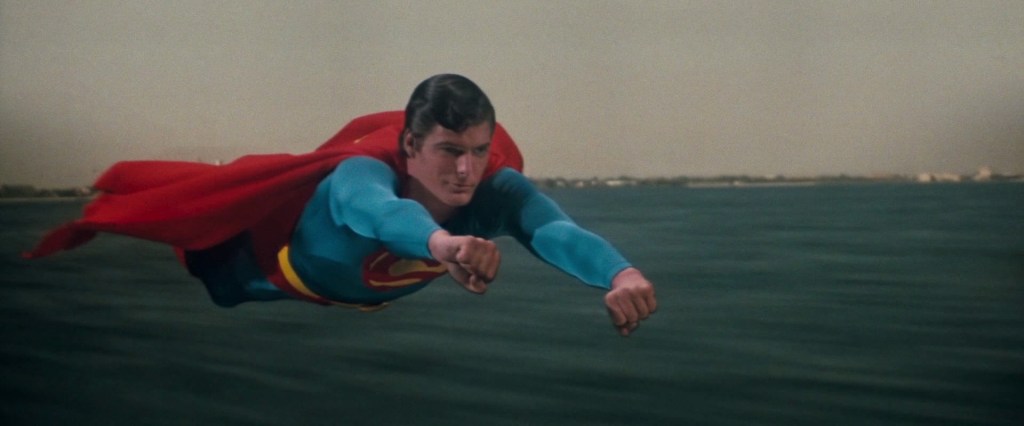
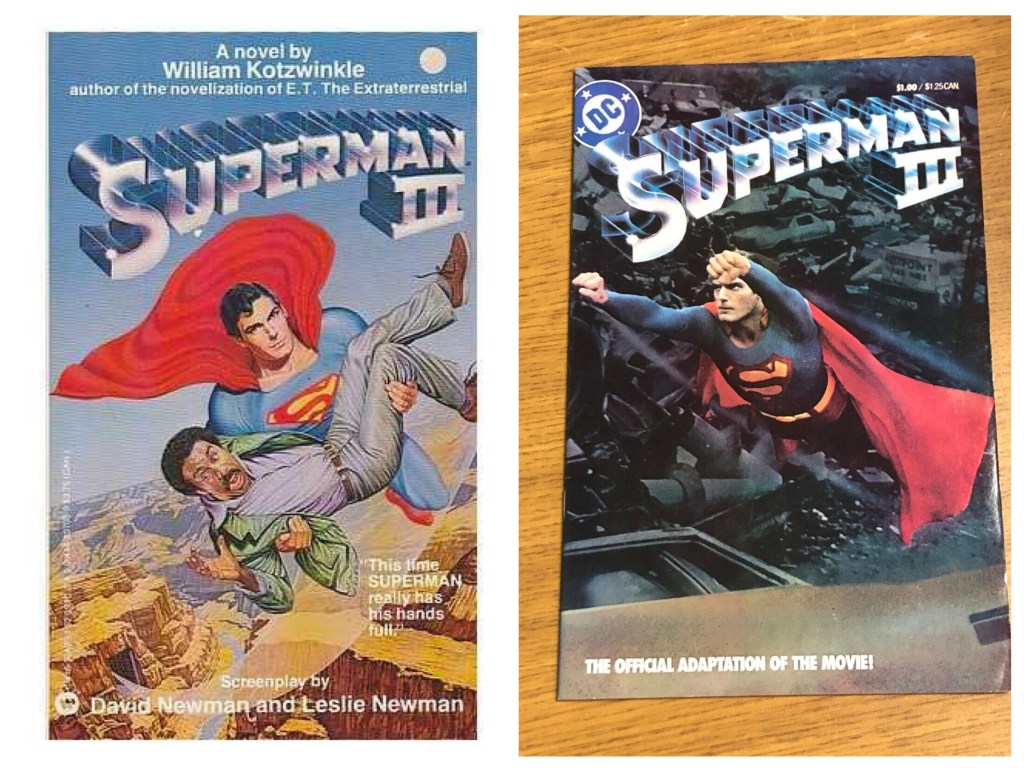
The film also had its share of firsts as well. No longer under the involvement or even the legal scrutiny of Mario Puzo, the Superman series could now be adapted into print, with a novelization from writer William Kotzwinkle and a comic book from DC Comics. If Superman looks an awful lot like Christopher Reeve in the comic book, it’s because Reeve specifically asked longtime artist Curt Swan to draw him that way—only fitting since Reeve’s portrayal of the Man of Steel first looked like a Curt Swan illustration come to life.
And then there was that fun computer game sequence of Superman escaping the missiles. Atari, then the leading video game developer behind scores of popular Atari 2600 home video games, developed the computer animation and went so far as to work on a prototype for its home gaming consoles. It’s too bad that it never saw the light of day. After the colossal and near mythic failure of its E.T. video game, those plans got scrapped, and by September 1983 thousands of Atari games (along with controllers and what have you) were buried in a landfill in New Mexico.
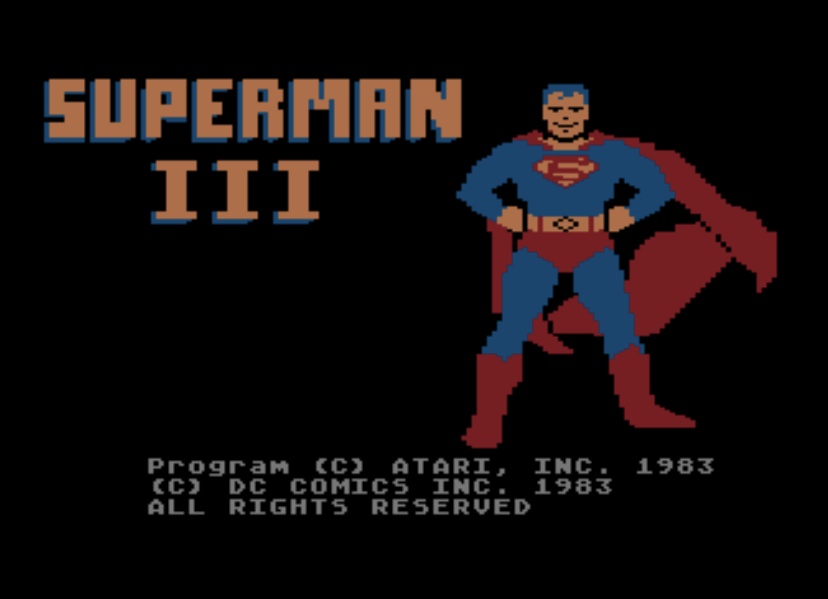
For the full story, go to AtariProtos,com. But Superman III still has Christopher Reeve in fine form, looking in top shape, with a more polished approach to Clark Kent in the process. Gone is the bumbling, mild mannered reporter, and now he’s more quietly confident in himself, which adds to his character development. And his dual turned triple performance adds another layer to the Man of Steel. And to think that the studio behind Kramer vs. Kramer would have potentially sued Warner Bros. if the film had been released as Superman vs. Superman. Sounds a little absurd, if you ask me. But the film has its fans and some good moments if you look hard enough.
It’s not the best Superman adventure, but it’s not the worst either. And with its recent release on 4K UHD, it’s looking better than ever.
-
The Many Faces of Lois Lane
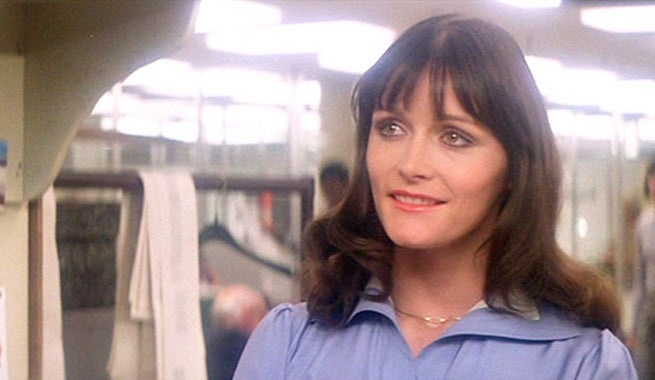
It’s hard to imagine the Superman film series without Margot Kidder as Lois Lane. In the same way that Christopher Reeve so perfectly embodied the dual portrayal of Clark Kent and the Man of Steel throughout the film series, Kidder redefined the character of Lois Lane for the series. She helped make Lois a very successful reporter with a nose for news, at times misspelling her way through stories, while having her own no-nonsense attitude that she’s going to get her story her way.
Since her debut in Action Comics #1 in 1938, there have been many actresses who have portrayed Lois in radio, animation, television, and film. Joan Alexander. The first live-action portrayer, Noel Neill. Phyllis Coates. Teri Hatcher. Erica Durance. Kate Bosworth. Amy Adams. Elizabeth Tulloch. And, of course, Margot Kidder. But who else was up for the role?
From January to April 1977, at least six other actresses read for and/or screen tested for the role alongside Christopher Reeve in two sequences from the Superman films, the interview from Superman: The Movie, and Lois attempting to trick Clark into becoming the Man of Steel from Superman II. As shooting began on the two films, it was reminiscent of when filming on Gone With the Wind was underway without its Scarlett O’Hara. So let’s see who was up for the part.
Holly Palance
The daughter of acting legend Jack Palance, Holly Palance was best known for her role as the nanny in Richard Donner’s film The Omen. What we know is that she read opposite Christopher Reeve during his screen tests on February 1, 1977. Whether she had screen tested for Lois Lane is unknown, though it is very likely this is not the case. While certainly attractive enough for the role, and in the right age range, her reading comes off a bit dry.
Anne Archer
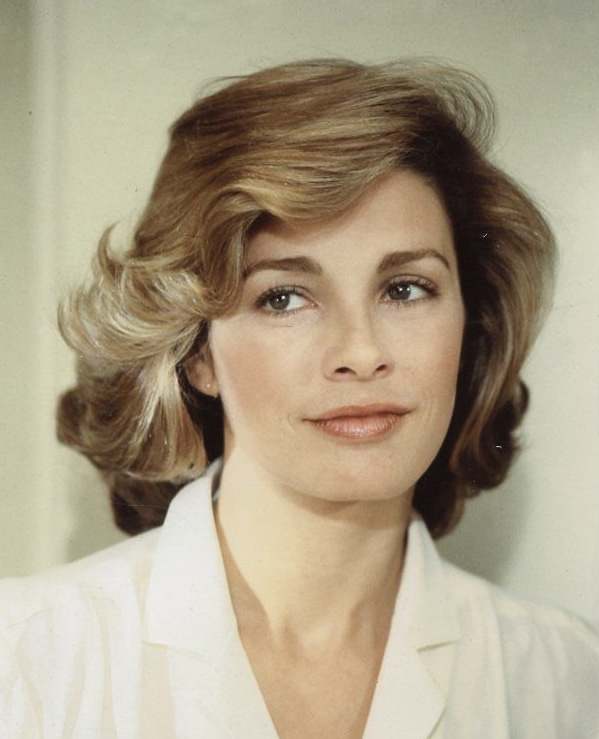
Anne Archer had built a name for herself as a reliable character actress in film and television since her debut in 1970 in the series Men at Law. Archer would shoot her screen test on March 10, 1977, shortly before the start of filming on Superman. Her presence was likable, and she would have made an effective Lois in my opinion. Archer would go on to have memorable roles in Fatal Attraction, Patriot Games, and Clear and Present Danger, among others.
Lesley Ann Warren
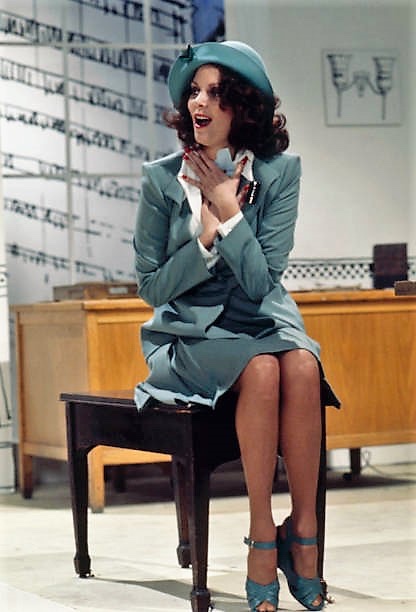
Of the actresses who auditioned for the role, Lesley Ann Warren was the only one who had experience in the part. Only two years earlier, she portrayed Lois Lane in the 1975 TV adaptation of the musical It’s a Bird, It’s a Plane, It’s Superman opposite David Wilson, which aired in a late night time slot. (If you’re brave enough to check out this sloppy video, knock yourself out.)
Warren’s screen test was filmed on March 22, 1977, also before the start of filming, and she brought her bubbly personality and smile to the screen test as she did in later movies. But her reading may have been a little over the top, if you ask me. According to David Michael Petrou in The Making of Superman: The Movie, it looked like Warren would be the choice. Good thing that Richard Donner and the Salkinds hesitated.
Deborah Raffin

Raffin made her acting debut in the TV drama Of Men and Women in 1973 and built up a steady stream of credentials in film and television, but she was still relatively unknown at the time of her screen test on April 16, 1977. There’s something about her screen test that just feels… off, in my opinion. I can’t put my finger on it. It’s possible that she didn’t have “the look” that would befit the character.
She would go on to a short-lived TV version of the film Foul Play, and in 1993 she would reunite with Christopher Reeve in the film Morning Glory.
Susan Blakely
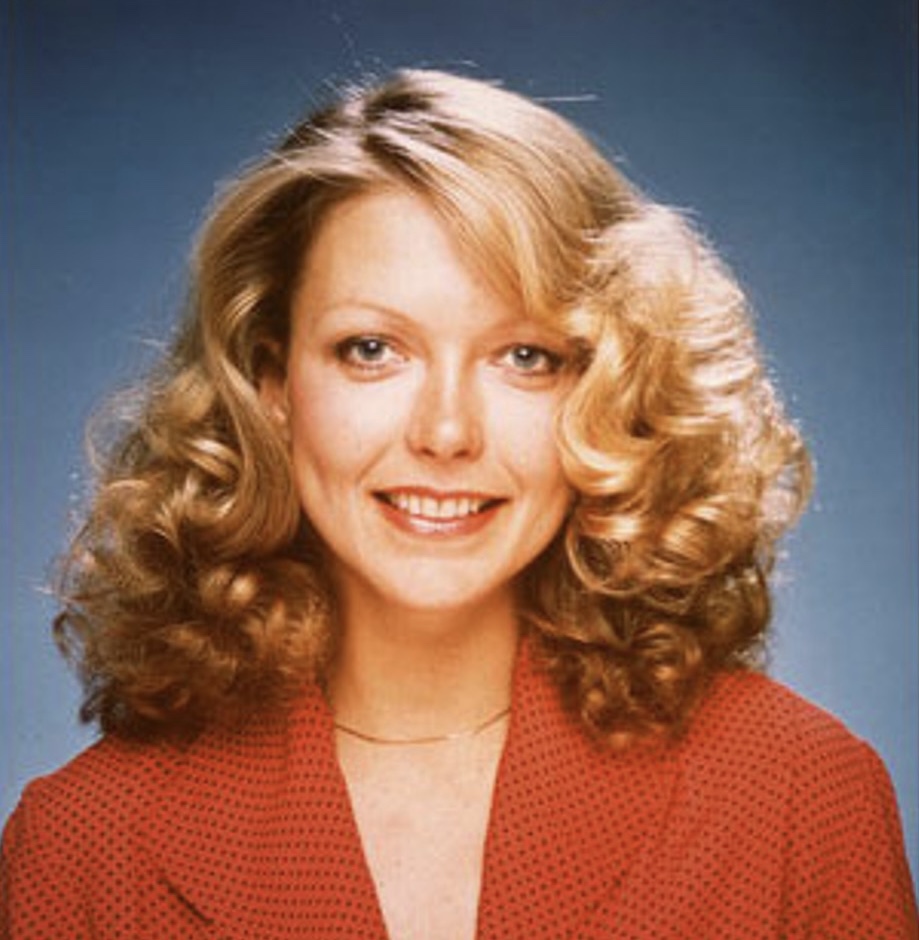
Like Deborah Raffin and Anne Archer, Susan Blakely had also built up a steady stream of acting credentials during the 1970s, beginning with Savages in 1973 and followed over the next year and a half with appearances in The Way We Were, The Lords of Flatbush, and The Towering Inferno. In 1976 she appeared in the landmark miniseries Rich Man, Poor Man.
Blakely filmed her screen test on April 2, 1977, and later had lunch with Christopher Reeve, where, at one point, she stuck a wad of gum on Reeve’s shoe, much to his chagrin. In my opinion, her reading didn’t come off as inspiring. While she didn’t get the part, Blakely would continue her career with steady appearances on numerous films and television series over the next four decades.
Stockard Channing
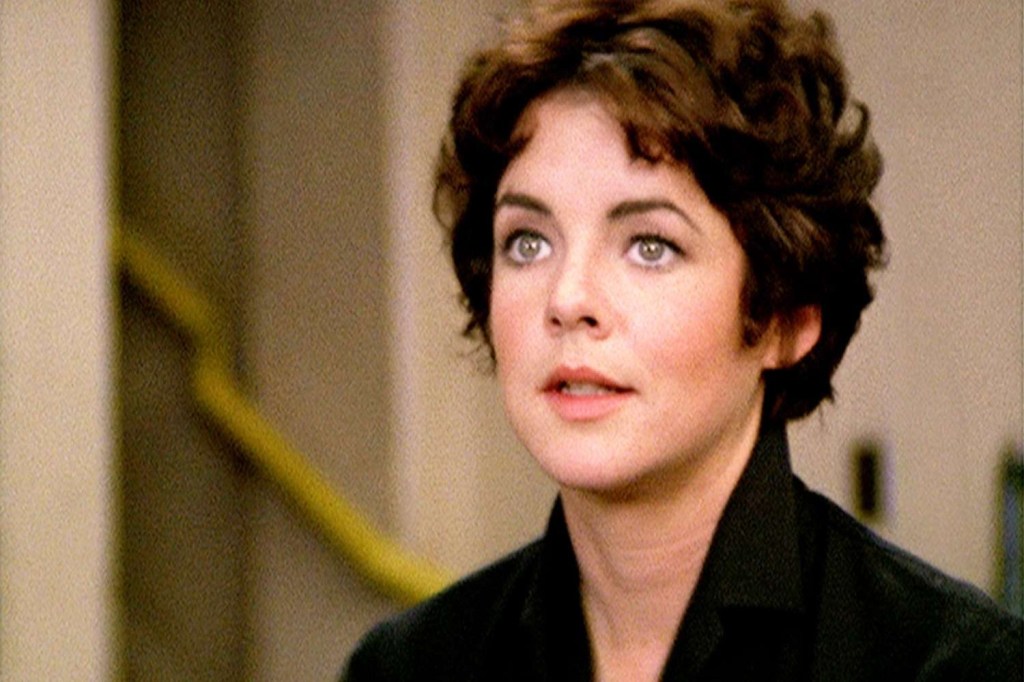
This saucy actress, born Susan Stockard, got her start in 1970 in the short film Comforts of Home and made numerous appearances in films and television over the decade. She filmed her screen test on April 30, 1977, a week after Margot Kidder had filmed her screen tests. Her screen test was that good. She gave Lois Lane a tough, no-nonsense attitude that helped define the character, and as a result she was named one of the two finalists for the part, along with Kidder.
Ultimately it came down to a decision that likely involved Richard Donner, Ilya Salkind, and casting director Lynn Stalmaster, and Margot Kidder was selected. Stockard Channing would then go on to film her part in the role that would define her career, that of the tough talking Betty Rizzo, the leader of the Pink Ladies, in the film version of Grease.
Other names that were mentioned but were not considered included Barbra Streisand, Jessica Lange, Jill Clayburgh, Liza Minnelli, Shirley MacLaine, Natalie Wood, Christina Raines, and even Carrie Fisher. Could you have pictured any of them as Lois Lane?
But thank goodness for Margot Kidder and her screen tests on April 24, 1977. And the rest, as the saying goes, is history.
-
The State of the 4K
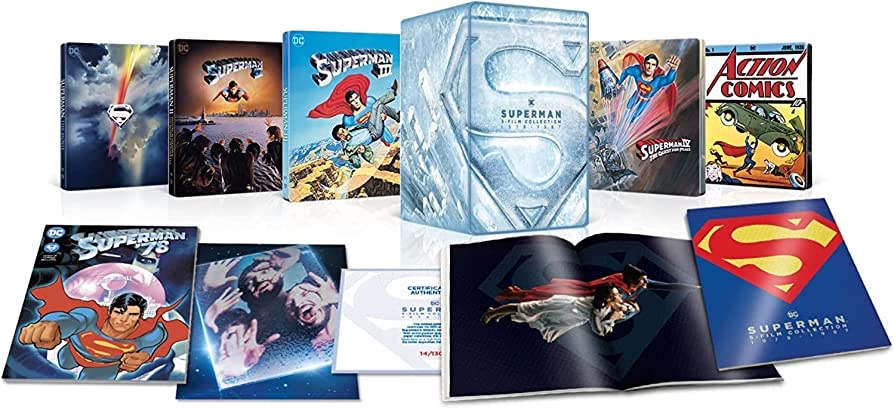
As the new 4K set of the Superman films are being released, a number of people in overseas markets have begun receiving their copies of the limited edition steelbook set. Some have posted unboxing videos on YouTube, and some others have uploaded the main title credits from Superman II and Superman II: The Richard Donner Cut to give fans a taste of what to expect. Jay Towers and Jim Bowers of the CapedWonder Superman Podcast recently released their first podcast of 2023 and dedicated it to the breakdown of the steelbook set from different markets.
And I’m still waiting for my copy to arrive. I preordered it back in late February from the WB Shop, and only this past Thursday did I, along with a friend of mine named Adam Thurmond, finally receive the word that the 4K steelbook set is being sent out. Interesting how we in the United States are late in the game getting this set. (Sounds like what happened when Superman II was reverse marketed in 1980-81 for different countries’ peak summer season.) I envy you guys who’ve already gotten your copies now. But I won’t have to wait much longer now. As the saying goes, good things come to those who wait.
But the question I have to ask is, is the new Superman 4K set a good thing? There’s been lots of talk about what’s on there, what’s not on there, and what’s changed. So let’s look at what we know so far, film by film:
Superman: The Movie
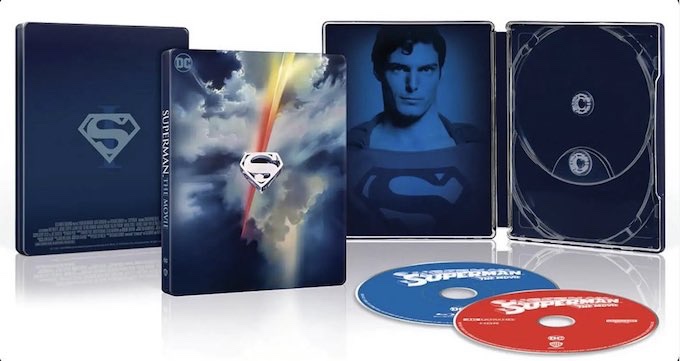
The new 4K set of the classic first film is missing one important thing: the 70-millimeter six-track audio mix from the 2018 release is no longer there. The only way to hear that original audio mix is the 2.0 mix. Why it was omitted remains unknown at this time. So it’s important that you hold on to the 2018 4K release if you want that audio track.
For that matter, the Blu-ray companion disc in the set is different in the UK release. According to Jim Bowers, the Blu-ray contains the 151-minute special edition that was first seen in 2001. The German box set contains the original 143-minute theatrical release, which allows you to switch between the 2001 sound mix and the original 1978 sound mix. Which version of the film that will be included in the US, Mexican, French, and other versions remains to be seen. But I wouldn’t be surprised if it contains the theatrical version.
Superman II

The opening credits to Superman II have never looked or sounded better than it does here! When I first saw the film with my parents in 1981, I picked up on how the sound and the music was really full and rich. Every version since then on VHS, laserdisc, DVD, and Blu-Ray has had the music partly buried in the mix. This is due to some incorrect channel mixing. The only other version of the film that I recall that the music was punched up to the forefront was the 1984 extended TV cut. Of course, if you listen to the 2008 soundtrack release from Film Score Monthly, or the 2018 soundtrack CD from LaLaLand Records, you’ll hear how rich the music is.
This is one thing that I’ve noticed in the sound mix for the 4K release, and judging from the video, this greatly benefits the film so much! It sounds amazing through my Bose wave speaker! And the colors look richer and fuller. Check out this video clip and you’ll see what I mean.
Superman II: The Richard Donner Cut
Now let’s look at its companion piece from 2006. I know I’m skipping ahead in terms of years, but when you talk about Superman II, you have to deal with both sides of the film. And this new 4K release includes both films in the same steelbook.
The film looks good based on the opening sequence and credits, but it’s clear that the fixes that should have been corrected were not done at all. The rocket still reads XK-10 instead of XK-101, the outer space background is still budget rate in places, and, if that’s any indication, the floating Marlon Brando head during his final appearance in the film—when Jor-El admonishes the powerless Superman for choosing to give up his powers in the name of love—is still stationary in those two places when it should have moved along with the camera. It’s a little thing, but if you pay attention long enough, you’ll notice it.
As with the theatrical cut, the Donner Cut looks even more colorful and sounds just as cool too through my Bose speaker. Check out this clip…
By the way, if you haven’t done so, go to Amazon Prime and get the 122-minute version of the Donner Cut. NOW. Before they upgrade to the new 4K and it disappears forever. It contains some extra footage of Lex Luthor and Miss Teschmacher in the Fortress, as well as more of the East Houston sequence with restored music, revised audio and visual effects, and added footage from the TV cut—Superman’s soufflé and Non killing the boy—in widescreen format. And save that cut to as many devices as you can—hard drive, flash drive, laptop, Kindle, DVD burner, you name it.
Superman III
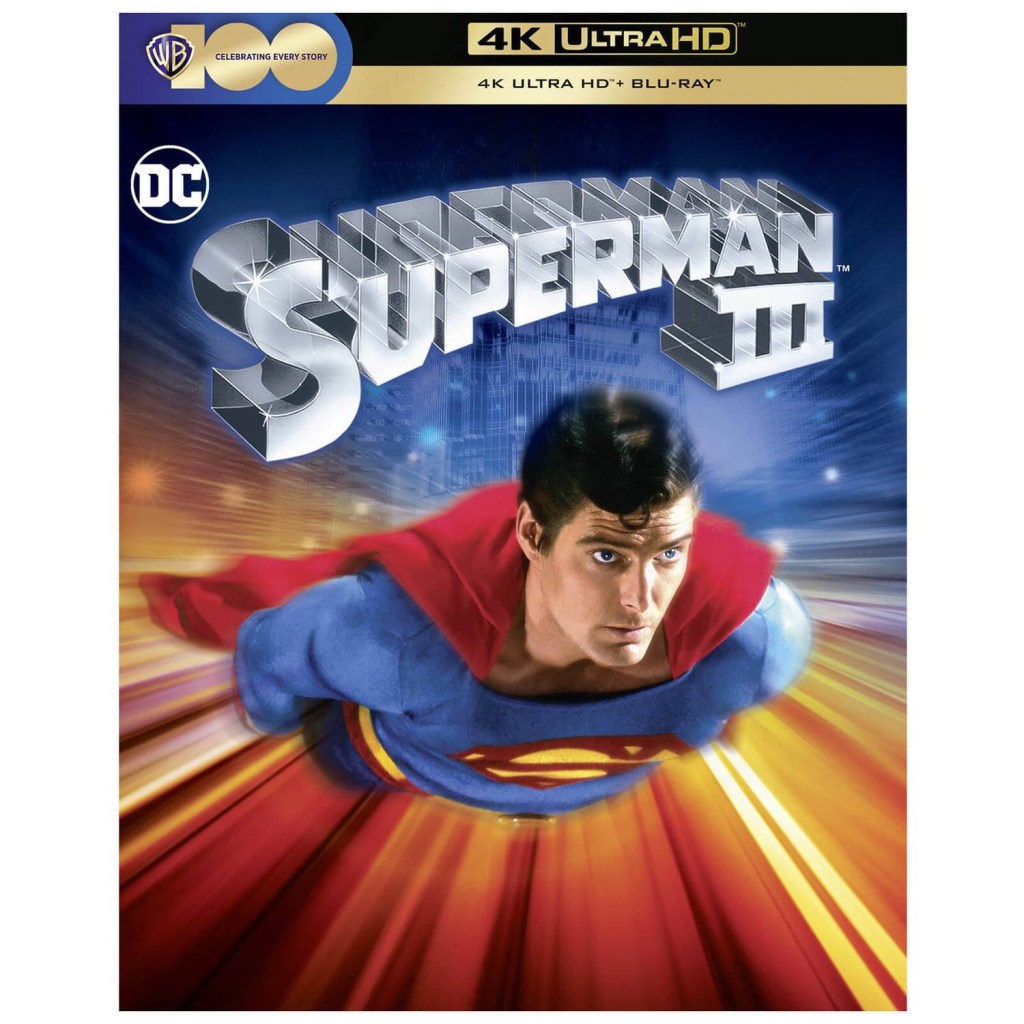
Not the image on the steelbook cover, but hey, you work with what you have. As with Superman II, the third film looks and sounds just as amazing based on the opening credits. What’s particularly striking is the series of live flying effects throughout the film. The wire removal process is spot on, and it brings you back to the tagline from 1978: “You’ll believe a man can fly.” Of course, it’s all because Christopher Reeve and the flying team made it look so seamless and perfect, and I have to give a long overdue credit to them for pulling off a totally realistic flying shot over live traffic, which could have been much more dangerous if something had gone wrong, but this is also due to the enormous amount of safety measures and practice that went into pulling it off perfectly.
Unfortunately, I can’t find a clip that shows off the new 4K release, so you’ll have to trust me with this one.
By the way, this year marks the 40th anniversary of the release of Superman III, so I will do a special anniversary retrospective on the film and how it’s aged over the decades.
Superman IV: The Quest for Peace
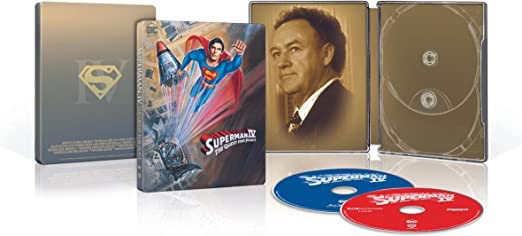
And now we come to the red-headed stepchild of the series. As I reported in an earlier blog, this one is a mixed bag from start to finish. Since it first dropped on iTunes, the major complaints have centered around the altered music throughout the film, with several substantial tracks from the theatrical release now replaced with the alternate German versions that were recorded in the middle of May 1987. Why they were replaced is still unclear as of this point.
In their recent podcast, Jim Bowers has suggested that it may be the original sound mix upgraded to 4K sound, but I have to disagree with him. In comparing the German tracks to the later English versions that appear in the final film and in the soundtrack CD, it’s easy to pick up on the differences. The main title theme, “Fresh Air”, and even the edited versions of “Confrontation” and “Volcano” (which have been edited accordingly to fit within the framework of the theatrical release) are dead giveaways. And another question I have to posit is this: how is it that the Spanish and French streaming versions utilize the sound mix from the theatrical release, and only the American version is affected?
And of course we’re still left with the obvious questions: who replaced the music, from where did these German tracks surface, and why? One thing is certain, and I’m sure our friends and acquaintances in the UK and Germany can clear this up: if the altered music is on the 4K physical disc as it is in the streaming versions, then, to quote Ricky Ricardo, someone’s got some ‘splainin’ to do.
A Little Inspiration?
But there’s also a little bit of inspiration in this new 4K set that I just picked up on, and I don’t know if anyone else has noticed it or not. Warner Home video has designed the discs around the two primary colors of Superman’s costume, red and blue, with the 4K discs in red and the Blu-Ray discs in, well, blue. At first it didn’t hit me, then it brought back this memory…
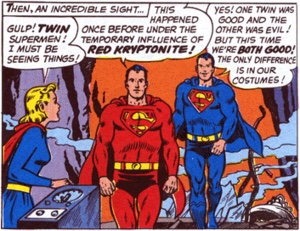
Superman-Red and Superman-Blue from the classic era of DC Comics! 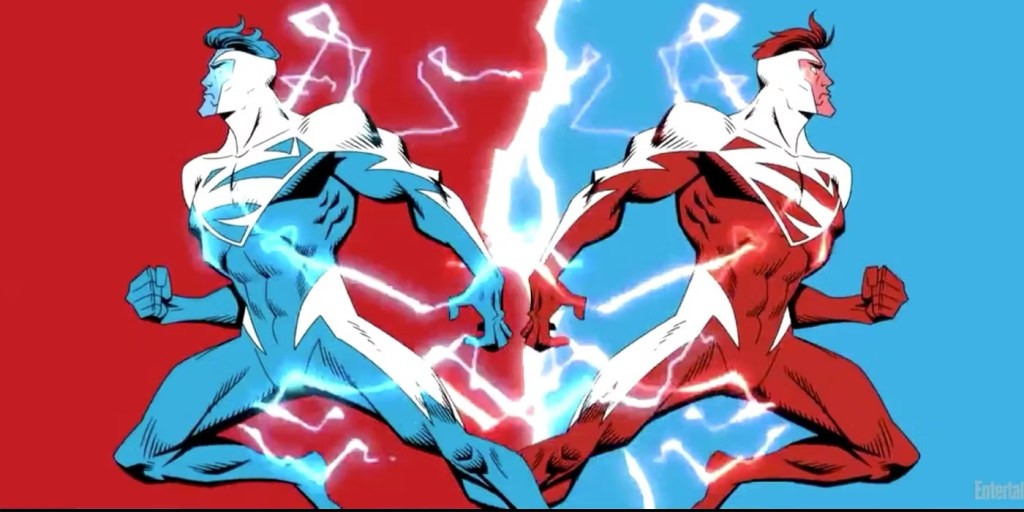
It would be revisited around 1997 in several issues of the Superman titles in this storyline. So to whoever came up with the red and blue disc color design, if you went back to these comics for inspiration, my hat is off to you!
I’ve now received word that my copy of the set will arrive next week, so I’m looking forward to sharing more with you once I have it in hand.
-
Those Super Cameos!
This past Thursday night I caught the series finale of Star Trek: Picard, which brought to an end the 36-year odyssey of Star Trek: The Next Generation. It was a finale that left me cheering, laughing, crying, and not wanting it to end. But during the finale I, like many other viewers, spotted two cameos that left me going, “What the…?” One at the beginning and one at the end. If you’re not a Star Trek fan, or if you’ve not seen the finale yet, I’m not going to spoil them for you.
But it got me thinking about some of the various cameos that surfaced in the Superman films, those little bits and pieces of film moments where you never know who’s going to show up in the films. Here’s a few of them:
Kathleen Carroll
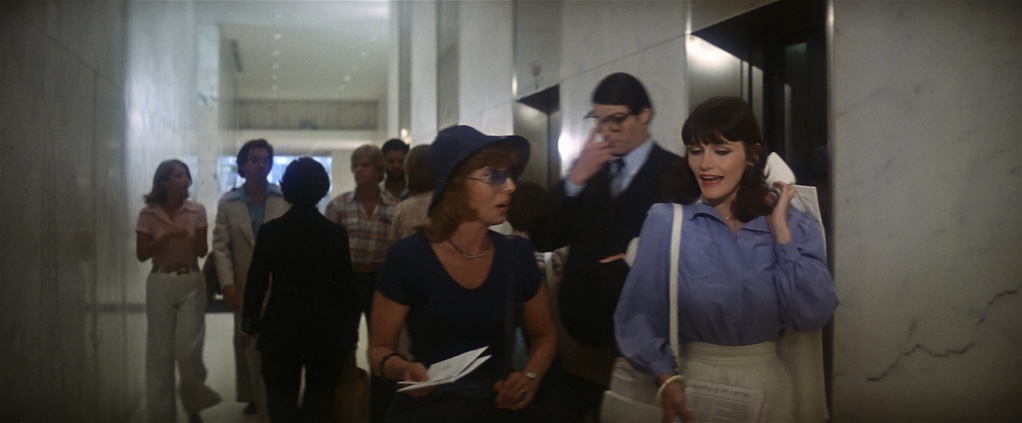
In this quick moment, Carroll—at the time a film critic for the New York Daily News—tells Lois Lane about meeting a fantastic guy at a dude ranch.
Rex Reed
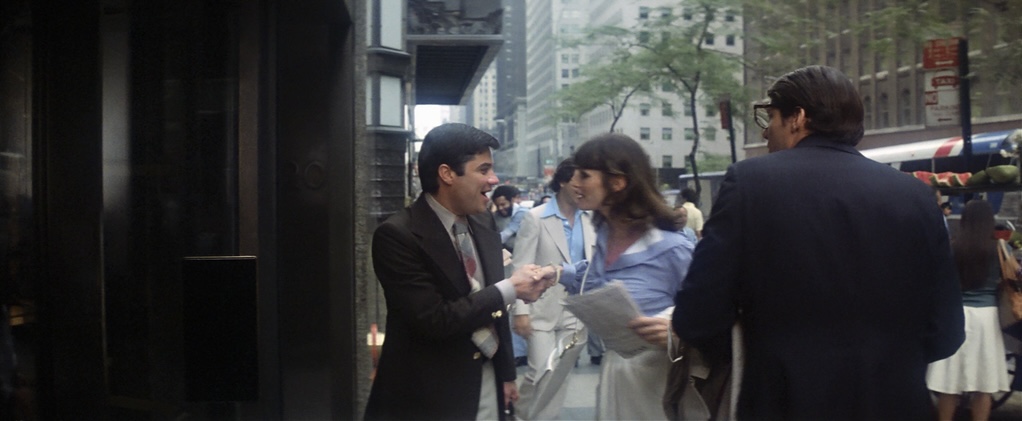
This quick encounter between the ever sardonic Reed and Lois occurs outside the Daily Planet where he doesn’t give Clark Kent the time of day. In an interview shot for the Making of Superman: The Movie documentary, Reed talks about his cameo in the film but also gives the viewers a look like he really doesn’t care about his cameo.
Richard Donner
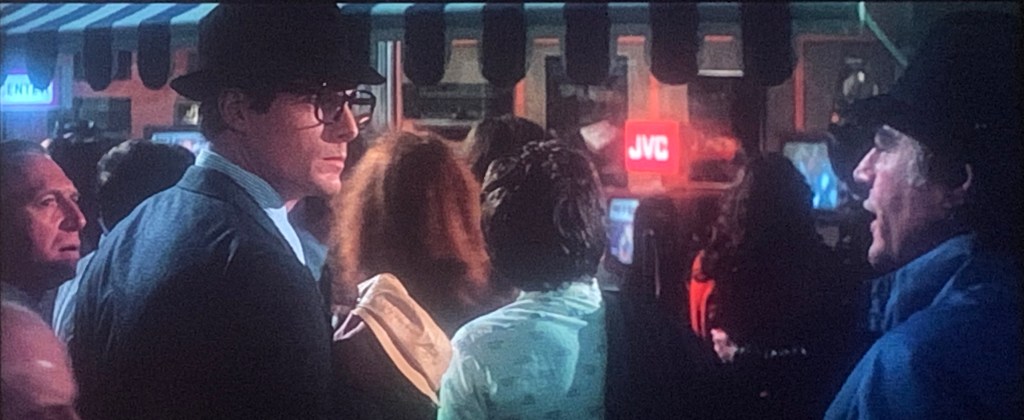
Our beloved director who made everyone believe in the concept of verisimilitude made two cameo appearances in the films. First, in the 1982 extended TV cut of Superman: The Movie, he is seen talking to Clark and asking, “That’ll be the day when a guy can fly, huh?”
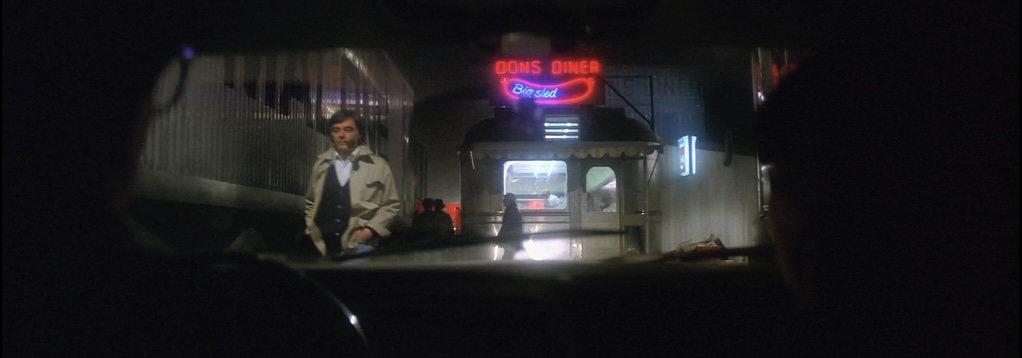
Then, in all versions of Superman II, Donner makes an almost Hitchcock-like appearance as he walks in front of Lois and Clark’s car outside Don’s Diner.
Donner’s voice can also be heard at the start of the helicopter sequence alongside Christopher Reeve’s voice, as well as the voice of the missile convoy talking to Mother Bird at the start of the missile hijacking sequence.
Leonard Nimoy
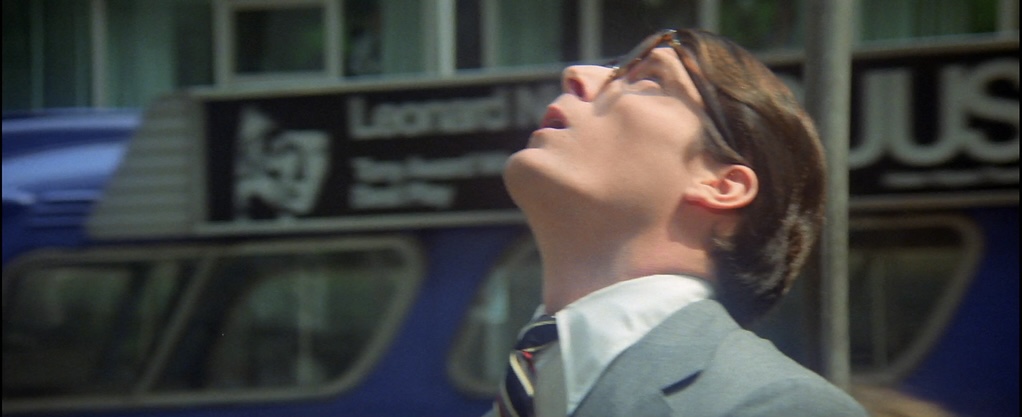
While not an actual walk-on cameo per se, an image of the world’s most famous Vulcan can be seen on a bus behind Christopher Reeve during Superman II: The Richard Donner Cut as Clark uses his super breath to save Lois by falling into a fruit cart. Nimoy’s image was used to promote his appearance on Broadway in the play Equus, which had just started only a couple of weeks earlier toward the end of June 1977. (See my blog for the full story.)
Stuart Freeborn
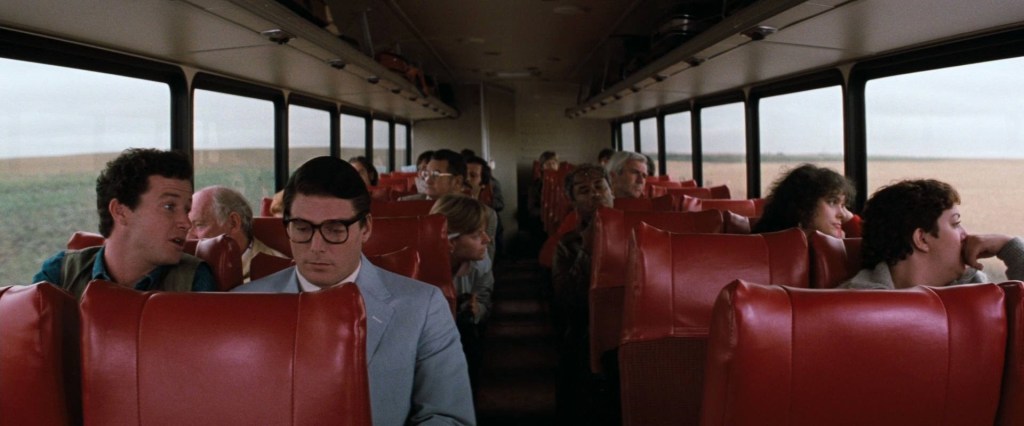
The makeup artist who worked on all four of the Superman films appears in this brief sequence sitting behind Reeve and Marc McClure as Jimmy rambles on to a disinterested Clark about how his family prefers to cook their stuffing.
Leslie Newman
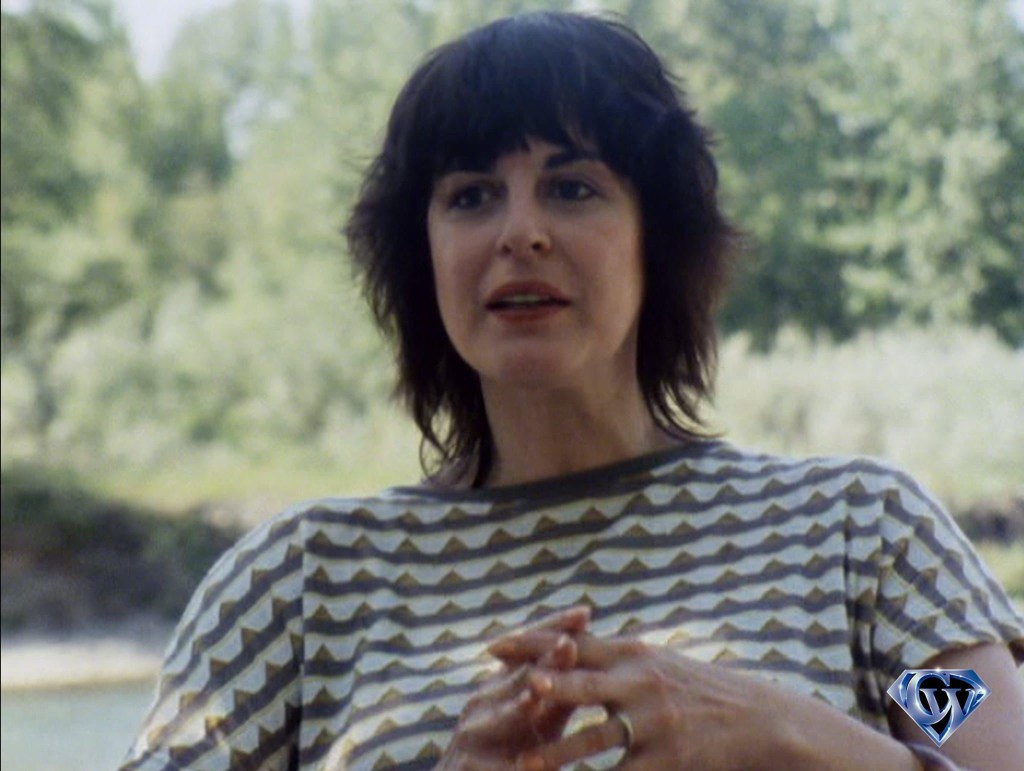
The screenwriter, who, along with her husband David Newman, co-wrote the scripts for the first three films, made a brief cameo appearance as Ross Webster’s secretary in the extended TV cut of Superman III.
Pamela Mandell

Not all cameo appearances in the Superman films were limited to production crew members. Actress Pamela Mandell had a small role as the waitress in the Don’s Diner scenes in Superman II, followed by a quick cameo as Maury Stokis’ wife in Superman III.
Robert Beatty
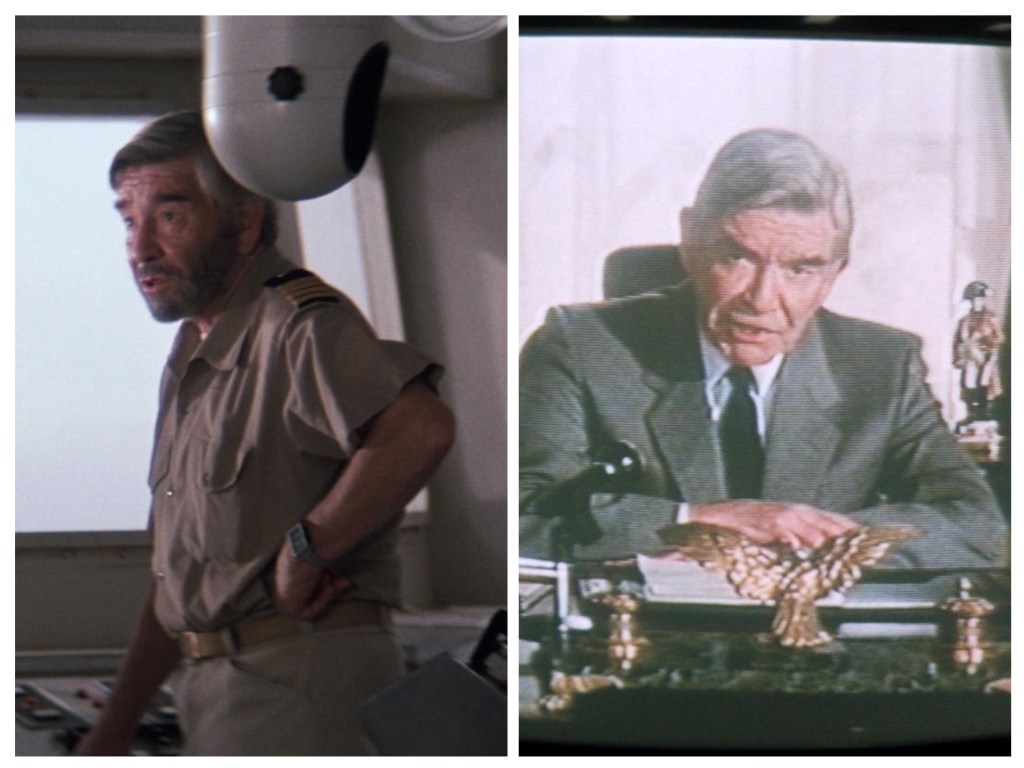
Beatty had a small role as an oil tanker captain in Superman III and a cameo as the US President in Superman IV.
John Hollis
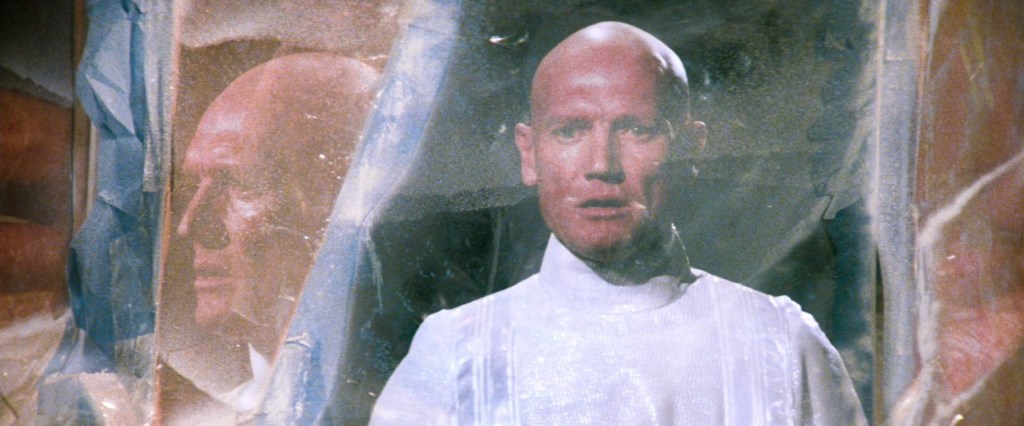
Best known as Lobot in The Empire Strikes Back, John Hollis had a brief cameo as a Kryptonian elder in the first two Superman films and a brief cameo as a Russian general in a deleted scene from Superman IV.
Les Kimber
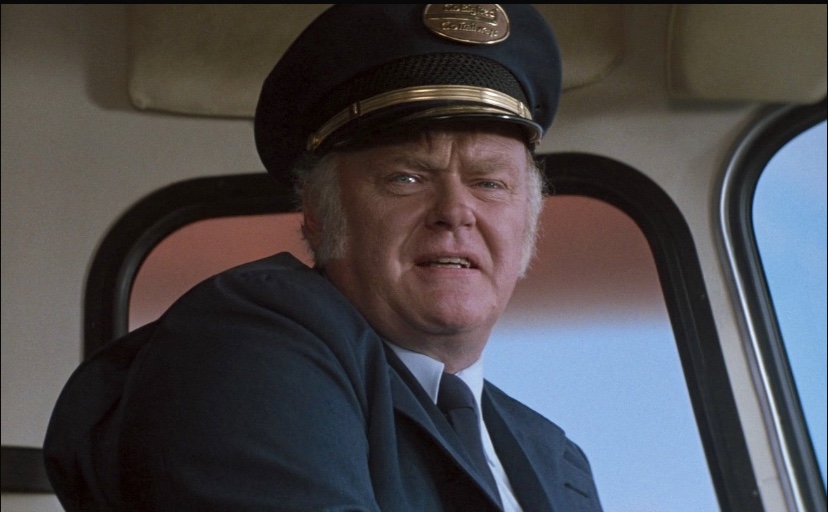
He served as a production manager on Superman: The Movie and made a brief cameo appearance as the bus driver in Superman III.
Shane Rimmer

Rimmer had a supporting role as a NASA controller in Superman II, then made a quick cameo as a sheriff in Superman III.
Peter Whitman
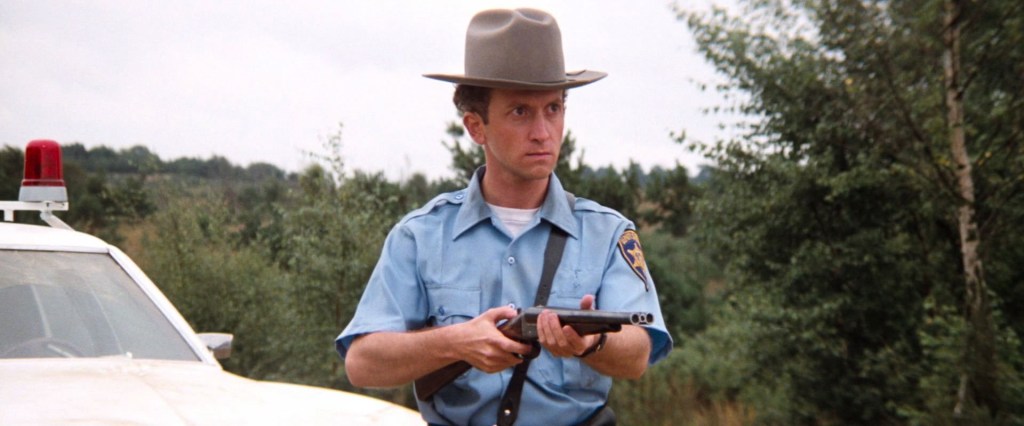
He was Deputy Dwayne during the East Houston scenes in Superman II, then he had a brief cameo as the guy at the ATM in Superman III.
Frank Oz
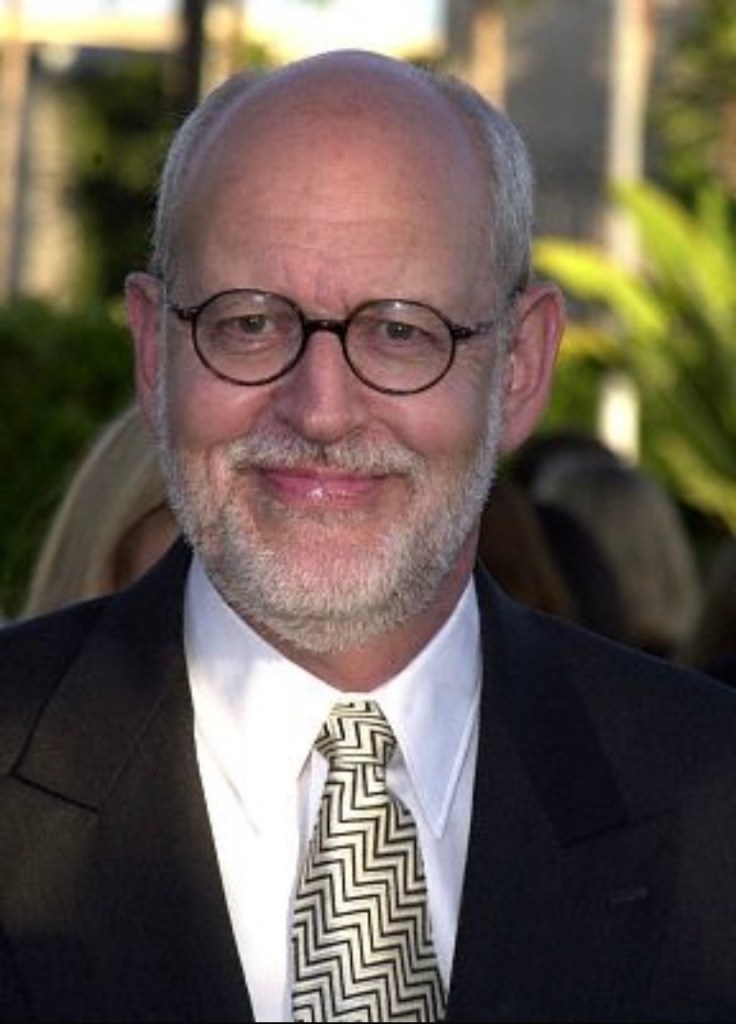
The famed Muppeteer who brought to life the voice of Miss Piggy and Yoda in The Empire Strikes Back had a cameo in the extended TV version of Superman III as a neurosurgeon during the nationwide blackout.
Larry Hagman
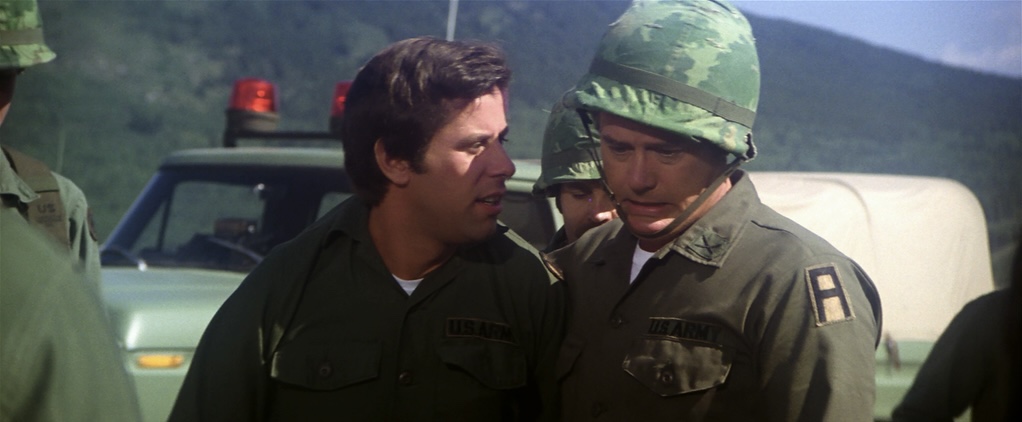
The former Major Tony Nelson of I Dream of Jeannie fame shot this quick cameo for Superman: The Movie in early August 1977 before going on to even greater fame as the devious and manipulative J.R. Ewing in the long-running nighttime drama Dallas.
David Michael Petrou
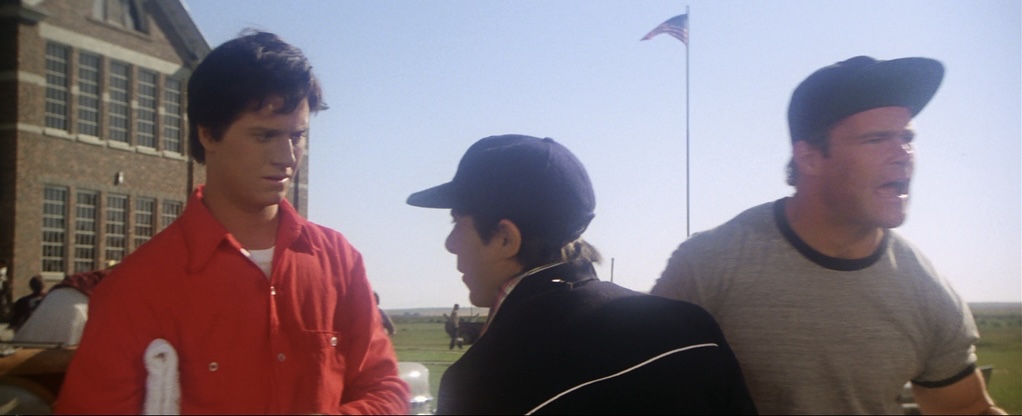
The writer of the acclaimed Making of Superman: The Movie book made a quick cameo in the film as a coaching assistant reminding young Clark Kent to get all of the football uniforms washed and prepared for Smallville High’s upcoming game.
Those are some of the cameos that occurred throughout the production of the Superman films. There are obviously others, but these are some of the more notable that come to my mind. Can you find other cameos in the movies?
(Some of the screenshots in this blog are used courtesy of CapedWonder.com.)
-
Alternate Donner Cut… Gone Forever?
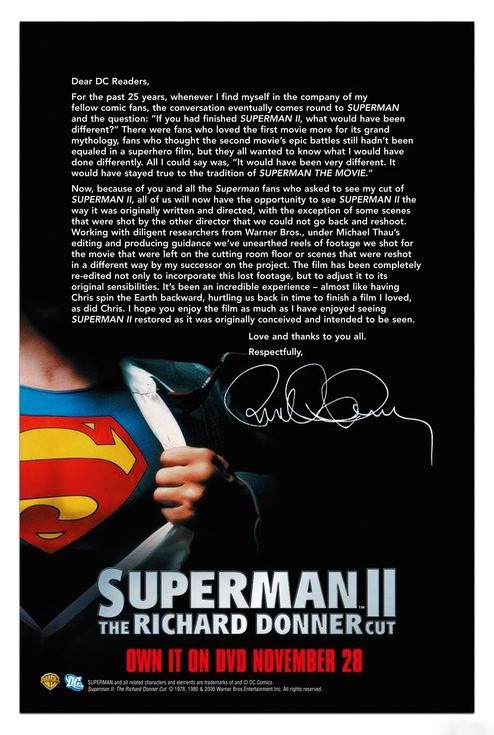
So this past Sunday I noticed on the CapedWonder Network Facebook page that Vudu Fandango had recently updated the Superman films to spotlight the new 4K UHD versions that are coming out on physical discs in the coming weeks. By now some people have received word that their copies of the 4K regular and steelbook sets are being shipped out from Amazon, so it is a sure bet that the WB Shop will ship their copies out soon as well. I have had my copy on preorder since March, so when I receive my copy, I will post about it.
The main thing that stood out is that Vudu Fandango has updated its version of Superman II: The Richard Donner Cut to reflect the current 4K release. As of Sunday, this was the listing that Vudu Fandango has for the film:
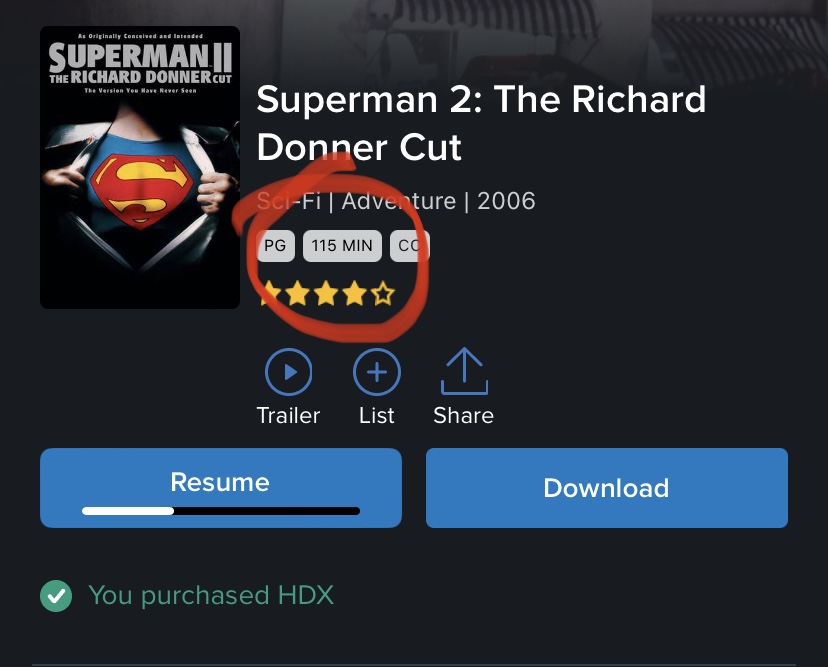
As you can see, the running length of the film is 115 minutes. This corresponds to the DVD, Blu-Ray, and 4K home video releases of the film.
Now if you remember, there was a longer version of the Donner Cut that ran 122 minutes in length and was unofficially referred to as the Vudu Cut. This version of the film contains an additional minute of footage shot by Richard Donner in May 1977 of Lex Luthor and Miss Teschmacher accessing the crystal program of Jor-El and learning about the Phantom Zone villains. It’s not much footage, but it’s still worth watching because it’s extra Donner footage.
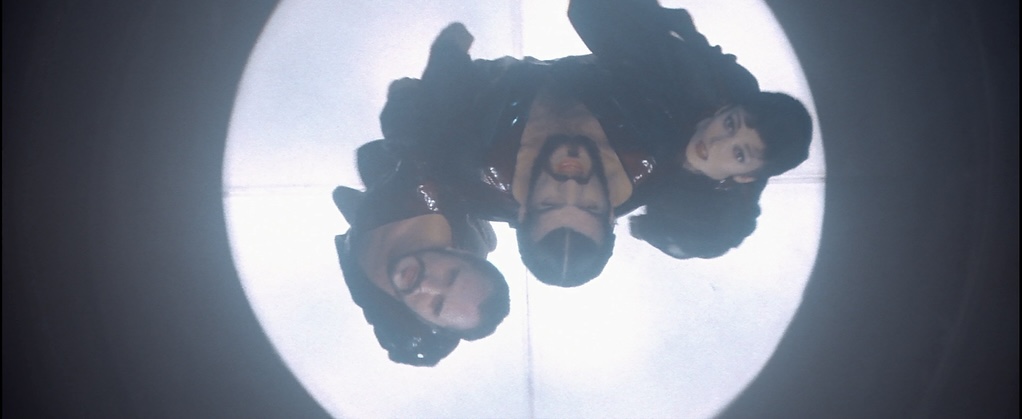
The other five minutes of footage was shot by Richard Lester in 1979 and encompasses all of the East Houston footage from the theatrical version of Superman II and the extended TV cut, including the added scene of Superman cooking the soufflé in the Fortress of Solitude and the added scene of Non killing a boy who tries to escape from the town.
Pay attention to the revised music in these clips from the longer Donner Cut. Originally featured in the extended TV cut on ABC in 1984, this added scene was featured in the You Will Believe documentary in 2006, but divided into two parts. This clip also features some revised music at the end of the scene. More changes in the sequence include revised sound effects, more retracked music, and in one instance a CGI modification where Zod’s energy beam has been removed from the film.
This version of the film also includes some slightly different end credits as it gives credit to Warner Bros. executives George Feltenstein and Paul Hemstreet for eternal gratitude and support, as well as a slightly different end card from Richard Donner about not supporting fur and tobacco.
When this version of the film was submitted to Donner for approval, Donner did not okay the cut and ordered more changes to the film, resulting in the six minutes of footage being cut from the film, presumably to give him more emphasis in the final film and to deal with less Lester footage. But this 122-minute cut of the film was archived in a file somewhere, where it sat for nearly a decade and was released on Vudu and Amazon Prime, while other streaming platforms received the 116-minute final cut.
As of today, the 122-minute version of the film remains solely available on Amazon Prime.
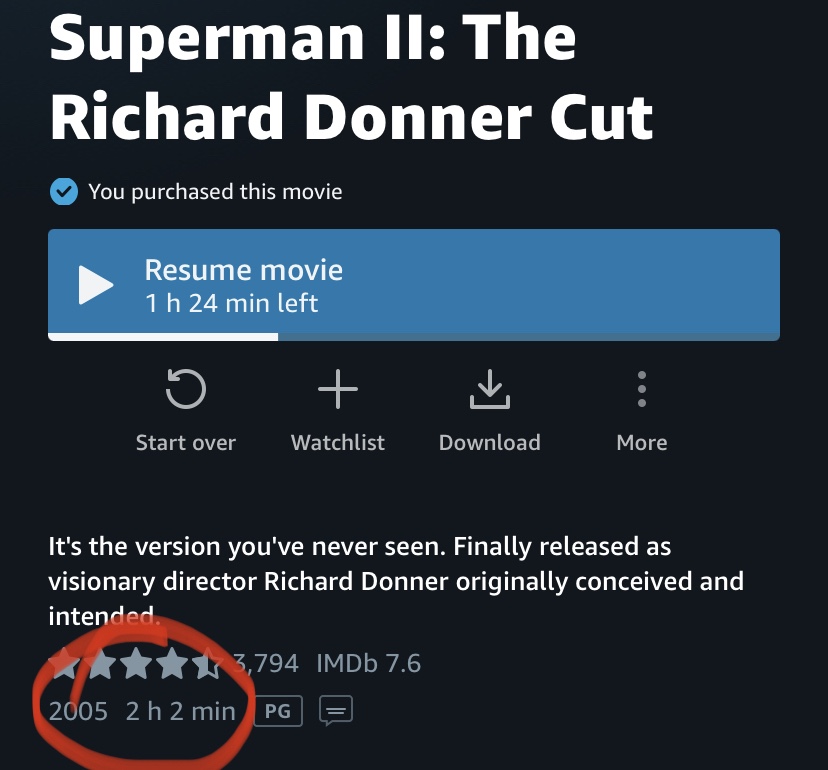
For how long, though, is unknown. With the new 4K update available on Vudu Fandango and other streaming platforms, it may not be on Amazon Prime much longer.
For those of you who have access to Amazon Prime, my advice to you is this: save this copy of Superman II: The Richard Donner Cut as soon as possible. Store it to your hard drive. Save it to a flash drive or burn it to disc. I will not be surprised if Amazon Prime upgrades the film to the new 4K version very soon. When that happens—not if, but when—an interesting part of Superman lore will be lost forever.
 Superman: The Blog