-
The latest 4K news…
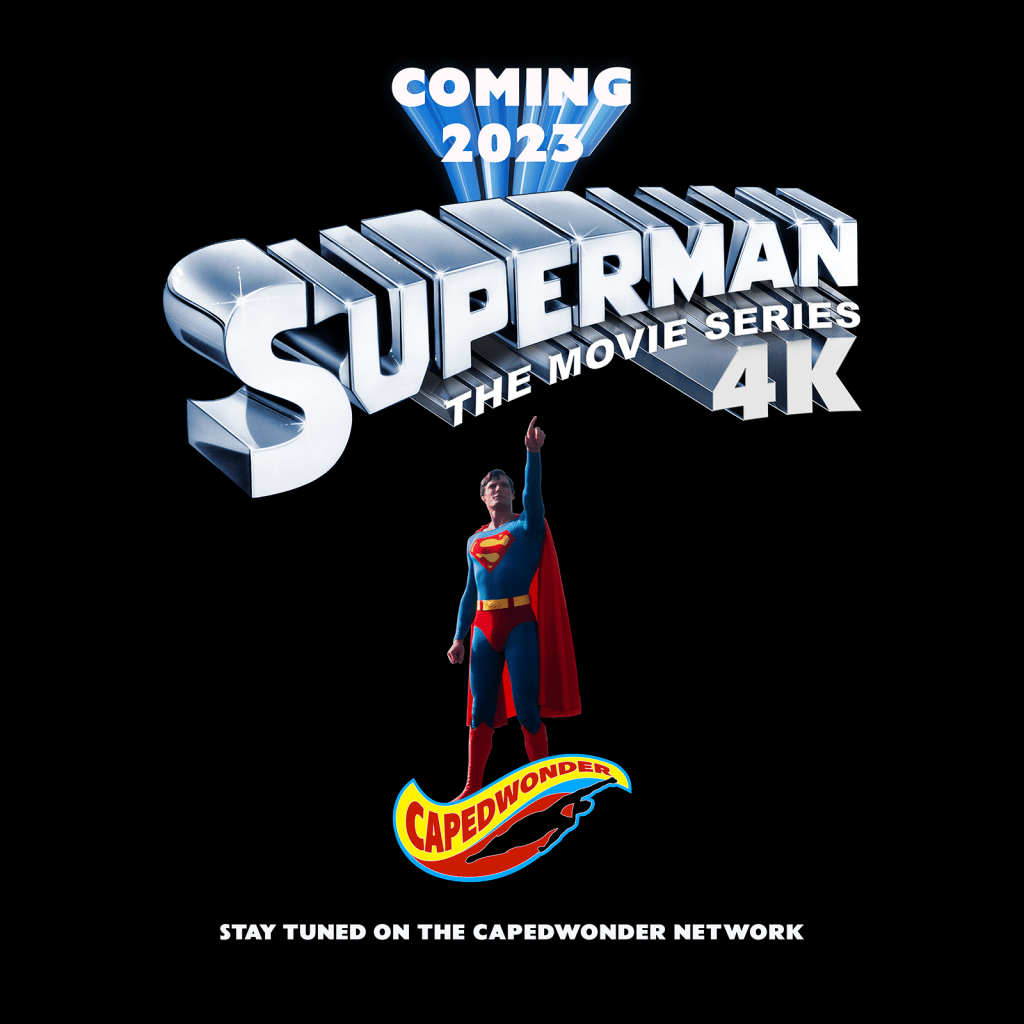
As we know, the Christopher Reeve Superman films are coming to 4K Ultra HD later this year, and now we have some more information about what we can expect.
According to Bill Hunt of The Digital Bits, we can expect the five-film Superman 4K collection on April 18, 2023 from Warner Bros. Discovery Home Entertainment. This will include the theatrical versions of all four films plus Superman II: The Richard Donner Cut. Both versions of Superman II will be included on separate discs in the collection. Whether or not the sequels and the Donner Cut will be released individually in separate 4K discs is unknown at this time. Also unknown is if both versions of Superman II will be released in separate versions or as a two-disc set.
As confirmed earlier on, the set will not include Richard Donner’s special edition recut from 2001 or the extended TV cut from 1982. Both versions can still be found on the two-disc Warner Archive Blu-ray from 2017. Nor will the Vudu streaming version of the Donner Cut be issued on 4K. Only the theatrical versions of the four films and the final version of the Donner Cut from 2006 will be issued on 4K.
Also, according to Bill Hunt, there are no plans to release Superman Returns on 4K UHD in the set, not are there any plans to release it in 4K UHD during this calendar year at this time.
Stay tuned to this blog, CapedWonder.com, the CapedWonder Superman Podcast, The Digital Bits, or your favorite online home media source for the latest information as it becomes available. Many thanks to Bill Hunt for bringing us this latest news, and to Jim Bowers for the 4K logo!
-
Superman, D.D.S.
In the days of the casting process for Superman, everyone and his brother had been considered for the role. From top names such as Robert Redford and Paul Newman to numerous actors including Nick Nolte, Sam Elliott, Clint Eastwood, Sylvester Stallone, Steve McQueen, Jeff Bridges, and even Harrison Ford, over two hundred different actors were considered.
But the most offbeat person to audition for the part was not an actor or an athlete or even a bodybuilder… but a California dentist.
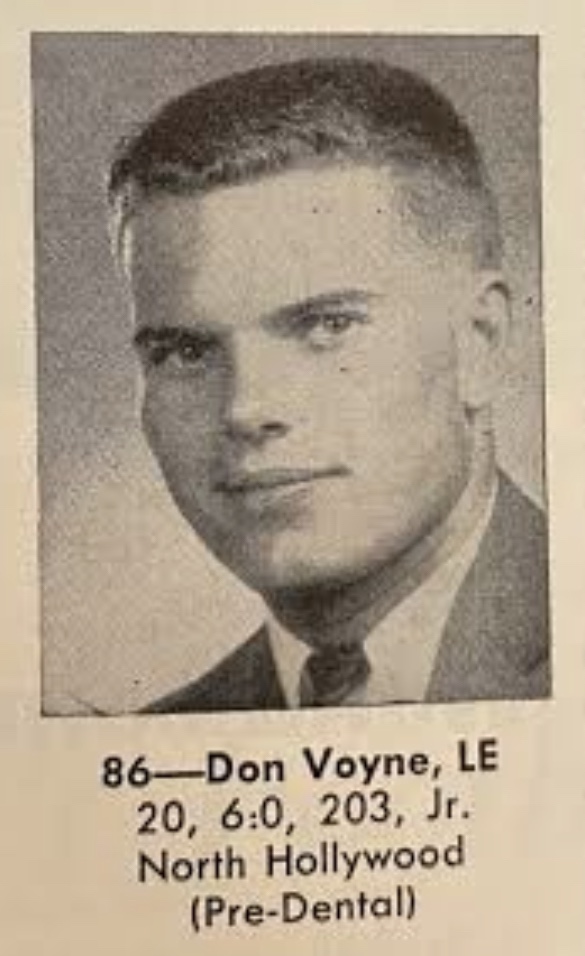
Don Voyne (1937-2020), from his days at USC. But who was he? Born in California on July 31, 1937, Donald Steven Voyne attended and graduated from North Hollywood High School and attended Valley Junior College in Los Angeles before attending the University of Southern California, where he played from 1956 to 1958 as a defensive and offensive tight end. It was during his time at USC that he entered the school’s pre-dentistry program.
One of Voyne’s classmates and teammates, Hall of Fame lineman Ron Mix, remembered Voyne for his sense of humor, his maturity, and his observations about the world around him, and that in a different era he would have been an all-American tight end. “By ‘different era,’ I mean when football changed from players having to both offensive and defense to players just playing one one or the other,” Mix said in a 2020 interview for the Palm Springs Desert Sun. “Don was an outstanding offensive end; great skills in speed, pass-catching, and blocking. However, at that time, USC was like most college teams and passed very little.” At his prime, Voyne stood six-foot-one and weighed 203 pounds. Even then, he certainly had the height and build like a potential Man of Steel.
After graduation, Voyne set up his dental practice in Beverly Hills, where he practiced over the decades. During the 1960’s he had accumulated a number of acting credits on the side, appearing in TV series such as Leave It to Beaver, It’s a Man’s World, Michael Shayne, and My Three Sons, and in films such as For Those Who Think Young, Honeymoon Hotel, The Marriage Go-Round, and A Gathering of Eagles.
But one meeting with a dental patient would give him a brief brush with near-superstardom. As David Michael Petrou recounted in his book The Making of Superman: The Movie, Ilya Salkind’s then-wife Skye Aubrey recommended Voyne to him during the casting process. “Hey, I’ve got this terrific guy, Don… he’s my dentist… seriously… and I think he looks just like Superman. Even Ryan O’Neal told Don he looked right for the role, since you don’t want him anyway. So what do you think?”
Ilya remarked to David Petrou, “Well, needless to say, Dick (Donner) and I thought perhaps this dentist was a bit too free with the sodium pentathol or something. We certainly didn’t feel inclined to waste another hour with some Beverly Hills dentist. But then I said, ‘Maybe I could kill two birds with one stone and have my teeth cleaned at the same time!’”
It was then that they reached out to Voyne and interviewed him. Ilya Salkind continued, “…then came that knock at the door—and wham! In walked Superman! Dick and I both thought this (Don) Voyne was great. Turns out he was something of a physical-fitness fanatic—tennis, jogging—like most Californians. So we arranged for a screen test at Shepperton in January, and Dick and I flew back to London, confident that we had our star.”
On January 26, 1977, Don Voyne filmed his screen test at Shepperton Studios in England, opposite actor/director Jeff Corey reading as Lex Luthor. (A couple of reports incorrectly list the date of the screen test as January 20, 1977.)
From the 2006 documentary Look! Up in the Sky – The Amazing Story of Superman. Salkind continued, “Well, we put Voyne in a Superman suit and ran the test. And in a complete turnaround from (Bruce) Jenner’s (1976 screen) test, he just looked too old. I mean, he’s a very good-looking guy—in his mid-thirties, I guess—but he didn’t convey that youth and power and courage that you associate with Superman. We all realized it at that moment. I don’t know, maybe he could have pulled it off by strong direction, but there was no guarantee.” The 39-year-old Voyne was out. A few days later, Christopher Reeve shot his screen test, and the rest is history.
One British publication, the New Musical Express, reported that Don Voyne was actually a runner-up for the role. Eventually, Don Voyne moved to the Coachella Valley and continued his Palm Springs dental practice, and with his wife they raised three sons, Donilo, Sava, and Fabrice. While Donilo and Sava followed in their father’s footsteps and excelled in high school football, all three of them learned from his example of achieving their very best in life.
“He was just the best person and man I knew,” Fabrice Voyne told the Palm Springs Desert Sun. “He would always constantly give me that support that any young kid needs, and he would help me and give me that confidence, and most importantly, teach me how I can give that to myself and now function on my own.”
Sava Voyne added, “Everything from my love of sports, my ability to be the best person I can be and and then eventually the path of going into the Navy and being in the military and training to be a pilot – that was all greatly influenced by my dad. Not so much to chase making him proud, but more so to just understand that whatever I’m doing I want to make sure that I’m putting myself in the best position to be the best version of myself. I think that’s really what my dad taught us.”
Fabrice’s football coach, former Oregon State and NFL player James Dockery, would seek out Don Voyne for parenting advice. “Fabrice’s dad instilled in his sons to be high-achieving individuals….Going out and playing his heart out in that first game was the best way Fabrice could have honored him.”
Don Voyne would pass away on August 29, 2020, from heart failure at the age of 83. That December, because of Covid-19 restrictions and schedules, the family gathered together to hold a Celebration of Life for him when the sons could be all together.
But for one moment in time, even though it was a screen test, a dentist from California briefly became the Man of Steel.
-
A Day in the Life of Superman
Have you ever stopped to wonder what exactly goes on in there making of a film? When it’s a big project like Superman, the preparation is on the scale of a military operation or a multimillion dollar business. Every bit is poured over down to the most minute of details that the average person wouldn’t even begin to consider. But for director Richard Donner, the general in charge of the production, the head of the multimillion dollar corporation, no detail went unnoticed. Indeed, he lived and directed the two Superman films according to the familiar saying, “Before you construct a building, be sure to count the cost.”
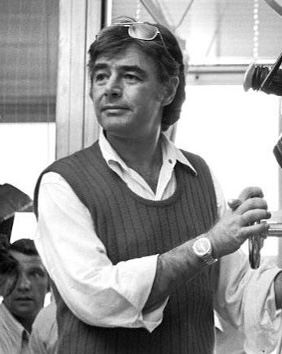
The man with the plan. Take today, for example. What exactly happened on January 24th? There are some key things that happened on this date where production on Superman are concerned.
First, a step outline was prepared for the events that would occur in Superman II. For those who are not familiar with the process, a step outline is like a road map. It lays out the direction for how the story will proceed and breaks down some of the events that will occur in the story. It’s not the final word, but only a guide to get there. Here are some of the events that were listed in the step outline for Superman II:
– Superman saving an airline from disaster
– Lois Lane jumping from the window of the Daily Planet and into a garbage truck

The final version as seen in Superman II: The Richard Donner Cut. – the villains from the Phantom Zone kill two Russian cosmonauts (changed to one in the final film
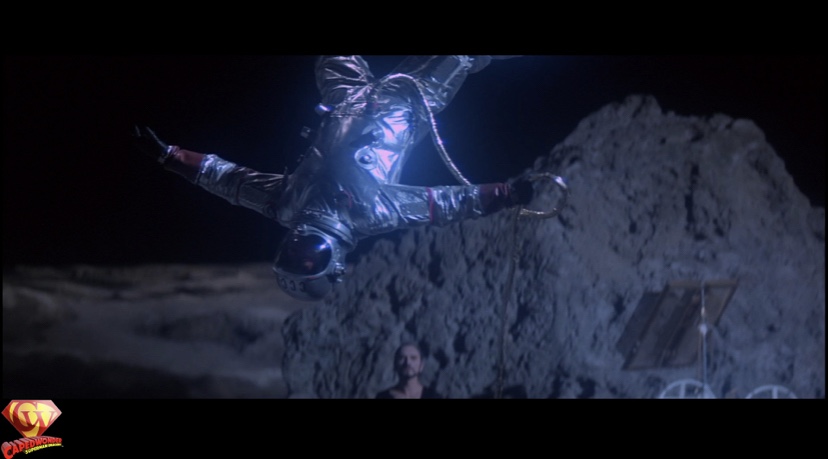
“What a fragile sort of life form this is.” – Lex Luthor escaping from prison by car
This scene is only present on the DVD and Blu-ray of Superman II: The Richard Donner Cut in the deleted scenes section. It would later be rewritten and reshot as the balloon escape. – Superman cooking the soufflé for Lois in the Fortress (this would be rewritten and shot by Richard Lester in October 1979)
Taken from the Vudu streaming version of the Richard Donner Cut. The soufflé scene also appears in the 1984 extended TV cut and as the sole deleted scene on the Superman II special edition DVD. – Zod, Non, and Ursa confronting a group of Texas Rangers (modified to a sheriff and deputy outside East Houston, Idaho)
– Ursa using her heat vision to alter Mount Rushmore (the Mount Rushmore model was filmed during Donner’s tenure)
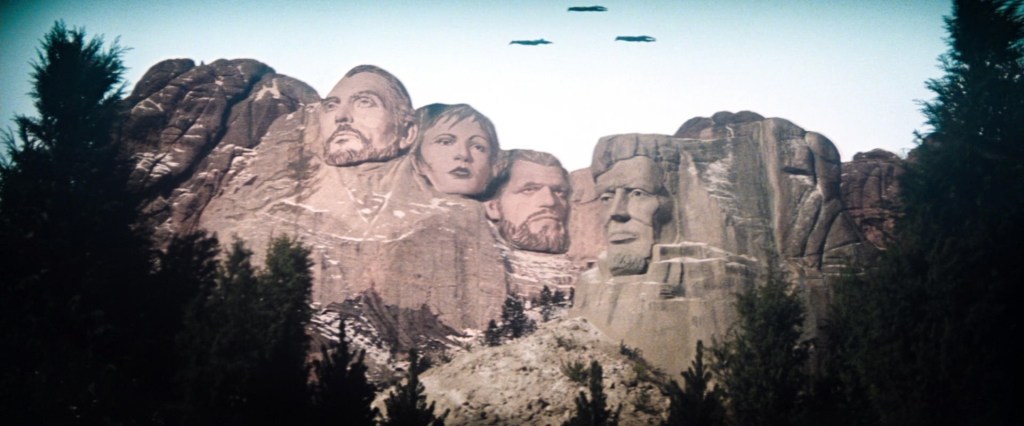
The flying elements of the villains using their heat vision would be shot during Richard Lester’s tenure on the film. – the villains arrested at the Fortress of Solitude toward the end of the film
Shot by Richard Donner in 1977, this scene would not be seen until the extended TV cut in February 1984 and later in the deleted scenes section of the 2006 Richard Donner Cut. – a final montage of scenes involving Lois and Clark, Lex and Miss Teschmacher, and Superman rescuing someone from danger
Granted, this was only a guide to what would be shot for the sequel and later in all four versions of the film – the 1990-81 theatrical release, the 1984 extended TV cut, the 2006 Richard Donner Cut, and the Vudu version of the Donner Cut. But it would serve as a good starting point for the development of the final script, first by Tom Mankiewicz in 1977, and then by David and Leslie Newman in 1979.
A year later, on January 24, 1978, filming occurred on the opening parts of Superman arriving at the balcony of Lois Lane’s apartment. Filming on the lengthy sequence had begun months earlier, as early as October 18, 1977, on M Stage at Pinewood Studios, continuing through November 1977 (along with the balcony scene for Superman II) before taking a break at Christmas and resuming in the middle of January 1978.
At one point in between filming, Christopher Reeve had said during filming of The Making of Superman: The Movie, “We changed the whole tone of that scene because I felt the time had come where Superman would be open enough to say that he’s there because he really likes her.” That meant all of the rigidity of the scene, from the screen tests to earlier shoots, were downplayed to reveal a natural chemistry between the characters.
In addition, filming on this scene led up to the point of Superman using his x-ray vision to check for any possible carcinogens in Lois’ lungs from smoking, to which he replies, “Not yet, thank goodness.”
The relaxed chemistry between the characters makes for one of the most perfect moments in the entire film, like a first date between two kids who like each other. This is what Richard Donner and Tom Mankiewicz believed would sell the film to viewers. There are many days like this during the production of all four Superman films, and these are but two small parts of the overall big picture, all separated by a single year.
(Some of the screenshots in this blog are courtesy of CapedWonder.com.)
-
The Star Field
We are familiar with the star field that appears throughout Superman: The Movie in its opening credits and in some of the scenes set in outer space. Without it, that added sense of mystery and wonder would not be an important element to the film, and it wouldn’t give us a backdrop to those beautiful opening credits. From the start of the film, the star field would be a vital visual element to the overall story arc for the film.
“Fly me to the moon and let me play among the stars…” But have you ever stopped to wonder in just how many films this particular star field appears? Let’s look very carefully.
Obviously, it appears multiple times throughout Superman – during the opening credits, at the start of the introduction to the planet Krypton, during Jor-El’s interactive lessons with his son Kal-El in the Fortress of Solitude, and during the film’s end credits.
Pay attention to the stars as they seem to bounce along in outer space. We would again see this amazing star field in the opening credits and the end title credits for Richard Lester’s version of Superman II in 1980-81.
Probably the best recap for a film in any sequel. And those streaking title credits! From there it would return for Superman III, but only in the extended TV cut. When the film was expanded for TV in 1985, an additional 17 minutes was restored to the film, mainly superfluous bits and pieces that added nothing to the overall story. The most significant addition to the TV cut was a new main credits sequence to remove the credits from its awkward placement under the opening slapstick scenes on the streets of Metropolis. The end credits music was borrowed and adapted for this new main credits sequence, bringing the film into the same vein as the first two films.
I personally prefer this credits sequence to the theatrical version. And the star field is back. But that’s not all. In the opening months of 1979, Richard Greenberg and his company R. Greenberg and Associates were at work developing a series of preview trailers for a then-upcoming science fiction film with a bent on horror. It was set to premiere on May 25, 1979, two years to the day after the premiere of the original Star Wars. So if you went to see Superman, Time After Time, The Warriors, Norma Rae, The China Syndrome, Mad Max, Dawn of the Dead, Manhattan, or other movies of the time, you probably saw this trailer in the theaters…
Another effective teaser without a single piece of footage from the film. Does that star field look familiar? It’s the same one that appears in Superman! And here’s a longer version of the Alien trailer that incorporates the Superman star field. It’s a shame that we didn’t get to see the Star field return in Superman IV. But it’s still one of the underrated elements that add to the mystery and wonder of the Superman franchise.
Update: Right after this blog went live, super fan Dan Kampling alerted me to another film that contains this same star field, one I hadn’t seen before until now… and that is David Lynch’s The Elephant Man. Toward the end of the film John Merrick desires nothing more than to sleep like a normal person and not be constrained by his disfigurement. As he drifts off to sleep, he hears soothing, comforting words, which play over a dreamlike journey through the stars. It is here that the star field from Superman appears once again.
Great catch, Dan! That brings the total to five different films in which this same star field appears. Thanks, Dan!
-
Superman and the Case of Physical Media Versus Digital Media – Part 2
In 1997, the next big thing in physical home media arrived, the DVD. Early releases such as Batman and Robin Hood: Prince of Thieves, for example, contained no features and were split over both sides of the disc in the same way that laserdiscs had done in years past. Eventually, DVD releases soon included theatrical trailers. This was soon followed by choosing between full screen or widescreen versions of films, as some viewers had not fully embraced the widescreen format by now. Within a few years, special editions of films arrived on DVD that were loaded with a vast array of bonus features, including audio commentaries, theatrical trailers, deleted scenes, production notes, documentary features, still photographs, visual effects creations, screen tests, and so forth. Films such as Superman and Gladiator, for example, proved to be highly successful with fans, while older releases such as Terminator 2 saw all of their laserdisc features ported to the new DVD format at a more economical cost.
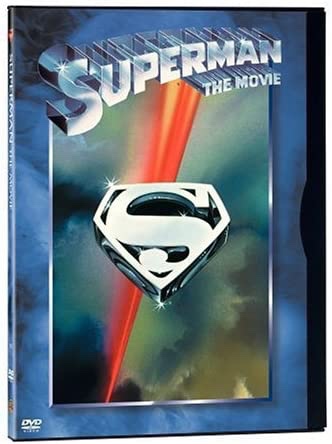

Some of the most fully loaded DVDs for its time. We also began to see a new trend in DVDs, the inclusion of Easter eggs, hidden features that fans could find that would further expand the visions of the films. They could be hidden interviews with cast or crew members, as with some of the Star Trek special editions; bloopers, such as seeing Spider-Man crash the first X-Men production; a Gladiator themed parody trailer for Chicken Run; hidden computer animatics on the DVD for the first Spider-Man film; hidden trailers for Aliens and Strange Days that were scattered across the menus of The Abyss; or a specially created alternate version of T2 which included deleted scenes and the alternate ending restored into the context of the film. We were also treated to isolated film scores for certain films such as Superman or Ben-Hur. The possibilities were now endless.
Get your own movie! Interesting note: that’s stuntman Scott Leva as Spider-Man. In the 1980’s, when Cannon Films was planning their own Spider-Man film, Leva was considered for the role. The DVD format also saw the release of more director’s cuts of films, including Robert Wise’s final cut of Star Trek: The Motion Picture (which was upgraded to 4k format in 2022), Richard Donner’s expanded version of Superman and his own cut of Superman II, Ridley Scott’s final cut of Blade Runner, and Peter Jackson’s expanded cuts of the Lord of the Rings trilogy. These director’s cuts could now join their theatrical counterparts on home video, complete with new commentaries and extensive features about their desires to see the films completed according to their respective visions. We also saw the first properly restored version of Metropolis on DVD, at a running length of 125 minutes. And we finally saw Ridley Scott’s original two-hour intended version of Legend and Jeannot Szwarc’s initial 138-minute cut of Supergirl released on DVD, both sourced from surviving prints located in film vaults and joined together with their respective theatrical releases.


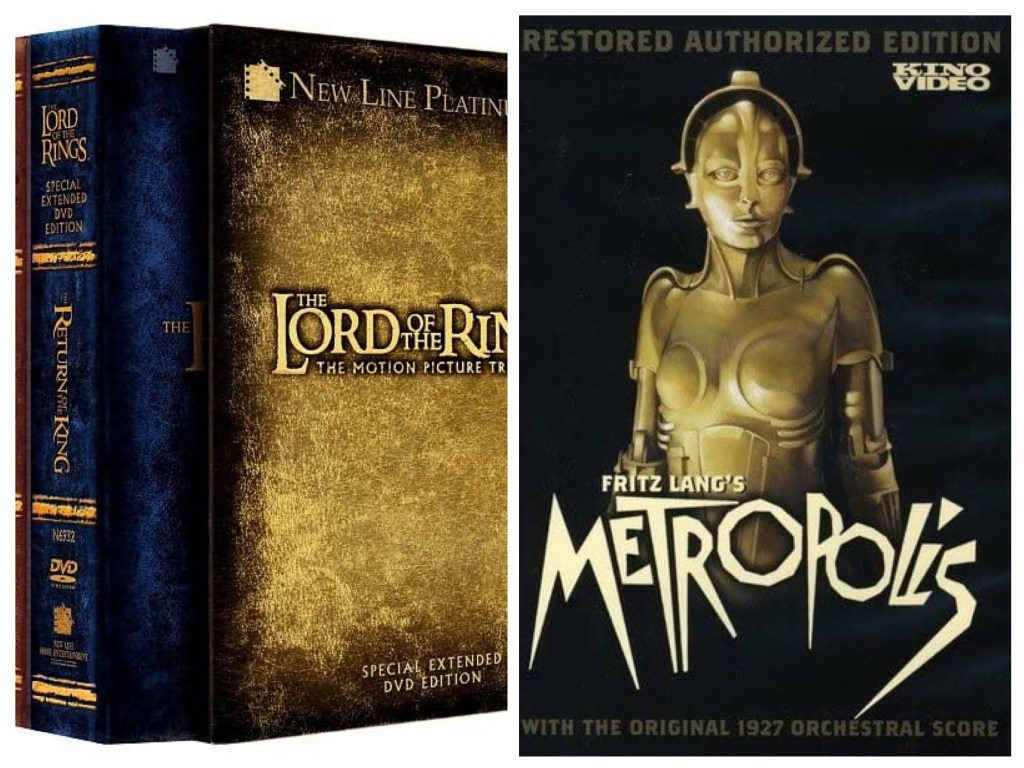
As the decade progressed, studios began to mine their catalog releases and present elaborate special editions of some of their most popular classic films, including Gone With the Wind, The Wizard of Oz, Casablanca, Citizen Kane, The Ten Commandments, Ben-Hur, and Lawrence of Arabia, to name a few. Warner Home Video would also present massive collections of the Matrix trilogy and the Superman films in collector’s edition box sets, with even more documentaries, audio commentaries, deleted scenes, and exclusive features not previously included in their earlier incarnations.

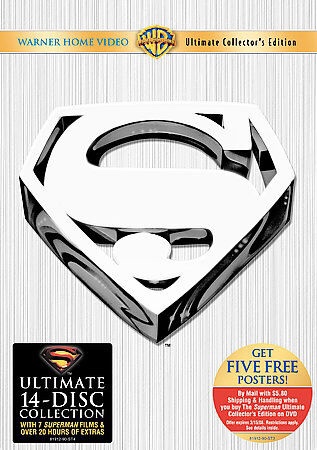
This led to other studios re-releasing titles with all-new features that were not included the first time around, and before long the idea of double dipping, or even triple dipping, on certain titles to obtain every single extra feature became commonplace much to the dismay of home video fans.
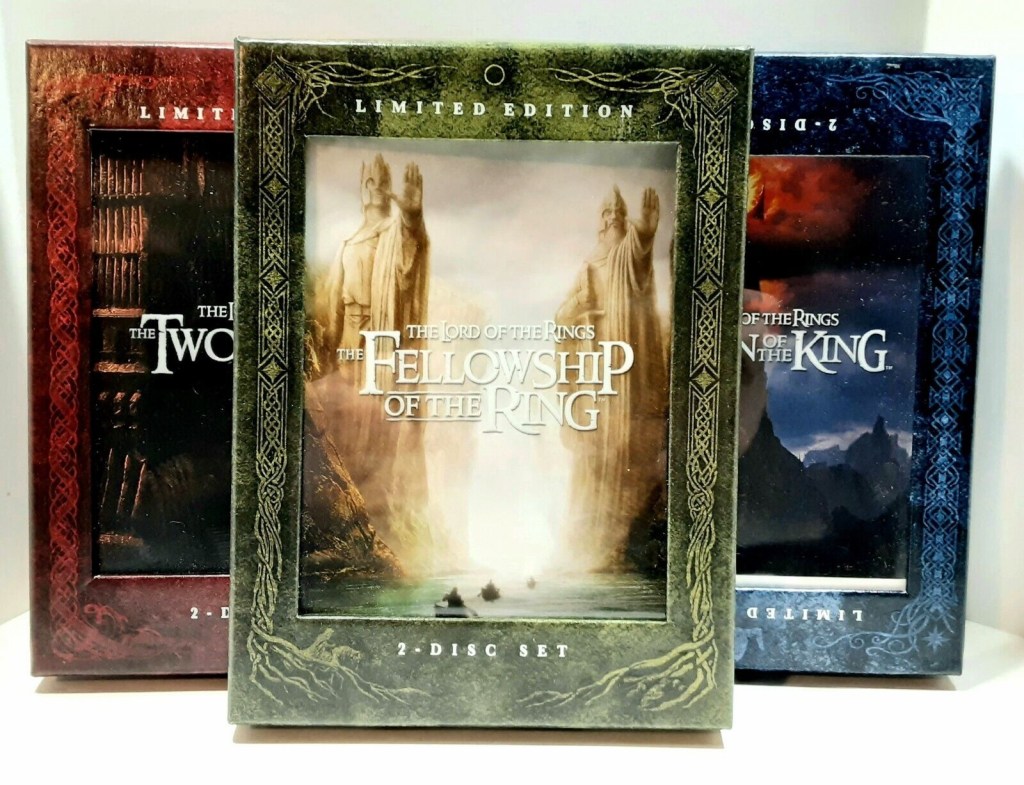
The Lord of the Rings trilogy DVD re-release would include both the theatrical and extended versions of the films, along with new feature-length documentaries on the making of the films produced by Costa Botes. And then came Blu-ray. The winner over HD-DVD in the format wars of the latter half of the 2000’s, Blu-Ray promised higher resolution, more interactivity, and more storage for films and television series and their respective bonus features. Once again studios mined both newer releases and their older catalog titles to bring more bang for their buck. Some studios would craft all new bonus features for their Blu-Ray releases, which meant that film fans would have to dip into their wallets again for even more added features that were not included on the earlier DVD sets.
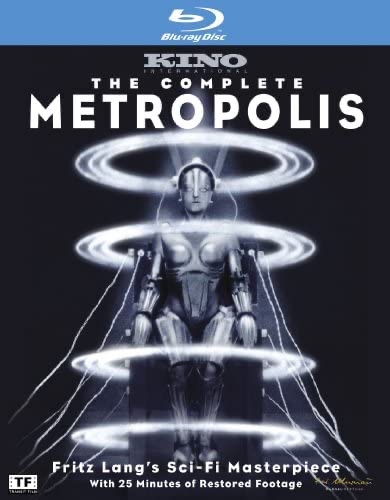
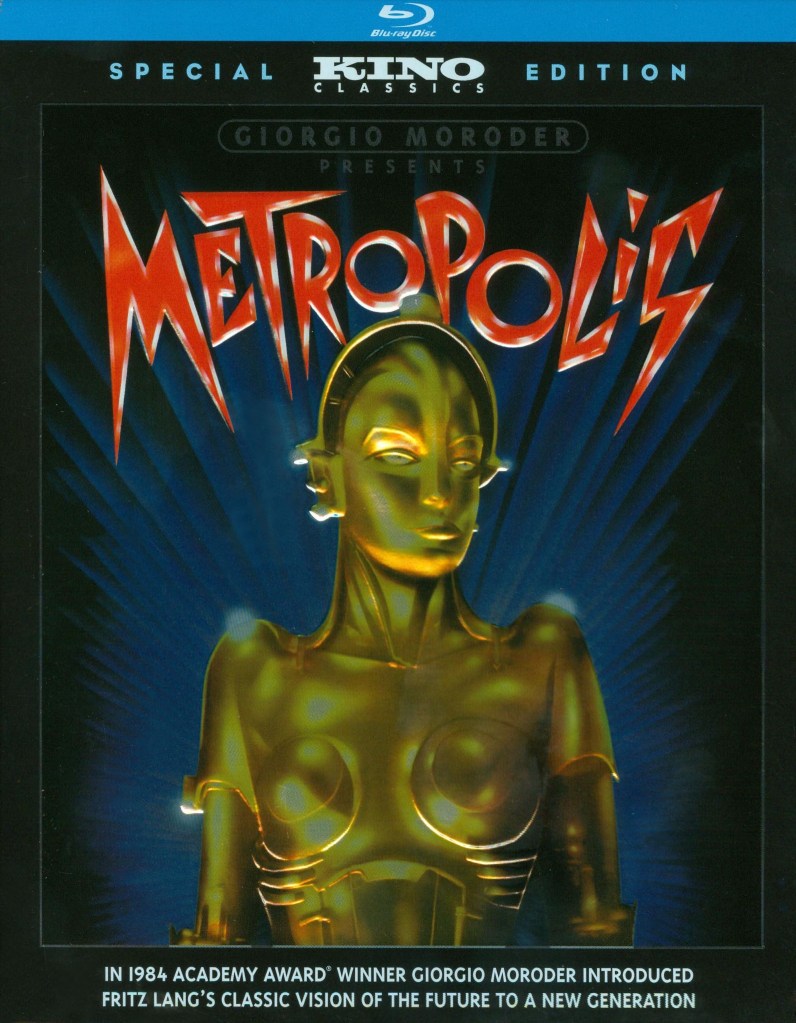
Metropolis is one of those films where you would have to have every version available in order to get all of the special features as well as different cuts of the film. Some catalog releases, like the Superman films, featured only one or two new added features, such as the “Science of Superman” documentary that was a Circuit City bonus disc and an extra deleted scene from Superman Returns. Others, like the Star Wars franchise, offered hours of all new features that were completely different from the earlier VHS and DVD releases. Still others like the original Star Trek series, Star Trek: The Next Generation, and the Alien franchise, combined the older legacy features with hours of extensive added features. In the case of the Alien series, fans were given their choice of the original theatrical versions or newly expanded alternate cuts, along with isolated film scores and alternate scores, as well as the original laserdisc archives, making it the final word in that series.

A must own for any home video collection. But something else happened going into the 2010’s. Studios began offering multiple versions of newer releases, including a bare bones DVD of just the film; a “special edition” of the film on DVD with a few added features; and combo sets containing the bare bones DVD, a feature-laden Blu-Ray, and a code for a digital version of the film on a streaming platform to allow for higher resolution and, in some cases such as the recent Star Wars trilogy, exclusive features presented in digital format only such as exclusive deleted scenes, exclusive bonus features, and a score-only version of The Last Jedi. Choices such as these forced film fans to once again choose their preferred method of viewing certain films in order to have all of the features available to that film. In recent years we have also seen certain stores include bonus features exclusive to their store and nowhere else. Target, for example, has included bonus content for films such as Rogue One, Finding Dory, Star Trek Beyond, and Star Wars: The Rise of Skywalker that were not found in other stores or even on their digital counterparts. Best Buy offers steelbook presentations if certain films. Walmart and Amazon offer exclusive swag in their packaging as well.
In the past few years we have seen the emergence of 4K UHD discs offering recent films and older catalog releases such as Superman increased picture and sound quality representing their original theatrical versions. In 2017 we saw the Warner Archive Blu-Ray release of Superman in a special two-disc set offering both the 2001 special edition set and the 1982 extended TV cut in widescreen formats, complete with a number of bonus features from the previous Blu-ray set. And the following year we received the international version of Supergirl on Blu-Ray, with some of the added features from the Anchor Bay DVD and the complete director’s cut of the film in standard definition DVD.
Today we now have access to a wide array of streaming platforms, including Netflix, iTunes, Amazon Prime, Vudu, Movies Anywhere, Disney+, CBS All Access, HBO Max, and Peacock, offering wide selections of films and television series available for nominal fees every month. Some of the films on Disney+, for example, such as Avengers: Endgame, Artemis Fowl, and the five recent Star Wars films, are laden with added extras including deleted scenes, audio commentaries, and documentaries on the making of the films. In addition, Avengers: Endgame and Star Wars: The Rise of Skywalker offer several exclusive features that are not present in any other version of the films. Others on Disney+, such as most of the X-Men films, have no added features at all, despite all of the features on the discs.
And on nearly every streaming platform, with the exception of theatrical trailers or preview clips, none of the Superman films or Supergirl contain any of its accompanying bonus features from the DVD or Blu-Ray releases.
Which brings us back to where it all began: why are the bonus features from the Superman films and Supergirl not included on iTunes – or any of the streaming platforms, for that matter?
It’s probably a case of deciding what is important to a film and what isn’t important.
To the studios and their respective streaming platforms, they have probably concluded that these extra features are not worth their time including with the films. Let’s examine why.
The average moviegoer or movie watcher is probably not concerned with these added features. After all, when we pay money to see a movie in the theater, are we given the options of watching deleted scenes or production features? No. We don’t have time for that. Our attention span is roughly two hours, three or even more if it is a gigantic epic the size, scope, or length of Gone With the Wind, The Ten Commandments, Ben-Hur, Lawrence of Arabia, Titanic, the Lord of the Rings trilogy, or Avengers: Endgame. Once we’re done, we’re tired, and we want to go home. We don’t want to pour over every little detail all in the presence of other filmgoers for hours on end.
But with fans of certain films, and film students alike, the DVD and Blu-ray formats allow for further exploration of the films with such added features. They can examine the nuts and the bolts of it all in the privacy of their homes. And the option of picking and choosing in what order to view those added features or listen to their audio commentaries gives them a ringside seat into their favorite films, where we can become like a Martin Scorsese or a Danny DeVito or a Peter Jackson in the process. Some of the streaming platforms such as Vudu, Disney+, or Movies Anywhere allow for that same option to view those extra features in the order that you wish. Amazon Prime, however, does not, placing all of the added features of a film after the film itself in one “play all” mode without any skipping forward or back.
With Superman we first had the opportunity to learn more about this film in 2001 with its first DVD release. Then we had more chances in 2006 with the release of the 14-disc Ultimate Collector’s Edition and in 2011 with the Blu-ray release of the film anthology. Who wouldn’t want to learn more about these films? And since then we have learned even more in the process.
It’s also probably a case of licensing rights.
With the films themselves, many of the streaming platforms are able to get the films and not have to worry about the extra features. These platforms don’t want to shell out additional fees for the rights to certain features involving certain actors or filmmakers who are no longer alive, especially where estates and licensing fees are concerned. And that’s certainly a valid point. Studios can make their money back on films and not necessarily the bonus features.
It’s also a case of availability.
For years Disney, for example, has had a habit of bringing its films out of their vaults for a period of time on DVD or Blu-ray before returning them to the vaults once again. With platforms such as Netflix and Disney+, films and television series are rotated in and rotated out again to make room for other programs. With DVD and Blu-ray, there are no rotation issues. The discs are safely in a person’s disc collection, and he or she can freely choose which film and which added features to watch. He or she will never have to worry about a favorite film or series going away. In this case we are not held at the mercy of the streaming platforms.
Enjoying a film such as Superman in physical media is like enjoying a fine dining experience. We are given our choice of appetizers, followed by the main course, sides to go along with the meal, a good drink, and our choice of desserts to round everything out. Now see that same film on iTunes or Amazon Prime without all of the extras. Are we going to pay for a full meal deal and just get the main course without anything else? Not necessarily.
In this case, physical media will win out over digital media any day. Even as advances in physical and digital media continue to push the envelope, with Superman being the first film selected for archiving and viewing on a future generation optical disc, film fans and studios alike will continue to mine their vaults for even more exclusives to accompany their favorite films for future generations to come.
-
Superman and the Case of Physical Media Versus Digital Media – Part 1
It began with a question. “How come none of the four Superman movies, including Supergirl, have special features on iTunes?”
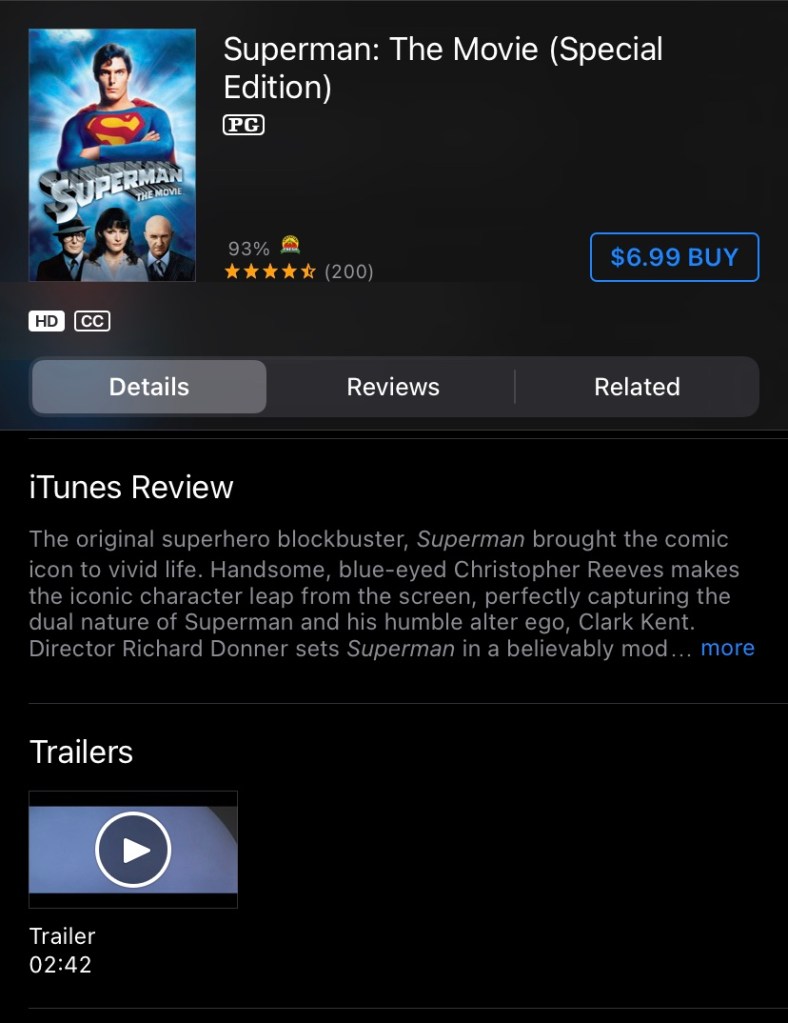
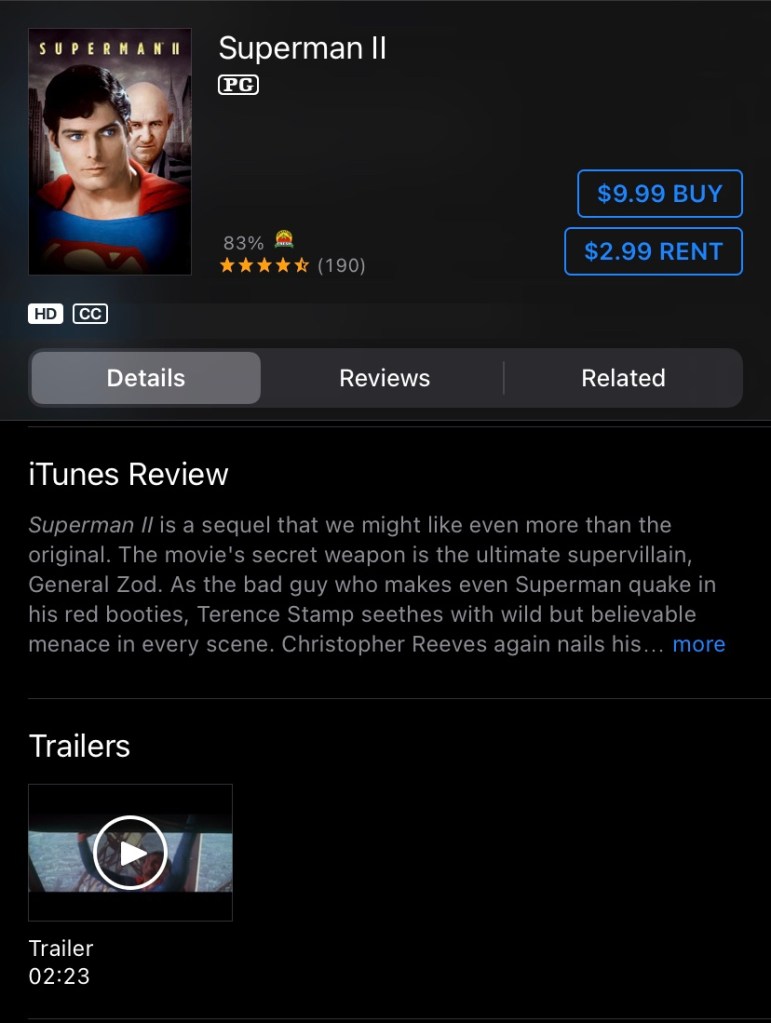
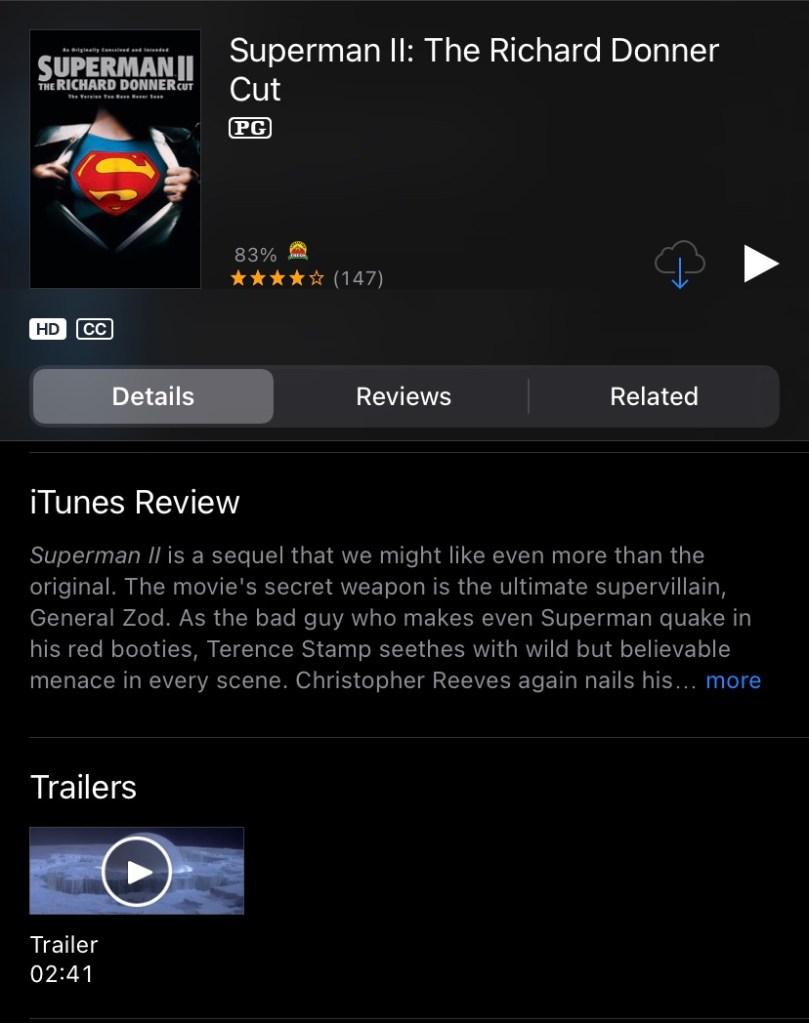
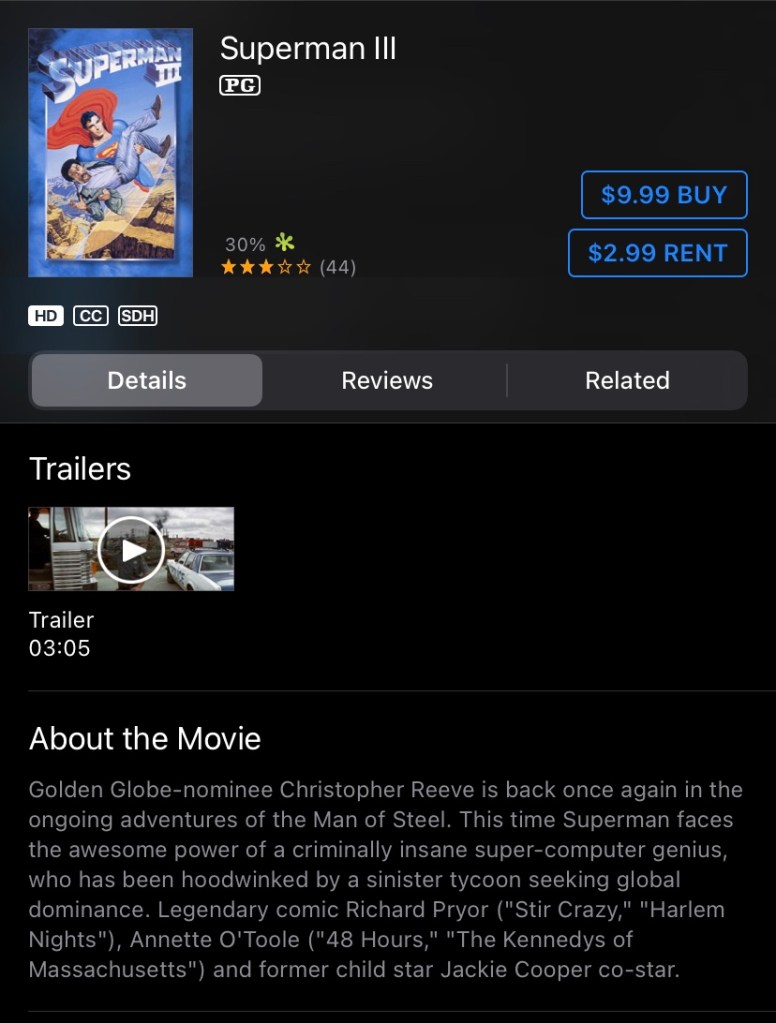
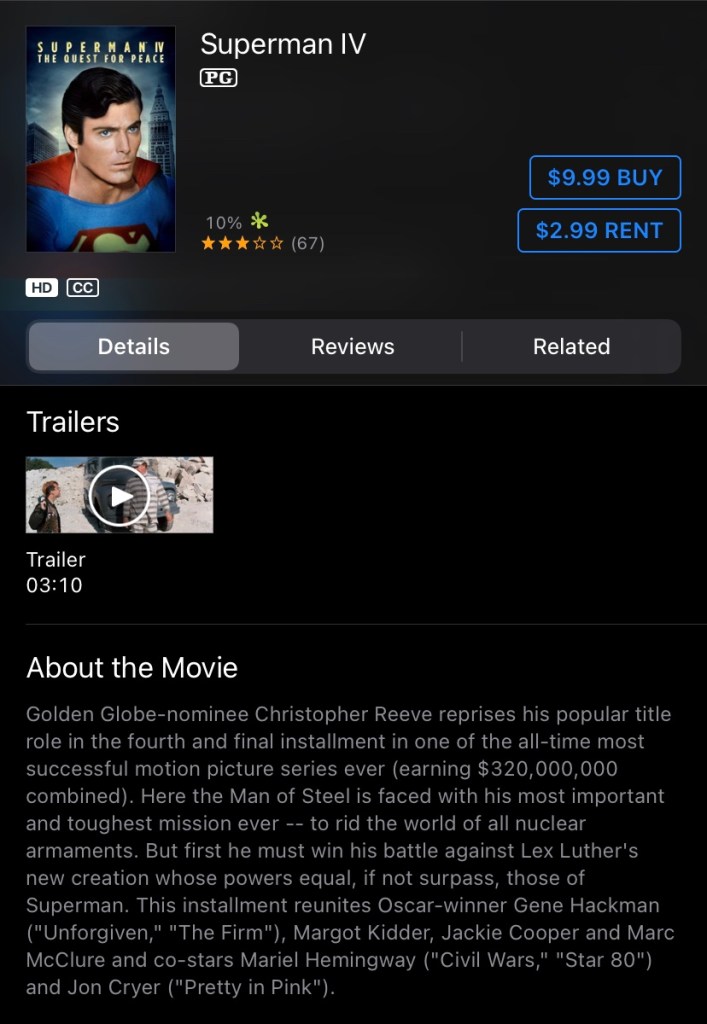
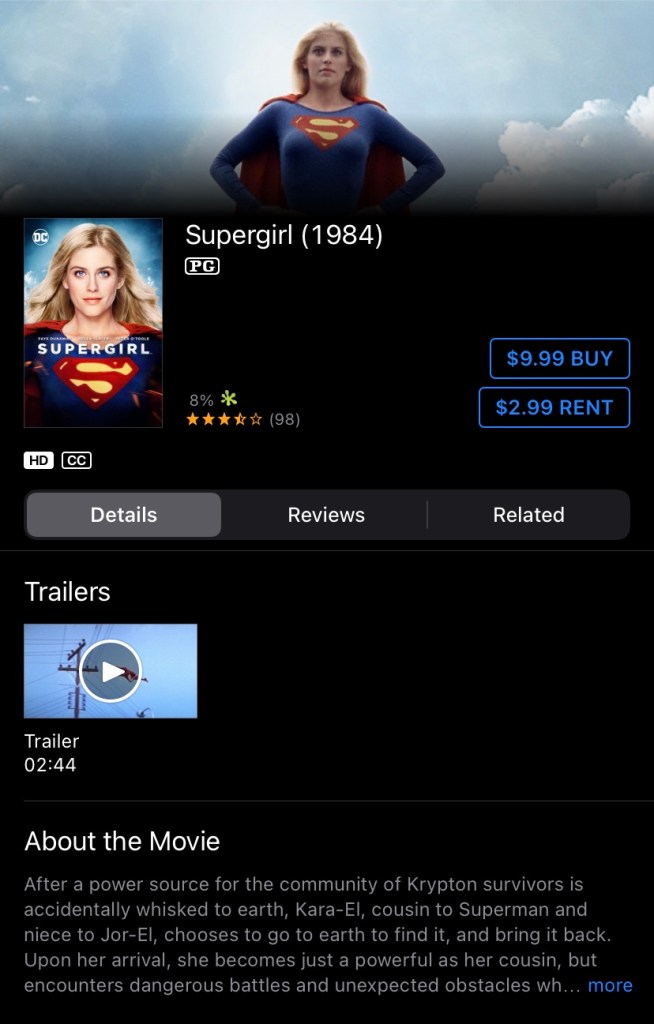
Nothing besides the trailers on iTunes. How come indeed?
As far back as I can remember, with the birth of the home video revolution in the 1970’s, its explosion in the 1980’s, and its transformation over the decades across multiple formats—Betamax, VHS, laserdisc, DVD, Blu-ray, 4K UHD, digital streaming—at first we never gave thought to such things. We were aware of theatrical trailers, teaser trailers, TV spots, interviews, and documentaries, but the general collective knowledge of the average filmgoer was pretty much limited to that. Only hardcore film buffs, students of the art, and astute fans were aware of much more regarding the creations of their favorite films and television series. A film or a television series was produced, shown, and put away in a vault when it was finished, and that was that.
With the birth of the home video movement in the 1970’s with Betamax and VHS, people could record shows off television or buy prerecorded tapes of various movies and television shows. But the quality wasn’t always the greatest. One only needs to look at the first Star Trek videotapes and compare them to their later incarnations on VHS, laserdisc, DVD, and Blu-ray, and see how the picture and sound quality wasn’t necessarily the greatest. At the time, it was something just to get a TV show or a movie on videotape in the first place, though the costs were at first a bit prohibitive.
Around this same time, something was happening on television. A few movies here and there were shown in expanded and edited formats to fit within the parameters of broadcast television standards of the day. The first films that come to mind are the Susan Anton film The Golden Girl and Burt Reynolds’ Hooper. These were the first films that I can recall that contained added scenes which were not shown in movie theaters. In the case of The Golden Girl, some forty minutes of footage was added to the film so it could fit in a three-hour time slot. With Hooper, the added footage amounted to very little, an added discussion between Jan Michael Vincent and Sally Field where they discuss her relationship with the title character. These were the first two films that I can recall where deleted scenes were added to the films. To this day, those scenes have been relegated to the film vaults once again and not seen since.
Then there was the 1970’s remake of King Kong. In 2021 Scream Factory, a branch of the Shout! Factory label, released the film on Blu-ray in a generous two-disc set that offered up not only the original theatrical version but also a two-part extended cut that included an additional 45 minutes of footage that was shown on television in a two-night broadcast in 1978. (Does this sound a little familiar, class?)
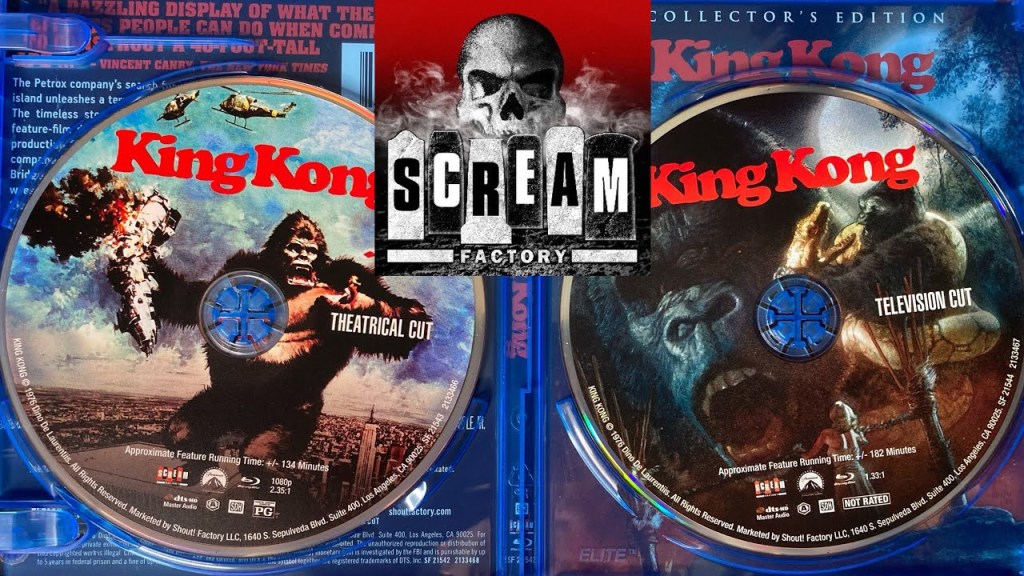
If you’re a fan of this film, this is the version to get! In addition, films would routinely be edited to remove objectionable language. In numerous cases, alternate clean versions of those scenes would be filmed and edited into the film for its network airings. Some of the films that immediately come to my mind include Tootsie, Ghostbusters, and Superman III, among others. In many other cases, alternate language replacement would occur, as with the PG version of Saturday Night Fever that was re-released to theaters in 1978 and later shown on television in the 1980’s, and the later family friendly version of Avatar that would be issued on Blu-ray and is currently offered on Disney+. Those familiar with the original theatrical versions of films could easily recognize the dialogue replacement.
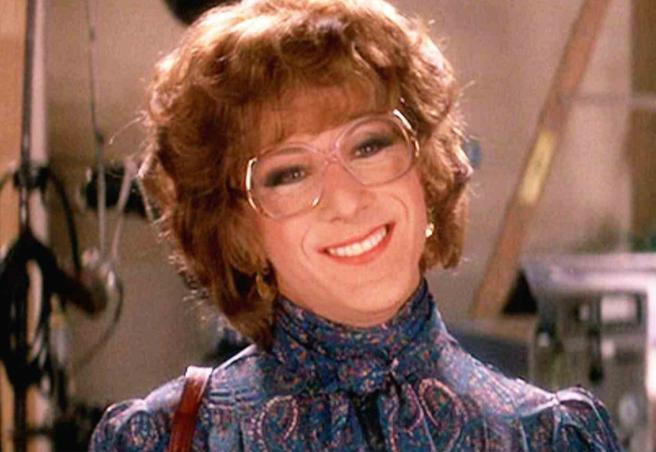
Somehow, “Shame on you, you macho man…” doesn’t come off as funny in the TV version as does the original line “Shame on you, you macho s—-head!” in the theatrical version of Tootsie. With the release of Superman: The Movie on Betamax and VHS in 1980, fans could now bring the beloved box office blockbuster home to watch. But it was edited from its original 143-minute run time to 127 minutes, as the film was sped up and edited in certain places, most notably the lengthy end credit sequence, to fit within the confines of a single videotape. WCI Home Video did not want to deal with the idea of dividing the film across two tapes, even though the complete version of the film had been released on CED videodisc in a two-disc set. Beyond that, no extras were included on the videotape.
But two things happened in the 1980s that began to change the way we looked at Superman and films in general, by and large. First, ABC aired a 60-minute program, The Making of Superman: The Movie, which gave fans a glimpse behind the scenes into some of the aspects of the film’s lengthy production in 1977 and 1978. We got to see production footage from some of the film’s key sequences on Krypton, in Smallville, at the Daily Planet, at Lois Lane’s apartment, and in Lex Luthor’s underground lair, among others. We witnessed different deliveries of certain lines across multiple takes, and we even got to see an unreleased alternate clip of the film’s final shot of Superman flying away. This confirmed to viewers that much more footage remained unreleased in the Warner Bros. film vaults. This documentary, along with the 1983 TV special The Making of Superman II, were later collected onto a single videotape release from USA Home Video.
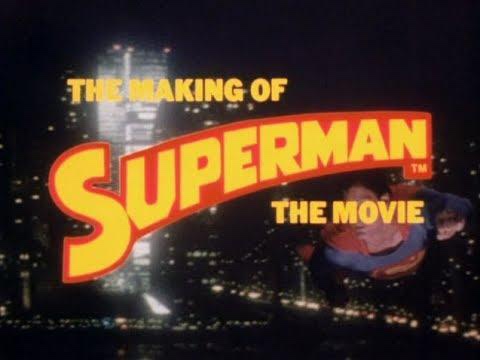
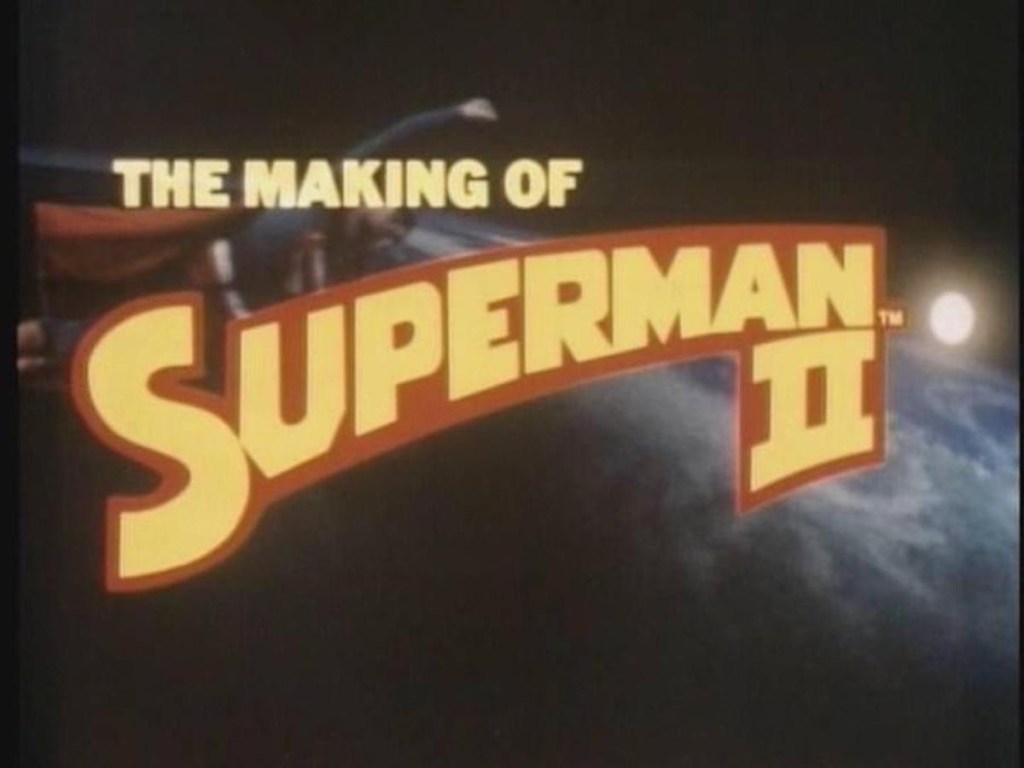
Today these are included on DVD and Blu-ray from Warner Home Video. Second, ABC secured the broadcast rights to Superman and aired a much longer version of the film, first in February 1982 and then later in November 1982. This version of the film contained forty-five minutes of additional footage not seen in the original theatrical version, making those deleted scenes available to viewers for the first time. From there a wave of extended versions of films would eventually be broadcast with deleted scenes restored throughout the course of their respective broadcasts, including the three Superman sequels, the infamous “Alan Smithee” version of Dune, Dances with Wolves, Who Framed Roger Rabbit, and Waterworld, among others. Before long, astute film fans began to consider the importance of deleted scenes from films and television series.
As the years progressed, so did the technology. CED videodiscs gave way to laserdiscs, and during the 1980’s and 1990’s the audio and video quality of laserdiscs surpassed their videotape counterparts. Many laserdiscs, including Superman, eventually presented their films in either pan-scan or deluxe widescreen editions, again without extras. The 1995 Japanese widescreen laserdisc release of Superman, however, contained the film’s teaser trailer, even though its 1990 American counterpart did not. The later 90’s U.S. laserdisc releases of Superman II and Superman III eventually included the original theatrical trailers, marking the first time that extra features to the Superman films were commercially available on laserdisc.
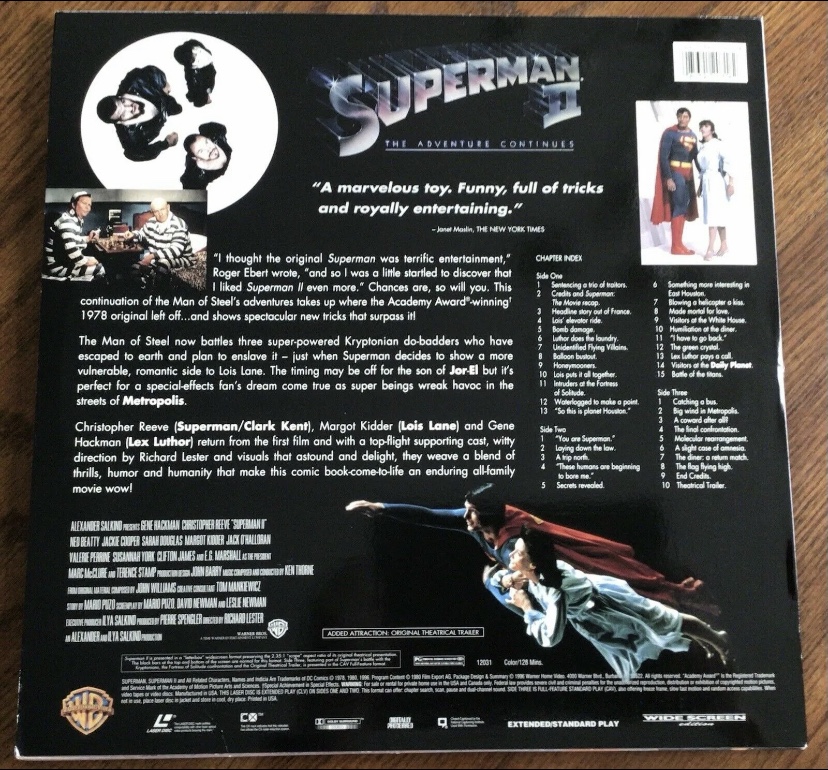
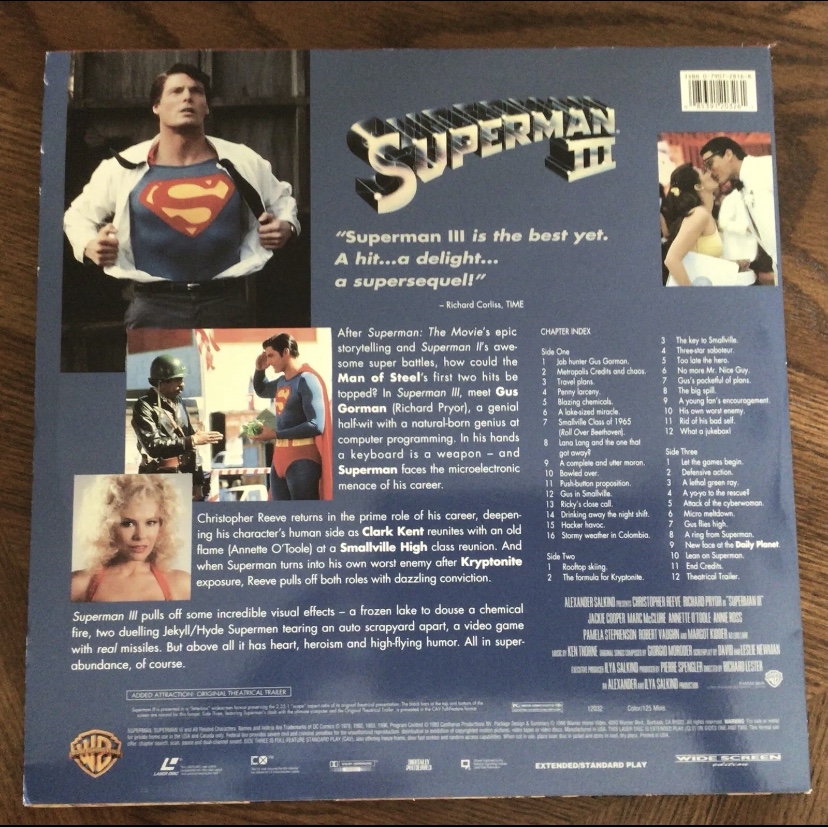
The first laserdisc I ever bought was, believe it or not, Superman III, years before I got my laserdisc player. During this time, laserdiscs began to expand in size and scope, as studios began to take advantage of the vast amount of extras that lay in their film vaults, presenting scores of added features to their films. Criterion became a leading distributor of elaborate special editions at the time, with films such as Blade Runner, Close Encounters of the Third Kind, and Ghostbusters containing interviews with the films’ creators, looks at the making of the films, deleted scenes, and trailers, making them highly collectible laserdiscs for film fans and students.
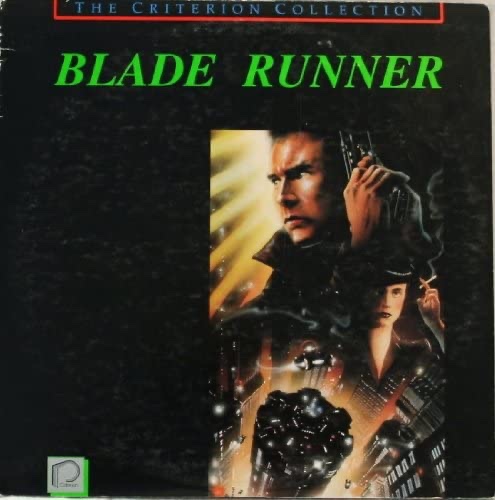
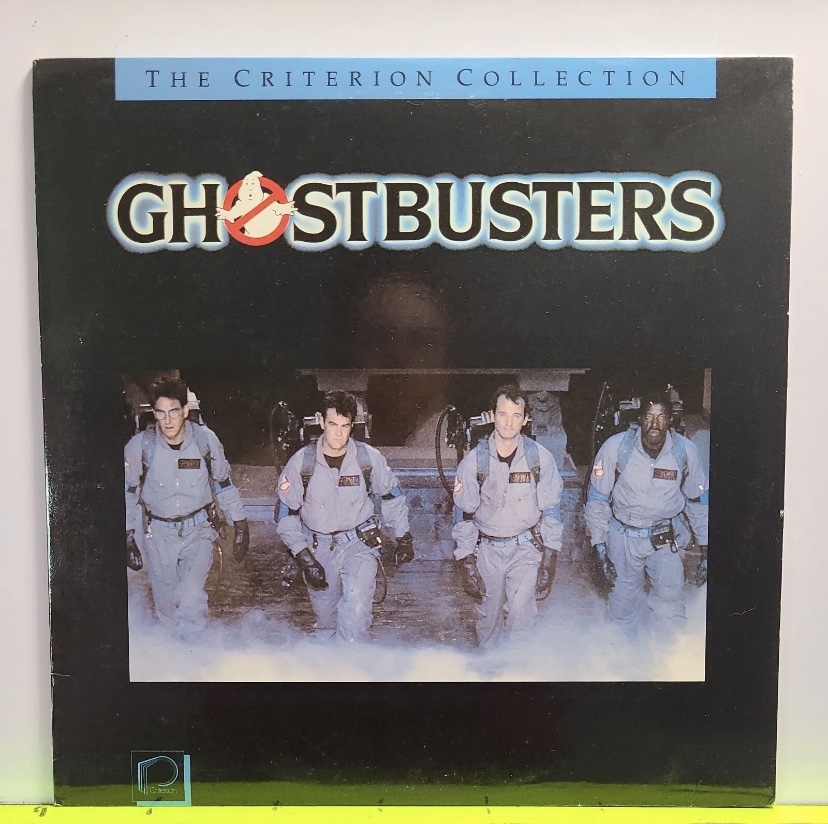
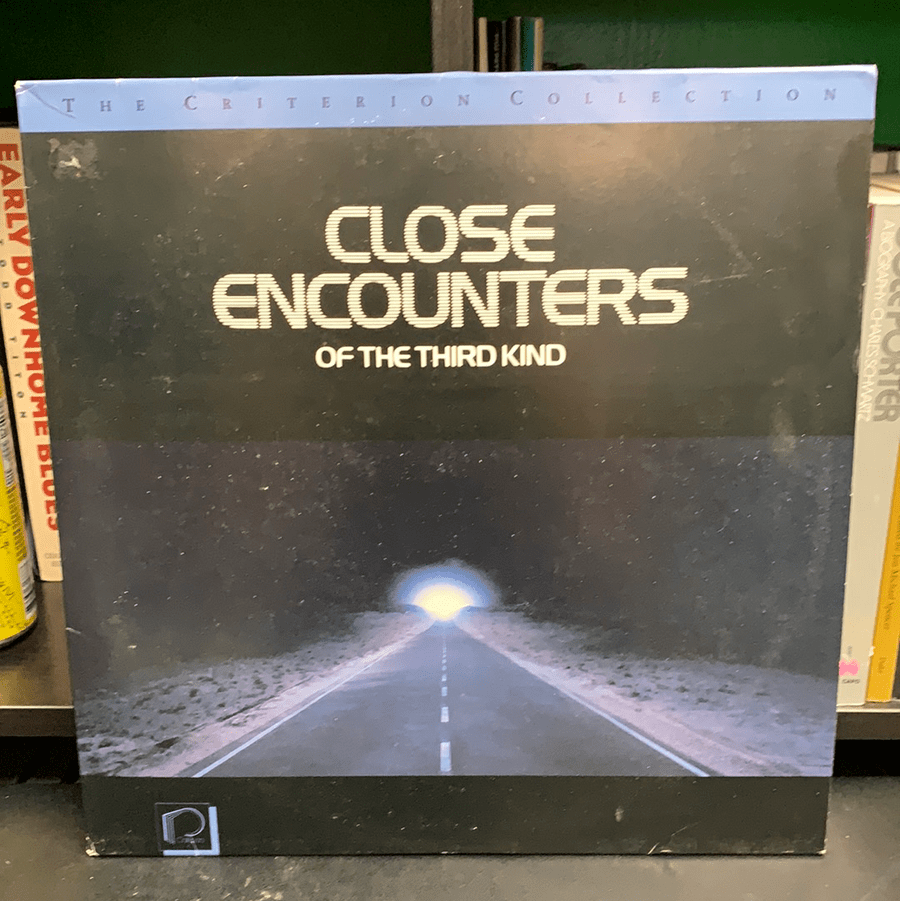
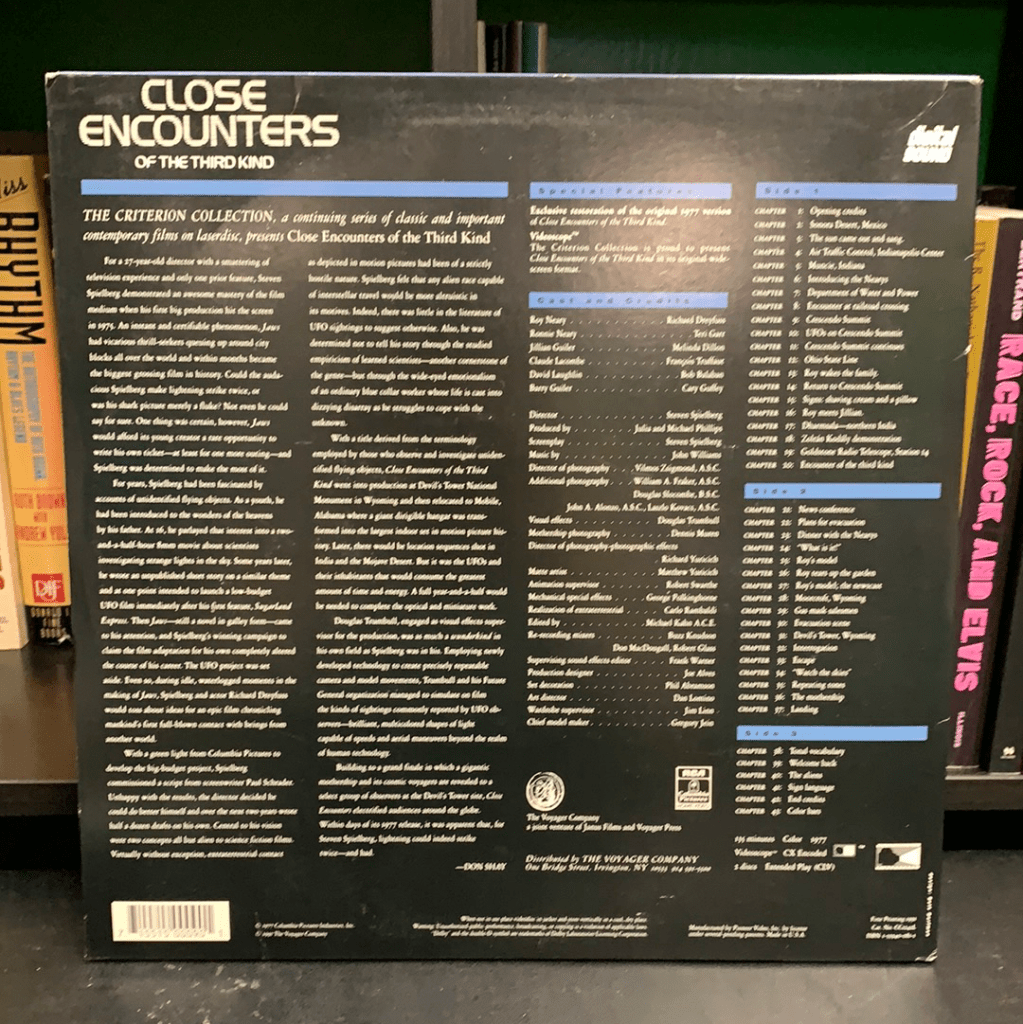
The Criterion Collection laserdiscs are highly sought after by fans and collectors. In addition, we began to see the release of expanded and restored versions of films making their way onto VHS and laserdisc in the 1990’s. One of the most important restored editions was David Lean’s epic masterpiece Lawrence of Arabia with a vast amount of scenes restored back into the context of the film. James Cameron would also restore and expand The Abyss, Aliens, and Terminator 2: Judgment Day, giving viewers a longer look at his films without being bound by the constraints of their theatrical running times. Those films, along with Ridley Scott’s Alien, would enjoy special edition laserdisc box set releases, complete with optional running audio commentaries, giving fans a chance to hear how the films were made. Even Danny DeVito would profess himself to be a fan of the laserdisc medium, presenting his films The War of the Roses and Hoffa in special edition box set releases as well. Before long, other studios would follow suit with their films.
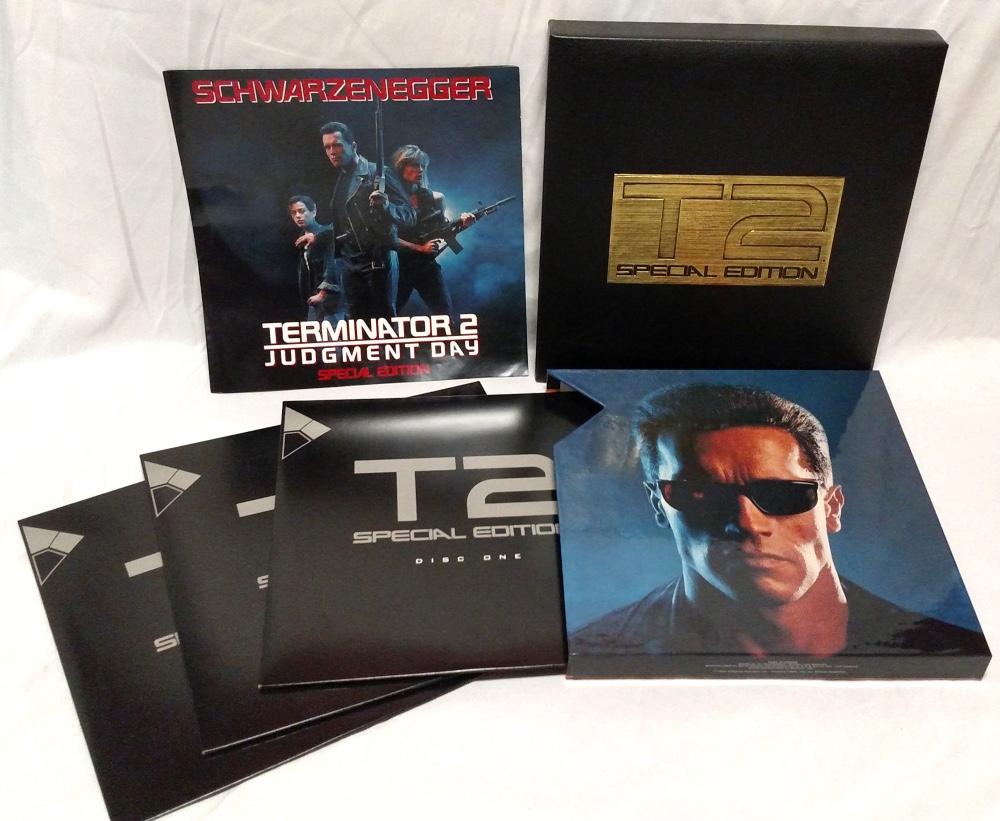
I had this laserdisc back in the 90s. This was a film school in a box. But laserdiscs also presented a chance to give viewers alternate versions of films that were never released in the United States. In November 1984, Supergirl was released to theaters across the United States at a running time of 105 minutes. Shortly before its release, the longer international version of the film running 124 minutes was released on VHS and laserdisc in Japan, with some copies making their way to video stores in Los Angeles, California. In 1990, a longer version of Ridley Scott’s 1985 film Legend was released on laserdisc in Japan, containing a slightly different edit of the film that ran 94 minutes and also included Jerry Goldsmith’s original soundtrack to the film (which would be replaced with an electronic score from Tangerine Dream for the film’s American release). And Tohokushinsha Video would release the 93-minute version of Superman IV on VHS and laserdisc, which contained the complete versions of two scenes not featured in the Warner Bros. version of the film—Superman averting a tornado in the Midwest, and Superman saving Russia from a nuclear missile attack—with music and visual effects in place.
The VHS format, which emerged as the more dominant of the two videocassette formats, also presented alternate versions of films as well. For years, the version of Blade Runner that had been released was the international release of the film. This would be replaced by Ridley Scott’s 1992 director’s cut, which removed all of Harrison Ford’s narration and the original happy ending (which had pilfered footage from The Shining) and included a mysterious unicorn dream sequence. By the turn of the decade, Anchor Bay Entertainment released the 124-minute cut of Supergirl on videocassette. And it was also commonplace to find various edited versions of Fritz Lang’s Metropolis on VHS. Alternate cuts of films soon became as important as extra features on home video. And this is just scratching the proverbial surface.
To be continued…
-
45 Years of a Teaser
Picture, if you will, going back in time to your local movie theater in the middle of January 1978. You choose a movie of the time that you’re interested in seeing, such as The Bad News Bears Go to Japan, Coming Home, Corvette Summer, Ice Castles, Same Time Next Year, Thank God It’s Friday, or Sgt. Pepper’s Lonely Hearts Club Band, to name a few. There’s probably some successful holdovers from 1977 still playing, such as Saturday Night Fever, Close Encounters of the Third Kind, or that game-changing blockbuster that’s still electrifying audiences, that little science fiction film called Star Wars.
You sit down with your overpriced Coke and bag of popcorn, and several movie trailers play before the start of the movie. Among those trailers, this one plays…
Everyone begins to cheer around you, and maybe some people even get up and leave, having been fully satisfied with the teaser trailer and not caring about the feature film to follow. That’s all there is to this trailer, just the sky and a listing of the actors, and that logo blazing across the screen. And not even one piece of footage from the film whatsoever.
It’s the middle of January, and the film has another eleven months before it opens in theaters. And yet everyone’s appetites is more than whetted, because they know that Superman is coming.
So what made this teaser trailer so successful?
It was the usage of a piece of film footage that was shot from the head of an airplane soaring through the clouds that began to generate excitement and anticipation for the film, the thought of flying through the air. According to Tom Mankiewicz, in the 2001 documentary Making Superman: Filming the Legend, “Richard Greenberg, who’d been hired by Dick (Donner), found this wonderful piece of footage which was taken from the nose of a jet flying through clouds. Audiences were just cheering. And it made everybody feel so great.”
In his book The Making of Superman: The Movie, David Michael Petrou recounted how the months of production on both Superman and Superman II had led to countless amounts of tensions among the cast and crew, and a death and a near death on the Air Force One set. But, as Petrou pointed out, “spirits lifted later in the week as word reached Pinewood that the teaser was already running in theaters in America and receiving highly enthusiastic response.”
It was the sweeping cast credits that blazed onto the screen over the clouds. Never in the history of cinema had a film had so many cast credits zooming onto the screen in succession like that. As Marc McClure recounted, “Greenberg later adapted the trailer’s title design for the film’s innovative opening title sequence.”
And then there was the S shield.
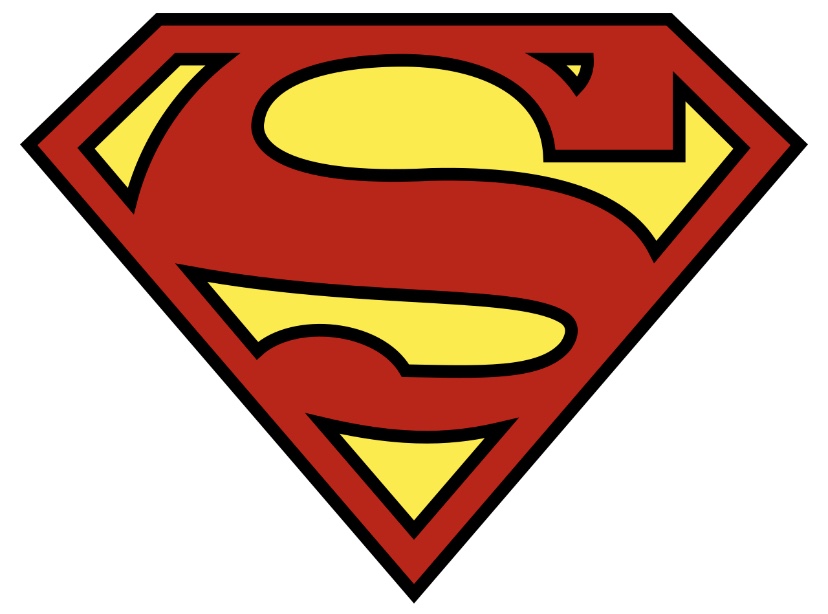
This version of the S shield had been designed only a few years earlier and had become the most recognizable version of the Superman shield in not only comics but also in pop culture in the 1970s. So when the teaser trailer featured the S shield streaking across the screen, it didn’t need to tell the moviegoers much else about the movie. That logo simply said it all. The animation of the logo would be the same as it would appear in the final film and numerous other trailers and TV spots, although at different varying speeds.
The final piece of the trailer was the title logo itself. Greenberg incorporated the comic book style logo that had graced many issues of the Superman comic book for decades, but even then it seemed to be a relic of the past. This new version of the classic story needed something new, something captivating, something that would usher in a new era for the character. It would take several months before that logo would be unveiled to the public. To this day it is synonymous with the film itself.
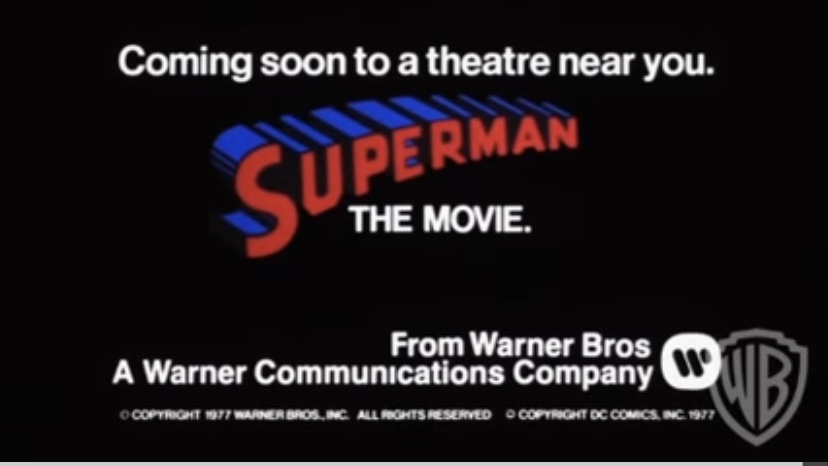
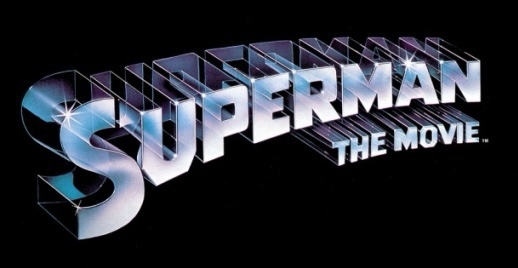
Old versus new. I never saw that teaser trailer in the theaters. It wouldn’t be until the special edition DVD release in 2001 before I would have a chance to see it for the first time. But even then, the minimalist approach worked. To this day it ranks alongside the teaser trailers to Gone With the Wind, Citizen Kane, and the 2009 Star Trek as one of the best trailers to use this “less is more” approach without spoiling any final footage within the trailer. More movie trailers could learn from this approach.
-
The Fourth Wall
It’s nothing new to see characters in a movie or a television series turn to the camera and say or do something interesting or hilarious or thoughtful that lets us into the story. The entire process of breaking the fourth wall, as it is called, allows us to enjoy their story and at times smile and laugh along with them.
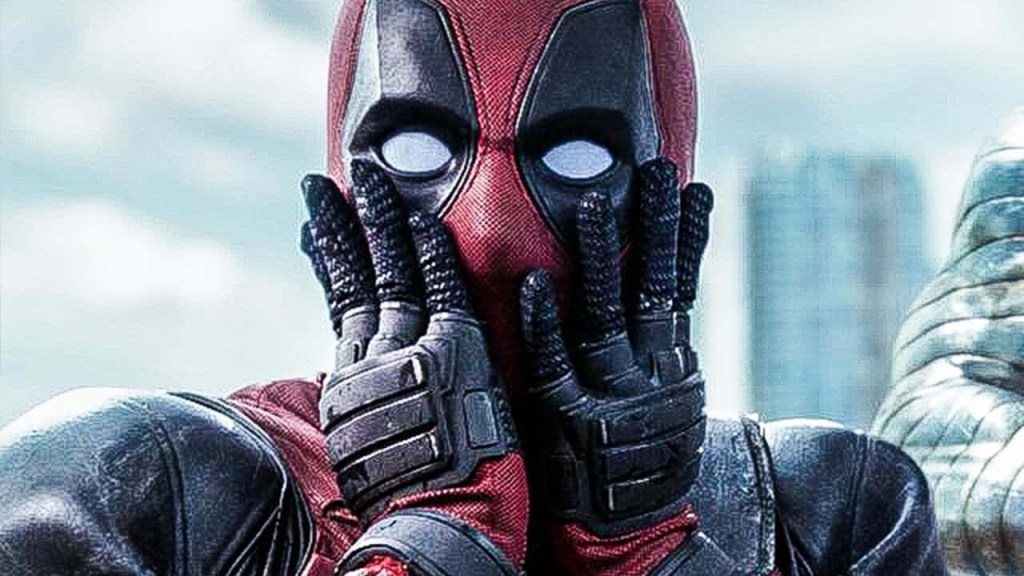
One of the reasons why the Deadpool movies have proven popular with fans is due to the fact that Ryan Reynolds’ title character frequently turns to the camera and shocks viewers with his thoughts and comments. And to think we’re going to get a third film soon, with Reynolds’ longtime friend Hugh Jackman along for the ride in their anti-bromance.
And decades earlier, in 1986 we had the hit teen comedy Ferris Bueller’s Day Off, which was successful due in part to Matthew Broderick’s straight monologue deliveries to the camera that delighted fans both then and to this day. Without them, the film would have fallen flat on its face.
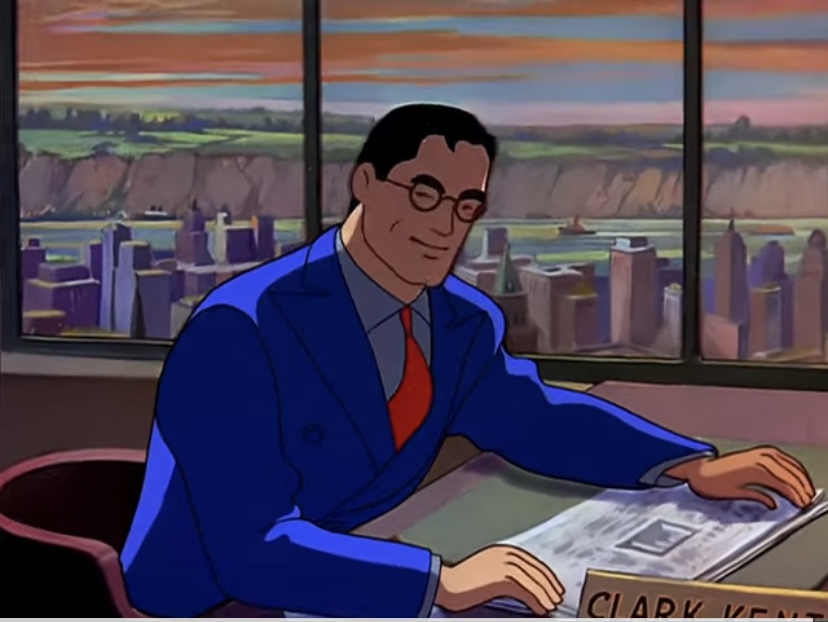
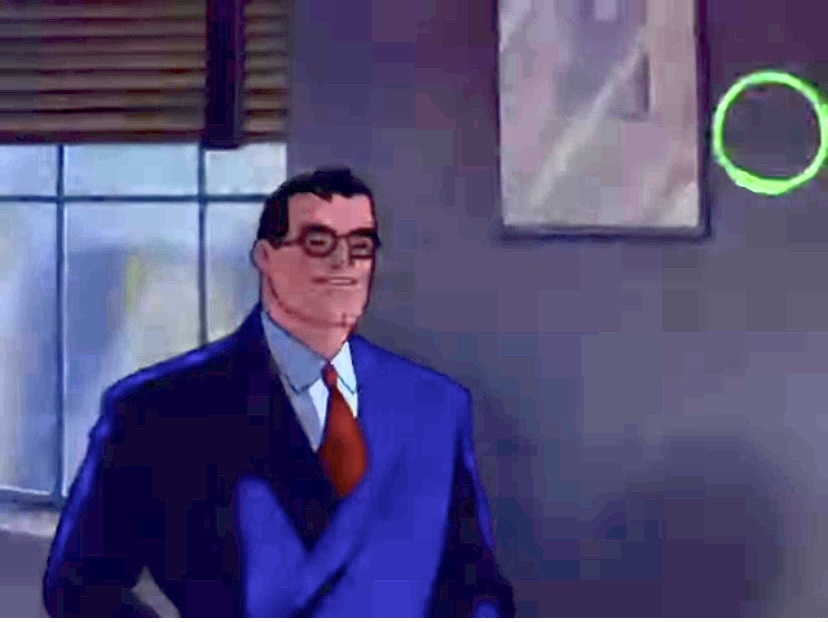
Obviously, they weren’t the first. Decades earlier, with the release of the first Superman animated cartoons from the Fleischer Studios, filmgoers were treated to a little break in the fourth wall as Clark Kent would turn to the camera at the end of the segment and wink at the camera. This is particularly noticeable at the end of the first two segments Superman (aka The Mad Scientist) and The Mechanical Monsters.
And part of the popularity of the Adventures of Superman in the 1950s was due to George Reeves turning to the camera and giving viewers at home a wink and a smile, adding to the charm of the character as if to say, “We all know the truth, so enjoy the ride. This is our little secret.”
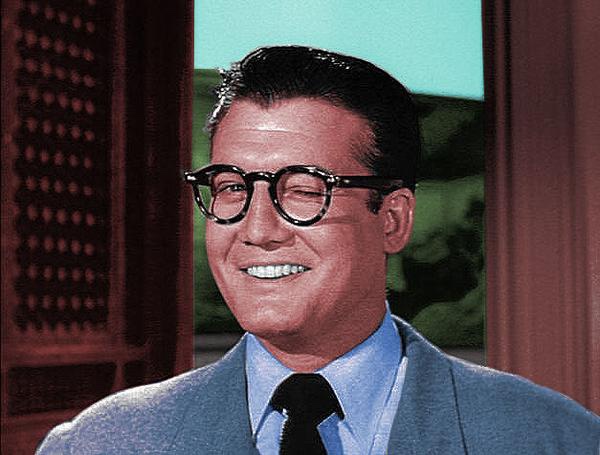
George Reeves mastered breaking the fourth wall. The Superman films are no exception. We are familiar with the final flyover shot as Christopher Reeve looks at the screen and smiles to us as he flies off. There are at least four different versions of that flyover shot, each appearing in the first three Superman films and a fourth alternate take appearing at the end of The Making of Superman: The Movie.
But there are other such fourth wall moments in the first film that are harder to spot and are so instantaneous that you’ll almost totally miss them. One of them occurs once Miss Teschmacher has saved Superman from drowning in Lex Luthor’s swimming pool by getting rid of the kryptonite chain from around Superman’s neck. With his powers fully restored, he gets up and prepares to take off. But as he turns, for a brief moment Christopher Reeve looks right into the camera as if to say, “Let’s get ready to fly!”

Some others are found in the extended TV cut. The first one is harder to spot, it’s that quick. After the near mugging in Metropolis, Lois Lane and Clark Kent take a taxi away from the alleyway. Once the taxi starts to drive away, we can quickly spot Margot Kidder turning to her left and looking straight into the camera. Thanks to the Warner Archive Blu-ray release from 2017, we have a clear image of this moment.
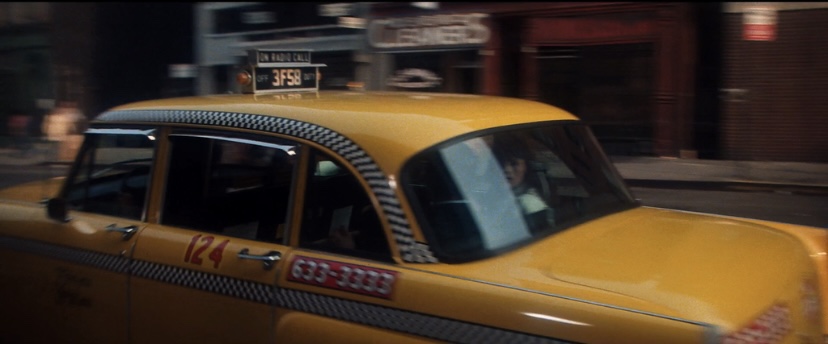
Smile! You’re on Candid Cab Camera! Another such moment occurs later in the film when Superman confronts Lex Luthor in his lair. After Luthor tells Superman that he will be the cause of death of innocent people, there’s a moment when Gene Hackman smiles and playfully winks at the camera, almost a throwback to George Reeves, which pulls the viewers out of the film as if to say, “Let’s have some fun with this, shall we?”
From my copy of the 2017 Warner Archive Blu-ray. A little later on, we also see a brief added shot of Jimmy Olsen snapping several pictures at Hoover Dam. In one brief instant that’s seen only in the 1994 KCOP broadcast of the extended TV cut and the 2017 Warner Archive Blu-ray, this brief little fourth wall moment with Marc McClure occurs…
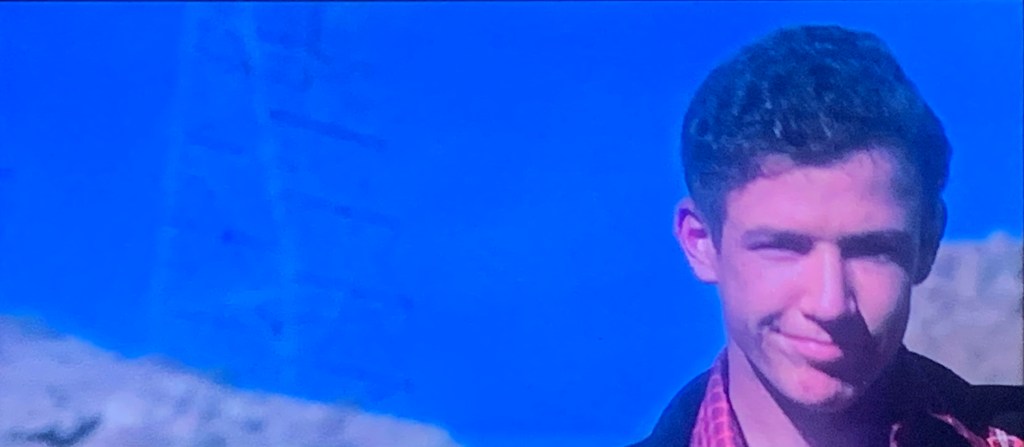
Golly, Mr. Kent! Moments like these make a film or a television series an even more interactive experience for the viewers and fans, bringing us into the world of our favorite stories and characters without over killing it or ruining the story altogether. Whether it’s deliberate or unintentional, the fourth wall is not always meant to be broken, but in some cases, and with the right actors, it works perfectly.
(Some screenshots in this blog are courtesy of CapedWonder.com.)
-
Crossovers – Part 2
In my previous log I pulled the curtain back behind a quick blink-and-you’ll-miss-it moment in Superman II and revealed the back story behind Leonard Nimoy’s surprise appearance in the film. Little things like that reveal the verisimilitude that went into these films, further solidifying Superman’s recognizable image in the world thanks in part to its temporary custodian of the role, Christopher Reeve.
And then there was the time that the world’s greatest superhero crossed paths with the world’s greatest secret agent.
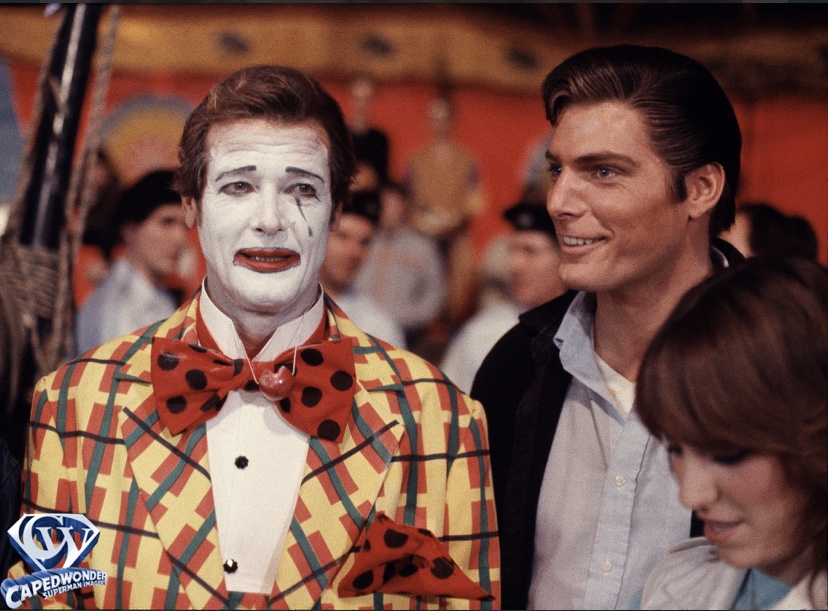
“The name’s Reeve. Christopher Reeve.” I’m sure you probably read it in that British accent like I did. It was in the first half of November 1982 that production on Superman III was nearing completion at Pinewood Studios in London. Christopher Reeve had a number of visual effects sequences left to complete, and he had also been approached to appear in a couple of scenes for the Salkinds’ forthcoming Supergirl spinoff film, which he declined.
Meanwhile, production was rolling along at Pinewood on Octopussy, the 13th film in the hugely popular James Bond film series. Based on part on the short story Property of a Lady by Ian Fleming, the film would be about Bond matching wits with international businessman Kamal Khan over a prized Faberge egg and engaging in a showdown right out of Richard Connell’s short story The Most Dangerous Game, while attempting to stop a smuggling ring from bombing an overseas U.S. Air Force base.
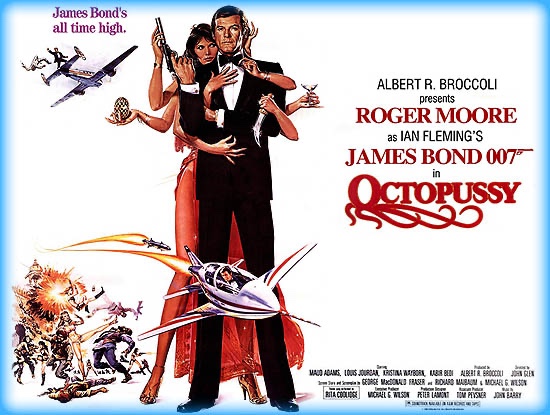
Part of the shooting on Octopussy occurred at the giant 007 Stage, which had been constructed six years earlier for the submarine sequence in The Spy Who Loved Me. It had also played host to some of the spectacular Fortress of Solitude exterior scenes in Superman: The Movie in the fall of 1977, and in the late summer of 1982 filming on Superman’s confrontation with the giant super computer had occurred there as well. A few months earlier, in late June 1982, the junkyard fight between Clark Kent and the evil Superman was shot at the 007 Stage’s back door.
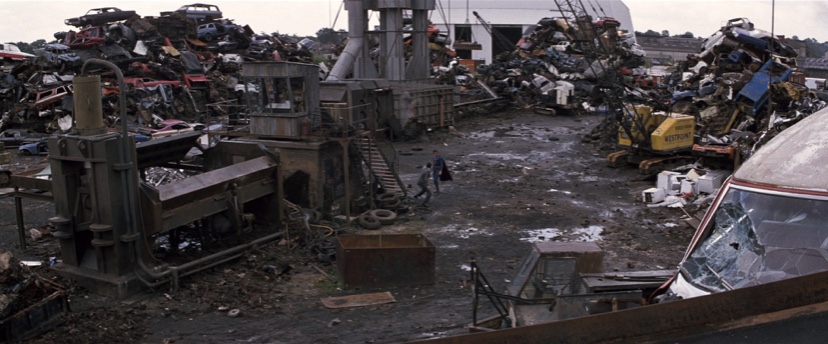

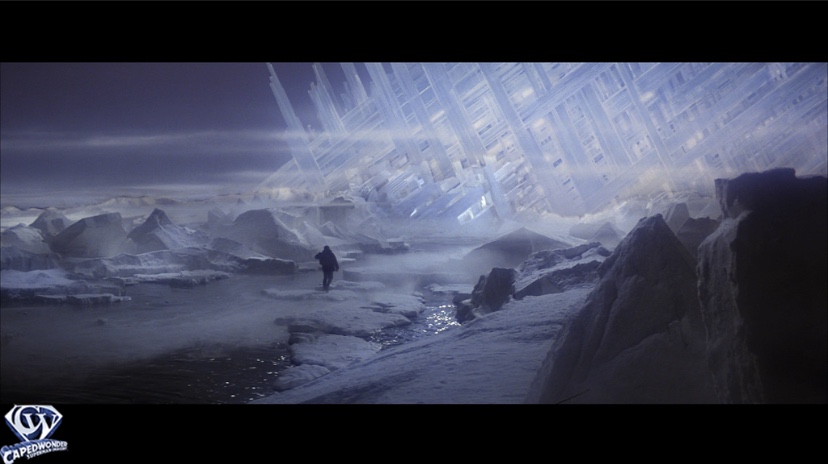
All shot at the 007 Stage at Pinewood Studios. You can see the stage in the background during the junkyard scene. Now the 007 Stage was in use again in November 1982, this time for a seemingly lighter sequence at first. It is a tremendous testimony to the crews of both films and the studio itself to have a quick turnaround in getting the stage prepared for filming on a relatively short notice. That’s how organized they are.
In Octopussy we are treated to a good old fashioned circus sequence at an overseas U.S. Air Force base, complete with big top canvases, ringmasters, elephants, acrobats, clowns, human cannonballs, and the like, everything you would expect at a circus. All of this had been organized and arranged by Barbara Broccoli, the daughter of longtime Bond film producer Albert “Cubby” Broccoli and only 22 at the time. But this circus had a much deadlier purpose. It is here that a bomb has been planted, and it is up to James Bond to intercept and stop the bomb before it kills Air Force officers and numerous innocent bystanders. And he has to do it in the most inconspicuous, or should I say conspicuous, manner…
It does indeed seem kind of low brow humor at first when you see an agent of the British secret service masquerading as a circus clown, but when lives are at stake, you don’t question Bond’s motives. You get the job done, even if it means wearing clown makeup and big floppy shoes.
Meanwhile, across the set at Pinewood, Christopher Reeve had taken a break from shooting some visual effects scenes for Superman III, and he ventured to the 007 Stage in full Superman makeup to observe the circus scene. In between takes he and Roger Moore met, and someone who happened to be in the right place at the right time captured a shot of Superman and James Bond together. (It would be really interesting if Reeve had been in the background of the circus sequence during filming.)
Reeve and Moore would later be seen at several events, including a wine tasting event. Moore would later write in his autobiography My Word is My Bond about his friendship with Reeve, and at one point he commented how, when Reeve was in makeup as Clark Kent, hardly anyone paid attention to him, but in full makeup and costume as Superman, the women swooned left and right.
But for one brief moment in time, the world was safe in the hands of both Superman and James Bond. I for one would have given anything to see that crossover story occur, even in comic book form.
(Some screenshots and photographs in this blog are courtesy of CapedWonder.com.)
-
Crossovers – Part 1
Watching the Superman films is quite logical! Last Thursday we received news that Christopher Reeve’s version of Superman would appear in the forthcoming film of The Flash as the film’s title character makes his way across the DC multiverse, encountering other incarnations of characters such as George Reeves’ Man of Steel from The Adventures of Superman, Michael Keaton’s Batman, Christian Bale’s Batman from the Dark Knight trilogy, Ben Affleck’s Batman from the recent Justice League and Batman vs Superman films, and numerous other interpretations. This is particularly exciting because this is the first time we will get to see Christopher Reeve back on the big screen as Superman since the 2006 premiere of Superman II: The Richard Donner Cut and his final turn in the role in 1987’s Superman IV: The Quest for Peace. Even if it’s borrowed footage, the fact that Earth-789 (as it is now referenced in DC Comics lore – the 78 a reference to the 1978 premiere of the first Superman film) is included in the film is an indicator of just how important and recognized the four Superman films are not just in the superhero film genre but in film itself.
But this is not the first multiverse genre crossover where Superman is concerned.
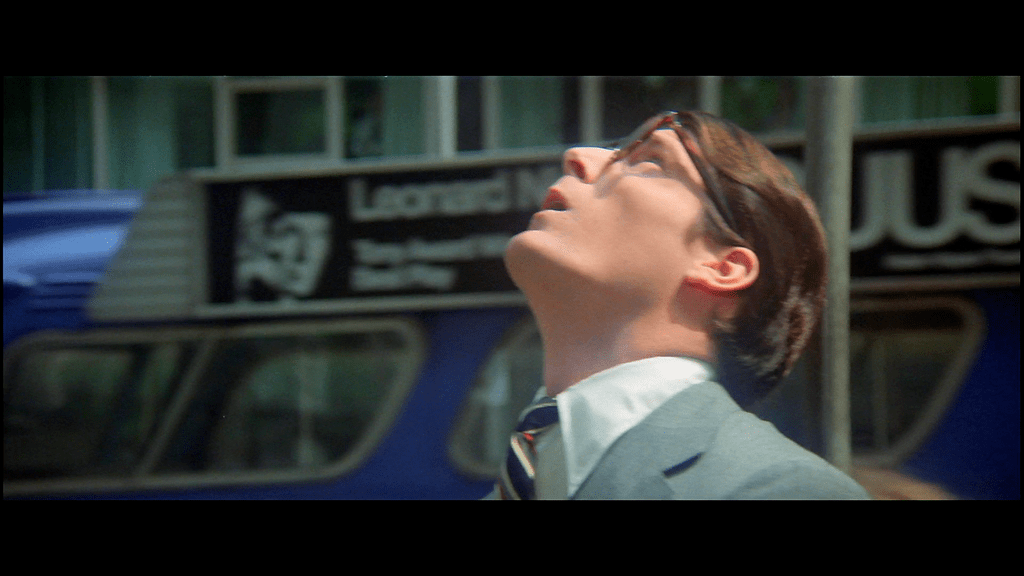
During filming of the fruit basket sequence for Superman II on July 11, 1977, director Richard Donner and cinematographer Geoffrey Unsworth captured a most unusual crossover indeed. At one point we see Clark Kent racing to the sidewalk and using his super breath to slow Lois Lane’s fall from the windows of the Daily Planet before using his heat vision to open the awning and bounce her into the fruit cart. As he does this, a commuter bus goes right behind him, and for a fleeting moment we can spot an advertisement on the top of the bus for the Broadway play Equus featuring Leonard Nimoy.
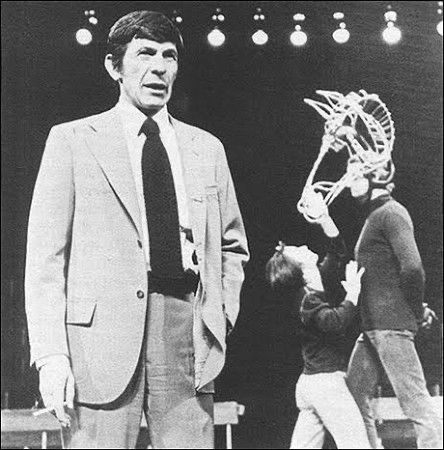
Leonard Nimoy as Dr. Martin Dysart in the Broadway production of Equus. Equus was the brainchild of writer Peter Shaffer, who wrote about the attempts of child psychologist Dr. Martin Dysart to treat a young man’s fascination with horses while trying to determine his own sense of purpose in his life. The play originally ran in London’s National Theatre from 1973 to 1975 before moving to Broadway’s Plymouth Theater, where it ran from October 24, 1974 to September 11, 1976, with Anthony Hopkins as Dysart and Tom Hulce as Alan Strang. It then moved to the Helen Hayes Theater and ran from October 5, 1976 to October 2, 1977, for a total of 1,209 performances.
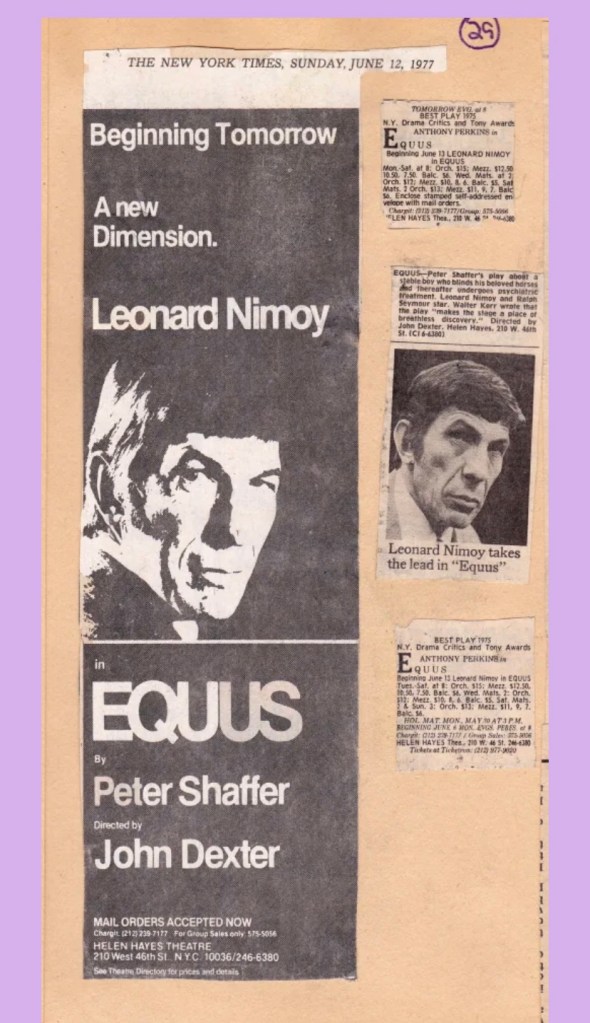
Vintage advertisements for Leonard Nimoy’s Broadway debut in Equus from June 1977. It is this shot of Nimoy on the left that was featured on the bus as seen in Superman II: The Richard Donner Cut. Leonard Nimoy succeeded Richard Burton in the role of Dysart, and his run began on June 13, 1977, on Broadway. At the time, Nimoy was not scheduled to return to his most famous role of Mr. Spock for the planned Star Trek: Phase II television series, and he was doing all he could to distance himself from the role that made him a household name.
When filming on the fruit cart sequence occurred on July 11, 1977, Nimoy’s run in Equus was into its first month, and the reviews were picking up speed by that time. So it was a serendipitous moment that Richard Donner and Geoffrey Unsworth captured this shot of the bus advertising Equus on film, further grounding the two Superman films with its sense of verisimilitude, that sense of reality within a fictional environment, although it would be 29 years before the shot would finally be seen by the public at large in Superman II: The Richard Donner Cut.
Nimoy would later be succeeded by Anthony Perkins for the remainder of the Broadway run until its conclusion in October 1977, and Shaffer would adapt his script into a feature film that would be released two weeks after the conclusion of the Broadway run, directed by Sidney Lumet with Richard Burton and Peter Firth.
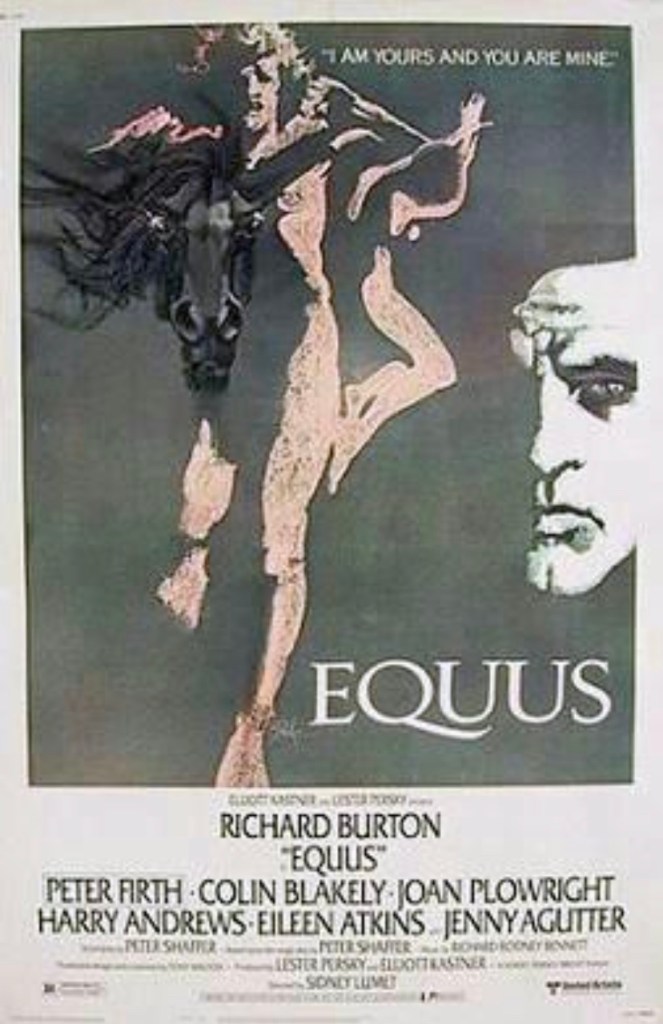
Look and see which Superman cast member gets fifth billing in this film! “Be reasonable!” Granted, a bus advertisement such as this makes the two Superman films dated for its time, as does the shot of the World Trade Center early in the Donner Cut. But for one fleeting moment we get to bear witness to a brief crossover featuring the world’s most famous Vulcan and the world’s most recognizable mild-mannered reporter. I don’t know if Christopher Reeve and Leonard Nimoy ever met in real life or not, but it makes the possibilities, as Spock would say, quite fascinating.
It wouldn’t, however, be the last.
(Screenshot courtesy of CapedWonder.com.)
 Superman: The Blog